EXT. ROCKY TERRAIN - DAY
Endless barren landscape. No sign of life. The atmosphere
is hazy, toxic-looking. Volcanoes erupt. Meteors bombard.
Lightning strikes, concussing murky pools of water. Silence.
INT. LARGE EMPTY LIVING ROOM - MORNING
SUBTITLE: HOLLYWOOD, CA, FOUR BILLION AND FORTY YEARS LATER
Beamed ceilings and ostentatious fireplace. A few birthday
cards on the mantel, two of them identical: "To Our Dear Son
on His Fortieth Birthday." Charlie Kaufman, a fat, balding
man in a purple sweater with tags still attached, paces the
room. His incantational voice-over carpets the scene.
KAUFMAN (V.O.)
I am old. I am fat. I am bald. My
toenails have turned strange. I am
repulsive. How repulsive? I don't know
for I suffer from a condition called Body
Dysmorphic Disorder. I am fat, but am I
as fat as I think? My therapist says no,
but people lie. I believe others call me
Fatty behind my back. Or Fatso. Or,
facetiously, Slim. But I also believe
this is simply my own perverted form of
self-aggrandizement, that no one really
talks about me at all. What possible
interest is an old, bald, fat man to
anyone? I am repulsive. I have never
lived. I blame myself. I --
EXT. STATE ROAD 29 - DAWN
A lonely two-lane highway cutting through swampland.
BRITISH NARRATOR
As natural selection works solely by and
for the good of each being, all corporeal
and mental endowments will tend to
progress towards perfection.
Suddenly, a beat-up white van barrels around a curve. It's
followed closely by an old green Ford.
SUBTITLE: STATE ROAD 29, FLORIDA, FIVE YEARS EARLIER
INT. WHITE VAN - CONTINUOUS
John Laroche drives. He's a skinny man with no front teeth.
The van is piled with bags of potting soil, gardening junk.
A Writings of Charles Darwin audio cassette case is on the
seat next to Laroche.
(CONTINUED)
CONTINUED:
BRITISH NARRATOR
It is interesting to contemplate an
entangled bank, clothed with many plants
of many kinds, with birds singing...
Laroche tries to contemplate the plants and birds whizzing
by. Almost too late, he spots the Fakahatchee Strand State
Preserve sign and makes a squealing right onto the dirt road
turn-off. The cassette case flies from the seat and half-
buries itself in an open bag of peat.
INT. GREEN FORD - CONTINUOUS
Nirvana blasts. Russell, Vinson, and Randy, three young
Indian men, pass a joint and watch the erratic van ahead.
RUSSELL
Laroche is asleep at the wheel.
RANDY
Crazy White Man is now Drowsy White Man.
They share a stoned laugh.
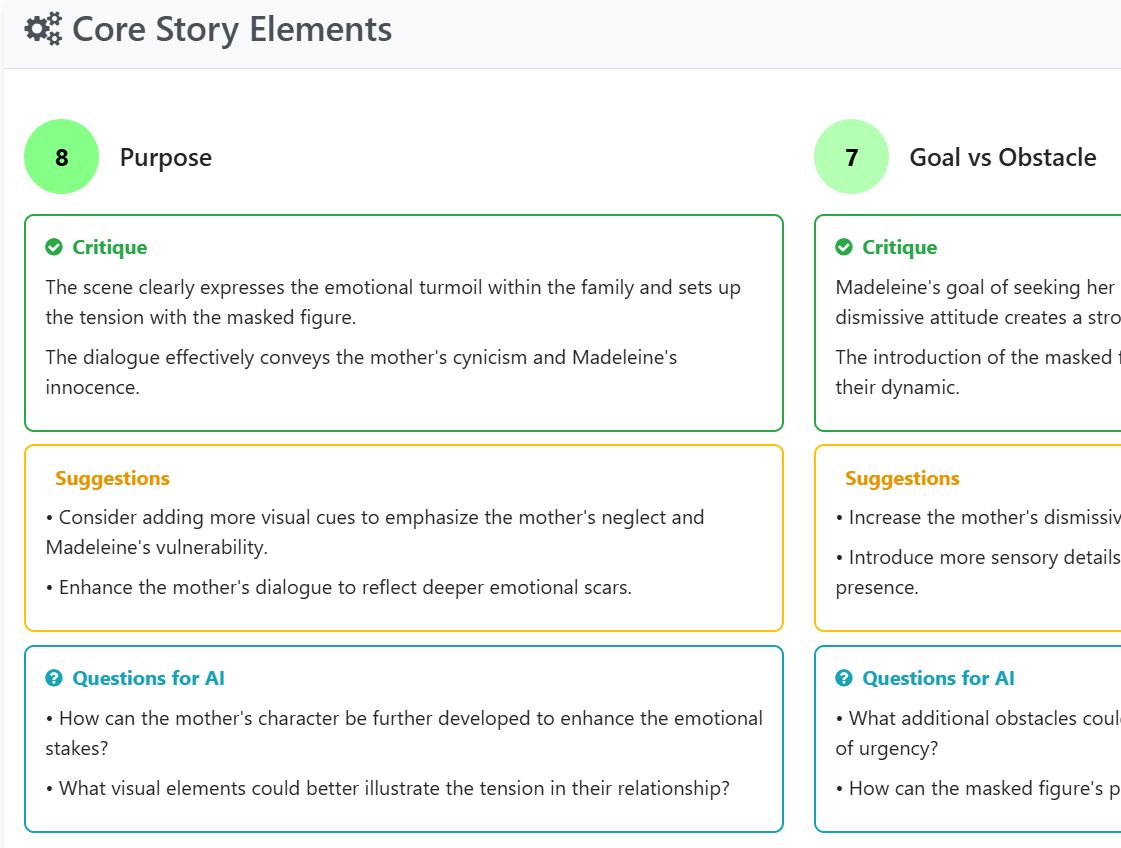
The scene clearly establishes Kaufman's character and his internal conflict, effectively using voice-over to convey his self-loathing.
Suggestions
• Consider adding a visual metaphor that reflects Kaufman's feelings, such as a close-up of the birthday cards juxtaposed with his self-criticism.
Questions for AI
• How can the visual elements enhance the emotional weight of Kaufman's voice-over?
• What additional imagery could symbolize Kaufman's internal struggle?
8
Goal vs Obstacle
Critique
Kaufman's goal of self-acceptance is clear, but the obstacle of his distorted self-image is primarily internal, making it less dynamic.
Suggestions
• Introduce a brief external conflict, such as a phone call or a knock at the door, to create tension against Kaufman's introspection.
Questions for AI
• What external events could heighten the tension of Kaufman's internal struggle?
• How can we better illustrate the conflict between Kaufman's desires and his self-perception?
7
Stakes
Critique
The stakes are personal and emotional, but they could be made more urgent by hinting at consequences of Kaufman's self-loathing.
Suggestions
• Introduce a moment where Kaufman faces a social situation that amplifies his fears, raising the stakes of his self-acceptance journey.
Questions for AI
• What potential consequences could Kaufman face if he continues down this path of self-loathing?
• How can we make the stakes feel more immediate and pressing in this scene?
8
Progression
Critique
The scene shows a clear progression from Kaufman's self-loathing to a broader existential reflection, but it could benefit from a more defined turning point.
Suggestions
• Create a moment of realization or a shift in Kaufman's perspective that leads to a more profound understanding of his situation.
Questions for AI
• What specific moment could serve as a turning point for Kaufman's self-reflection?
• How can we enhance the emotional arc within this scene?
6
Turn Potency
Critique
The scene lacks a strong turning point that shifts Kaufman's perspective or emotional state, making it feel somewhat static.
Suggestions
• Incorporate a moment of clarity or a realization that propels Kaufman toward a new understanding of himself.
Questions for AI
• What could trigger a significant emotional shift for Kaufman in this scene?
• How can we create a more impactful moment of realization?
Supporting Elements
8
Exposition
Critique
Exposition is woven into Kaufman's voice-over effectively, providing context without feeling forced.
Suggestions
• Consider integrating visual cues that reinforce the exposition, such as the birthday cards reflecting his age.
Questions for AI
• How can we further integrate visual storytelling to enhance the exposition?
• What additional context might be necessary for the audience to fully grasp Kaufman's situation?
9
Subtext
Critique
The subtext of self-acceptance and the absurdity of existence is rich and resonates throughout the scene.
Suggestions
• Explore deeper layers of subtext by contrasting Kaufman's thoughts with the barren landscape imagery.
Questions for AI
• What deeper themes can be explored through Kaufman's reflections?
• How can we enhance the contrast between Kaufman's internal dialogue and the external environment?
7
Setups & Payoffs
Critique
The scene sets up Kaufman's internal conflict well, but there are few payoffs that resonate with the audience.
Suggestions
• Introduce a payoff that connects Kaufman's self-loathing to a future event or character interaction.
Questions for AI
• What future events could be foreshadowed through this scene's setup?
• How can we create a more satisfying payoff for Kaufman's internal conflict?
8
Beat Clarity
Critique
The beats within the scene are clear, but the rhythm could be tightened to maintain engagement.
Suggestions
• Consider varying the pacing of Kaufman's voice-over to create more dynamic shifts in tone.
Questions for AI
• How can we adjust the pacing of Kaufman's thoughts to enhance engagement?
• What specific beats could be emphasized or condensed for clarity?
Scene Transitions
Next Scene
9
Hook Out: Kaufman's introspection sets the stage for the next scene's exploration of his character.
Energy UP
The scene effectively hands off momentum to the next, maintaining thematic continuity.
Suggestions
• Ensure that the emotional resonance of this scene carries into the next to maintain engagement.
Questions for AI
• What elements from this scene can be echoed in the next to enhance continuity?
• How can we ensure the emotional impact of this scene is felt in the following one?
Scene Necessity
9
MUST HAVE
This scene is crucial for establishing Kaufman's character and the overarching themes of the screenplay.
Suggestions
Ensure that the emotional weight of this scene is felt throughout the screenplay by reinforcing its themes in later scenes.
Questions for AI
• What elements in this scene are essential for the overall narrative?
• How can we ensure this scene's impact resonates throughout the screenplay?
Enhancement Tags
#selfAcceptance#existentialism#bodyImage
Character Delta: Kaufman begins to confront his self-image and the absurdity of his existence.
Improvement Recommendations
Introduce a visual metaphor that reflects Kaufman's feelings.
Create a moment of realization that propels Kaufman toward a new understanding.
Incorporate a brief external conflict to create tension against Kaufman's introspection.
The #1 Rule of Screenwriting: Make your reader or audience compelled to keep reading.
“Grab ‘em by the throat and never let ‘em go.”
The scene level score is the impact on the reader or audience to continue reading.
The Script score is how compelled they are to keep reading based on the rest of the script so far.
Compelled to keep Reading Score: 7/10
This scene masterfully establishes a sense of mystery and intrigue right from the start. The juxtaposition of the primordial, chaotic Earth with Charlie Kaufman's hyper-modern, self-loathing monologue creates immediate disorientation and curiosity. The abrupt shift to Florida and John Laroche's reckless driving, followed by the observation of the Indian men, introduces multiple characters and potential plot threads without resolving any of them. The Darwin quote adds a philosophical layer, hinting at deeper thematic explorations. The scene leaves the reader with questions about who these characters are, their motivations, and how these disparate elements will connect.
Script Continuation Score: 8/10
The script begins with a bold, multi-layered approach that immediately hooks the reader. The vast temporal leap from primordial Earth to modern Hollywood, coupled with Kaufman's deeply personal and relatable internal struggle, creates a powerful emotional and intellectual anchor. The introduction of Laroche and the Seminole men in Florida, with the contrasting auditory elements (Darwin vs. Nirvana), injects immediate narrative drive and a sense of impending collision. The overarching themes of evolution, self-perception, and the search for meaning are established, promising a rich and complex narrative. The time jumps and diverse settings suggest a sprawling, ambitious story that the reader will want to unravel.
EXT. NEW YORK APARTMENT BUILDING - NIGHT
SUBTITLE: NEW YORK, TWO YEARS LATER
Late night street. The click-click of typing. We move
slowly up the building to the only glowing window.
ORLEAN (O.S.)
(wistful)
John Laroche is a tall guy, skinny as a
stick, pale-eyed, slouch-shouldered and
sharply handsome despite the fact that he
is missing all his front teeth.
In the window, lit by a single desk lamp, a woman types.
INT. APARTMENT - CONTINUOUS
We glide over the desk piled with books about orchids, past a
photo of Laroche tacked to an overwhelmed bulletin board, and
come to rest on a woman typing. It's Susan Orlean: pale,
delicate and blond. We lose ourselves in her melancholy
beauty. She turns to the camera and talks to us.
(CONTINUED)
CONTINUED:
ORLEAN
Two years ago I went to Florida to meet
Laroche after reading a small article
about a white man and three Seminole men
arrested with rare orchids they'd stolen
out of a place called the...
INT. RANGER'S TRUCK - MID-MORNING
Tony, a ranger, drives along a dirt road past the Fakahatchee
Strand State Preserve sign and enters the swamp. He sees the
white van and Ford parked ahead, spots a Seminole license
plate on the Ford. He pulls over down the road, and whispers
into his C.B.
TONY
We got a Seminole, or Seminoles, in the
swamp. I'm on Janes Scenic Drive just
east of Logging Road Twelve. I repeat,
Indians in the swamp.
Tony waits for a response. Nothing.
TONY (cont'd)
Indians in the swamp.
Nothing still. Tony clears his throat into the radio.
RADIO VOICE
I don't know what you want me to say.
TONY
Barry, Indians do not go on swamp walks.
If there are Indians in the swamp, they
are in there for a reason.
No response. Tony glowers, gets out of the truck, watches
the vehicles through binoculars. Nothing. He straightens
his cap. Mosquitoes land on his neck, his nose, his lips.
Scene Objective: Introduce Susan Orlean and her motivations for writing about John Laroche.
Setting: New York City, night.
POV: Susan Orlean's perspective as she reflects on her past experiences.
Emotional Arc: − isolation → + curiosity
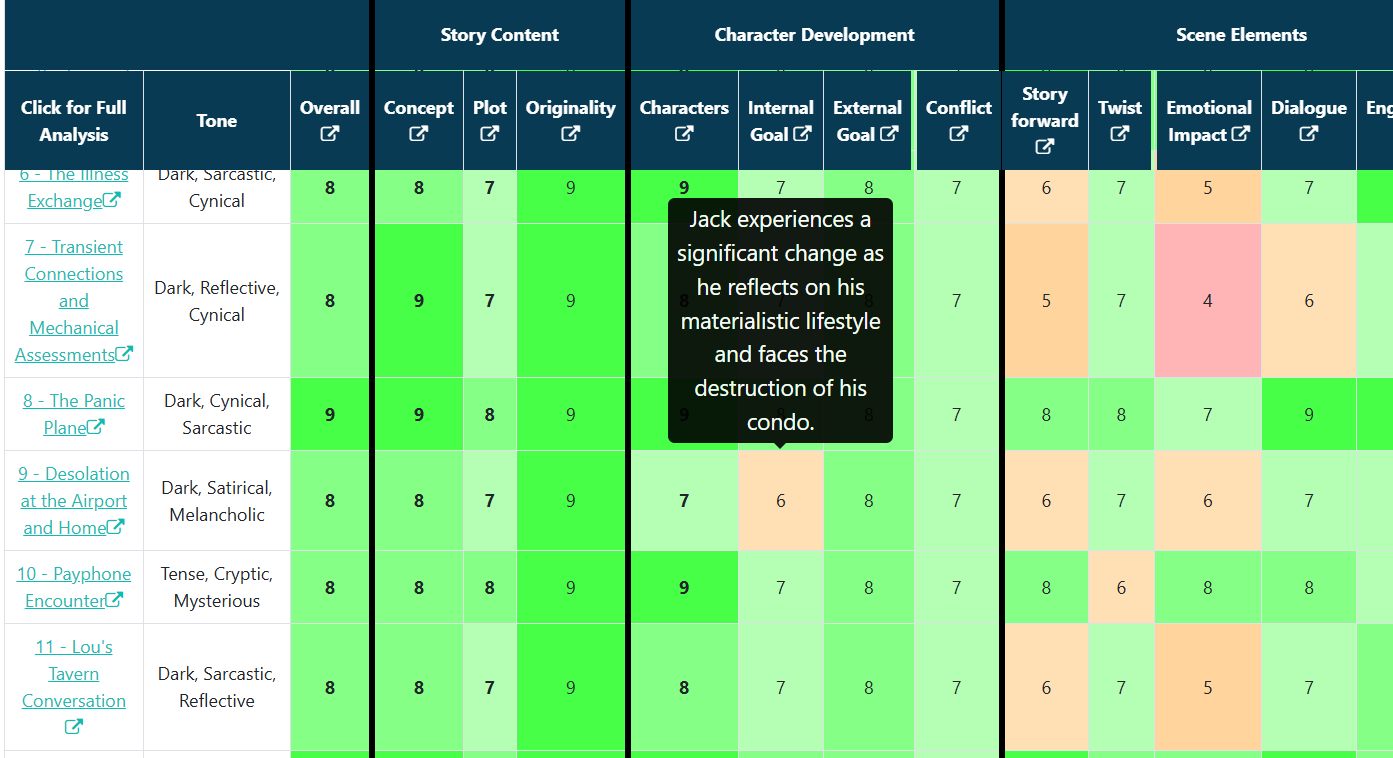
Score Overview
Group
Category
Score
Overall
Overall Score
7.8
Core Elements
Purpose
8
Goal vs Obstacle
7
Stakes
6
Progression
8
Turn Potency
7
Supporting
Exposition
8
Subtext
7
Setups & Payoffs
6
Beat Clarity
8
Quality
Scene Necessity
9
Thematic Resonance
8
Core Story Elements
8
Purpose
Critique
The scene clearly establishes Orlean's character and her emotional state, effectively setting up her journey.
The wistful tone captures her longing for deeper connections.
Suggestions
• Consider adding a brief moment of hesitation or doubt in Orlean's voice to deepen her emotional complexity.
• Incorporate a visual element that symbolizes her internal conflict, such as a close-up of her typing.
Questions for AI
• How can Orlean's internal conflict be visually represented in this scene?
• What additional details could enhance the emotional weight of her reflections?
7
Goal vs Obstacle
Critique
Orlean's goal of understanding Laroche is clear, but the obstacles she faces are not yet fully articulated.
The scene hints at her emotional barriers but could benefit from more explicit tension.
Suggestions
• Introduce a moment where Orlean doubts her ability to connect with Laroche.
• Foreshadow potential challenges she may encounter in her pursuit of understanding.
Questions for AI
• What specific obstacles could Orlean face in her quest to meet Laroche?
• How can the scene hint at future conflicts in her journey?
6
Stakes
Critique
The stakes are implied through Orlean's emotional state, but they lack urgency.
The scene could benefit from a clearer articulation of what she stands to gain or lose.
Suggestions
• Add a line that emphasizes the importance of this meeting for Orlean's career.
• Introduce a sense of time pressure or a deadline related to her article.
Questions for AI
• What specific stakes can be introduced to heighten Orlean's emotional investment?
• How can the scene convey a sense of urgency regarding her meeting with Laroche?
8
Progression
Critique
The scene shows a clear progression from Orlean's reflections to her determination to meet Laroche.
The transition from her past to her present is smooth and effective.
Suggestions
• Consider adding a moment of realization that propels her to take action.
• Enhance the emotional shift by contrasting her past feelings with her current resolve.
Questions for AI
• What moment of realization could deepen Orlean's commitment to her goal?
• How can the emotional shift be made more pronounced in this scene?
7
Turn Potency
Critique
The scene's pivotal moment occurs when Orlean decides to pursue Laroche, but it could be more impactful.
The transition from reflection to action feels somewhat abrupt.
Suggestions
• Build up to the decision with more internal conflict or hesitation.
• Create a stronger emotional climax that leads to her resolve.
Questions for AI
• What internal struggle could make Orlean's decision feel more earned?
• How can the emotional climax be heightened in this scene?
Supporting Elements
8
Exposition
Critique
Exposition is woven naturally through Orlean's voice-over, providing context without feeling forced.
The details about Laroche are intriguing and set up future developments.
Suggestions
• Consider adding a brief visual flashback to her initial article to enhance context.
• Weave in more sensory details about her environment to enrich the scene.
Questions for AI
• What additional context could be provided to deepen the audience's understanding of Orlean's motivations?
• How can sensory details enhance the scene's atmosphere?
7
Subtext
Critique
The subtext of longing and the search for connection is present but could be more pronounced.
Orlean's wistfulness hints at deeper emotional layers that could be explored.
Suggestions
• Introduce a metaphor or symbol that represents her emotional state.
• Use visual cues to reinforce the theme of isolation versus connection.
Questions for AI
• What metaphor could effectively symbolize Orlean's emotional journey?
• How can visual elements enhance the subtext of longing in this scene?
6
Setups & Payoffs
Critique
Setups for future payoffs are present but not fully developed.
The scene hints at Orlean's obsession but lacks concrete foreshadowing.
Suggestions
• Introduce a specific detail about Laroche that will pay off later in the story.
• Foreshadow Orlean's emotional struggles with a visual or auditory cue.
Questions for AI
• What specific detail about Laroche could be introduced as a setup for later events?
• How can the scene foreshadow Orlean's emotional challenges?
8
Beat Clarity
Critique
The beats within the scene are clear and well-defined, contributing to a smooth flow.
The rhythm of Orlean's reflections effectively builds emotional tension.
Suggestions
• Consider varying the pacing to create moments of tension and release.
• Introduce a beat that contrasts Orlean's internal thoughts with external distractions.
Questions for AI
• How can the pacing be adjusted to enhance emotional tension?
• What external distractions could create contrast with Orlean's internal reflections?
Scene Transitions
Previous Scene
8
Hook In: The transition from Laroche's chaotic driving to Orlean's reflective typing creates a stark contrast.
Energy FLAT
The tonal shift is effective, but could benefit from a stronger thematic link. The flow from the previous scene to this one is smooth, maintaining narrative continuity.
Suggestions
• Consider adding a visual motif that connects the two scenes more explicitly.
• Enhance the thematic resonance between Laroche's chaos and Orlean's introspection.
Questions for AI
• What visual motifs could strengthen the connection between these two scenes?
• How can the thematic links be made more explicit in the transition?
Next Scene
9
Hook Out: Orlean's decision to pursue Laroche sets up the next scene's exploration of her motivations.
Energy UP
The scene effectively hands off momentum to the next, creating anticipation for Orlean's journey. The emotional stakes are heightened, making the transition impactful.
Suggestions
• Consider adding a cliffhanger or unresolved question to further enhance the transition.
• Strengthen the emotional resonance of Orlean's decision to propel the narrative forward.
Questions for AI
• What unresolved questions could enhance the anticipation for the next scene?
• How can the emotional stakes be further amplified in this transition?
Scene Necessity
9
MUST HAVE
This scene is crucial for establishing Orlean's character and motivations, making it essential for the narrative.
Suggestions
Enhance emotional depth to ensure the scene's necessity is felt throughout the story.
Questions for AI
• What elements could further solidify this scene's necessity in the overall narrative?
• How can the emotional stakes be heightened to reinforce its importance?
Enhancement Tags
#obsession#self-discovery#longing
Character Delta: Orlean transitions from a passive observer to an active seeker of connection.
Improvement Recommendations
Add a moment of hesitation in Orlean's decision to pursue Laroche to deepen emotional complexity.
Introduce a visual metaphor that symbolizes Orlean's internal conflict.
Foreshadow potential challenges Orlean may face in her pursuit of understanding Laroche.
The #1 Rule of Screenwriting: Make your reader or audience compelled to keep reading.
“Grab ‘em by the throat and never let ‘em go.”
The scene level score is the impact on the reader or audience to continue reading.
The Script score is how compelled they are to keep reading based on the rest of the script so far.
Compelled to keep Reading Score: 7/10
This scene successfully shifts focus to Susan Orlean and introduces a new conflict with Ranger Tony, immediately creating intrigue. Orlean's wistful description of Laroche, coupled with the revelation of his arrest for orchid theft, piques curiosity about his character and the circumstances. The introduction of Tony and his suspicion of the 'Indians in the swamp' adds a layer of potential conflict and mystery, hinting at law enforcement involvement and the illicit nature of orchid hunting. The unresolved tension from Tony's superiors' dismissive response leaves the reader wondering how this will play out.
Script Continuation Score: 8/10
The script continues to weave multiple threads, primarily focusing on the developing narrative around John Laroche and the stolen orchids. The introduction of Susan Orlean as a journalist investigating Laroche provides a new avenue for uncovering details about his character and the crime. The ongoing presence of Charlie Kaufman, even if only through his voice-over in previous scenes, and the thematic echoes of evolution and nature from Scene 1, suggest a larger, interconnected story. Ranger Tony's presence and his suspicions hint at an impending confrontation, building suspense. The audience is still invested in understanding the motivations behind the orchid theft and how these disparate characters and plotlines will converge.
Expert Critiques
Expert Suggestions
View Analysis
View Script
3 -
A Tense Lunch: The Battle of Adaptation - Overall Grade:
8.3
INT. L.A. BUSINESS LUNCH RESTAURANT - MIDDAY
Kaufman, wearing his purple sweater sans tags, sits with
Valerie, an attractive woman in wire-rim glasses. They pick
at salads. Kaufman steals glances at her lips, her hair, her
breasts. She looks up at him. He blanches, looks away.
KAUFMAN (V.O.)
I'm old. I'm bald. I'm repulsive.
VALERIE
We think you're just great.
(CONTINUED)
CONTINUED:
KAUFMAN
(with studied modesty)
Oh, thank you.
Valerie absently rubs her nose. Kaufman self-consciously
rubs his nose in response.
VALERIE
And we're thrilled you're interested.
Valerie rubs her nose again. Kaufman pulls at his nostril.
A rivulet of sweat slides down his forehead. Valerie watches
it. Kaufman sees her watching it. She sees him seeing her
watching it. She looks at her salad. He quickly swabs.
KAUFMAN
Oh, thanks, wow. That's nice to hear.
VALERIE
You have a really unique voice.
KAUFMAN
Well, thanks. That's... I appreciate
that.
VALERIE
Very talented. Really.
KAUFMAN
Thanks. Thank you. Thanks.
VALERIE
(looking up)
So --
Kaufman's brow is dripping again. He smiles, embarrassed.
KAUFMAN
Sort of hot in here.
VALERIE
(kindly)
Yeah, it is a bit. So, why don't you
tell me your thoughts on this crazy
little project of ours.
In one motion, Kaufman swabs his forehead and pulls a book
entitled The Orchid Thief from his bag.
KAUFMAN
First, I think it's a great book.
(CONTINUED)
CONTINUED: (2)
VALERIE
Laroche is a fun character, isn't he?
Kaufman nods, flips through the book, stalling. There's a
smiling author photo of Susan Orlean on the inside back
cover.
KAUFMAN
And Orlean makes orchids so fascinating.
Plus her musings on Florida, orchid
poaching. Indians. Great, sprawling New
Yorker stuff. I'd want to remain true to
that, let the movie exist rather than be
artificially plot driven.
VALERIE
Okay, great, great. I guess I'm not
exactly sure what that means.
KAUFMAN
Oh. Well... I'm not sure exactly yet
either. So... y'know, it's...
VALERIE
Oh. Okay. Great. So, um, what --
KAUFMAN
It's just, I don't want to compromise by
making it a Hollywood product. An orchid
heist movie. Or changing the orchids
into poppies and turning it into a movie
about drug running. Y'know?
VALERIE
Oh, of course. We agree. Definitely.
KAUFMAN
Or cramming in sex, or car chases, or
guns. Or characters learning profound
life lessons. Or characters growing or
characters changing or characters
learning to like each other or characters
overcoming obstacles to succeed in the
end. Y'know? Movie shit.
Kaufman is sweating like crazy now. Valerie is quiet for a
moment.
VALERIE
See, we thought maybe Susan Orlean and
Laroche could fall in love during the
course of --
(CONTINUED)
CONTINUED: (3)
KAUFMAN
Alienated journalist writes about
passionate backwoods guy and he teaches
her to love. I mean, it didn't happen,
it wouldn't happen. It's Hollywood.
The scene clearly expresses Kaufman's struggle with self-image and his desire to remain true to his artistic vision, which is central to his character development.
Suggestions
• Enhance the dialogue to further emphasize Kaufman's internal conflict and his fear of compromise.
Questions for AI
• How can the dialogue be adjusted to better reflect Kaufman's anxiety?
• What additional physical actions could illustrate Kaufman's discomfort?
7
Goal vs Obstacle
Critique
Kaufman's goal of maintaining artistic integrity is clear, but the obstacles presented by Valerie's suggestions create a dynamic tension.
Suggestions
• Introduce more explicit stakes regarding Kaufman's career to heighten the conflict.
Questions for AI
• What specific fears does Kaufman have about compromising his vision?
• How can Valerie's character be developed to present a stronger opposing force?
6
Stakes
Critique
The stakes are present but could be more urgent; Kaufman's career and self-worth are on the line, yet this urgency isn't fully realized.
Suggestions
• Add a moment where Kaufman reflects on the consequences of failing to adapt the screenplay as he envisions.
Questions for AI
• What would make the stakes feel more immediate for Kaufman in this scene?
• How can the dialogue hint at potential repercussions for Kaufman if he compromises?
7
Progression
Critique
The scene shows a clear progression from Kaufman's initial discomfort to a more engaged discussion about the screenplay.
Suggestions
• Make the transition from discomfort to engagement more pronounced through pacing and dialogue.
Questions for AI
• How can the pacing be adjusted to enhance the emotional arc of the scene?
• What specific moments can be added to show Kaufman's gradual shift in engagement?
6
Turn Potency
Critique
The pivotal moment occurs when Valerie suggests a romantic subplot, but Kaufman's reaction could be more impactful.
Suggestions
• Heighten Kaufman's emotional response to Valerie's suggestion to emphasize his internal conflict.
Questions for AI
• What alternative reactions could Kaufman have to Valerie's suggestion to make the turn more powerful?
• How can the dialogue be crafted to reflect a deeper emotional impact?
Supporting Elements
7
Exposition
Critique
Exposition is woven into the dialogue effectively, providing context for Kaufman's character and his project.
Suggestions
• Consider adding a brief flashback or visual cue to reinforce Kaufman's past struggles.
Questions for AI
• What additional context could be provided to deepen the audience's understanding of Kaufman's character?
• How can visual elements enhance the exposition in this scene?
8
Subtext
Critique
The subtext of Kaufman's fear of rejection and desire for acceptance is well conveyed through his interactions with Valerie.
Suggestions
• Introduce more non-verbal cues to enhance the subtext of Kaufman's insecurities.
Questions for AI
• What subtle hints can be added to deepen the subtext of Kaufman's feelings?
• How can the physical space reflect Kaufman's emotional state?
6
Setups & Payoffs
Critique
There are setups for Kaufman's artistic integrity and self-image, but the payoffs could be more pronounced.
Suggestions
• Create a stronger payoff for Kaufman's internal conflict by linking it to a future scene.
Questions for AI
• What future scenes can be referenced to create a more satisfying payoff for Kaufman's struggles?
• How can the setups in this scene be made more explicit?
7
Beat Clarity
Critique
The beats are generally clear, but some moments could benefit from tighter pacing to maintain tension.
Suggestions
• Refine the dialogue to ensure each beat builds on the previous one more effectively.
Questions for AI
• What specific beats could be tightened to improve the flow of the scene?
• How can the rhythm of the dialogue be adjusted for better clarity?
Scene Transitions
Previous Scene
8
Hook In: Tony's frustration with the radio silence sets a tone of tension that carries into Kaufman's anxiety.
Energy FLAT
The transition maintains a consistent tone, but could benefit from a stronger emotional link.
Suggestions
• Add a visual or auditory cue that connects the two scenes more seamlessly.
Questions for AI
• How can the emotional tone from the previous scene be more effectively carried into this one?
• What specific elements can create a stronger connection between the two scenes?
Next Scene
7
Hook Out: Kaufman's rejection of the romantic subplot leads to a sense of unresolved tension.
Energy UP
The scene hands off momentum well, but could leave the audience with a stronger cliffhanger.
Suggestions
• End with a more pronounced emotional beat that propels the narrative forward.
Questions for AI
• What can be added to the end of this scene to create a more compelling transition to the next?
• How can the emotional stakes be heightened as we move into the next scene?
Scene Necessity
8
MUST HAVE
This scene is crucial for establishing Kaufman's character and the thematic conflict of self-acceptance versus commercial pressures.
Suggestions
Strengthen the emotional stakes to ensure the scene's necessity is felt.
Questions for AI
• What elements can be added to make this scene feel even more essential to the narrative?
• How can the emotional weight of this scene be amplified?
Enhancement Tags
#self_acceptance#artistic_integrity#anxiety
Character Delta: Kaufman becomes more aware of his insecurities and the pressures of Hollywood.
Improvement Recommendations
Enhance the emotional stakes in Kaufman's dialogue.
Introduce more physicality to convey Kaufman's discomfort.
Create a stronger emotional connection between Kaufman and Valerie.
The #1 Rule of Screenwriting: Make your reader or audience compelled to keep reading.
“Grab ‘em by the throat and never let ‘em go.”
The scene level score is the impact on the reader or audience to continue reading.
The Script score is how compelled they are to keep reading based on the rest of the script so far.
Compelled to keep Reading Score: 7/10
This scene effectively raises the stakes for Kaufman's adaptation project by introducing immediate conflict regarding creative direction. Valerie's suggestion that Susan Orlean and John Laroche fall in love directly challenges Kaufman's purist vision, creating dramatic tension. His passionate, if somewhat flustered, defense of the book's integrity, coupled with his physical manifestations of anxiety (sweating), makes the reader curious to see how this disagreement will be resolved and whether Kaufman will compromise his artistic principles.
Script Continuation Score: 7/10
The screenplay is building momentum by introducing key creative conflicts. Kaufman's struggle to adapt 'The Orchid Thief' and his anxieties about Hollywood conventions are now directly clashing with studio executive expectations, as exemplified by Valerie. This scene solidifies the central conflict of the adaptation process and how Kaufman's personal insecurities might influence it. The earlier introduction of Laroche's world and Orlean's perspective still lingers, providing a broader narrative context for Kaufman's specific challenge.
INT. OFFICE - DAY
SUBTITLE: HOLLYWOOD, CALIFORNIA, THREE WEEKS EARLIER
The office is decorated with potted flowers, Audobon posters,
lots of books. Kaufman, nervous and sweaty, watches
Margaret, a soulful development executive, unpack boxes.
KAUFMAN
So anyway I just wanted to stop by to
congratulate you on your promotion.
MARGARET
Well, thanks again. It's all so stupid.
KAUFMAN
I think it's great. Your photo in the
trades and everything. Pretty cool.
MARGARET
Anyway. Yeah. So what's up with you?
KAUFMAN
I'm considering jobs. Mostly crap.
There's one you might like, about
flowers.
MARGARET
Flowers? Really? What is it?
KAUFMAN
They want me to do an adaptation of a
book called The Orchid Thief.
MARGARET
Oh my God! You're kidding? I read that!
I loved that book!
Kaufman is thrilled; he's scored. Margaret pulls a copy of
The Orchid Thief from her bookshelf.
MARGARET (cont'd)
See, see, see! I'm not lying to you!
KAUFMAN
I loved the book.
(CONTINUED)
CONTINUED:
MARGARET
Oh, Charlie, orchids are the most amazing
flowers. So complex.
Margaret plops onto the couch next to Kaufman.
KAUFMAN
I know. They're really great.
MARGARET
You should take this job. Doesn't it
sound exciting, to immerse yourself in a
real subject and learn everything about
it? Blake wrote about seeing heaven in a
wild flower. And after you learn all
this stuff, you can teach me!
KAUFMAN
(thrilled but controlled)
That'd be fun.
MARGARET
God, they're such beautiful flowers. And
so sexy. Y'know?
(whispering)
Did you know that orchid means --
KAUFMAN
Testicle. I just read that.
MARGARET
(shrieks with delight)
Testicle! Can you believe it!
Margaret giggles happily. Kaufman giggles weirdly.
MARGARET (cont'd)
I swear, it'd be fucking great for
someone to have the testicles to make
that book into a movie, man. Instead of
this bullshit all the time. Something
not about sex and violence and car chases
and love stories, people learning
profound lessons. Jesus, isn't nature
enough?
Scene Objective: To convey Kaufman's anxiety about his career choices and his desire for authenticity in storytelling.
Setting: Hollywood, California, during the day.
POV: Kaufman's perspective, highlighting his insecurities and aspirations.
Emotional Arc: − insecurity → + hope
Score Overview
Group
Category
Score
Overall
Overall Score
7.7
Core Elements
Purpose
8
Goal vs Obstacle
7
Stakes
6
Progression
7
Turn Potency
8
Supporting
Exposition
7
Subtext
8
Setups & Payoffs
6
Beat Clarity
7
Quality
Scene Necessity
9
Thematic Resonance
8
Core Story Elements
8
Purpose
Critique
The scene clearly expresses Kaufman's purpose of seeking validation and exploring the potential of adapting 'The Orchid Thief.'
Margaret's enthusiasm contrasts with Kaufman's anxiety, effectively highlighting his internal struggle.
Suggestions
• Consider adding more internal monologue from Kaufman to deepen his emotional conflict.
• Incorporate more visual cues that reflect Kaufman's nervousness, such as his body language.
Questions for AI
• How can I further illustrate Kaufman's internal conflict through his dialogue with Margaret?
• What additional elements can enhance the contrast between Kaufman's anxiety and Margaret's enthusiasm?
7
Goal vs Obstacle
Critique
Kaufman's goal of securing the job is clear, but the obstacles he faces are primarily internal, which may not be as dynamic.
Margaret's excitement serves as a subtle obstacle, as it highlights Kaufman's self-doubt.
Suggestions
• Introduce a more explicit external obstacle, such as a competing offer or a critical comment from Margaret.
• Enhance the tension by showing Kaufman's hesitation more vividly.
Questions for AI
• What external factors could complicate Kaufman's decision to take the job?
• How can I better illustrate the tension between Kaufman's aspirations and his self-doubt?
6
Stakes
Critique
The stakes feel somewhat low, as Kaufman's internal conflict overshadows the potential consequences of his decisions.
While there is emotional weight, the urgency of the stakes could be heightened.
Suggestions
• Clarify what Kaufman stands to lose if he doesn't take the job or fails in the adaptation.
• Introduce a time constraint or deadline to increase the urgency.
Questions for AI
• What specific consequences could arise from Kaufman's decision regarding the adaptation?
• How can I make the stakes feel more immediate and impactful for Kaufman?
7
Progression
Critique
The scene shows a clear progression from Kaufman's nervousness to a moment of hope as he connects with Margaret.
However, the transition could be more pronounced to emphasize the emotional shift.
Suggestions
• Use visual metaphors or changes in lighting to signify Kaufman's emotional journey.
• Add a moment of realization for Kaufman that reinforces his desire for authenticity.
Questions for AI
• How can I better illustrate the emotional progression of Kaufman throughout this scene?
• What visual elements could enhance the transition from anxiety to hope?
8
Turn Potency
Critique
The pivotal moment occurs when Margaret expresses her passion for orchids, which inspires Kaufman.
This turn feels earned, as it aligns with Kaufman's desire for authenticity.
Suggestions
• Consider heightening the emotional impact of this moment by adding a physical reaction from Kaufman.
• Explore how this moment could resonate with Kaufman's past experiences.
Questions for AI
• What alternative reactions could Kaufman have to Margaret's enthusiasm that would deepen the scene?
• How can I enhance the emotional weight of this turning point?
Supporting Elements
7
Exposition
Critique
Exposition is woven into the dialogue naturally, particularly through Margaret's enthusiasm for the book.
However, some background on Kaufman's previous work could be more explicitly stated.
Suggestions
• Integrate subtle references to Kaufman's past successes or failures to provide context.
• Use visual elements in the office to hint at Kaufman's career history.
Questions for AI
• What additional background information about Kaufman would enhance the audience's understanding?
• How can I make the exposition feel even more organic within the dialogue?
8
Subtext
Critique
The subtext of Kaufman's struggle with self-acceptance and the search for authenticity is clear.
Margaret's comments about nature and beauty resonate with Kaufman's internal conflict.
Suggestions
• Consider adding more layers to the dialogue that hint at Kaufman's deeper fears.
• Use visual motifs related to nature to reinforce the theme of authenticity.
Questions for AI
• What additional layers of subtext could I incorporate into Kaufman's dialogue?
• How can I visually represent the theme of authenticity in this scene?
6
Setups & Payoffs
Critique
There are some setups regarding Kaufman's insecurities, but the payoffs are not fully realized in this scene.
The connection between Kaufman's internal struggle and the external opportunity could be stronger.
Suggestions
• Foreshadow future conflicts related to Kaufman's adaptation more clearly.
• Create a more explicit link between Kaufman's insecurities and the job opportunity.
Questions for AI
• What setups could I introduce that would lead to more impactful payoffs later?
• How can I better connect Kaufman's internal struggles to the external narrative?
7
Beat Clarity
Critique
The beats are generally clear, but some moments could benefit from tighter pacing.
The rhythm of the dialogue flows well, but Kaufman's internal conflict could be more pronounced.
Suggestions
• Tighten the dialogue to enhance the pacing and clarity of each beat.
• Add pauses or reactions that emphasize Kaufman's internal struggle.
Questions for AI
• How can I refine the beats to enhance clarity and emotional impact?
• What specific moments could benefit from a change in pacing?
Scene Transitions
Previous Scene
8
Hook In: Kaufman's anxiety about his appearance and career choices.
Energy FLAT
The transition from the previous scene is smooth, maintaining the tone and emotional weight. However, a stronger visual or thematic link could enhance the connection.
Suggestions
• Consider using a visual motif from the previous scene to create a more cohesive transition.
• Reinforce the emotional tone through sound design or music.
Questions for AI
• What visual elements could strengthen the connection between the two scenes?
• How can I enhance the emotional continuity from the previous scene?
Next Scene
8
Hook Out: Kaufman's excitement about the potential of adapting 'The Orchid Thief.'
Energy UP
The scene effectively hands off momentum to the next, with Kaufman's hope contrasting his earlier anxiety. The emotional shift is clear, but could be made more impactful.
Suggestions
• Use a strong visual or auditory cue to emphasize the transition to the next scene.
• Consider ending with a more definitive statement from Kaufman that encapsulates his emotional journey.
Questions for AI
• What elements could I add to make the transition to the next scene feel more dynamic?
• How can I ensure that the emotional shift is as impactful as possible?
Scene Necessity
9
MUST HAVE
This scene is crucial for establishing Kaufman's internal conflict and his relationship with Margaret, setting the stage for his journey.
Suggestions
Ensure that the emotional stakes are clear to reinforce the scene's necessity.
Questions for AI
• What elements could I add to further emphasize the importance of this scene in Kaufman's journey?
• How can I ensure that this scene feels indispensable to the overall narrative?
Enhancement Tags
#self_acceptance#authenticity#nature
Character Delta: Kaufman begins to embrace the possibility of pursuing a meaningful project.
Improvement Recommendations
Add more internal monologue from Kaufman to deepen his emotional conflict.
Introduce a more explicit external obstacle to heighten tension.
Use visual motifs to reinforce the theme of authenticity.
The #1 Rule of Screenwriting: Make your reader or audience compelled to keep reading.
“Grab ‘em by the throat and never let ‘em go.”
The scene level score is the impact on the reader or audience to continue reading.
The Script score is how compelled they are to keep reading based on the rest of the script so far.
Compelled to keep Reading Score: 8/10
This scene significantly propels the narrative forward by introducing a tangible professional opportunity for Kaufman and revealing Margaret's strong enthusiasm for 'The Orchid Thief.' The shared excitement over the book and its sexual connotations ('testicle') creates a palpable energy. The scene ends with Margaret posing a powerful rhetorical question about nature being sufficient for storytelling, which directly challenges conventional Hollywood narratives and sets up a strong hook for how Kaufman might approach this project, making the reader eager to see his decision and its implications.
Script Continuation Score: 8/10
The script has been successfully building multiple intersecting storylines: Charlie Kaufman's internal struggles and career anxieties, Susan Orlean's journalistic pursuits into the world of orchids and John Laroche, and John Laroche's eccentric existence. This scene directly advances Kaufman's arc by presenting him with a concrete project that aligns with his desire for meaningful storytelling, while simultaneously hinting at the broader themes of nature and authenticity that tie into Orlean's narrative. The introduction of Margaret as a potential champion for this unconventional adaptation is a positive development that will likely fuel Kaufman's creative process and further engage the reader in his journey, building on the earlier hints of his creative dissatisfaction.
Expert Critiques
Expert Suggestions
View Analysis
View Script
5 -
Orchids and Turtles: A Journey Through Nature and Aspirations - Overall Grade:
8.5
EXT. SWAMP - MORNING
Hot, dirty, miserable. Laroche leads the Indians through
waist-high black water. He points out a turtle on a rock.
(CONTINUED)
CONTINUED:
LAROCHE
Pseudemys floridana. Did you fellas know
you fellas believe the world rests on the
back of a turtle? Not you fellas
specifically. Although, maybe you fellas
specifically. That I can't speak to.
The Indians ignore him. They trudge. Laroche spots
something else, a dull green root wrapped around a tree. He
stops, circles the tree. His eyes widen in reverent awe.
LAROCHE (cont'd)
A ghost. Polyrrhiza Lindenii.
The Indians come around. Laroche stares at a single
beautiful, glowing white flower hanging from the tree. He
tenderly caresses the petals. Then, business-like:
LAROCHE (cont'd)
Cut it down, Russell.
Russell pulls out a hacksaw, begins sawing through the tree.
INT. RESTAURANT - MIDDAY
Kaufman still sweats as he talks to Valerie.
KAUFMAN
...plus I love the idea of learning all
about orchids. I really admire those
guys who know everything about ants or
fungus or whatever. I'd like to be more
like that. See, I tend to write self-
involved, self-loathing... even
masturbatory stuff.
VALERIE
And it's wonderful, by the way.
KAUFMAN
Thanks. That's nice to hear. But I need
to challenge myself as a writer. I've
arrived at an age where I want to think
about the world in a different way.
VALERIE
Adapting someone else's work is certainly
an opportunity to think differently.
(CONTINUED)
CONTINUED:
KAUFMAN
Yes. And I welcome the challenge of
taking a small subject, like orchids,
something that would never draw people
into a theater and making that
fascinating. I want to show people
heaven in a wildflower. As Blake wrote.
INT. PET STORE (1972) - DAY
SUBTITLE: NORTH MIAMI, TWENTY-SIX YEARS EARLIER
A serious ten year old boy walks from cage to aquarium,
studying the inhabitants. He turns to his frumpy mother,
who's been following at a respectful distance.
BOY
Any one at all, ma?
She nods sweetly. The boy returns to his search. He stops
at a small turtle in an aquarium.
BOY (cont'd)
I want this then.
MOTHER
(hugging him)
A wonderful choice! And spiritually
significant! Did you know that Native
Americans believe the whole world rests
on the back of a turtle?
BOY
Cool! I can't wait to tell the guys.
EXT. SWAMP - MORNING
As Laroche supervises, Randy, Russell, and Vinson saw through
tree branches supporting lovely flowering orchids. They
unceremoniously stuff the flowers into bulging pillowcases.
Scene Objective: To illustrate Laroche's fervent passion for orchids while contrasting it with Kaufman's insecurities and aspirations.
Setting: Swamp in the morning
POV: The scene is primarily viewed through Laroche's perspective, with Kaufman's internal voice-over providing insight into his thoughts.
Emotional Arc: − insecurity → + awe
Score Overview
Group
Category
Score
Overall
Overall Score
7.7
Core Elements
Purpose
8
Goal vs Obstacle
7
Stakes
6
Progression
7
Turn Potency
8
Supporting
Exposition
7
Subtext
8
Setups & Payoffs
6
Beat Clarity
7
Quality
Scene Necessity
9
Thematic Resonance
8
Core Story Elements
8
Purpose
Critique
The scene clearly conveys Laroche's obsession with orchids, serving as a pivotal moment that contrasts with Kaufman's self-doubt.
The dialogue effectively captures Laroche's reverence for nature, enhancing the thematic depth.
Suggestions
• Consider adding more sensory details to Laroche's description of the ghost orchid to heighten its significance.
• Incorporate Kaufman's internal thoughts more explicitly to deepen the contrast between the two characters.
Questions for AI
• How can Laroche's passion for the ghost orchid be further emphasized through visual or auditory elements?
• What additional internal conflicts could Kaufman express during this scene to enhance the emotional stakes?
7
Goal vs Obstacle
Critique
Laroche's goal of showcasing the ghost orchid is clear, but Kaufman's internal obstacles could be more pronounced.
The Indians' indifference to Laroche's passion serves as a subtle obstacle, but it could be emphasized further.
Suggestions
• Highlight Kaufman's internal struggle more vividly as Laroche expresses his awe.
• Introduce a moment of tension between Laroche and the Indians to create a more dynamic conflict.
Questions for AI
• What specific internal conflicts could Kaufman face as he witnesses Laroche's passion?
• How can the Indians' reactions be used to reflect or contrast with Laroche's enthusiasm?
6
Stakes
Critique
The stakes are somewhat implicit; while Laroche's passion is evident, the urgency of the moment could be heightened.
Kaufman's emotional stakes are less clear, which diminishes the overall tension.
Suggestions
• Introduce a time constraint or external pressure that raises the stakes for both characters.
• Make Kaufman's emotional investment in the orchids more explicit to enhance the stakes.
Questions for AI
• What external factors could increase the urgency of Laroche's quest for the ghost orchid?
• How can Kaufman's emotional stakes be made more tangible in this scene?
7
Progression
Critique
The scene shows a clear progression from Laroche's discovery to the act of cutting down the orchid, but Kaufman's emotional journey could be more pronounced.
The transition between Laroche's reverence and the practical action of cutting the orchid is effective.
Suggestions
• Add a moment of hesitation or reflection for Kaufman to emphasize his internal conflict during the progression.
• Consider a visual metaphor that represents Kaufman's emotional journey alongside Laroche's actions.
Questions for AI
• How can the emotional progression of Kaufman be visually represented alongside Laroche's actions?
• What moments of reflection could enhance the emotional depth of this scene?
8
Turn Potency
Critique
The pivotal moment of Laroche's awe at the ghost orchid is impactful, effectively showcasing his passion.
The transition from admiration to action (cutting down the orchid) is well-timed and resonates with the theme.
Suggestions
• Consider adding a moment of silence or stillness before the cutting to heighten the emotional impact.
• Explore the possibility of Laroche's internal conflict about cutting the orchid to add complexity to the turn.
Questions for AI
• What additional emotional beats could enhance the impact of Laroche's decision to cut the orchid?
• How can the moment of cutting the orchid be framed to emphasize its significance?
Supporting Elements
7
Exposition
Critique
The scene provides necessary background on Laroche's obsession with orchids without feeling forced.
However, more context about the significance of the ghost orchid could enhance understanding.
Suggestions
• Integrate subtle hints about the ghost orchid's rarity and importance within the dialogue.
• Use visual cues to reinforce the significance of the orchid in the context of the story.
Questions for AI
• What additional context could be woven into the dialogue to clarify the ghost orchid's significance?
• How can visual storytelling enhance the exposition of Laroche's obsession?
8
Subtext
Critique
The subtext of obsession versus self-doubt is effectively conveyed through Laroche's passion and Kaufman's internal struggle.
The contrast between the beauty of the orchid and Kaufman's insecurities adds depth.
Suggestions
• Explore more layers of subtext in Laroche's dialogue to reveal his vulnerabilities.
• Consider using visual metaphors to enhance the subtext of obsession and self-acceptance.
Questions for AI
• What deeper layers of subtext could be explored in Laroche's relationship with the orchid?
• How can Kaufman's internal conflict be visually represented to enhance the subtext?
6
Setups & Payoffs
Critique
The setup of Laroche's passion is clear, but the payoff of cutting the orchid could be more impactful.
The connection between Kaufman's aspirations and Laroche's actions could be strengthened.
Suggestions
• Foreshadow the significance of the orchid more clearly to enhance the payoff.
• Create a stronger emotional connection between Kaufman's journey and Laroche's actions.
Questions for AI
• What specific setups could enhance the emotional payoff of cutting the orchid?
• How can Kaufman's aspirations be tied more closely to Laroche's actions for a stronger payoff?
7
Beat Clarity
Critique
The beats within the scene are generally clear, but some moments could benefit from tighter pacing.
The transition between Laroche's admiration and the act of cutting could be more fluid.
Suggestions
• Refine the pacing of the beats to enhance clarity and emotional impact.
• Consider adding transitional beats that emphasize the shift from admiration to action.
Questions for AI
• What specific beats could be tightened to improve the flow of the scene?
• How can the emotional transitions between beats be made more impactful?
Scene Transitions
Previous Scene
8
Hook In: Kaufman's discussion about the beauty of orchids and the desire to make them fascinating.
Energy FLAT
The transition from the previous scene is smooth, maintaining the thematic focus on nature and passion. However, a stronger emotional connection could enhance the flow.
Suggestions
• Add a visual or auditory cue that links Kaufman's aspirations to Laroche's actions more explicitly.
• Consider a moment of reflection for Kaufman that bridges the two scenes.
Questions for AI
• How can the emotional tone from the previous scene be better integrated into this one?
• What specific elements could enhance the transition between Kaufman's aspirations and Laroche's actions?
Next Scene
9
Hook Out: Laroche's command to cut down the orchid, leading to a significant action.
Energy UP
The scene effectively builds momentum as Laroche's passion culminates in a decisive action. The transition to the next scene is clear and impactful.
Suggestions
• Consider adding a moment of tension before the cut to enhance the emotional stakes.
• Explore visual metaphors that could deepen the impact of the transition.
Questions for AI
• What additional elements could heighten the emotional impact of the scene's conclusion?
• How can the transition to the next scene be made even more compelling?
Scene Necessity
9
MUST HAVE
This scene is crucial for establishing Laroche's character and his obsession with orchids, which is central to the narrative.
Suggestions
Ensure that the emotional stakes are clear to reinforce the scene's necessity.
Questions for AI
• What elements could be added to further emphasize the necessity of this scene in the overall narrative?
• How can the emotional stakes be heightened to ensure this scene feels indispensable?
Enhancement Tags
#obsession#self_acceptance#nature
Character Delta: Kaufman begins to confront his insecurities as he witnesses Laroche's passion.
Improvement Recommendations
Enhance the sensory details of the ghost orchid to elevate its significance.
Deepen Kaufman's internal conflict during Laroche's moment of awe.
Introduce a moment of hesitation for Laroche before cutting the orchid to heighten emotional stakes.
The #1 Rule of Screenwriting: Make your reader or audience compelled to keep reading.
“Grab ‘em by the throat and never let ‘em go.”
The scene level score is the impact on the reader or audience to continue reading.
The Script score is how compelled they are to keep reading based on the rest of the script so far.
Compelled to keep Reading Score: 7/10
This scene effectively builds intrigue and introduces several hooks that compel the reader to continue. We see John Laroche's extreme and almost reckless obsession with orchids, culminating in him ordering a tree to be cut down for a single flower. This action raises questions about his motivations, legality, and the potential consequences. Simultaneously, Charlie Kaufman's conversation with Valerie reveals his artistic aspirations and his struggle to balance authenticity with commercial viability in filmmaking, creating tension around his creative process. The flashback to a young boy choosing a turtle and his mother's commentary on Native American beliefs about turtles, while seemingly disconnected, hints at deeper thematic layers and character origins that may become relevant later. The final image of the Indians unceremoniously stuffing orchids into pillowcases adds a sense of urgency and potential illegality, leaving the reader wondering about the fate of these plants and the individuals involved.
Script Continuation Score: 8/10
The script continues to weave together disparate narrative threads, creating a rich tapestry of themes and characters. Kaufman's internal struggles with his creative process and self-doubt are further explored, contrasting with the tangible, albeit questionable, pursuits of Laroche and the initial introduction of Orlean's investigative angle (though she's not yet in this scene). The juxtaposition of Kaufman's intellectual anxieties with Laroche's primal, almost destructive, obsession with nature, and the subtle introduction of the turtle myth, all contribute to a growing sense of mystery and anticipation. The time jumps and shifts in focus, while potentially disorienting, are designed to build a complex portrait of various characters and their obsessions, making the reader eager to see how these elements will eventually converge or inform one another.
INT. ROMANTIC RESTAURANT - EVENING
Kaufman eats with Margaret. Margaret raises a glass.
MARGARET
To a fucking awesome assignment, man.
Kaufman, pleased, clicks glasses. He takes a breath.
KAUFMAN
Hey, I'm going to an orchid show Sunday?
For research? Maybe you'll come?
(CONTINUED)
CONTINUED:
MARGARET
Absolutely. I think David, this guy I'm
seeing, would enjoy it, too. He's a real
naturalist. Okay if he comes along?
KAUFMAN
(covering heartbreak)
Yeah, of course. Sure.
MARGARET
He wants to meet you anyway. All I do is
tell him how great you are.
KAUFMAN
Oh, thanks. That's nice to hear.
MARGARET
You'll like him. He's so honest and
smart. It's rare to find someone in this
town who thinks about things other than
this fucking business, y'know?
KAUFMAN
Yeah. That's great. He sounds great.
MARGARET
Like the other day we were in bed
discussing Hegel. Hegel! In bed! It
was fucking amazing. Have you read much?
KAUFMAN
Y'know, a long time ago. A bit. Y'know.
MARGARET
Well, anyway, David and I were discussing
his Philosophy of History and I was...
The entrees arrive.
MARGARET (cont'd)
... struck by his notion that history is
a human construct...
Kaufman begins the laborious task of getting through his
plate of food. He can no longer look up at Margaret.
KAUFMAN
Yeah.
MARGARET
... that nature doesn't exist
historically, but rather cyclically.
(MORE)
(CONTINUED)
CONTINUED: (2)
MARGARET (cont'd)
So whereas human history spirals forward,
building upon itself, nature...
INT. BARNES AND NOBLE - DAY
Kaufman pulls a bunch of orchid books off the shelf, carries
them to the register, along with a book on Hegel, which
features an engraving of the philosopher on the cover.
Kaufman waits in line and watches the tattooed female cashier
flirting with the handsome guy ahead of him. He studies
their interaction, the way she looks at him. Her eyes, her
lips. The guy leaves and the cashier waves Kaufman over. As
she rings him up, she expresses no interest in him. He's
hurt and fixates on a sexy flower tattoo on her arm. She
catches him, pulls down her sleeve.
Scene Objective: To explore Kaufman's emotional turmoil regarding his self-worth and his feelings for Margaret, while introducing her boyfriend David as a potential obstacle.
Setting: INT. ROMANTIC RESTAURANT - EVENING
POV: Kaufman's perspective, highlighting his insecurities and internal dialogue.
The scene clearly establishes Kaufman's emotional state and his complicated feelings towards Margaret and her boyfriend, David.
The dialogue effectively conveys the tension between Kaufman's desire for connection and his feelings of inadequacy.
Suggestions
• Consider adding a moment where Kaufman visibly reacts to David's presence to heighten the emotional stakes.
• Incorporate more internal monologue to deepen Kaufman's insecurities during the conversation.
Questions for AI
• How can I further illustrate Kaufman's internal conflict during this dinner scene?
• What specific actions can I add to show Kaufman's discomfort with David's presence?
7
Goal vs Obstacle
Critique
Kaufman's goal of connecting with Margaret is clear, but David's presence serves as a significant obstacle that complicates the interaction.
The dynamic between the characters is engaging, but could be more pronounced.
Suggestions
• Enhance the tension by having David make a comment that directly challenges Kaufman's self-image.
• Introduce a moment where Kaufman almost speaks up but hesitates, emphasizing his internal struggle.
Questions for AI
• What specific dialogue can I use to heighten the conflict between Kaufman and David?
• How can I make Kaufman's goal of connection more urgent in this scene?
6
Stakes
Critique
The stakes are present but could be more tangible; Kaufman's emotional investment in Margaret is clear, but the consequences of failing to connect are not fully explored.
The scene hints at deeper emotional stakes but doesn't fully capitalize on them.
Suggestions
• Introduce a moment where Kaufman reflects on what losing Margaret would mean for him.
• Make David's character more imposing to raise the stakes of Kaufman's emotional struggle.
Questions for AI
• How can I better illustrate the emotional stakes for Kaufman in this scene?
• What can I add to show the potential consequences of Kaufman's failure to connect with Margaret?
7
Progression
Critique
The scene shows a clear progression from initial pleasantries to underlying tension, effectively building emotional complexity.
However, the transition from light-hearted conversation to tension could be more pronounced.
Suggestions
• Add a moment of silence or awkwardness that highlights the shift in tone.
• Consider a visual cue, like a change in Kaufman's body language, to mark the emotional shift.
Questions for AI
• What specific moments can I use to emphasize the emotional progression in this scene?
• How can I make the transition from light-heartedness to tension more impactful?
8
Turn Potency
Critique
The pivotal moment occurs when Margaret mentions David, which effectively shifts the emotional landscape of the scene.
This turn feels earned and resonates with Kaufman's internal conflict.
Suggestions
• Consider adding a visual reaction from Kaufman that underscores the impact of this turn.
• Explore a more dramatic pause after Margaret mentions David to heighten the tension.
Questions for AI
• How can I enhance the impact of the moment when David is mentioned?
• What visual elements can I incorporate to emphasize Kaufman's reaction to this turn?
Supporting Elements
7
Exposition
Critique
The scene provides necessary context about Margaret and David's relationship without feeling forced.
However, more subtle hints about their dynamic could enhance understanding.
Suggestions
• Incorporate a brief exchange that hints at David's character before he is introduced.
• Use Kaufman's internal thoughts to provide context about his feelings towards Margaret and David.
Questions for AI
• What additional context can I provide about David to enrich the scene?
• How can I weave exposition into the dialogue more naturally?
8
Subtext
Critique
The subtext of Kaufman's insecurities and longing for connection is well-expressed through dialogue and body language.
The contrast between Kaufman's internal struggle and the external conversation adds depth.
Suggestions
• Consider adding more non-verbal cues that reflect Kaufman's emotional state.
• Explore ways to deepen the subtext in Margaret's dialogue to reflect her awareness of Kaufman's feelings.
Questions for AI
• How can I enhance the subtext in this scene to reflect Kaufman's internal conflict?
• What additional layers can I add to Margaret's dialogue to enrich the subtext?
6
Setups & Payoffs
Critique
The scene sets up Kaufman's emotional conflict effectively, but the payoff could be stronger.
The introduction of David feels somewhat abrupt and could benefit from earlier hints.
Suggestions
• Foreshadow David's character earlier in the scene to create a more satisfying payoff.
• Consider a callback to an earlier moment that highlights Kaufman's feelings for Margaret.
Questions for AI
• What earlier moments can I reference to enhance the setup for David's introduction?
• How can I create a more satisfying payoff for Kaufman's emotional conflict?
7
Beat Clarity
Critique
The beats within the scene are clear, but some moments could benefit from tighter pacing.
The rhythm of the conversation flows well, but could be more dynamic.
Suggestions
• Identify moments where the dialogue could be snappier to maintain momentum.
• Consider varying the pacing to emphasize emotional shifts.
Questions for AI
• What specific beats can I tighten to improve the flow of this scene?
• How can I create more dynamic shifts in rhythm throughout the conversation?
Scene Transitions
Previous Scene
8
Hook In: Kaufman's internal monologue about his insecurities sets the stage for the dinner.
Energy FLAT
The transition from the previous scene is smooth, maintaining the emotional tone. However, a stronger visual or emotional cue could enhance the connection.
Suggestions
• Consider a visual motif that links the two scenes more clearly.
• Add a moment of reflection for Kaufman that bridges the emotional gap.
Questions for AI
• How can I create a more impactful transition from the previous scene to this one?
• What visual elements can I use to enhance the connection between these scenes?
Next Scene
7
Hook Out: Kaufman's emotional turmoil is palpable as he navigates the complexities of the dinner.
Energy UP
The scene ends with a clear emotional shift, but could benefit from a stronger cliffhanger. The transition to the next scene is effective but could be more dynamic.
Suggestions
• Introduce a moment of tension that leaves the audience wanting more.
• Consider a visual cue that emphasizes the emotional stakes as the scene concludes.
Questions for AI
• What can I add to create a stronger emotional cliffhanger at the end of this scene?
• How can I enhance the transition to the next scene to maintain momentum?
Scene Necessity
9
MUST HAVE
This scene is crucial for establishing Kaufman's emotional landscape and the dynamics with Margaret and David, which are central to the narrative.
Suggestions
Ensure that the emotional stakes are clear and impactful to reinforce the scene's necessity.
Questions for AI
• What elements can I add to ensure this scene feels indispensable to the overall narrative?
• How can I deepen the emotional stakes to emphasize the scene's importance?
Character Delta: Kaufman experiences a moment of connection but is reminded of his insecurities.
Improvement Recommendations
Add a moment where Kaufman visibly reacts to David's presence to heighten emotional stakes.
Incorporate more internal monologue to deepen Kaufman's insecurities during the conversation.
Foreshadow David's character earlier in the scene to create a more satisfying payoff.
The #1 Rule of Screenwriting: Make your reader or audience compelled to keep reading.
“Grab ‘em by the throat and never let ‘em go.”
The scene level score is the impact on the reader or audience to continue reading.
The Script score is how compelled they are to keep reading based on the rest of the script so far.
Compelled to keep Reading Score: 6/10
This scene introduces a new romantic entanglement for Kaufman, creating immediate personal stakes for him. Margaret's description of her boyfriend David as intellectually superior and her reference to discussing Hegel in bed directly trigger Kaufman's insecurities and feelings of inadequacy. This makes the reader want to see how Kaufman will react to this perceived competition and whether he can overcome his self-doubt. The contrast between his internal turmoil and Margaret's oblivious enthusiasm also creates dramatic tension.
Script Continuation Score: 7/10
The script continues to weave together Charlie Kaufman's personal struggles with his professional aspirations and the unfolding narrative of John Laroche and Susan Orlean. This scene deepens Kaufman's character by showing his internal insecurities and romantic jealousy, particularly in contrast to Margaret's intellectual and seemingly perfect boyfriend. This personal conflict adds another layer to Kaufman's journey and his motivation to adapt 'The Orchid Thief,' potentially seeking inspiration or escape through his work. The juxtaposition of his internal struggle with the external realities of adapting the book (as seen in his subsequent visit to Barnes & Noble) keeps the narrative momentum, though the focus on Kaufman's romantic woes might be slightly overshadowing the central orchid story for a moment.
Expert Critiques
Expert Suggestions
View Analysis
View Script
7 -
The Perils of Orchid Hunting - Overall Grade:
8.5
EXT. JANES SCENIC DRIVE - MORNING
Tony waits, sweaty and mosquito bitten. The radio crackles.
RADIO VOICE
How's that Injun round-up going, Tony?
TONY
Fuck you, Barry, you fuckin'...
Rustling near the parked cars. Tony tenses. Laroche steps
from the swamp with the Indians, who haul the pillowcases.
TONY (cont'd)
We got poachers.
(into the radio, pleased)
We got fuckin' poachers, Barry. Ha!
Tony jumps into the truck and turns it around.
INT. ORLEAN'S APARTMENT - NIGHT
Orlean types. Her delicate fingers move with a pianist's
grace across the computer keyboard.
ORLEAN (V.O.)
Orchid hunting is a mortal occupation.
EXT. TROPICAL RIVER - DAY
SUBTITLE: ORINOCO RIVER, ONE HUNDRED YEARS EARLIER
An overturned boat and uprooted orchids float on the river.
ORLEAN (V.O.)
The Victorian-era orchid hunter William
Arnold drowned on a collecting
expedition.
EXT. CLIFF - DAY
SUBTITLE: SIERRA LEONE
A man lies at the bottom of a cliff, clutching a flower.
ORLEAN (V.O.)
Schroeder fell to his death.
EXT. FIELD - DAY
SUBTITLE: RIO HACHA
A man lies face down near an unplucked orchid.
ORLEAN (V.O.)
Endres was shot dead in Rio Hacha.
EXT. RIVER - DAY
SUBTITLE: YANGTZE RIVER
An emaciated, limping, wheezing man with a makeshift bandage
wrapped around his head, docks his boat.
ORLEAN (V.O.)
Augustus Margary survived toothache,
rheumatism, pleurisy, and dysentery...
Someone steps from behind a bush, stabs him, steals his boat.
ORLEAN (V.O.) (cont'd)
... only to be murdered when he completed
his mission and traveled beyond Bhamo.
The murderer sails down river.
ORLEAN (V.O.) (cont'd)
Laroche loved orchids but I came to
believe he loved the difficulty and
fatality of getting them almost as much
as he loved the orchids themselves.
Scene Objective: To illustrate the perilous nature of orchid hunting and deepen the audience's understanding of Laroche's character.
Setting: Fakahatchee Strand, morning.
POV: Susan Orlean's perspective, as she reflects on the dangers associated with orchid hunting.
Emotional Arc: - danger → + fascination
Score Overview
Group
Category
Score
Overall
Overall Score
7.8
Core Elements
Purpose
8
Goal vs Obstacle
7
Stakes
8
Progression
7
Turn Potency
6
Supporting
Exposition
8
Subtext
7
Setups & Payoffs
6
Beat Clarity
7
Quality
Scene Necessity
9
Thematic Resonance
9
Core Story Elements
8
Purpose
Critique
The scene clearly conveys the risks involved in orchid hunting, linking it to the overarching theme of obsession.
Orlean's voice-over effectively contextualizes the historical dangers faced by orchid hunters.
Suggestions
• Incorporate more vivid imagery of the characters' emotional responses to the dangers they face.
• Consider adding a moment of tension where Laroche's obsession with orchids puts him at risk.
Questions for AI
• How can I enhance the emotional stakes for Orlean as she reflects on the dangers of orchid hunting?
• What specific historical anecdotes could deepen the audience's understanding of the risks involved?
7
Goal vs Obstacle
Critique
The scene presents clear goals for Orlean to understand Laroche's obsession, but the obstacles are more implicit.
Laroche's nonchalant attitude towards danger contrasts with Orlean's growing concern.
Suggestions
• Make Laroche's obsession more palpable by showing how it blinds him to the dangers.
• Introduce a moment where Orlean's concern for Laroche's safety becomes more pronounced.
Questions for AI
• What specific actions can I show that highlight Laroche's disregard for danger?
• How can I better illustrate Orlean's internal conflict regarding Laroche's obsession?
8
Stakes
Critique
The stakes are effectively established through the historical context of orchid hunting, emphasizing the potential for fatal consequences.
Orlean's voice-over adds a layer of urgency to the narrative.
Suggestions
• Consider adding a moment where the characters face a near-miss with danger to heighten the stakes.
• Explore how the stakes of orchid hunting reflect broader themes of obsession and mortality.
Questions for AI
• How can I create a more immediate sense of danger in this scene?
• What historical examples can I use to illustrate the fatal consequences of orchid hunting?
7
Progression
Critique
The scene shows a clear progression from the historical context of orchid hunting to the present-day implications for Laroche.
However, the transition between the historical flashbacks and the present could be smoother.
Suggestions
• Use visual cues or sound design to create a more seamless transition between past and present.
• Consider adding a moment of reflection for Orlean that connects the historical dangers to her current situation.
Questions for AI
• What techniques can I use to enhance the flow between the historical flashbacks and the present narrative?
• How can I better connect Orlean's reflections to the unfolding events in the present?
6
Turn Potency
Critique
The pivotal moment of realization about the dangers of orchid hunting is impactful but could be more pronounced.
The transition from historical anecdotes to Laroche's current obsession lacks a strong emotional punch.
Suggestions
• Highlight a specific moment where Orlean's understanding of the dangers crystallizes.
• Consider adding a visual metaphor that symbolizes the risks involved in orchid hunting.
Questions for AI
• What specific moment can I create to emphasize the turning point in Orlean's understanding of the dangers?
• How can I visually represent the risks associated with orchid hunting in a more striking way?
Supporting Elements
8
Exposition
Critique
The scene effectively weaves in historical exposition about orchid hunting without feeling forced.
Orlean's voice-over provides necessary context while maintaining a narrative flow.
Suggestions
• Consider integrating more visual elements that reflect the historical context alongside the voice-over.
• Explore ways to show rather than tell some of the historical anecdotes.
Questions for AI
• How can I enhance the visual storytelling to complement the exposition provided in the voice-over?
• What additional historical details could enrich the audience's understanding of orchid hunting?
7
Subtext
Critique
The subtext of obsession and the dangers of pursuing passion is present but could be more layered.
Orlean's reflections hint at deeper themes of mortality and desire.
Suggestions
• Incorporate more nuanced dialogue or actions that reveal the characters' internal struggles.
• Explore how the historical context of orchid hunting parallels the characters' personal journeys.
Questions for AI
• What subtle cues can I add to deepen the subtext of obsession in this scene?
• How can I better connect the historical anecdotes to the characters' current emotional states?
6
Setups & Payoffs
Critique
The scene sets up the dangers of orchid hunting well, but the payoffs in terms of character development could be stronger.
The historical anecdotes serve as setups but lack immediate relevance to the characters' current actions.
Suggestions
• Create a more direct connection between the historical dangers and Laroche's current behavior.
• Consider foreshadowing future events that tie back to the historical context.
Questions for AI
• How can I create stronger connections between the setups and payoffs in this scene?
• What future events can I hint at that would resonate with the historical anecdotes shared?
7
Beat Clarity
Critique
The beats within the scene are generally clear, but some transitions feel abrupt.
The rhythm of the scene could benefit from more varied pacing to enhance tension.
Suggestions
• Experiment with pacing to create more tension during key moments.
• Clarify the transitions between historical anecdotes and present-day reflections.
Questions for AI
• What specific beats can I refine to improve the overall clarity and flow of the scene?
• How can I enhance the rhythm of the scene to better convey tension?
Scene Transitions
Previous Scene
8
Hook In: Kaufman's internal struggle with self-acceptance and the absurdity of life.
Energy FLAT
The transition from the previous scene is smooth, maintaining the introspective tone. However, the energy could be heightened to better reflect the stakes of the upcoming scene.
Suggestions
• Consider adding a moment of tension or urgency to bridge the two scenes more effectively.
• Enhance the emotional resonance of the transition to prepare the audience for the upcoming stakes.
Questions for AI
• How can I better align the emotional tone of this scene with the previous one?
• What specific elements can I introduce to create a more dynamic transition?
Next Scene
9
Hook Out: Orlean's realization of the dangers of orchid hunting and Laroche's obsession.
Energy UP
The scene effectively hands off momentum to the next, with a clear emotional and narrative progression. The stakes are raised, leaving the audience eager to see how the characters navigate their obsessions.
Suggestions
• Consider adding a cliffhanger or unresolved question to further enhance the transition.
• Explore ways to deepen the emotional impact of the scene's conclusion.
Questions for AI
• What can I do to amplify the emotional stakes as we transition to the next scene?
• How can I create a more compelling hook that propels the audience forward?
Scene Necessity
9
MUST HAVE
This scene is crucial for establishing the thematic underpinnings of obsession and mortality, linking historical context to character motivations.
Suggestions
Ensure that the emotional stakes are palpable to reinforce the scene's necessity.
Questions for AI
• What elements can I add to ensure this scene feels indispensable to the overall narrative?
• How can I heighten the emotional impact to solidify the scene's necessity?
Enhancement Tags
#obsession#mortality#nature
Character Delta: Orlean's understanding of the dangers of obsession deepens.
Improvement Recommendations
Add a moment of tension where Laroche's obsession puts him at risk.
Create a more seamless transition between historical anecdotes and present-day implications.
Enhance the emotional stakes by showing Orlean's growing concern for Laroche.
The #1 Rule of Screenwriting: Make your reader or audience compelled to keep reading.
“Grab ‘em by the throat and never let ‘em go.”
The scene level score is the impact on the reader or audience to continue reading.
The Script score is how compelled they are to keep reading based on the rest of the script so far.
Compelled to keep Reading Score: 7/10
This scene effectively uses its voice-over narration to create a sense of historical weight and danger surrounding orchid hunting. The rapid succession of historical deaths directly tied to obtaining orchids creates a strong, immediate sense of peril for anyone involved, particularly John Laroche. The juxtaposition of Tony's petty, territorial conflict with Barry against the backdrop of these fatal pursuits highlights the different stakes at play. The scene ends by directly linking Laroche's fascination with the 'difficulty and fatality' of obtaining orchids, which strongly implies future danger and intrigue for him, thus compelling the reader to see how this obsession will play out.
Script Continuation Score: 8/10
This scene significantly elevates the stakes of the narrative by weaving in a historical perspective on the dangers of orchid hunting. The voice-over narration detailing multiple deaths in pursuit of orchids adds a layer of gravitas and foreshadowing that impacts both John Laroche's character and the potential for conflict in the present. Furthermore, Tony's interaction, while seemingly minor, establishes a thread of potential conflict and authority that could intersect with Laroche's activities. The audience is now aware of the lethal consequences associated with the central pursuit, making the eventual confrontation or outcome of Laroche's obsession highly anticipated.
Expert Critiques
Expert Suggestions
View Analysis
View Script
8 -
Confrontation and Reflection - Overall Grade:
8.5
EXT. JANES SCENIC DRIVE - MORNING
Tony steps out of his truck. Laroche smiles warmly.
TONY
Morning. May I ask what you gentlemen
have in those pillowcases?
LAROCHE
Yes, sir, you absolutely may.
(CONTINUED)
CONTINUED:
Laroche goes back to directing the Indians. Tony's confused.
TONY
Okay, I'm asking then.
LAROCHE
Oh, Okay then! Let's see...
(peeking in bags)
Five kinds of bromeliad, one peperomia,
nine orchid varieties. About a hundred
and thirty plants all told, which my
colleagues have removed from the swamp.
TONY
You're aware that it's illegal to remove
plants or animals from state owned land?
LAROCHE
And don't forget these plants are all
endangered, sir. Every one of them.
TONY
Exactly. Well, that's exactly the issue.
This is a state preserve.
LAROCHE
Yes, sir, it is.
(afterthought)
Oh, and my colleagues are all Seminole
Indians. Did I mention that? You're
familiar, I'm sure, with the State of
Florida v. James E. Billie.
Tony nods, even though he has no idea.
LAROCHE (cont'd)
So you know that even though Seminole
Chief Billie killed a Florida panther,
one of, what, forty in the entire world?
Laroche looks to the Indians for confirmation. They give it.
LAROCHE (cont'd)
The state couldn't successfully prosecute
him. Because he's an Indian and it's his
right. As repugnant as you or I as white
conservationists might find his actions.
TONY
But --
(CONTINUED)
CONTINUED: (2)
LAROCHE
Not to mention the failed attempts on
three separate occasions to prosecute
Seminoles for poaching palm fronds,
which, I believe, they use to thatch the
roofs of their traditional chickee huts.
Laroche again looks to the Indians for confirmation.
RUSSELL
He's right. That's exactly what we use
them for. Chickee huts.
Tony looks at the Indians.
RANDY
Yeah.
VINSON
Yeah.
RUSSELL
Yeah.
TONY
Yeah, but I don't... I can't let you
fellas go yet. Just hold on while I...
(into radio)
Hey, Barry, can I get some help? Barry?
INT. RENTAL CAR - DAY
We watch Orlean as she drives out of the Miami Airport
parking lot, onto the freeway, past congestion and
billboards. Her mournful face glows beautifully,
dramatically with golden sunlight. She talks to us.
ORLEAN
Nothing in Florida seems hard or
permanent. The developed places are just
little clearings in the jungle, but the
jungle is unstoppably fertile, everything
is always growing or expanding. At the
same time, the wilderness disappears
before your eyes.
Orlean gets quiet. Her eyes tear.
EXT. SUBURBAN BACKYARD - DAY
SUBTITLE: AKRON, OHIO, THIRTY YEARS EARLIER
(CONTINUED)
CONTINUED:
Lush color. A seven year old girl is gleeful as her parents
push her on a swing. She watches from the air as her mother
and father, deeply in love, kiss between pushes.
Scene Objective: To reveal the tension between Laroche's actions and the law while highlighting the complexities of cultural rights.
Setting: Exterior, morning at Jane's Scenic Drive.
POV: Third-person perspective focusing on Laroche and Tony.
Emotional Arc: − tension → + conflict
Score Overview
Group
Category
Score
Overall
Overall Score
7.2
Core Elements
Purpose
7
Goal vs Obstacle
8
Stakes
6
Progression
7
Turn Potency
8
Supporting
Exposition
7
Subtext
6
Setups & Payoffs
5
Beat Clarity
7
Quality
Scene Necessity
8
Thematic Resonance
7
Core Story Elements
7
Purpose
Critique
The scene's purpose is clear in establishing the conflict over the illegal collection of plants, but it could be more impactful with deeper emotional stakes.
Suggestions
• Incorporate more emotional reactions from Tony to heighten the stakes of the confrontation.
• Add a moment of reflection from Laroche that reveals his motivations beyond legality.
Questions for AI
• How can I deepen Tony's emotional response to Laroche's actions?
• What additional motivations can I give Laroche to make his character more sympathetic?
8
Goal vs Obstacle
Critique
Laroche's goal of defending his actions is clear, but Tony's opposing force could be more defined to enhance the conflict.
Suggestions
• Clarify Tony's motivations and background to make his opposition to Laroche more compelling.
• Introduce a sense of urgency in Tony's actions to raise the stakes.
Questions for AI
• What specific obstacles can I introduce for Laroche that would complicate his defense?
• How can I make Tony's authority feel more threatening to Laroche?
6
Stakes
Critique
The stakes are present but lack urgency; the potential consequences of Laroche's actions could be more pronounced.
Suggestions
• Introduce a time constraint or immediate threat to Laroche's freedom to raise the stakes.
• Highlight the endangered status of the plants to emphasize the moral implications.
Questions for AI
• What immediate consequences could Laroche face if Tony decides to take action?
• How can I illustrate the importance of the plants to both Laroche and the Seminole Indians?
7
Progression
Critique
The scene shows a clear progression from initial inquiry to escalating conflict, but the emotional shift could be more pronounced.
Suggestions
• Add a moment of realization for Tony that deepens the conflict.
• Include a reaction from the Seminole Indians that reflects their stakes in the situation.
Questions for AI
• How can I better illustrate the emotional progression of both Laroche and Tony throughout the scene?
• What moments can I add to show the impact of this confrontation on the Seminole Indians?
8
Turn Potency
Critique
The pivotal moment of Laroche asserting his rights is impactful, but it could be enhanced with more tension leading up to it.
Suggestions
• Build more tension in the dialogue leading up to Laroche's revelation of the Seminole rights.
• Introduce a physical element that heightens the stakes during the confrontation.
Questions for AI
• What can I do to increase the tension before Laroche's pivotal moment?
• How can I make the turn feel more inevitable and earned?
Supporting Elements
7
Exposition
Critique
The necessary background information about the legal context is provided, but it feels somewhat forced.
Suggestions
• Weave in exposition more naturally through dialogue rather than direct statements.
• Use visual cues to hint at the legal implications without overtly stating them.
Questions for AI
• How can I present the legal context in a more organic way?
• What visual elements can I incorporate to enhance the exposition?
6
Subtext
Critique
The subtext regarding cultural rights and environmentalism is present but could be more deeply explored.
Suggestions
• Add layers to Laroche's dialogue that hint at his deeper motivations and beliefs.
• Include reactions from the Seminole Indians that reflect their perspectives on the situation.
Questions for AI
• What deeper motivations can I give Laroche that would resonate with the audience?
• How can I better illustrate the Seminole Indians' views on their rights?
5
Setups & Payoffs
Critique
The setups for conflict are present, but the payoffs feel weak and lack emotional resonance.
Suggestions
• Create stronger connections between Laroche's earlier actions and the current confrontation.
• Introduce foreshadowing that hints at the consequences of this encounter.
Questions for AI
• What earlier moments can I tie into this scene to create stronger payoffs?
• How can I enhance the emotional impact of the payoffs in this scene?
7
Beat Clarity
Critique
The beats are generally clear, but some moments could benefit from more distinct transitions.
Suggestions
• Clarify the transitions between beats to enhance the flow of dialogue.
• Add pauses or reactions to emphasize emotional shifts.
Questions for AI
• How can I improve the clarity of the transitions between beats?
• What specific moments can I enhance to create more distinct emotional shifts?
Scene Transitions
Previous Scene
8
Hook In: Tony's radio conversation sets the stage for the conflict.
Energy FLAT
The transition maintains the tension from the previous scene but could benefit from a stronger emotional hook.
Suggestions
• Add a moment of reflection for Tony that connects to the previous scene's themes.
Questions for AI
• How can I create a more emotionally resonant transition from the previous scene?
• What elements can I incorporate to maintain the tension effectively?
Next Scene
7
Hook Out: Laroche's confident assertion of rights leads to a cliffhanger.
Energy UP
The scene ends with a clear escalation of conflict, but the emotional stakes could be heightened.
Suggestions
• Introduce a moment of realization for Tony that leaves the audience wanting more.
Questions for AI
• What can I do to enhance the cliffhanger at the end of this scene?
• How can I make the transition to the next scene feel more impactful?
Scene Necessity
8
MUST HAVE
This scene is crucial for establishing the legal and moral conflict surrounding Laroche's actions.
Suggestions
Enhance the emotional stakes to make the scene feel even more essential.
Questions for AI
• What elements can I add to make this scene feel even more integral to the story?
• How can I deepen the emotional impact to ensure this scene is unforgettable?
Enhancement Tags
#culturalRights#environmentalism#conflict
Character Delta: Laroche becomes more assertive in defending his actions.
Improvement Recommendations
Add emotional stakes for Tony to enhance the conflict.
Clarify Laroche's motivations to make him more relatable.
Introduce a sense of urgency to the confrontation.
The #1 Rule of Screenwriting: Make your reader or audience compelled to keep reading.
“Grab ‘em by the throat and never let ‘em go.”
The scene level score is the impact on the reader or audience to continue reading.
The Script score is how compelled they are to keep reading based on the rest of the script so far.
Compelled to keep Reading Score: 7/10
This scene provides a crucial turning point by introducing a legal and cultural defense for Laroche's actions, significantly complicating Tony's attempts to enforce conservation laws. The introduction of Seminole tribal rights and past legal precedents creates immediate tension and raises questions about how this will be resolved. Simultaneously, Orlean's contemplative voice-over about Florida's transient nature and the juxtaposed flashback to her idyllic childhood offer a deeply personal and contrasting emotional landscape. The scene ends with a powerful visual and emotional contrast, leaving the reader curious about the outcome of the confrontation and the resonance of Orlean's past.
Script Continuation Score: 8/10
The script continues to build momentum by weaving together multiple narrative threads. The legal confrontation in the swamp, combined with Orlean's introspective monologue and the emotionally charged flashback to her childhood, adds layers of complexity. The introduction of specific legal cases (State of Florida v. James E. Billie) and cultural context for the Seminole people adds depth to the central conflict. Orlean's voice-over, while seemingly tangential, deepens her character and hints at underlying themes of loss and the search for permanence, which may connect to Kaufman's own struggles. The juxtaposition of these elements keeps the reader engaged and invested in how these disparate plotlines will eventually converge.
Expert Critiques
Expert Suggestions
View Analysis
View Script
9 -
Reflections and Aspirations - Overall Grade:
8.5
EXT. BIG SPANISH-STYLE HOUSE - DAY
Kaufman gets out of his car with his books. Two teenage
girls walk by. Kaufman watches as one whispers to the other.
He thinks he hears the word "Fatso." The girls giggle.
INT. EMPTY HOUSE - A COUPLE OF MINUTES LATER
Kaufman passes a hall mirror, regards himself glumly, and
climbs the stairs.
KAUFMAN (V.O.)
I am fat. I am repulsive. I cannot bear
my own reflection.
At the landing Kaufman comes upon Donald, his identical twin
brother, on his back in pajama bottoms, opening a gift box.
DONALD
Did you open your present from mom yet?
KAUFMAN
What's with you?
DONALD
My back.
Kaufman nods vaguely, continues down the hall. Donald pulls
a purple sweater from the box, calls after Kaufman.
DONALD (cont'd)
Hey, Charles, you'll be glad, I have a
plan to get me out of your house pronto.
KAUFMAN
A job is a plan. Is your plan a job?
DONALD
(big build up)
I'm gonna be a screenwriter! Like you!
Kaufman doesn't respond, enters his bedroom.
DONALD (cont'd)
I know you think this is just one of my
get-rich-quick schemes. But I'm doing it
right this time. I'm taking a seminar!
INT. EMPTY BEDROOM - CONTINUOUS
Kaufman lies face down on his mattress on the floor.
DONALD (O.S.)
It's only five hundred bucks!
KAUFMAN
(muffled by pillow)
Screenwriting seminars are bullshit.
Kaufman pulls a copy of Variety, open to a photo of Margaret,
from under his pillow. He gets lost in the picture.
DONALD (O.S.)
In theory I agree with you. But this one
is highly regarded within the industry.
KAUFMAN
Donald, don't say "industry."
Donald, now in the sweater, appears on all fours in the
doorway. Kaufman puts the paper back under his pillow.
DONALD
I'm sorry, I forgot. Charles, this guy
knows screenwriting. People from all
over come to study his method. I'll pay
you back, man. As soon as I sell --
KAUFMAN
Let me explain something to you.
DONALD
Yeah, okay.
KAUFMAN
Anybody who says he's got "the answer" is
going to attract desperate people. Be it
in the world of religion --
DONALD
(indicating his back)
I just need to lie down while you explain
this to me. Sorry. I apologize.
(lies down, stares at ceiling)
Okay, go ahead. Sorry. Okay. Go.
KAUFMAN
There are no rules to follow, Donald, and
anybody who says there are, is just --
(CONTINUED)
CONTINUED:
DONALD
Not rules, principles. McKee writes:
"A rule says, you must do it this way. A
principle says, this works... and has
through all remembered time."
KAUFMAN
The script I'm starting, it's about
flowers. No one's ever done a movie
about flowers before. So, there're no
guidelines, and that's good because --
DONALD
What about Flowers for Algernon?
KAUFMAN
That's not about flowers. And it's not a
movie.
DONALD
Oh, okay, I never saw it. Go ahead.
KAUFMAN
My point is, those teachers are dangerous
if your goal is to do something new. And
a writer should always have that goal.
Writing is a journey into the unknown.
It's not building a model airplane.
Donald stares at the ceiling, fuming. Kaufman waits.
Getting no no response, he pulls out his Hegel book and
reads:
KAUFMAN (V.O.)
Each being is, because posited, an op-
posited, a conditional and conditioning,
the Understanding completes these its
limitations by positing the opposite...
Kaufman's head is spinning. He puts the book down. Both
brothers stare at the ceiling. Donald finally speaks
DONALD
McKee is a former Fulbright scholar. Are
you a former Fulbright scholar, Charles?
INT. KITCHEN (1972) - EVENING
The young boy eats with his family. His father wears a
backbrace, his sister is weak and anemic. Only his sweet
mother pays attention as he chatters excitedly.
(CONTINUED)
CONTINUED:
BOY
Turtles are of the order Testudine!
MOTHER
Really? Testudine?
BOY
Yeah. And they're found on every
continent! Except Antarptica!
MOTHER
Antarctica. Every continent, huh?
BOY
Uh-huh. The turtle shell has remained
unchanged for two hundred million years!
And there's all different kinds, Pelusio
gabonensis, Phyrnops rufipes, Chitra
indica, Dermochelys coriacea coriacea...
The scene clearly expresses Kaufman's internal conflict and his disdain for conventional screenwriting methods, effectively setting up the contrast with Donald's enthusiasm.
Suggestions
• Enhance the emotional weight of Kaufman's self-loathing by incorporating more vivid imagery or metaphors related to his appearance.
Questions for AI
• How can I deepen the emotional impact of Kaufman's self-reflection?
• What specific imagery could better illustrate Kaufman's feelings of inadequacy?
7
Goal vs Obstacle
Critique
Kaufman's goal of pursuing an original screenplay is clear, but the obstacle of Donald's enthusiasm creates a dynamic tension that could be further explored.
Suggestions
• Introduce more direct conflict between Kaufman's artistic integrity and Donald's commercial aspirations to heighten the stakes.
Questions for AI
• What additional obstacles could Kaufman face in his pursuit of originality?
• How can I better illustrate the tension between Kaufman's ideals and Donald's approach?
6
Stakes
Critique
The stakes are present but could be made more tangible; Kaufman's fear of failure and Donald's ambition need to feel more urgent.
Suggestions
• Incorporate a moment where Kaufman feels the weight of his insecurities more acutely, perhaps through a flashback or a more intense internal monologue.
Questions for AI
• How can I raise the stakes for Kaufman in this scene?
• What specific moments could illustrate the urgency of Kaufman's fears?
7
Progression
Critique
The scene shows a clear progression from Kaufman's internal conflict to a moment of connection with Donald, but the transition could be more pronounced.
Suggestions
• Add a moment of realization for Kaufman that highlights his relationship with Donald, making the emotional shift more impactful.
Questions for AI
• What moments could better illustrate the progression of Kaufman's emotional state?
• How can I make the transition from conflict to connection more pronounced?
6
Turn Potency
Critique
The pivotal moment of Kaufman's realization about his insecurities is present but lacks a strong emotional punch.
Suggestions
• Consider adding a more dramatic reaction from Kaufman to Donald's enthusiasm to heighten the impact of the turn.
Questions for AI
• What alternative reactions could make Kaufman's realization more powerful?
• How can I enhance the emotional weight of the pivotal moment in this scene?
Supporting Elements
7
Exposition
Critique
Exposition is woven into the dialogue effectively, but some details about Kaufman's past could be more seamlessly integrated.
Suggestions
• Use subtext in the dialogue to reveal more about Kaufman's background without overtly stating it.
Questions for AI
• How can I better integrate exposition about Kaufman's past into the dialogue?
• What subtext could enhance the audience's understanding of Kaufman's character?
8
Subtext
Critique
The subtext of Kaufman's insecurities and Donald's ambition is clear, adding depth to their interaction.
Suggestions
• Explore more nuanced subtext in their dialogue to reveal hidden tensions or desires.
Questions for AI
• What additional layers of subtext could I add to their conversation?
• How can I make the subtext more impactful in this scene?
6
Setups & Payoffs
Critique
Setups for future conflicts are present, but the payoffs could be more pronounced to enhance the narrative flow.
Suggestions
• Foreshadow future conflicts between Kaufman and Donald more clearly to create a stronger narrative thread.
Questions for AI
• What setups could I introduce that would lead to more impactful payoffs later?
• How can I make the connections between setups and payoffs clearer?
7
Beat Clarity
Critique
Beats are generally clear, but some transitions between Kaufman's thoughts and dialogue could be smoother.
Suggestions
• Refine the transitions between beats to improve the overall flow and clarity.
Questions for AI
• How can I improve the transitions between beats for better clarity?
• What specific changes could enhance the rhythm of the dialogue?
Scene Transitions
Previous Scene
8
Hook In: Orlean's emotional reflection on the transient nature of life.
Energy FLAT
The transition maintains a consistent tone, but could benefit from a stronger emotional link.
Suggestions
• Create a more explicit connection between Orlean's reflections and Kaufman's internal struggles.
Questions for AI
• How can I strengthen the emotional link between the previous scene and this one?
• What elements could enhance the transition's impact?
Next Scene
7
Hook Out: Kaufman lies down on his mattress, lost in thought.
Energy UP
The scene hands off momentum effectively, but could be more impactful.
Suggestions
• Consider a more dramatic exit that emphasizes Kaufman's emotional state.
Questions for AI
• What could I do to make the exit from this scene more impactful?
• How can I enhance the emotional resonance of the transition?
Scene Necessity
9
MUST HAVE
This scene is crucial for establishing Kaufman's internal conflict and his relationship with Donald, making it essential for the narrative.
Suggestions
Emphasize the emotional stakes further to solidify its necessity.
Questions for AI
• What elements could I add to make this scene even more essential to the narrative?
• How can I deepen the emotional impact to reinforce its necessity?
Character Delta: Kaufman begins to confront his insecurities while recognizing his brother's ambition.
Improvement Recommendations
Add more vivid imagery to illustrate Kaufman's self-loathing.
Introduce more direct conflict between Kaufman and Donald's ambitions.
Foreshadow future conflicts more clearly.
The #1 Rule of Screenwriting: Make your reader or audience compelled to keep reading.
“Grab ‘em by the throat and never let ‘em go.”
The scene level score is the impact on the reader or audience to continue reading.
The Script score is how compelled they are to keep reading based on the rest of the script so far.
Compelled to keep Reading Score: 7/10
This scene introduces Donald, Kaufman's twin brother, and immediately establishes a dynamic of creative conflict and differing philosophies on screenwriting. Donald's eagerness to become a screenwriter and his belief in the efficacy of seminars, particularly Robert McKee's, directly challenges Kaufman's more existential and abstract approach. The juxtaposition of their personalities and their contrasting views on storytelling, particularly the idea of 'rules' versus 'principles,' creates immediate intrigue. Kaufman's internal monologue about his self-loathing and the abrupt flashback to a young boy passionate about turtles hints at deeper thematic explorations that pique curiosity. The scene ends with a moment of shared, albeit strained, silence between the brothers, leaving the reader wondering how this creative friction will play out.
Script Continuation Score: 8/10
The screenplay continues to build its core thematic concerns around the nature of creativity, self-doubt, and the search for meaning, now introducing a familial dynamic with Donald. The conflict between Kaufman's artistic integrity and Donald's embrace of industry-sanctioned methods, particularly the mention of Robert McKee, sets up a compelling exploration of different paths to success and artistic expression. The introduction of Kaufman's profound self-loathing, a recurring motif, is further emphasized here, and the flashback to the boy's intense passion for turtles, contrasted with his family's disinterest, foreshadows the deep-seated emotional landscapes that will likely drive the narrative. The juxtaposition of these elements creates a strong momentum for understanding Kaufman's complex psyche and the screenplay's meta-narrative ambitions.
EXT. SWAMP - LATE MORNING
Ranger, sheriff, and state police cars are parked near the
van and Ford. Lots of sweating, uniformed people. The
pillowcases have been emptied, the plants lie on black
plastic sheets. A guy sprinkles water on them. Laroche
enthusiastically helps Ranger Mike Owen catalogue the
flowers. The Indians lean against their car, bored and
smoking. Nirvana seeps tinnily out the car window.
LAROCHE
... and what we have here, my friend, is
... thirteen Encyclia Cochleata... four
Encyclia Tampensis --
MIKE OWEN
I'm sorry, Encyclia what?
LAROCHE
(pointing to each)
Coch-le-ata. Tem-pen-sis.
(checks Owen's spelling)
Okay, let's see, twenty-two Epidendrum
Nocturnum. A very good haul. Two
Catopsi Floribunda. Three Polyrrhiza
Lindenii, the ghost orchid. What I
really came for. These sweeties grow
nowhere in the U.S. except in your swamp.
MIKE OWEN
That true? Boy, you really know your
plants, Mr. Laroche.
(CONTINUED)
CONTINUED:
LAROCHE
Yeah. I do. I'm one of the world's
foremost experts. But that'll all be
revealed at the hearing.
INT. EMPTY DINING ROOM - DAY
Kaufman sits at a card table, picking at a salad and reading
an orchid book. Donald lies on the floor, chomping a hoagie
and reading a copy of Story by Robert McKee.
KAUFMAN (V.O.)
The Orchidaceae is a large, ancient
family of perennial plants with...
Kaufman, bored, looks over at Donald, whose cheeks are
stuffed with food.
DONALD (V.O.)
The most memorable, fascinating
characters tend to have not only a
conscious but an unconscious desire.
Although these characters are unaware of
their subconscious need...
KAUFMAN
Maybe you should watch what you eat,
Donald. Did you ever consider maybe
you're a bit fat? Does it ever occur to
you, you kind of represent me in the
world? That people look at you and
think, he's Charlie's twin, therefore
that's what Charlie must look like?
DONALD
By the way, mom's paying for the seminar.
KAUFMAN
Did you even hear what I said?
DONALD
Yeah. Anyway. I pitched mom my
screenplay --
KAUFMAN
Jesus, don't say "pitch."
DONALD
Sorry. Anyway, she loved my... telling
of my story to her. She said it's like
"Silence of the Lambs" meets "Psycho."
(CONTINUED)
CONTINUED:
KAUFMAN
Hey, maybe you and mom could collaborate.
I hear she's really good with structure.
DONALD
You think you're so superior, Charles.
Well, I'm really gonna write this. And
you'll see. And, and... you suck, okay?
The two glare at each other. They go back to their books.
KAUFMAN (V.O.)
Florida is a landscape of transition...
DONALD (V.O.)
Do not proliferate characters; do not
multiply locations. Rather than
hopscotching through time, space, and
people, discipline yourself to a
reasonably contained cast and world...
INT. RENTAL CAR - DAY
Orlean drives on State Road 29, past prefab housing, into
swampland. She talks to us.
ORLEAN
Florida is a landscape of transition and
mutation, a hybrid of unruliness and
orderliness, nature and artifice.
She brushes a wisp of hair from her face and tucks it behind
her small, pretty ear. We linger on the ear, which grows
pink with sunlight. Orlean catches us and smiles shyly.
INT. EMPTY BEDROOM - DAY
Kaufman traces a stubby, nail-bitten finger along State Road
29 along a Florida road map. He turns to his typewriter, and
types in a clumsy hunt-and-peck style.
KAUFMAN (V.O.)
We open on State Road 29. A lonely
stretch of road cutting through untamed
swampland. Suddenly a beat-up white van
barrels around a curve. It's driver: a
skinny man with no front teeth...
INT. COURT ROOM - DAY
The proceedings are in progress. Orlean hurries in, sits in
the back.
(CONTINUED)
CONTINUED:
Laroche, in a Miami Hurricanes cap, wrap-around Mylar
sunglasses, and a Hawaiian shirt, is on the stand. Alan
Lerner, the tribe's lawyer, questions him.
LERNER
Finally, Mr. Laroche, what is your
experience in the area of horticulture?
LAROCHE
Okay, I've been a professional
horticulturist for twelve years. I've
owned a plant nursery of my own which was
destroyed by the hurricane. I'm a
professional plant lecturer. I've given
at least sixty lectures on the
cultivation of plants. I'm a published
author, both in magazine and book form.
I have extensive experience with orchids,
and the asexual micropropagation of
orchids under aseptic cultures. This is
laboratory work, not at all like your
nursery work.
(grins)
I'm probably the smartest person I know.
LERNER
Thank you.
LAROCHE
You're very welcome.
Scene Objective: To illustrate the consequences of Laroche's actions and Kaufman's ongoing internal conflict regarding his screenplay.
Setting: Swamp during late morning, courtroom during the day.
POV: Charlie Kaufman's perspective, interspersed with Orlean's observations.
Emotional Arc: − anxiety → + tension
Score Overview
Group
Category
Score
Overall
Overall Score
8.3
Core Elements
Purpose
8
Goal vs Obstacle
7
Stakes
9
Progression
8
Turn Potency
7
Supporting
Exposition
8
Subtext
9
Setups & Payoffs
7
Beat Clarity
8
Quality
Scene Necessity
9
Thematic Resonance
9
Core Story Elements
8
Purpose
Critique
The scene clearly conveys the stakes of Laroche's actions and Kaufman's emotional turmoil, effectively linking the two narratives.
Suggestions
• Enhance the emotional weight of Kaufman's voice-over to deepen the audience's connection to his internal conflict.
Questions for AI
• How can Kaufman's voice-over be adjusted to reflect his growing anxiety about the consequences of Laroche's actions?
• What additional imagery could reinforce the emotional stakes for Kaufman in this scene?
7
Goal vs Obstacle
Critique
Laroche's goal of cataloguing the orchids contrasts with the legal obstacles he faces, but Kaufman's internal conflict could be more pronounced.
Suggestions
• Introduce more direct conflict in Kaufman's thoughts about Laroche's actions to heighten the tension.
Questions for AI
• What specific fears does Kaufman have about Laroche's actions that could be highlighted in his voice-over?
• How can the scene better illustrate the tension between Laroche's ambitions and the legal consequences?
9
Stakes
Critique
The stakes are high for both Laroche and Kaufman, with the potential for legal repercussions and personal failure looming large.
Suggestions
• Add a moment where Kaufman reflects on the potential fallout of Laroche's actions to further personalize the stakes.
Questions for AI
• What specific consequences does Kaufman fear that could be emphasized in his internal dialogue?
• How can the scene visually represent the stakes involved in Laroche's actions?
8
Progression
Critique
The scene shows a clear progression from Laroche's excitement to the realization of the consequences of his actions, paralleling Kaufman's internal journey.
Suggestions
• Make the transition between Laroche's enthusiasm and the courtroom's gravity more abrupt to enhance the emotional impact.
Questions for AI
• How can the pacing of the scene be adjusted to better reflect the emotional shifts between excitement and tension?
• What visual cues could signal the shift in tone more effectively?
7
Turn Potency
Critique
The pivotal moment occurs when Laroche reveals his expertise, but it could be more impactful if tied directly to Kaufman's fears.
Suggestions
• Create a more dramatic moment where Kaufman's realization of the stakes coincides with Laroche's confidence.
Questions for AI
• What specific moment could serve as a stronger turning point for Kaufman in this scene?
• How can the dialogue be adjusted to heighten the tension during Laroche's reveal?
Supporting Elements
8
Exposition
Critique
The necessary background information about Laroche's actions is woven into the dialogue and voice-over effectively.
Suggestions
• Consider streamlining some of the exposition to maintain pacing without losing clarity.
Questions for AI
• What details could be trimmed to enhance the flow of the scene while retaining essential information?
• How can the exposition be made more engaging through character interactions?
9
Subtext
Critique
The subtext of ambition versus consequence is rich, with Laroche's enthusiasm contrasting sharply with the legal implications.
Suggestions
• Explore deeper layers of subtext in Kaufman's reflections on his own ambitions and fears.
Questions for AI
• What additional layers of subtext could be introduced to enhance the complexity of the characters' motivations?
• How can the dialogue be adjusted to reveal more about the characters' inner conflicts?
7
Setups & Payoffs
Critique
The scene sets up the stakes for both Laroche and Kaufman, but the payoffs could be more pronounced.
Suggestions
• Reinforce the setups earlier in the screenplay to make the payoffs in this scene more impactful.
Questions for AI
• What earlier scenes could be referenced to strengthen the setup for this moment?
• How can the payoffs in this scene be made more resonant with the audience?
8
Beat Clarity
Critique
The beats within the scene are clear, but some moments could benefit from tighter pacing.
Suggestions
• Identify any beats that could be condensed to maintain momentum.
Questions for AI
• Which beats could be restructured for better clarity and flow?
• How can the rhythm of the scene be adjusted to enhance tension?
Scene Transitions
Previous Scene
8
Hook In: Kaufman's internal conflict about his screenplay and self-image.
Energy FLAT
The transition maintains a consistent tone but could benefit from a stronger emotional link.
Suggestions
• Create a more explicit connection between Kaufman's internal struggle and the events in the swamp.
Questions for AI
• How can the emotional tone from the previous scene be better integrated into this one?
• What specific imagery could enhance the transition between these scenes?
Next Scene
9
Hook Out: Laroche's confident declaration of his expertise.
Energy UP
The scene hands off momentum effectively, leaving the audience eager to see the consequences of Laroche's actions.
Suggestions
• Consider adding a cliffhanger element to further heighten anticipation for the next scene.
Questions for AI
• What elements could be introduced to make the transition to the next scene even more impactful?
• How can the exit of this scene be crafted to maintain audience engagement?
Scene Necessity
9
MUST HAVE
This scene is crucial for establishing the stakes and consequences of Laroche's actions, directly impacting Kaufman's journey.
Suggestions
Ensure that the emotional weight of this scene is felt throughout the rest of the screenplay.
Questions for AI
• What elements could be added to further emphasize the necessity of this scene in the overall narrative?
• How can the emotional stakes be heightened to make this scene indispensable?
Enhancement Tags
#self_acceptance#ambition#consequences
Character Delta: Kaufman becomes more aware of the consequences of ambition and his own insecurities.
Improvement Recommendations
Enhance Kaufman's internal dialogue to reflect his growing anxiety about the consequences of Laroche's actions.
Introduce more direct conflict in Kaufman's thoughts to heighten the tension.
Create a more dramatic moment where Kaufman's realization of the stakes coincides with Laroche's confidence.
The #1 Rule of Screenwriting: Make your reader or audience compelled to keep reading.
“Grab ‘em by the throat and never let ‘em go.”
The scene level score is the impact on the reader or audience to continue reading.
The Script score is how compelled they are to keep reading based on the rest of the script so far.
Compelled to keep Reading Score: 8/10
This scene masterfully balances multiple narrative threads, creating a strong pull to continue. The immediate tension of Laroche's confrontation with conservation officers and his confident defense using legal precedent sets up a compelling legal and ethical conflict. Simultaneously, Kaufman's internal monologue and Donald's aggressive screenwriting ambitions create a fascinating sibling dynamic and a meta-commentary on storytelling. The scene also provides rich visual and auditory detail, from the plant cataloging and Nirvana music to Orlean's poetic narration and Kaufman's clumsy typing. The ending with Laroche's boastful testimony in court leaves the reader wanting to know the outcome of the legal battle and how these disparate elements will eventually connect.
Script Continuation Score: 9/10
Scene 10 significantly advances the core conflicts and thematic explorations established in earlier parts of the script. Laroche's legal predicament, Susan Orlean's evolving perspective on Florida, and Charlie Kaufman's personal and professional struggles are all being developed in parallel. The introduction of Donald's character and his nascent screenwriting aspirations adds a new layer of complexity to Kaufman's narrative. The scene also deepens the exploration of themes like obsession, nature versus artifice, and the search for meaning through Laroche's expertise, Orlean's observations, and Kaufman's self-doubt. The various plot threads are not just maintained but actively woven together, creating a strong momentum.
INT. BARNES AND NOBLE - DAY
As she rings up his books, Kaufman admires the cashier's
flower tattoo. She catches him and smiles with red, wet,
pierced lips. She unbuttons her blouse and shows him a breast
with a heart tattoo. A sweet heartbeat turns to knocking.
INT. EMPTY BEDROOM - NIGHT
Kaufman, in bed masturbating, looks up at the closed door.
KAUFMAN
What?!
The door opens. Donald stands there for a moment in shadows.
DONALD
Look, you wanna hear my pitch, or what?
KAUFMAN
Go away. God damn it.
(CONTINUED)
CONTINUED:
DONALD
(lost)
Y'know, I'm just trying to do something.
Kaufman squints at his brother, sits up, waits.
DONALD (CONT'D)
Hey, thanks a lot, man. Cool.
(flicks on light, then in pitch
mode:)
Okay, there's this serial killer, right --
Kaufman groans, lies down, pulls the covers over his face.
DONALD (CONT'D)
No, wait. See, he's being hunted by a
cop. And he's taunting the cop, right?
Sending clues who his next victim is.
He's already holding her hostage in his
creepy basement. So the cop gets
obsessed with figuring out her identity,
and in the process he falls in love with
her. Even though he's never even met
her. She becomes, like, the
unattainable, like the Holy Grail.
KAUFMAN
(through a blanket)
It's a little obvious, don't you think?
DONALD
Okay, but there's a twist. See, we find
out the killer suffers from multiple
personality disorder. Okay? See, he's
really also the cop and the girl. All of
them. It's all him! Isn't that crazy?
Donald waits, proud. Kaufman pulls off the covers.
KAUFMAN
Look, the only idea more overused than
serial killers, is multiple personality.
On top of that you explore the notion
that cop and criminal are really two
aspects of the same person. See every
cop movie ever made for other examples of
this.
DONALD
Mom called it psychologically taut.
(CONTINUED)
CONTINUED: (2)
KAUFMAN
The other thing is, there's no way to
write this. Did you consider that? I
mean, how exactly would you show a
character holding himself hostage?
DONALD
Trick photography?
KAUFMAN
Okay, that's not what I'm asking. What
I'm asking is in the reality of this
movie, if there's only one character,
right?... Okay? How could you... What
exactly would the scene... How...
Donald waits blankly. Kaufman gives up, gets out of bed,
dresses.
KAUFMAN (cont'd)
I agree with mom. Very taut. Sybil
meets.. I dunno, something very taut.
Kaufman exits.
The scene clearly expresses Kaufman's internal conflict through his interactions with the cashier and his subsequent actions.
The juxtaposition of his admiration for the tattoo and his self-loathing creates a strong emotional impact.
Suggestions
• Enhance the cashier's character to provide a more dynamic interaction.
• Include more of Kaufman's internal dialogue to deepen the emotional resonance.
Questions for AI
• How can the cashier's character be developed to reflect Kaufman's insecurities more vividly?
• What additional internal thoughts could Kaufman express to heighten the emotional stakes?
7
Goal vs Obstacle
Critique
Kaufman's goal of connecting with the cashier is clear, but his self-doubt acts as a significant obstacle.
The scene effectively portrays the tension between his desire and his fear of rejection.
Suggestions
• Introduce a moment where Kaufman almost acts on his desire before retreating, to heighten the tension.
• Clarify the cashier's reactions to Kaufman to better illustrate the obstacle he faces.
Questions for AI
• What specific actions could Kaufman take that would illustrate his internal conflict more clearly?
• How can the cashier's responses be adjusted to reflect Kaufman's fears more acutely?
6
Stakes
Critique
The stakes feel personal and relatable, but they could be made more urgent.
Kaufman's emotional turmoil is evident, yet the scene lacks a sense of immediate consequence.
Suggestions
• Introduce a time constraint or external pressure that forces Kaufman to confront his feelings.
• Highlight the potential loss of connection with the cashier to raise the stakes.
Questions for AI
• What external factors could increase the urgency of Kaufman's desire to connect?
• How can the scene be adjusted to make the emotional stakes feel more immediate?
7
Progression
Critique
The scene shows a clear progression from Kaufman's admiration to his retreat into self-loathing.
However, the transition between his admiration and subsequent actions could be more pronounced.
Suggestions
• Add a moment of hesitation before Kaufman retreats to emphasize his internal struggle.
• Create a more distinct shift in Kaufman's emotional state as he interacts with the cashier.
Questions for AI
• How can the emotional shift in Kaufman be made more impactful?
• What specific moments can be added to enhance the progression of his feelings?
6
Turn Potency
Critique
The pivotal moment of Kaufman's retreat is effective but could be sharpened.
The timing of the turn feels slightly predictable, lacking a surprising element.
Suggestions
• Introduce an unexpected reaction from the cashier that prompts Kaufman's retreat.
• Create a moment of clarity for Kaufman that leads to a more dramatic turn.
Questions for AI
• What unexpected elements could be introduced to heighten the impact of Kaufman's retreat?
• How can the turn be made more surprising while still aligning with Kaufman's character?
Supporting Elements
7
Exposition
Critique
The scene provides necessary context about Kaufman's character through his thoughts and actions.
However, some exposition feels a bit forced and could be woven in more naturally.
Suggestions
• Integrate exposition into Kaufman's internal dialogue more seamlessly.
• Use visual cues in the bookstore to convey information about Kaufman's character.
Questions for AI
• How can exposition be delivered more organically within the scene?
• What visual elements can be added to enhance the storytelling without overt exposition?
8
Subtext
Critique
The subtext of Kaufman's insecurities and desire for connection is rich and layered.
The interaction with the cashier serves as a metaphor for his broader struggles.
Suggestions
• Deepen the subtext by adding more nuanced reactions from the cashier.
• Explore Kaufman's thoughts further to reveal more layers of his internal conflict.
Questions for AI
• What additional layers of subtext can be introduced to enhance the scene's depth?
• How can the cashier's character reflect Kaufman's internal struggles more clearly?
6
Setups & Payoffs
Critique
The scene sets up Kaufman's insecurities well, but the payoff feels somewhat lacking.
The connection between his admiration and subsequent retreat could be more tightly woven.
Suggestions
• Create a stronger payoff by having the cashier respond in a way that challenges Kaufman's self-image.
• Ensure that the setup of Kaufman's admiration leads to a more impactful conclusion.
Questions for AI
• What specific setups can be introduced to enhance the payoff of Kaufman's actions?
• How can the scene be structured to ensure a more satisfying resolution?
7
Beat Clarity
Critique
The beats within the scene are generally clear, but some transitions feel abrupt.
The rhythm could be improved to enhance emotional engagement.
Suggestions
• Smooth out transitions between beats to create a more cohesive flow.
• Add pauses or moments of reflection to deepen emotional engagement.
Questions for AI
• How can the rhythm of the scene be adjusted to enhance emotional clarity?
• What specific beats could be expanded or condensed for better flow?
Scene Transitions
Previous Scene
8
Hook In: Kaufman's internal monologue about his insecurities sets the stage for this scene.
Energy FLAT
The transition from the previous scene is smooth, maintaining the emotional tone. However, a stronger hook could enhance the connection between scenes.
Suggestions
• Add a visual or auditory cue that links the two scenes more explicitly.
• Consider a brief moment of reflection that ties Kaufman's thoughts to the bookstore setting.
Questions for AI
• What specific elements can be introduced to create a stronger link between the previous and current scenes?
• How can the emotional tone be maintained while transitioning between scenes?
Next Scene
7
Hook Out: Kaufman's retreat from the cashier leads to a sense of unresolved tension.
Energy UP
The scene ends with a clear emotional shift, but the transition to the next scene could be more impactful. The exit could better set up the following events.
Suggestions
• Create a more dramatic exit that emphasizes Kaufman's emotional state.
• Consider a visual cue that foreshadows the next scene's events.
Questions for AI
• How can the exit from this scene be made more impactful to enhance the transition?
• What specific elements can be added to foreshadow the next scene's developments?
Scene Necessity
8
MUST HAVE
This scene is essential for illustrating Kaufman's internal struggles and setting up his character arc.
Suggestions
Enhance the emotional stakes to make the scene feel even more crucial to the narrative.
Questions for AI
• What elements can be added to ensure this scene feels indispensable to Kaufman's journey?
• How can the emotional weight of this scene be amplified to reinforce its necessity?
Enhancement Tags
#self_acceptance#desire#insecurity
Character Delta: Kaufman experiences a moment of connection but ultimately retreats into self-loathing.
Improvement Recommendations
Introduce a moment where Kaufman almost acts on his desire before retreating.
Enhance the cashier's character to provide a more dynamic interaction.
Add a visual or auditory cue that links the two scenes more explicitly.
The #1 Rule of Screenwriting: Make your reader or audience compelled to keep reading.
“Grab ‘em by the throat and never let ‘em go.”
The scene level score is the impact on the reader or audience to continue reading.
The Script score is how compelled they are to keep reading based on the rest of the script so far.
Compelled to keep Reading Score: 8/10
This scene ends with a strong comedic push to continue. Kaufman's exasperation with Donald's overly simplistic and derivative screenplay idea, especially the 'killer is also the cop and the victim' twist, creates a compelling desire to see how Kaufman will react to this kind of writing and perhaps how Donald will attempt to implement it. The interaction highlights the stark contrast in their creative approaches and sets up potential future conflicts or absurd scenarios based on Donald's flawed logic. The scene doesn't offer direct answers, but rather the promise of more awkward and humorous clashes between the brothers.
Script Continuation Score: 7/10
The script continues to build intrigue through the contrasting narratives of Kaufman's internal struggles and his brother's increasingly bizarre screenwriting aspirations. The ongoing tension between Charlie's self-doubt and Donald's naive ambition, coupled with the overarching mystery surrounding the orchid theft and Orlean's article, keeps the reader invested. However, the focus on the brothers' dynamic, while entertaining, could potentially overshadow the central orchid narrative if not balanced with further developments on Susan Orlean's investigation or Laroche's machinations. The lack of significant plot advancement in this specific scene, beyond the character dynamics, slightly tempers the overall forward momentum.
EXT. COURTHOUSE - DAY
Orlean exits the courthouse and watches Laroche in a huddle
with Lerner, Vinson, and Buster Baxley, vice-president of the
tribe's business operations. They're all smoking intently.
LAROCHE
They're gonna fucking crucify me.
BAXLEY
I'll go into the Fakahatchee with a
chainsaw. I swear to God.
LERNER
Buster, for crying out loud, I reminded
her the Indians used to own Fakahatchee.
Look, we'll deal with all this at trial.
Buster waves a dismissive hand at Lerner, walks away. Vinson
shrugs, stubs his cigarette, follows Buster. Lerner and
Laroche stand there a moment. Lerner walks off. Laroche
cracks his neck. A charmingly shy Orlean approaches.
ORLEAN
Mr. Laroche?
Orlean smiles, apologetic for the intrusion.
(CONTINUED)
CONTINUED:
ORLEAN (CONT'D)
My name's Susan Orlean, I'm a writer for
the New Yorker. It's a maga --
LAROCHE
I'm familiar with the New Yorker. The
New Yorker, yes, the New Yorker. Right?
ORLEAN
Right. So I was interested in doing a
piece about your situation down here.
Laroche scowls, smokes furiously, then, a test:
LAROCHE
Yeah? Put this in: I don't care what
goes on here. I'm right, and I'll take
this all the way to the Supreme Court.
That judge can screw herself.
Orlean scribbles on her pad. Laroche twists his head to see
that she's writing "Judge can screw herself."
LAROCHE (cont'd)
That for real would go in?
Orlean nods. Laroche smiles his toothless smile at Orlean.
Scene Objective: To establish Susan Orlean's intent to write about John Laroche and his situation, while showcasing his personality and the stakes involved.
Setting: Exterior courthouse during the day.
POV: Susan Orlean's perspective as she navigates her professional and personal interests.
Emotional Arc: - uncertainty → + determination
Score Overview
Group
Category
Score
Overall
Overall Score
7.4
Core Elements
Purpose
8
Goal vs Obstacle
7
Stakes
6
Progression
8
Turn Potency
7
Supporting
Exposition
7
Subtext
8
Setups & Payoffs
6
Beat Clarity
7
Quality
Scene Necessity
8
Thematic Resonance
8
Core Story Elements
8
Purpose
Critique
The scene clearly establishes Orlean's motivation to write about Laroche, showcasing her determination and curiosity.
Laroche's initial hostility and subsequent charm create a compelling dynamic.
Suggestions
• Enhance Orlean's internal conflict by adding a moment of hesitation before she approaches Laroche.
• Include a brief flashback or thought that connects her past experiences with her current pursuit.
Questions for AI
• How can I deepen Orlean's internal conflict in this scene?
• What additional details can I include to make Laroche's character more intriguing?
7
Goal vs Obstacle
Critique
Orlean's goal to connect with Laroche is clear, but Laroche's initial resistance adds tension.
The scene could benefit from more visible stakes regarding Laroche's legal troubles.
Suggestions
• Introduce a sense of urgency by hinting at the impending trial or consequences for Laroche.
• Show Orlean's anxiety about approaching Laroche more explicitly.
Questions for AI
• What specific obstacles can I introduce to heighten the tension in this interaction?
• How can I better illustrate the stakes for both characters in this scene?
6
Stakes
Critique
The stakes are present but could be more pronounced; the audience needs to feel the weight of Laroche's situation.
Orlean's desire to write a compelling piece is clear, but the potential consequences for Laroche could be emphasized.
Suggestions
• Add a line where Laroche expresses fear about the repercussions of his actions.
• Include Orlean's thoughts on the potential fallout from her article.
Questions for AI
• How can I make the stakes feel more immediate for both characters?
• What elements can I introduce to raise the emotional stakes in this scene?
8
Progression
Critique
The scene shows a clear progression from Orlean's initial approach to her gaining Laroche's attention.
The shift from tension to a more relaxed interaction is well-executed.
Suggestions
• Consider adding a moment where Laroche's demeanor shifts more dramatically to highlight the change in their interaction.
• Include a visual cue that signifies Orlean's growing confidence.
Questions for AI
• What specific moments can I enhance to better illustrate the progression of their relationship?
• How can I make the transition from tension to rapport more impactful?
7
Turn Potency
Critique
The pivotal moment occurs when Laroche acknowledges Orlean's presence, shifting the dynamic.
However, the turn could be sharper to emphasize the change in their interaction.
Suggestions
• Add a moment of silence or tension before Laroche responds to Orlean to heighten the impact of his acknowledgment.
• Consider a more dramatic reaction from Orlean upon receiving Laroche's attention.
Questions for AI
• How can I make the turning point in this scene more surprising or impactful?
• What additional elements can I introduce to enhance the emotional weight of this moment?
Supporting Elements
7
Exposition
Critique
The scene provides necessary background on Orlean and Laroche, but could integrate more subtle exposition.
Orlean's familiarity with the New Yorker is clear, but her motivations could be more deeply explored.
Suggestions
• Weave in more of Orlean's thoughts about her past experiences with writing to enrich her character.
• Use visual cues or props to hint at Laroche's backstory without overt exposition.
Questions for AI
• What are some organic ways to embed more exposition about Orlean's character?
• How can I reveal Laroche's background without heavy-handed dialogue?
8
Subtext
Critique
The subtext of Orlean's admiration for Laroche and her desire for a deeper connection is palpable.
Laroche's initial hostility masks a vulnerability that adds depth to their interaction.
Suggestions
• Consider adding more non-verbal cues to illustrate the tension and attraction between the characters.
• Explore Orlean's internal thoughts to reveal her conflicting feelings about Laroche.
Questions for AI
• How can I enhance the subtext in this scene to reflect the characters' deeper motivations?
• What visual or auditory elements can I use to underscore the unspoken tension?
6
Setups & Payoffs
Critique
The scene sets up the potential for a deeper relationship between Orlean and Laroche but lacks immediate payoffs.
The tension created could lead to more significant developments later, but it feels somewhat unresolved.
Suggestions
• Introduce a small payoff in this scene that hints at their future interactions.
• Consider foreshadowing elements that will pay off later in the narrative.
Questions for AI
• What setups can I introduce that will lead to meaningful payoffs later in the story?
• How can I create a more immediate payoff in this scene to enhance its impact?
7
Beat Clarity
Critique
The beats within the scene are generally clear, but some moments could be tightened for better flow.
The rhythm of the dialogue is engaging, but the pacing could be adjusted to heighten tension.
Suggestions
• Identify beats that can be shortened or eliminated to maintain momentum.
• Consider varying the pacing of dialogue to create more dynamic exchanges.
Questions for AI
• What specific beats can I refine to improve clarity and flow?
• How can I adjust the rhythm of the dialogue to enhance tension?
Scene Transitions
Previous Scene
7
Hook In: Orlean's determination to write about Laroche sets the stage for this encounter.
Energy FLAT
The transition from the previous scene is smooth, but could benefit from a stronger emotional link. The tone remains consistent, but a more dynamic shift could enhance engagement.
Suggestions
• Add a moment of reflection for Orlean before she approaches Laroche to deepen the emotional connection.
• Consider a visual cue that links the two scenes more effectively.
Questions for AI
• How can I create a more impactful transition from the previous scene?
• What elements can I introduce to enhance the emotional continuity?
Next Scene
8
Hook Out: Laroche's reaction to Orlean's approach sets up future complications in their relationship.
Energy UP
The scene effectively hands off momentum to the next, with Laroche's charm contrasting his earlier hostility. The emotional stakes are raised, creating anticipation for their future interactions.
Suggestions
• Consider a cliffhanger moment that leaves the audience eager for the next scene.
• Enhance the emotional resonance of Laroche's smile to create a stronger lead-in.
Questions for AI
• What can I do to ensure the transition to the next scene feels seamless and engaging?
• How can I amplify the emotional stakes to enhance the handoff?
Scene Necessity
8
MUST HAVE
This scene is essential for establishing the relationship dynamics between Orlean and Laroche, which are central to the narrative.
Suggestions
Ensure that the emotional stakes are clear to reinforce the scene's necessity.
Questions for AI
• What elements can I add to ensure this scene feels indispensable to the overall narrative?
• How can I deepen the emotional impact to solidify its necessity?
Enhancement Tags
#obsession#self-discovery#connection
Character Delta: Orlean transitions from a passive observer to an active participant in Laroche's world.
Improvement Recommendations
Add more internal conflict for Orlean to enhance her character depth.
Introduce a moment of hesitation before Orlean approaches Laroche to build tension.
Highlight the stakes of Laroche's situation more explicitly to raise urgency.
The #1 Rule of Screenwriting: Make your reader or audience compelled to keep reading.
“Grab ‘em by the throat and never let ‘em go.”
The scene level score is the impact on the reader or audience to continue reading.
The Script score is how compelled they are to keep reading based on the rest of the script so far.
Compelled to keep Reading Score: 8/10
This scene effectively raises the stakes and introduces new interpersonal dynamics, compelling the reader to continue. The confrontation in the parking lot provides immediate tension, showcasing Laroche's defiance and the tribe's support, juxtaposed with the legal maneuvering of Lerner. The introduction of Susan Orlean, a writer for The New Yorker, sets up a crucial interview and a potential new narrative thread. Laroche's test for Orlean – his provocative quote – and her willingness to include it suggest a bold and potentially risky exposé, making the reader curious about how this interaction will unfold and what the article will reveal.
Script Continuation Score: 9/10
The script continues to weave multiple compelling narrative threads, each with its own momentum. Laroche's legal troubles and his defiance in the face of them remain a central hook. The introduction of Susan Orlean as a New Yorker writer pursuing this story adds a significant new layer, promising insight into Laroche and the complex world of orchid poaching. Meanwhile, Charlie Kaufman's personal struggles and his evolving screenplay offer an ongoing meta-narrative. The established themes of obsession, the natural world, and the complexities of human nature are consistently explored, ensuring sustained reader interest.
EXT. FIELD - MORNING
MUSIC: lush, profound orchestral piece.
A glorious orange, large-petalled orchid blooms in dramatic
time-lapse. We slowly, lovingly circle the flower.
SENSUOUS FEMALE NARRATOR
The Orchidaceae is a large, ancient
family of perennial plants with one
fertile stamen and a three petalled
flower. In most orchid species, one petal
is enlarged into a lip and is the most
conspicuous part of the flower.
INT. CALIFORNIA PIZZA KITCHEN - DAY
Kaufman, in a booth, reads his orchid book, takes notes.
KAUFMAN (V.O.)
The Orchidaceae is a large, ancient...
He's bored, looks up, watches a waitress with glorious,
orange hair, pouty lips, soulful eyes, and a voluptuous form
turning slowly around, scanning her station.
(CONTINUED)
CONTINUED:
She sees Kaufman, approaches, and smiles warmly down at him.
Her badge reads: Alice, Arcadia, CA. Kaufman sweats.
ALICE
So what looks good today?
KAUFMAN
Um. Hi. Thank you. The key lime pie,
please. A small slice. I'm watching
my... And a coffee, please. Skim milk.
ALICE
(sees book)
Orchids! I absolutely love orchids.
He goes blank.
KAUFMAN
Yes. They're really great.
He flinches at his response. A small awkward pause.
ALICE
So, I'll be right back with your pie.
She smiles warmly again and leaves. Kaufman is humiliated.
EXT. ORCHID SHOW - DAY
Alice the waitress and Kaufman walk hand-in-hand, inspecting
sexy orchids together. She smiles warmly at him.
ALICE
(I love you)
I absolutely love orchids.
INT. EMPTY ROOM - NIGHT
Kaufman finishes jerking off. He lies lonely in the dark.
INT. SUBURBAN BACKYARD - EVENING
Dark and muted. The seven year old girl is pushed on the
swing by her father. From the air she sees her mother, tiny
and lost, sitting across the yard smoking.
The scene clearly conveys Kaufman's internal conflict and desire for connection through his interactions with Alice and his thoughts on orchids.
Suggestions
• Consider adding more internal dialogue to deepen Kaufman's emotional state during his interaction with Alice.
Questions for AI
• How can I enhance the emotional stakes of Kaufman's interaction with Alice?
• What additional details could emphasize Kaufman's feelings of inadequacy?
7
Goal vs Obstacle
Critique
Kaufman's goal of connecting with Alice is evident, but his self-doubt serves as a significant obstacle that complicates the interaction.
Suggestions
• Introduce a moment where Kaufman almost reveals his feelings but holds back, heightening the tension.
Questions for AI
• What specific actions can Kaufman take that would illustrate his internal conflict more vividly?
• How can I better depict the contrast between Kaufman's desires and his fears?
6
Stakes
Critique
The stakes feel personal but could be heightened; Kaufman's emotional investment in the interaction is clear, yet the consequences of failure are not fully explored.
Suggestions
• Incorporate a moment where Kaufman imagines the potential outcome of his connection with Alice, amplifying the stakes.
Questions for AI
• What could be at risk for Kaufman if he fails to connect with Alice?
• How can I make the emotional stakes feel more urgent in this scene?
8
Progression
Critique
The scene shows a clear progression from Kaufman's initial boredom to a moment of connection with Alice, reflecting his internal journey.
Suggestions
• Consider adding a moment of realization for Kaufman that highlights his emotional growth by the end of the scene.
Questions for AI
• How can I make the transition from Kaufman's isolation to a sense of connection more impactful?
• What specific moments can I include to illustrate Kaufman's emotional journey?
7
Turn Potency
Critique
The moment of connection with Alice is poignant, but the turn could be sharper to emphasize Kaufman's emotional awakening.
Suggestions
• Introduce a moment where Kaufman almost acts on his feelings but hesitates, creating a more dramatic turn.
Questions for AI
• What alternative actions could Kaufman take that would create a more significant emotional turn?
• How can I enhance the impact of the moment when Kaufman realizes his feelings for Alice?
Supporting Elements
7
Exposition
Critique
Exposition about orchids is woven into the scene, but it could be more seamlessly integrated with Kaufman's emotional state.
Suggestions
• Use Kaufman's thoughts on orchids to reflect his feelings about connection and beauty.
Questions for AI
• How can I better integrate the exposition about orchids with Kaufman's internal conflict?
• What details can I add to make the exposition feel more organic?
8
Subtext
Critique
The subtext of Kaufman's longing for connection is clear, particularly in his interactions with Alice and his thoughts on beauty.
Suggestions
• Consider adding more layers to the dialogue that hint at Kaufman's deeper insecurities.
Questions for AI
• What subtle cues can I include to deepen the subtext of Kaufman's longing?
• How can I enhance the emotional resonance of the subtext in this scene?
6
Setups & Payoffs
Critique
There are setups regarding Kaufman's feelings for Alice, but the payoffs could be more pronounced.
Suggestions
• Create a moment where Kaufman reflects on previous interactions with women to heighten the payoff of his connection with Alice.
Questions for AI
• What earlier moments can I reference to create a stronger payoff in this scene?
• How can I make the setups feel more impactful in relation to Kaufman's journey?
8
Beat Clarity
Critique
The beats within the scene are clear, with a good rhythm that reflects Kaufman's emotional state.
Suggestions
• Consider tightening the dialogue to enhance the flow and clarity of the beats.
Questions for AI
• How can I refine the beats to create a more dynamic rhythm?
• What specific moments could be restructured for better clarity?
Scene Transitions
Previous Scene
8
Hook In: Kaufman's internal monologue about his self-loathing and desire for connection.
Energy FLAT
The transition from the previous scene is smooth, maintaining the emotional tone.
Suggestions
• Consider adding a visual cue that links the two scenes more explicitly.
Questions for AI
• How can I enhance the visual connection between the previous scene and this one?
• What elements can I use to create a stronger emotional bridge?
Next Scene
9
Hook Out: Kaufman's moment of connection with Alice, leading to his feelings of loneliness.
Energy UP
The scene effectively hands off momentum, leaving the audience eager to see how Kaufman navigates his feelings.
Suggestions
• Consider ending with a more pronounced emotional beat to heighten anticipation for the next scene.
Questions for AI
• What can I do to make the exit from this scene feel more impactful?
• How can I ensure that the emotional energy carries into the next scene?
Scene Necessity
9
MUST HAVE
This scene is crucial for illustrating Kaufman's internal struggles and his longing for connection, making it essential to the narrative.
Suggestions
Ensure that the emotional stakes are clear to reinforce the necessity of this scene.
Questions for AI
• What elements can I add to further emphasize the necessity of this scene?
• How can I ensure that this scene feels integral to Kaufman's journey?
Enhancement Tags
#self_acceptance#longing#beauty
Character Delta: Kaufman begins to confront his feelings of inadequacy and desire for connection.
Improvement Recommendations
Add more internal dialogue to deepen Kaufman's emotional state during his interaction with Alice.
Introduce a moment where Kaufman almost reveals his feelings but holds back, heightening the tension.
Create a moment where Kaufman imagines the potential outcome of his connection with Alice, amplifying the stakes.
The #1 Rule of Screenwriting: Make your reader or audience compelled to keep reading.
“Grab ‘em by the throat and never let ‘em go.”
The scene level score is the impact on the reader or audience to continue reading.
The Script score is how compelled they are to keep reading based on the rest of the script so far.
Compelled to keep Reading Score: 7/10
This scene provides a visually stunning and sensuous opening with the blooming orchid and narrator's voice, immediately grabbing attention. The shift to Kaufman's mundane yet relatable awkwardness in the California Pizza Kitchen, particularly his interaction with Alice, creates a strong hook. His internal humiliation and subsequent fantasy sequence, followed by the poignant image of the lonely child, offer a compelling emotional and visual contrast, making the reader curious about how these disparate threads will eventually connect.
Script Continuation Score: 7/10
The script continues to weave together disparate narrative threads with intriguing transitions. The exploration of Kaufman's self-doubt and unrequited desires, juxtaposed with the emerging allure of Alice and the lingering image of familial disconnect, adds depth. The recurring theme of orchids and their symbolic representation in Kaufman's life and the broader narrative promises further thematic exploration. The introduction of a fantasy sequence directly tied to Kaufman's internal state provides a visually dynamic element that suggests deeper psychological exploration to come.
EXT. HOTEL PARKING LOT - MORNING
Orlean leans against a car and smokes. A tiny, lost figure.
There's a honk. Orlean snaps out of her reverie to see
Laroche screeching to a stop in his banged-up van.
(CONTINUED)
CONTINUED:
ORLEAN
(to camera)
A few days after the hearing, Laroche
took me to an orchid show in Miami.
She opens the passenger door.
ORLEAN (cont'd)
Hi. Thanks for picking --
LAROCHE
I want you to know this van is a piece of
shit. When I hit the jackpot, I'll buy
myself an awesome car, maybe an Aurora.
Orlean nods, climbs in, and tries to rearrage some of the
junk on the front seat so she'll have a place to sit.
LAROCHE (cont'd)
Sit on top of that. You won't hurt it.
She situates herself on the seat. Laroche lurches off.
INT. VAN - DAY
Laroche drives manically. Orlean watches the road and holds
one hand against the dashboard.
LAROCHE
The thing you gotta know is my whole life
is looking for a goddamn profitable
plant. And that's the ghost.
ORLEAN
Why the ghost orchid?
LAROCHE
The sucker's rare. Collectors covet what
is not available. I'm the only one in
the world who knows how to cultivate it.
He looks at her and smiles. Orlean smiles back and
indicates, with a small jerk of the head, that he might want
to watch the road. He doesn't take the hint.
LAROCHE (cont'd)
The plan was, get the Indians to pull it
from the swamp. I researched it. As
long as I don't touch the plants, Florida
can't touch us. Then I'd clone hundreds
of them babies in my lab, sell 'em, and
make the Seminoles a shitload of change.
(CONTINUED)
CONTINUED:
In handwriting made jerky by the bouncing van, Orlean writes
"shitload of change" on her notepad.
LAROCHE (cont'd)
And I stop future poaching by making the
flowers readily available in stores.
Then I give a big speech at the trial
about how the legislature should get rid
of loopholes smart people like me can
find. I'm a hero. The flowers are
saved. Laroche and nature win.
EXT. SWAMP - DAY
Old black and white footage, taken from up high, of two 19th
century men leading a horse drawn cart full of poached
orchids.
ORLEAN (V.O.)
Men from Florida dominated the orchid
hunting scene. Hunters in the
Fakahatchee hauled out thousands of
orchids in horse-drawn flatbed carts.
The camera swoops down, close to the men. As it does, the
image transforms. It turns to color, the men become
mannequins, the horse becomes papier-mache: it's a display.
A live man in modern work clothes is arranging actual orchids
in the cardboard cart.
Scene Objective: To reveal Laroche's obsession with the ghost orchid and his convoluted plan to profit from it while showcasing Orlean's growing intrigue.
Setting: Exterior of a hotel parking lot in the morning.
POV: Susan Orlean's perspective as she navigates her complex feelings about Laroche.
Emotional Arc: − confusion → + intrigue
Score Overview
Group
Category
Score
Overall
Overall Score
7.4
Core Elements
Purpose
8
Goal vs Obstacle
7
Stakes
6
Progression
7
Turn Potency
8
Supporting
Exposition
7
Subtext
8
Setups & Payoffs
6
Beat Clarity
7
Quality
Scene Necessity
8
Thematic Resonance
8
Core Story Elements
8
Purpose
Critique
The scene clearly establishes Laroche's motivations and the absurdity of his plans, effectively setting the stage for the ensuing events.
Suggestions
• Consider adding more internal conflict for Orlean to deepen her emotional engagement with Laroche's plans.
Questions for AI
• How can Orlean's internal conflict be more vividly expressed in her reactions to Laroche's plans?
• What additional details could enhance the absurdity of Laroche's character?
7
Goal vs Obstacle
Critique
Laroche's goal of cultivating the ghost orchid is clear, but the obstacles he faces are less defined, making the stakes feel somewhat muted.
Suggestions
• Introduce a more immediate obstacle that Laroche must confront to heighten tension.
Questions for AI
• What specific challenges could Laroche face in executing his plan that would create more tension?
• How can Orlean's skepticism serve as an obstacle to Laroche's ambitions?
6
Stakes
Critique
The stakes are present but lack urgency; the potential consequences of Laroche's actions could be more pronounced.
Suggestions
• Clarify the potential legal or personal repercussions of Laroche's plan to raise the stakes.
Questions for AI
• What are the potential consequences for Laroche if his plan fails?
• How can Orlean's involvement complicate the stakes for both characters?
7
Progression
Critique
The scene shows a clear progression from Orlean's initial skepticism to a growing intrigue in Laroche's plans.
Suggestions
• Enhance the emotional arc by showing a more dramatic shift in Orlean's feelings towards Laroche.
Questions for AI
• What moments could better illustrate Orlean's emotional journey throughout this scene?
• How can the pacing of the dialogue reflect the tension between the characters?
8
Turn Potency
Critique
The pivotal moment where Laroche reveals his plan is impactful, showcasing his character's eccentricity and ambition.
Suggestions
• Consider adding a moment of hesitation or doubt from Orlean to heighten the tension of the turn.
Questions for AI
• How can the reveal of Laroche's plan be made more surprising or impactful?
• What internal reactions from Orlean could enhance the potency of this turn?
Supporting Elements
7
Exposition
Critique
Exposition is woven into the dialogue effectively, but some details could be more seamlessly integrated.
Suggestions
• Use visual cues or actions to convey information rather than relying solely on dialogue.
Questions for AI
• What visual elements could enhance the exposition without feeling forced?
• How can Laroche's backstory be hinted at more subtly?
8
Subtext
Critique
The subtext of obsession and the absurdity of ambition is present, adding depth to the characters' interactions.
Suggestions
• Explore more layers of subtext in Orlean's reactions to Laroche's plans.
Questions for AI
• What deeper meanings can be drawn from Laroche's obsession with the ghost orchid?
• How can Orlean's internal conflict reflect broader themes of desire and ambition?
6
Setups & Payoffs
Critique
Some setups are present, but the payoffs are not yet fully realized, leaving potential connections unfulfilled.
Suggestions
• Foreshadow future conflicts or revelations that will pay off later in the narrative.
Questions for AI
• What setups can be introduced that will have significant payoffs later in the story?
• How can Laroche's character traits be foreshadowed to enhance future developments?
7
Beat Clarity
Critique
Beats are generally clear, but some transitions could be smoother to maintain flow.
Suggestions
• Refine transitions between beats to enhance the rhythm of the dialogue.
Questions for AI
• How can the pacing of dialogue be adjusted to improve beat clarity?
• What moments could benefit from a more pronounced emotional shift?
Scene Transitions
Previous Scene
7
Hook In: Kaufman's internal struggle with self-acceptance sets the stage for Orlean's encounter with Laroche.
Energy FLAT
The transition maintains a consistent tone but could benefit from a stronger emotional link.
Suggestions
• Create a more explicit connection between Kaufman's internal conflict and Orlean's external journey.
Questions for AI
• How can the emotional tone from the previous scene be more effectively carried into this one?
• What elements can be added to enhance the connection between Kaufman and Orlean's experiences?
Next Scene
8
Hook Out: Orlean's intrigue in Laroche's plans leads to a visual metaphor of orchid poaching.
Energy UP
The scene hands off momentum effectively, transitioning from dialogue to visual storytelling.
Suggestions
• Consider amplifying the visual metaphor to create a more striking transition.
Questions for AI
• What visual elements can enhance the transition to the next scene?
• How can the emotional stakes be heightened as we move forward?
Scene Necessity
8
MUST HAVE
This scene is crucial for establishing Laroche's character and motivations, which are central to the narrative.
Suggestions
Ensure that the emotional stakes are clear to reinforce the scene's necessity.
Questions for AI
• What elements could be added to further emphasize the scene's importance in the overall narrative?
• How can this scene be made more essential to the character arcs?
Enhancement Tags
#obsession#ambition#nature
Character Delta: Orlean shifts from skepticism to intrigue regarding Laroche's plans.
Improvement Recommendations
Add more internal conflict for Orlean to enhance her emotional engagement.
Introduce immediate obstacles for Laroche to heighten tension.
Clarify the potential consequences of Laroche's actions to raise the stakes.
The #1 Rule of Screenwriting: Make your reader or audience compelled to keep reading.
“Grab ‘em by the throat and never let ‘em go.”
The scene level score is the impact on the reader or audience to continue reading.
The Script score is how compelled they are to keep reading based on the rest of the script so far.
Compelled to keep Reading Score: 8/10
This scene significantly ramps up the narrative momentum by focusing on John Laroche's audacious and potentially illegal plan. His conviction and detailed explanation of how he intends to profit from rare orchids, while simultaneously positioning himself as a hero, create a compelling and morally ambiguous character. Orlean's uneasy presence and note-taking suggest she's both fascinated and disturbed, hinting at a growing obsession or at least a deep journalistic intrigue. The transition to the historical footage, then revealing it as a modern exhibit, provides a visually interesting commentary on the evolution of orchid hunting and the themes of the film.
Script Continuation Score: 9/10
The script continues to weave together its disparate narrative threads with increasing urgency. Laroche's elaborate scheme, coupled with Orlean's increasing involvement and Kaufman's continued internal struggles (though not present in this specific scene), builds significant anticipation. The themes of obsession, legality versus morality, and the nature of passion are becoming more intertwined. The historical commentary on orchid hunting adds depth and context, suggesting a larger exploration of human motivations and their consequences.
INT. CAR - DAY
Kaufman drives slowly past Barnes and Noble, squints in the
window, sees the tattooed cashier. He passes Burger King,
sees a pretty employee, the same at Starbucks. Glassed-in
women on display, different types, different attitudes.
Kaufman stops in front of the California Pizza Kitchen.
Alice and her orange hair glow through the window. He
hesitates, then drives off.
INT. EMPTY BEDROOM - MORNING
Kaufman sits on the floor and types.
KAUFMAN (V.O.)
A beautiful orange orchid blooms in time-
lapse --
Donald enters. Kaufman ignores him, continues typing.
Donald dawdles, picks up The Orchid Thief, flips through it.
(CONTINUED)
CONTINUED:
KAUFMAN (V.O.) (cont'd)
The camera circles it, revealing how
lovely and perfect and sweet and inviting
and delicate and...
DONALD
Cool.
KAUFMAN
What do you want, Donald?
DONALD
Nothing. I just read about that Swamp
Ape that supposedly lives in the swamp?
Like bigfoot? You should put that in
your script, like, killing people or
something. That'd be very, very cool.
KAUFMAN
Why are you in here now?
DONALD
Nothing, I was just... Oh, one thing, I
need a cool way to kill people. Don't
worry! For my script! Ha ha!
Kaufman stares at Donald, rubs his eyes, then:
KAUFMAN
Um, okay, killer's a literature professor
who cuts off little chunks of his
victims' bodies until they die. He'd be
known in the tabloids as "The
Deconstructionist."
DONALD
That's kinda good. I like that.
KAUFMAN
See, I was kidding, Donald.
DONALD
Oh, okay. Sorry. You got me! Heh-heh.
Do you mind if I use it, though?
Genres:
Drama, Character Study Tone:
Introspective, Awkward, Lonely
Ratings
Scene Objective: To illustrate Kaufman's frustration with his brother's superficial approach to screenwriting and to highlight the absurdity of their contrasting creative processes.
Setting: INT. EMPTY BEDROOM - MORNING
POV: Kaufman's perspective, reflecting his insecurities and disdain for conventional storytelling.
Emotional Arc: − frustration → + absurdity
Score Overview
Group
Category
Score
Overall
Overall Score
7.4
Core Elements
Purpose
8
Goal vs Obstacle
7
Stakes
6
Progression
7
Turn Potency
8
Supporting
Exposition
7
Subtext
8
Setups & Payoffs
6
Beat Clarity
7
Quality
Scene Necessity
8
Thematic Resonance
8
Core Story Elements
8
Purpose
Critique
The scene clearly conveys Kaufman's frustration with Donald's approach to writing, contrasting their creative philosophies effectively.
Suggestions
• Enhance the absurdity of Donald's suggestions to further emphasize Kaufman's disdain.
Questions for AI
• How can the dialogue be sharpened to heighten the contrast between Kaufman's seriousness and Donald's silliness?
• What additional actions could illustrate Kaufman's frustration more vividly?
7
Goal vs Obstacle
Critique
Kaufman's goal of maintaining artistic integrity clashes with Donald's desire for commercial appeal, creating a clear dynamic.
Suggestions
• Introduce more tension in their dialogue to heighten the conflict between their goals.
Questions for AI
• What specific lines could better illustrate the stakes of Kaufman's artistic integrity?
• How can Donald's character be developed further to create a more compelling obstacle for Kaufman?
6
Stakes
Critique
The stakes are present but could be made more tangible by emphasizing the consequences of Kaufman's choices.
Suggestions
• Add a moment where Kaufman reflects on the potential impact of Donald's ideas on his own work.
Questions for AI
• What could be at stake for Kaufman if he were to adopt Donald's suggestions?
• How can the emotional stakes be raised to make Kaufman's frustration feel more urgent?
7
Progression
Critique
The scene shows a clear progression from Kaufman's irritation to a moment of absurdity, but could benefit from a stronger emotional arc.
Suggestions
• Incorporate a moment of realization for Kaufman that highlights his internal conflict more clearly.
Questions for AI
• How can the emotional journey of Kaufman be made more pronounced throughout the scene?
• What beats could be added to enhance the sense of progression?
8
Turn Potency
Critique
The turn from Kaufman's serious tone to the absurdity of Donald's suggestions is effective and well-timed.
Suggestions
• Consider adding a more dramatic pause before the punchline to enhance its impact.
Questions for AI
• What alternative comedic beats could be introduced to make the turn even sharper?
• How can the timing of the punchline be adjusted for maximum effect?
Supporting Elements
7
Exposition
Critique
Exposition is woven in through dialogue, but could be more seamlessly integrated into the action.
Suggestions
• Show more of Kaufman's workspace to visually convey his creative process.
Questions for AI
• What visual elements could enhance the exposition without relying solely on dialogue?
• How can the scene's setting contribute to the understanding of Kaufman's character?
8
Subtext
Critique
The subtext of Kaufman's struggle with authenticity versus commercialism is clear and resonates well.
Suggestions
• Deepen the subtext by incorporating more non-verbal cues that reflect Kaufman's internal conflict.
Questions for AI
• What additional layers of subtext could be introduced through character interactions?
• How can the dialogue hint at deeper themes without being overt?
6
Setups & Payoffs
Critique
Setups are present but could be more effectively tied to payoffs later in the script.
Suggestions
• Foreshadow Donald's influence on Kaufman's work more explicitly to create stronger payoffs.
Questions for AI
• What specific setups could be introduced to enhance the payoff later in the story?
• How can the relationship dynamics be used to create more impactful setups?
7
Beat Clarity
Critique
Beats are generally clear, but some moments could be tightened for better flow.
Suggestions
• Streamline dialogue to maintain momentum and clarity.
Questions for AI
• What beats could be restructured for better pacing?
• How can the rhythm of dialogue be adjusted to enhance clarity?
Scene Transitions
Previous Scene
8
Hook In: The absurdity of the previous scene's historical footage transitions well into Kaufman's internal conflict.
Energy FLAT
The tone shifts smoothly from the previous scene, maintaining a consistent narrative flow.
Suggestions
• Consider a more dramatic visual transition to enhance the shift in tone.
Questions for AI
• How can the transition be made more visually engaging?
• What elements from the previous scene could be echoed in this one for continuity?
Next Scene
7
Hook Out: Kaufman's frustration leads to a moment of absurdity, setting up the next scene's emotional depth.
Energy UP
The scene hands off momentum effectively, but could benefit from a stronger emotional hook.
Suggestions
• End with a more poignant line or action that resonates with the themes of self-acceptance.
Questions for AI
• What could be added to create a more impactful exit from this scene?
• How can the emotional tone be maintained as we transition to the next scene?
Scene Necessity
8
MUST HAVE
This scene is essential for establishing the dynamic between Kaufman and Donald, highlighting Kaufman's internal struggles.
Suggestions
Emphasize the absurdity of their conversation to make the scene feel even more integral.
Questions for AI
• What elements could be added to reinforce the necessity of this scene in the overall narrative?
• How can the stakes be raised to make this scene feel indispensable?
Enhancement Tags
#self_acceptance#absurdity#brotherhood
Character Delta: Kaufman becomes more aware of his insecurities and the absurdity of his situation.
Improvement Recommendations
Add more absurdity to Donald's suggestions to heighten the comedic effect.
Incorporate visual elements that reflect Kaufman's internal conflict.
Strengthen the emotional stakes by emphasizing the consequences of Kaufman's choices.
The #1 Rule of Screenwriting: Make your reader or audience compelled to keep reading.
“Grab ‘em by the throat and never let ‘em go.”
The scene level score is the impact on the reader or audience to continue reading.
The Script score is how compelled they are to keep reading based on the rest of the script so far.
Compelled to keep Reading Score: 6/10
This scene offers a slight continuation of Kaufman's internal struggles and his writing process, but it doesn't introduce a strong immediate hook. The interaction with Donald, while adding a touch of dark humor, feels somewhat repetitive in its depiction of their sibling dynamic and contrasting creative approaches. Kaufman's brief driving sequence where he observes women in shop windows provides a glimpse into his ongoing fixation and isolation, but it's not a direct cliffhanger. The primary interest is in how Kaufman will develop his script, but the scene itself doesn't present a compelling question that demands an immediate answer.
Script Continuation Score: 7/10
The overall script continues to build its unique, fragmented narrative. Kaufman's internal struggles with self-doubt, his interactions with Donald, and his persistent, albeit awkward, attempts to connect with women (like the waitresses and the cashier) remain central. The underlying narrative thread of adapting 'The Orchid Thief' and the potential for its cinematic realization is still present. The contrast between Kaufman's introspective and artistic aspirations and Donald's more commercial and genre-driven approach to screenwriting is an ongoing source of tension and thematic exploration. The lingering mystery of Susan Orlean and John Laroche's story, and how Kaufman will weave it into his own narrative, still provides forward momentum, even if their direct presence is absent from this particular scene.
INT. BOY'S BEDROOM (1972) - NIGHT
There are now many turtles in aquariums. Many turtle books
and posters. The boy, in a turtle T-shirt, looks out the
window into the darkness. His eyes are troubled.
INT. LIVING ROOM (1972) - CONTINUOUS
The boy comes downstairs. His father, in his backbrace,
watches TV; his sister lies on the couch, semi-conscious,
more pale than before. His mother pats the girl's head with
a damp cloth. There's a little Hindu altar with candles.
MOTHER
(praying softly)
For certain is death for the born/And
certain is birth for the dead/Therefore
over the inevitable/Thou shouldst not
grieve. Sweet, sweet Diane.
The boy surveys the sad scene. His mother looks up, smiles.
MOTHER (CONT'D)
A slice of pie for my turtle expert?
The boy beams with pride, then gets solemn.
BOY
Mom, there's something I feel I have to
do. I don't know how to do this, but I
feel in my stomach that I have to.
MOTHER
What do you have to do, honey?
BOY
Collect one of every turtle in the world.
(beat)
It's a long list, ma. Cuora
galbinifrons, Graptemys versa, Callagur
borneoensis, all the Galapagos species,
people think there's only one, but that's
hardly the case. Cycloderma frenatum,
Cuora pani...
(sighs)
I don't think my life is worth living if
I can't do this.
The boy and his mother look at each other.
MOTHER
Well, we'd better get started, huh, baby?
The boy nods his head solemnly.
Genres:
Drama, Family Tone:
Nostalgic, Yearning, Innocent
Ratings
Scene Objective: To illustrate the boy's intense desire to collect turtles as a metaphor for his search for purpose and connection.
Setting: 1972, night, in a family home.
POV: The boy's perspective, highlighting his internal struggles and aspirations.
Emotional Arc: − despair → + hope
Score Overview
Group
Category
Score
Overall
Overall Score
8.4
Core Elements
Purpose
9
Goal vs Obstacle
8
Stakes
7
Progression
8
Turn Potency
9
Supporting
Exposition
8
Subtext
9
Setups & Payoffs
7
Beat Clarity
8
Quality
Scene Necessity
9
Thematic Resonance
9
Core Story Elements
9
Purpose
Critique
The scene clearly conveys the boy's obsession and the emotional weight of his family's struggles, effectively linking personal ambition to broader themes of life and death.
Suggestions
• Consider adding a moment where the boy's mother reflects on her own dreams to deepen the emotional resonance.
Questions for AI
• How can the boy's ambition be further contrasted with his family's situation to enhance emotional impact?
• What additional details could emphasize the mother's support or concern for the boy's aspirations?
8
Goal vs Obstacle
Critique
The boy's goal of collecting turtles is clear, but the obstacles presented by his family's emotional state add depth to his struggle.
Suggestions
• Introduce a moment of doubt from the boy about his goal to heighten the tension.
Questions for AI
• What internal conflicts could the boy face that would complicate his ambition?
• How can the family's dynamics serve as a more direct obstacle to the boy's goals?
7
Stakes
Critique
The stakes are personal and emotional, but could be made more tangible by illustrating the consequences of failure in the boy's quest.
Suggestions
• Include a moment where the boy fears losing his mother's support if he fails to achieve his goal.
Questions for AI
• What specific consequences could the boy face if he doesn't achieve his dream?
• How can the stakes be raised to make the audience more invested in the boy's journey?
8
Progression
Critique
The scene shows a clear progression from the boy's initial pride to a more solemn realization of the weight of his ambition.
Suggestions
• Enhance the transition by showing a moment of realization that his ambition may not be achievable.
Questions for AI
• How can the emotional shift be made more pronounced to emphasize the boy's journey?
• What additional beats could illustrate the boy's internal conflict more clearly?
9
Turn Potency
Critique
The pivotal moment of the boy declaring his ambition is impactful and resonates with the audience's understanding of his character.
Suggestions
• Consider adding a moment of hesitation before the declaration to heighten the emotional stakes.
Questions for AI
• What alternative ways could the boy express his ambition to create a stronger emotional impact?
• How can the moment of declaration be framed to enhance its significance?
Supporting Elements
8
Exposition
Critique
The scene provides necessary background on the boy's family dynamics and his obsession without feeling forced.
Suggestions
• Integrate more visual cues about the family's past to enrich the exposition.
Questions for AI
• What additional context could be woven into the scene to enhance understanding of the family's situation?
• How can the exposition be delivered more organically through dialogue or action?
9
Subtext
Critique
The subtext of the boy's ambition reflecting a deeper search for connection and meaning is well-articulated.
Suggestions
• Explore more visual metaphors related to turtles that could deepen the subtext.
Questions for AI
• What layers of meaning can be added to the boy's obsession with turtles to enhance the subtext?
• How can the family's emotional state serve as a metaphor for the boy's internal struggles?
7
Setups & Payoffs
Critique
The scene sets up the boy's ambition effectively, but the payoff could be more pronounced in later scenes.
Suggestions
• Foreshadow future challenges related to his ambition to create a stronger payoff.
Questions for AI
• What future scenes could better reflect the consequences of the boy's ambition?
• How can the setup in this scene be echoed in later moments for a more satisfying payoff?
8
Beat Clarity
Critique
The beats within the scene are clear and build effectively towards the boy's declaration.
Suggestions
• Consider tightening the dialogue to enhance the rhythm of the beats.
Questions for AI
• How can the pacing of the beats be adjusted for greater emotional impact?
• What specific moments could be expanded or condensed for clarity?
Scene Transitions
Previous Scene
8
Hook In: The boy's internal conflict is set against the backdrop of his family's struggles.
Energy FLAT
The transition maintains a consistent tone, but could benefit from a stronger emotional hook.
Suggestions
• Introduce a visual or auditory cue that links the previous scene's emotional state to this one.
Questions for AI
• How can the emotional tone from the previous scene be more effectively carried into this one?
• What specific elements can create a smoother transition between the two scenes?
Next Scene
9
Hook Out: The boy's solemn declaration of his ambition leads directly into the next scene's exploration of Laroche's character.
Energy UP
The scene hands off momentum effectively, creating anticipation for the next character's journey.
Suggestions
• Consider a more dramatic exit line that encapsulates the boy's emotional state.
Questions for AI
• What can be added to the exit of this scene to enhance the anticipation for the next?
• How can the emotional stakes be heightened as we transition to the next scene?
Scene Necessity
9
MUST HAVE
This scene is crucial for establishing the boy's character and motivations, which are central to the screenplay's themes.
Suggestions
Ensure that the emotional weight of this scene is echoed in later developments to maintain its significance.
Questions for AI
• What elements of this scene are essential for the overall narrative arc?
• How can this scene's emotional impact be preserved in future scenes?
Enhancement Tags
#obsession#family#search_for_meaning
Character Delta: The boy's ambition solidifies, revealing his desire for purpose amidst familial despair.
Improvement Recommendations
Add a moment of doubt for the boy to heighten emotional stakes.
Introduce visual metaphors related to turtles to deepen subtext.
Foreshadow future challenges to create a stronger payoff.
The #1 Rule of Screenwriting: Make your reader or audience compelled to keep reading.
“Grab ‘em by the throat and never let ‘em go.”
The scene level score is the impact on the reader or audience to continue reading.
The Script score is how compelled they are to keep reading based on the rest of the script so far.
Compelled to keep Reading Score: 7/10
This scene provides a deeply emotional and poignant insight into young Charlie Kaufman's formative years, specifically his intense connection to turtles and the roots of his perceived existential burden. The shift from his troubled gaze out the window to the somber family scene, particularly his mother's prayer for his dying sister, Diane, creates a powerful emotional foundation. His declaration to his mother about collecting every turtle species in the world, coupled with his belief that his life wouldn't be worth living otherwise, is a significant character moment that explains his later obsessions and anxieties. The scene ends on a note of support from his mother, offering a glimmer of hope but also solidifying the immense pressure he feels.
Script Continuation Score: 8/10
This scene is crucial for understanding the origins of Charlie Kaufman's lifelong struggles with self-worth and his tendency towards elaborate, almost overwhelming, life goals. The juxtaposition of his sister's illness and his mother's grief with his own nascent obsession with turtles creates a powerful psychological backdrop. It directly informs his character arc by showing the deep-seated roots of his anxieties and the intense pressure he places upon himself. The themes of mortality, the search for meaning, and the weight of family expectations introduced here resonate with Charlie's later struggles with writing and his own identity.
INT. VAN - DAY
Laroche drives, solemnly nodding his head. Orlean studies
him for a moment, her sad eyes wet and glistening.
(CONTINUED)
CONTINUED:
ORLEAN
Wow, that's some story. So how many
turtles did you end up collecting?
LAROCHE
(matter-of-fact)
Oh, I lost interest right after that.
ORLEAN
Oh.
LAROCHE
I dropped turtles when I fell in love
with Ice Age fossils. Learned everything
about them. Collected the shit out of
'em. Fossils were the only thing made
any sense to me in this fucking world.
Y'know?
They drive in silence. Orlean watches a flying heron.
LAROCHE (CONT'D)
Then fossils were over when I found
lapidary, which I just adored.
ORLEAN
Okay, now what is lap --
LAROCHE
Ditched lapidary for resilvering old
mirrors. Did that with my mom for a
while. We had the largest collection of
19th Century Dutch mirrors on the planet.
Perhaps you read about us. Mirror World
October '88? I have a copy somewhere...
Laroche fishes through junk as he drives.
ORLEAN
So, did you ever miss the turtles? The
only thing that made you ten year old
life worth living?
LAROCHE
I'll tell you a story. I once fell
deeply, profoundly in love with tropical
fish. I had sixty goddamn fish tanks in
my house. I'd skin-dive to find just the
right ones. Anisotremus virginicus,
Holacanthus ciliaris, Chaetodon
capistratus. You name it. Then one day
I say, fuck fish. I renounce fish.
(MORE)
(CONTINUED)
CONTINUED: (2)
LAROCHE (cont'd)
I vow to never set foot in the ocean
again, that's how much fuck fish. That
was seventeen years ago and I have never
since stuck so much as a toe into that
ocean. And I love the ocean!
ORLEAN
(beat)
But why?
LAROCHE
(shrugs)
Done with fish.
Genres:
Drama, Character Study Tone:
Reflective, Melancholic, Nostalgic
Ratings
Scene Objective: To explore Laroche's shifting obsessions and his philosophical outlook on life, while deepening Orlean's understanding of him.
Setting: INT. VAN - DAY
POV: Orlean's perspective as she observes and interacts with Laroche.
Emotional Arc: − disconnection → + understanding
Score Overview
Group
Category
Score
Overall
Overall Score
7.6
Core Elements
Purpose
8
Goal vs Obstacle
7
Stakes
6
Progression
7
Turn Potency
6
Supporting
Exposition
8
Subtext
7
Setups & Payoffs
7
Beat Clarity
8
Quality
Scene Necessity
9
Thematic Resonance
8
Core Story Elements
8
Purpose
Critique
The scene clearly expresses Laroche's character through his monologue about past obsessions, effectively illustrating his complexity and the theme of fleeting passions.
Suggestions
• Consider adding more emotional reactions from Orlean to Laroche's stories to enhance her engagement and the audience's connection.
Questions for AI
• How can Orlean's emotional responses to Laroche's stories be deepened to enhance the scene's impact?
• What additional details about Laroche's past could further illustrate his character?
7
Goal vs Obstacle
Critique
Laroche's goal of sharing his past is clear, but Orlean's internal conflict about her feelings towards him could be more pronounced.
Suggestions
• Introduce subtle tension in Orlean's reactions to Laroche's stories to highlight her conflicting feelings.
Questions for AI
• What specific obstacles could Orlean face in her understanding of Laroche that would add depth to their interaction?
• How can Laroche's storytelling create a more dynamic conflict with Orlean's emotional state?
6
Stakes
Critique
The stakes feel somewhat low as the conversation is more reflective than confrontational, which may lessen the urgency.
Suggestions
• Introduce a moment where Laroche's past directly relates to Orlean's current situation to raise the stakes.
Questions for AI
• What could be at risk for Orlean if she fails to understand Laroche's character?
• How can the stakes of their conversation be heightened to create a sense of urgency?
7
Progression
Critique
The scene shows a clear progression in Orlean's understanding of Laroche, but it could benefit from a more dramatic shift.
Suggestions
• Incorporate a moment of realization for Orlean that shifts her perception of Laroche.
Questions for AI
• What pivotal moment could occur in this scene that would significantly alter Orlean's view of Laroche?
• How can the emotional arc of this scene be made more pronounced?
6
Turn Potency
Critique
The turn in Laroche's narrative about his past is interesting but lacks a strong emotional punch that could elevate its impact.
Suggestions
• Add a surprising or poignant detail in Laroche's story that resonates with Orlean and shifts the tone of the scene.
Questions for AI
• What unexpected twist in Laroche's story could deepen the emotional resonance of this scene?
• How can the turn in this scene be made more impactful for both characters?
Supporting Elements
8
Exposition
Critique
Exposition about Laroche's past is woven into the dialogue naturally, enhancing character development without feeling forced.
Suggestions
• Ensure that any additional exposition remains organic and relevant to the current conversation.
Questions for AI
• How can further exposition about Laroche's past be integrated without disrupting the flow of dialogue?
• What details about Laroche's character could be revealed more subtly?
7
Subtext
Critique
There is a layer of subtext regarding the fleeting nature of passion, but it could be more explicitly tied to Orlean's own journey.
Suggestions
• Highlight Orlean's internal conflict regarding her own passions in contrast to Laroche's transient interests.
Questions for AI
• What subtextual elements could be emphasized to draw parallels between Laroche's and Orlean's experiences?
• How can the dialogue hint at deeper themes of obsession and loss?
7
Setups & Payoffs
Critique
The scene sets up Laroche's character effectively, but the payoff regarding Orlean's understanding could be stronger.
Suggestions
• Create a more explicit connection between Laroche's past and Orlean's current emotional state to enhance the payoff.
Questions for AI
• What setups in this scene could lead to a more satisfying payoff later in the narrative?
• How can the relationship dynamics be foreshadowed more clearly?
8
Beat Clarity
Critique
The beats within the scene are clear and well-defined, allowing for a smooth flow of dialogue and character interaction.
Suggestions
• Consider varying the pacing of beats to create moments of tension or reflection.
Questions for AI
• How can the rhythm of the beats be adjusted to enhance emotional impact?
• What specific beats could be expanded or condensed for better clarity?
Scene Transitions
Previous Scene
8
Hook In: The previous scene ends with a poignant moment between a mother and son, setting a reflective tone.
Energy FLAT
The transition maintains a reflective tone, but could benefit from a stronger emotional connection to the previous scene.
Suggestions
• Consider a brief moment that ties the emotional weight of the previous scene to Orlean's current reflections.
Questions for AI
• How can the emotional tone from the previous scene be more effectively carried into this one?
• What specific elements from the previous scene could enhance the transition?
Next Scene
7
Hook Out: The scene ends with Laroche's declaration of abandoning passions, leading to a deeper exploration of his character.
Energy UP
The scene hands off momentum well, but could create a stronger lead-in to the next scene's conflict.
Suggestions
• Introduce a hint of tension or unresolved conflict at the end to propel the audience into the next scene.
Questions for AI
• What elements can be added to create a more compelling transition to the next scene?
• How can the emotional stakes be heightened to enhance the scene's exit?
Scene Necessity
9
MUST HAVE
This scene is crucial for developing Laroche's character and deepening Orlean's understanding, making it essential for the narrative.
Suggestions
Ensure that the emotional stakes are clear to reinforce the scene's necessity.
Questions for AI
• What elements could be added to further emphasize the necessity of this scene in the overall narrative?
• How can the emotional weight of this scene be enhanced to underline its importance?
Enhancement Tags
#obsession#identity#transience
Character Delta: Orlean begins to understand the complexity of Laroche's character and his transient passions.
Improvement Recommendations
Add more emotional reactions from Orlean to Laroche's stories to enhance engagement.
Introduce subtle tension in Orlean's reactions to Laroche's stories to highlight her conflicting feelings.
Create a more explicit connection between Laroche's past and Orlean's current emotional state to raise the stakes.
The #1 Rule of Screenwriting: Make your reader or audience compelled to keep reading.
“Grab ‘em by the throat and never let ‘em go.”
The scene level score is the impact on the reader or audience to continue reading.
The Script score is how compelled they are to keep reading based on the rest of the script so far.
Compelled to keep Reading Score: 7/10
This scene continues to build intrigue around John Laroche's character by revealing his pattern of intense, fleeting obsessions. His shift from turtles to fossils, then to lapidary, and finally to resilvering mirrors, culminating in his passionate vow against tropical fish, creates a compelling portrait of a man driven by an insatiable need for new stimuli. The abruptness of these abandonments and his strong declarations about never returning to the ocean leave the reader wondering about the underlying reasons and the stability of his current obsession with orchids. Orlean's probing questions and Laroche's dismissive yet detailed answers make him a fascinating, albeit erratic, figure.
Script Continuation Score: 7/10
The script continues to weave together Kaufman's internal struggles and Orlean's journalistic pursuit, with Laroche serving as a central, enigmatic figure. Laroche's character arc, revealed through his history of obsessions, adds depth and complexity to the narrative. His pattern of intense focus followed by abrupt abandonment, particularly his renunciation of the ocean, mirrors some of Kaufman's own anxieties about commitment and purpose. The juxtaposition of Laroche's erratic nature with Orlean's methodical journalistic approach, and Kaufman's introspective writing process, maintains a dynamic tension. However, the screenplay could benefit from more direct connections between Kaufman's internal state and the unfolding events involving Laroche and Orlean.
INT. THERAPIST'S OFFICE - DAY
Kaufman sits in silence across from his female therapist.
THERAPIST
So --
KAUFMAN
I'm still obsessed with that girl.
THERAPIST
The Burger King girl? Dimples and sparkly
eyes?
KAUFMAN
California Pizza Kitchen.
THERAPIST
Oh. Red hair and nice? Likes orchids?
KAUFMAN
Yeah. She's really nice. I feel pretty
certain she likes me maybe.
THERAPIST
So do you think you'll talk to this one?
INT. CALIFORNIA PIZZA KITCHEN - DAY
Kaufman, hair combed, sits nervously in a booth, watching
Alice. He tenses as she comes up to him. She smiles warmly.
KAUFMAN
Hi!
ALICE
Hey! Some key lime pie for ya today?
(CONTINUED)
CONTINUED:
KAUFMAN
(thrilled she remembered)
Okay, yeah! That sounds great! Yeah!
ALICE
I'll pick you out an extra large piece.
Preferred customer.
She winks at him. He's so in love.
KAUFMAN
Thank you. That's really sweet of you.
ALICE
Still reading about orchids, I hope.
KAUFMAN
Yes, I am, in fact! Beautiful flowers.
ALICE
A friend of mine has a pretty little pink
one, grows right on a tree branch.
KAUFMAN
That's what's called an epiphyte.
ALICE
(pointing at him excitedly)
Right! Boy, you know your stuff, huh?
KAUFMAN
Not really. I'm just learning.
Epiphytes grow on trees, but they're not
parasites. They get all their
nourishment from the air and rain.
ALICE
Well, I'm impressed. That's great.
Awkward pause.
KAUFMAN
There are more than thirty thousand kinds
of orchids in the world.
ALICE
Wow, that's a lot, huh? Okay, then, so
I'll be right back with a nice big slice
of key lime pie for my orchid expert.
He beams. She smiles and turns to leave. Kaufman blurts:
(CONTINUED)
CONTINUED: (2)
KAUFMAN
But, so, anyway, I was also wondering...
Alice turns back, still smiling.
KAUFMAN (cont'd)
I'm going up to this orchid show on
Saturday in Santa Barbara and I --
Alice's smile slips away. Her warmth dissipates.
ALICE
Oh, um, well --
KAUFMAN
I'm sorry. I apologize. I'm sorry.
ALICE
(nodding)
So I'll be right back with your pie then.
He nods, watches Alice walk away and say something to another
waitress. The other waitress looks over at him. He sweats.
KAUFMAN (V.O.)
I am fat. I am old. I am repulsive.
The other waitress brings his pie. He smiles a thank you.
INT. NEW YORK APARTMENT - MORNING
Orlean sits at her desk and talks to us.
ORLEAN
There are more than thirty thousand known
orchid species. One species looks like a
German shepherd...
EXT. SANTA BARBARA ORCHID SHOW - DAY
Kaufman walks alone among the crowd of orchid enthusiasts,
past a Santa Barbara Orchid Society sign. He tries to study
the flowers. They are dull. He forces himself to look.
ORLEAN (V.O.)
... one looks like an onion, one looks
like an octopus. One looks...
Kaufman finds his attention drifting from orchids to women:
all different shapes, colors, personalities, some in subtle
clothing, some in garish clothing, all glowing.
(CONTINUED)
CONTINUED:
ORLEAN (V.O.) (cont'd)
... like a school teacher, one looks like
a gymnast, one looks like a Midwestern
beauty queen, one looks like a New York
intellectual with whom you'd do the
Sunday Times crossword puzzle in bed.
One looks like that girl in high school
with creamy skin. One has eyes that
dance. One has eyes that contain the
sadness of the world.
He is sick with adoration for the women, who pay him no mind.
ORLEAN (V.O.) (cont'd)
Nothing in science can account for the
way some people feel about orchids.
Those love them, love them madly.
One by one the women turn to the men they're with: a whisper
in the ear, a shared look, an arm slipped through an arm.
Kaufman is alone in this sea of people and flowers.
The scene clearly expresses Kaufman's longing for connection and his struggle with self-image, effectively setting up his character's emotional state.
Suggestions
• Consider adding more internal monologue to deepen Kaufman's feelings of inadequacy during the interaction.
Questions for AI
• How can I enhance the tension between Kaufman's self-doubt and his desire for connection with Alice?
• What additional details could emphasize Kaufman's emotional turmoil during this encounter?
7
Goal vs Obstacle
Critique
Kaufman's goal of connecting with Alice is clear, but his self-doubt serves as a significant obstacle that complicates the interaction.
Suggestions
• Introduce a moment where Alice's response could either validate or further undermine Kaufman's feelings.
Questions for AI
• What specific actions or dialogue could heighten the tension between Kaufman's desire and his fear of rejection?
• How can I make Alice's reactions more impactful in relation to Kaufman's internal conflict?
6
Stakes
Critique
The stakes feel personal and emotional, but they could be heightened to emphasize the significance of this moment for Kaufman.
Suggestions
• Incorporate a moment where Kaufman reflects on the potential consequences of this interaction on his self-esteem.
Questions for AI
• What could be at stake for Kaufman if he fails to connect with Alice in this scene?
• How can I make the emotional stakes clearer to the audience?
7
Progression
Critique
The scene shows a clear progression from Kaufman's nervousness to a brief moment of connection, but the emotional arc could be more pronounced.
Suggestions
• Add a moment of realization for Kaufman that highlights his feelings of loneliness after Alice leaves.
Questions for AI
• How can I better illustrate the emotional shift in Kaufman from hope to despair in this scene?
• What beats could enhance the sense of progression in Kaufman's character development?
8
Turn Potency
Critique
The pivotal moment occurs when Kaufman awkwardly tries to invite Alice to the orchid show, which effectively showcases his vulnerability.
Suggestions
• Consider making the moment of rejection more pronounced to amplify its emotional impact.
Questions for AI
• What alternative approaches could I take to make Kaufman's turn more surprising or impactful?
• How can I enhance the emotional weight of Kaufman's failed attempt to connect with Alice?
Supporting Elements
7
Exposition
Critique
Exposition about Kaufman's obsession with orchids and Alice is woven into the dialogue, but could be more seamless.
Suggestions
• Integrate more subtle hints about Kaufman's feelings for Alice throughout the scene.
Questions for AI
• How can I better integrate exposition about Kaufman's character without it feeling forced?
• What details can I add to enrich the context of Kaufman's obsession with orchids?
8
Subtext
Critique
The subtext of Kaufman's insecurities and longing for connection is clear, adding depth to the scene.
Suggestions
• Explore more layers of subtext in Kaufman's dialogue to reveal his internal conflict.
Questions for AI
• What additional layers of subtext can I incorporate to deepen the emotional resonance of this scene?
• How can I make Kaufman's internal struggles more evident through his interactions?
6
Setups & Payoffs
Critique
The scene sets up Kaufman's feelings of inadequacy but lacks a strong payoff that resonates with the audience.
Suggestions
• Create a more impactful moment where Kaufman's feelings are either validated or rejected.
Questions for AI
• What setups can I introduce earlier in the scene to enhance the payoff of Kaufman's emotional journey?
• How can I create a stronger connection between Kaufman's setup and the eventual outcome of the scene?
7
Beat Clarity
Critique
The beats are generally clear, but some moments could benefit from tighter pacing to enhance emotional impact.
Suggestions
• Refine the dialogue to ensure each beat contributes to the overall emotional arc.
Questions for AI
• How can I improve the clarity of each beat to ensure they build effectively towards the climax of the scene?
• What adjustments can I make to the pacing to enhance the emotional flow?
Scene Transitions
Previous Scene
7
Hook In: Kaufman's nervousness and self-doubt from the previous scene carry over into this interaction.
Energy FLAT
The transition maintains the tone but could benefit from a stronger emotional link to heighten anticipation.
Suggestions
• Add a moment of reflection for Kaufman as he leaves the previous scene to enhance the emotional connection.
Questions for AI
• How can I create a more seamless transition that heightens the emotional stakes from the previous scene?
• What elements can I incorporate to better connect the two scenes?
Next Scene
8
Hook Out: Kaufman's feelings of isolation deepen as he watches Alice walk away.
Energy UP
The scene effectively hands off momentum, leaving Kaufman in a state of longing that propels the narrative forward.
Suggestions
• Consider adding a moment of realization for Kaufman that emphasizes his emotional state as he exits.
Questions for AI
• What can I do to ensure the emotional impact of this scene carries over into the next?
• How can I enhance the sense of urgency or longing as Kaufman transitions to the next scene?
Scene Necessity
8
MUST HAVE
This scene is essential for illustrating Kaufman's internal struggles and his desire for connection, which are central to the narrative.
Suggestions
Emphasize the emotional stakes to make the scene feel even more integral to Kaufman's journey.
Questions for AI
• What elements can I add to ensure this scene feels indispensable to the overall narrative?
• How can I deepen the emotional impact to reinforce the scene's necessity?
Enhancement Tags
#self_acceptance#romantic_aspiration#isolation
Character Delta: Kaufman experiences a fleeting moment of connection but ultimately feels more isolated.
Improvement Recommendations
Add more internal monologue to highlight Kaufman's insecurities during the interaction.
Create a stronger moment of realization for Kaufman after Alice leaves.
Incorporate more subtle hints about Kaufman's feelings for Alice throughout the scene.
The #1 Rule of Screenwriting: Make your reader or audience compelled to keep reading.
“Grab ‘em by the throat and never let ‘em go.”
The scene level score is the impact on the reader or audience to continue reading.
The Script score is how compelled they are to keep reading based on the rest of the script so far.
Compelled to keep Reading Score: 7/10
This scene presents a dual focus: Kaufman's continued struggle with social anxiety and romantic rejection, and Orlean's fascinating voice-over about the diversity of orchids and their symbolic resemblance to people. Kaufman's rejection by Alice is a strong emotional beat that makes the reader wonder how he will cope, while Orlean's narration provides a fresh perspective and introduces a new layer of intrigue about the nature of attraction and obsession. The contrast between Kaufman's internal turmoil and Orlean's intellectual dissection of orchids creates a compelling narrative drive, leaving the reader curious to see how these threads will eventually intertwine or diverge.
Script Continuation Score: 7/10
The overall script continues to build intrigue through its exploration of obsession, artistic struggle, and the search for meaning. Kaufman's persistent self-loathing and his increasingly desperate attempts at connection (both romantic and artistic) create a consistent emotional throughline. Orlean's voice-over, comparing orchids to people, adds a layer of metaphorical depth that hints at deeper thematic connections between the characters and their quests. The introduction of the Santa Barbara Orchid Show, alongside the ongoing narrative threads of Laroche and his dealings, suggests a convergence of storylines is building, which keeps the overall momentum strong.
Expert Critiques
Expert Suggestions
View Analysis
View Script
19 -
Nature's Obsession and Human Connection - Overall Grade:
8.5
EXT. SWAMP - DAY
Teenaged Laroche and his mother tromp through the swamp. He
carries a camera on a tripod. They spot a beautiful flower.
Laroche is in awe.
TEENAGED LAROCHE
Encyclia tempensis. The butterfly.
Laroche sets up the tripod, focuses on the flower. His
mother almost cries at the flower's beauty.
MOTHER
"You will find something more in woods
than in books. Trees and stones will
teach you that which you can never learn
from masters." Saint Bernard said that.
TEENAGED LAROCHE
That's pretty, ma.
MOTHER
Diane would've loved this flower, Johnny.
TEENAGED LAROCHE
Maybe somehow she can see it. Y'know?
MOTHER
(beat)
So... after this one how many, honey?
(CONTINUED)
CONTINUED:
Laroche snaps the photo, makes a check in his notebook.
TEENAGED LAROCHE
Only one hundred and seventeen more.
MOTHER
And you have to have a photo of every
single type of orchid in Florida?
TEENAGED LAROCHE
I have to, ma. You know that.
She smiles at him, rubs his neck.
INT. THERAPIST'S OFFICE - DAY
Kaufman talks to the therapist.
KAUFMAN
I'm successful, right? I mean, I could
say to a woman, I'm a screenwriter and
she'd look at me differently. I could
get laid. But I want someone to like me.
For me. Y'know? The way I like them.
The way I'd do anything for that woman
walking down the street. A million women
walking down the street. I don't need to
know what their jobs are. No one will
ever love me like that. Like I love
almost every woman I see.
Kaufman glances down at his therapist's breasts. He does it
fast and unintentionally. He quickly shifts back to her
face. His therapist wraps her shawl around her.
INT. SHOW HALL - DAY
Crowded with orchid lovers. Noisy chatter and calliope
music. Elaborate displays include orchids on a ferris wheel,
plastic clowns, and a booth that looks like a circus big top.
LAROCHE
Once you get the sickness, it takes over
your life. I started out just
photographing 'em. Now look at me.
(dramatic pause)
It'll happen to you. You'll see.
ORLEAN
I don't think so. I'm not prone to --
Laroche runs over to a flower.
(CONTINUED)
CONTINUED:
LAROCHE
Angraecum sesquipedale! Beauty! God!
Darwin wrote about this one. Charles
Darwin? Evolution guy? Hello?
ORLEAN
(annoyed)
I know who Darwin is.
Genres:
Drama, Character Study Tone:
Reflective, Introspective, Melancholic
Ratings
Scene Objective: To illustrate Laroche's childhood passion for orchids and the emotional bond with his mother, while foreshadowing his future obsession.
Setting: Swamp during the day
POV: The perspective of both Laroche and his mother, highlighting their shared experience.
Emotional Arc: + admiration → + nostalgia
Score Overview
Group
Category
Score
Overall
Overall Score
7.9
Core Elements
Purpose
8
Goal vs Obstacle
7
Stakes
6
Progression
8
Turn Potency
7
Supporting
Exposition
7
Subtext
8
Setups & Payoffs
6
Beat Clarity
8
Quality
Scene Necessity
9
Thematic Resonance
9
Core Story Elements
8
Purpose
Critique
The scene clearly expresses Laroche's childhood wonder and the emotional connection with his mother, establishing a poignant backstory.
The dialogue effectively conveys their bond and foreshadows Laroche's future obsession with orchids.
Suggestions
• Consider adding more sensory details to enhance the emotional impact of the flower's beauty.
• Incorporate a brief moment of conflict or tension to deepen the emotional stakes.
Questions for AI
• How can I enhance the emotional resonance of Laroche's relationship with his mother?
• What additional details could emphasize the significance of the flower in this moment?
7
Goal vs Obstacle
Critique
Laroche's goal of photographing every orchid is clear, but the scene lacks a tangible obstacle that complicates this goal.
The mother's supportive role provides a positive force, but there is little tension to drive the scene.
Suggestions
• Introduce a minor obstacle, such as a distraction or a challenge in capturing the perfect photo.
• Highlight any doubts or fears Laroche might have about achieving his goal.
Questions for AI
• What could serve as a subtle obstacle for Laroche in this moment?
• How can I create a sense of urgency or tension in this scene?
6
Stakes
Critique
The stakes are somewhat low, as the scene focuses on a moment of beauty rather than a pressing conflict.
While the emotional stakes are present, they could be heightened to create a more impactful moment.
Suggestions
• Introduce a sense of time pressure or a looming threat to the swamp environment.
• Explore the mother's emotional state more deeply to raise the stakes of their connection.
Questions for AI
• How can I raise the emotional stakes for Laroche and his mother in this scene?
• What external factors could add urgency to their experience in the swamp?
8
Progression
Critique
The scene shows a clear progression from admiration to a deeper emotional connection, effectively illustrating Laroche's passion.
The transition from the flower's beauty to the mother's reflection on loss is poignant.
Suggestions
• Consider adding a moment of reflection from Laroche that connects this experience to his future.
• Enhance the emotional shift by contrasting the beauty of the flower with the mother's sadness.
Questions for AI
• What additional layers of progression can I add to deepen the emotional impact?
• How can I connect this moment more explicitly to Laroche's future obsession?
7
Turn Potency
Critique
The moment of awe at the flower serves as a pivotal beat, but the transition to the mother's reflection could be sharper.
The emotional turn is effective but could benefit from a more dramatic shift.
Suggestions
• Enhance the moment of awe with more vivid imagery or a sudden realization.
• Create a more pronounced contrast between the beauty of the flower and the mother's sadness.
Questions for AI
• How can I make the emotional turn more impactful in this scene?
• What specific imagery could heighten the moment of awe for Laroche?
Supporting Elements
7
Exposition
Critique
The scene provides necessary background on Laroche's passion for orchids and his relationship with his mother.
Exposition is woven into the dialogue but could be more seamlessly integrated.
Suggestions
• Consider showing more of Laroche's actions that reflect his passion for orchids.
• Weave in subtle hints about the mother's past to enrich the exposition.
Questions for AI
• What additional background information can I include without feeling forced?
• How can I make the exposition feel more organic in this scene?
8
Subtext
Critique
The subtext of loss and longing is present, particularly in the mother's comments about Diane.
The scene effectively conveys deeper emotional themes without overtly stating them.
Suggestions
• Explore the mother's emotional state further to enhance the subtext.
• Add layers of meaning to Laroche's admiration for the flower that connect to his future.
Questions for AI
• How can I deepen the subtext regarding the mother's loss?
• What additional layers of meaning can I add to Laroche's passion for orchids?
6
Setups & Payoffs
Critique
The scene sets up Laroche's future obsession with orchids but lacks immediate payoffs.
While the emotional connection is established, it could be tied more closely to future events.
Suggestions
• Introduce a specific detail that foreshadows Laroche's later actions.
• Create a more direct link between this moment and Laroche's future pursuits.
Questions for AI
• What specific setups can I introduce that will pay off later in the story?
• How can I create a stronger connection between this scene and Laroche's future?
8
Beat Clarity
Critique
The beats within the scene are clear and flow well, with a natural rhythm.
The emotional beats are well-timed, creating a poignant moment.
Suggestions
• Consider tightening the dialogue to enhance the flow.
• Add a moment of silence or reflection to deepen the emotional impact.
Questions for AI
• How can I improve the clarity of the emotional beats in this scene?
• What specific changes can I make to enhance the rhythm of the dialogue?
Scene Transitions
Previous Scene
8
Hook In: Kaufman feels sick with adoration for the women, who pay him no mind.
Energy FLAT
The transition from Kaufman's feelings of isolation to Laroche's moment of connection is smooth but could be more dynamic. The emotional tone shifts effectively, but the energy could be heightened.
Suggestions
• Consider adding a visual or auditory cue that links the two scenes more clearly.
• Enhance the emotional contrast between Kaufman's loneliness and Laroche's connection.
Questions for AI
• How can I create a more dynamic transition between Kaufman's isolation and Laroche's connection?
• What specific elements can I use to link these two scenes more effectively?
Next Scene
9
Hook Out: Laroche snaps the photo, makes a check in his notebook.
Energy UP
The scene hands off momentum effectively, transitioning from a moment of beauty to the next phase of Laroche's obsession. The emotional weight carries through, setting up the next scene well.
Suggestions
• Consider adding a final line or action that emphasizes the significance of this moment.
• Create a stronger emotional link to the next scene's events.
Questions for AI
• What can I do to strengthen the emotional handoff to the next scene?
• How can I ensure that the momentum from this scene carries into the next?
Scene Necessity
9
MUST HAVE
This scene is essential for understanding Laroche's character and his motivations, providing crucial backstory.
Suggestions
Ensure that the emotional weight of this scene is felt throughout the screenplay.
Questions for AI
• What elements can I add to make this scene even more essential to the overall narrative?
• How can I ensure that the emotional impact of this scene resonates throughout the story?
Enhancement Tags
#nostalgia#mother-son bond#beauty#loss
Character Delta: Laroche's childhood passion for orchids is established, foreshadowing his future obsession.
Improvement Recommendations
Add sensory details to enhance the emotional impact of the flower's beauty.
Introduce a minor obstacle to create tension in Laroche's goal.
Explore the mother's emotional state more deeply to raise the stakes.
The #1 Rule of Screenwriting: Make your reader or audience compelled to keep reading.
“Grab ‘em by the throat and never let ‘em go.”
The scene level score is the impact on the reader or audience to continue reading.
The Script score is how compelled they are to keep reading based on the rest of the script so far.
Compelled to keep Reading Score: 7/10
This scene presents a compelling blend of young Laroche's developing obsession, Kaufman's raw vulnerability in therapy, and adult Laroche's passionate, almost manic, pursuit of orchids. The juxtaposition of these elements creates intrigue. Laroche's ambition to photograph every orchid, coupled with his mother's supportive yet slightly melancholic presence, hints at the depth of his fixation. Simultaneously, Kaufman's confession of deep-seated loneliness and unrequited love, underscored by his awkward interaction with the therapist, makes him a relatable and sympathetic figure whose emotional journey we want to follow. The adult Laroche's fervent enthusiasm at the orchid show, contrasted with Orlean's dismissive annoyance, sets up a dynamic that begs for further exploration.
Script Continuation Score: 8/10
The script continues to weave together the disparate threads of Charlie Kaufman's internal struggles, John Laroche's obsessive pursuit of orchids, and Susan Orlean's journalistic journey. This scene deepens our understanding of Laroche's long-standing fascination, rooting it in his childhood ambition and familial support. Kaufman's therapy session offers a raw, poignant look into his profound loneliness and self-doubt, directly contrasting with the driven passion of Laroche. The introduction of the orchid show, with Laroche's almost religious fervor and Orlean's detached response, creates a significant point of tension and foreshadows their future interactions and divergent perspectives on orchids and life itself. The script is successfully building layers of character and thematic complexity, leaving the reader eager to see how these elements will collide.
INT. EMPTY BEDROOM - NIGHT
A depressed Kaufman fishes on his floor through an ever
increasing pile of books: books about turtles, mirror
resilvering, tropical fish, Hegel, etc. He picks up The
Portable Darwin. The cover features a daguerreotype of
Darwin. Kaufman paces and reads.
INT. BOOK-LINED STUDY - NIGHT
SUBTITLE: ENGLAND, ONE HUNDRED AND THIRTY NINE YEARS EARLIER
Sepia. A sickly Darwin writes at his desk.
DARWIN (V.O.)
Therefore I should infer from analogy
that probably all the organic beings
which have ever lived on this earth have
descended from some one primordial form,
into which life was first breathed.
INT. EMPTY BEDROOM - NIGHT
Kaufman looks off into space, thinking. Silence. Suddenly,
he grabs his mini-recorder and paces like a caged animal.
KAUFMAN
Okay, opening of movie. Four billion
years ago. Life has not begun. Endless,
barren terrain. Silence. Silence.
EXT. SHOW HALL - DAY
Blasting music. Crowds. Laroche shows the flower to Orlean.
LAROCHE
See that nectary all the way down there?
Darwin hypothesized a moth with a nose
twelve inches long to pollinate it.
Everyone thought he was a loon. Then,
sure enough, they found this moth with a
twelve inch proboscis -- proboscis means
nose, by the way -- and --
(CONTINUED)
CONTINUED:
ORLEAN
I know what proboscis means.
LAROCHE
Every one of these flowers has a specific
relationship with the insect that
pollinates it. There's an orchid that
looks exactly like this particular
insect. So the bug humps the flower and
gets covered with its pollen. Thusly...
Laroche mimes humping.
ORLEAN
I get it.
LAROCHE
That's called pseudo-copulation. These
flowers are smart! You gotta fall in
love with them. Once you learn anything
about orchids, you'll devote your life to
learning everything about them.
Orlean looks around: people sniffing flowers, feeling petals,
staring deep into nectaries. People jabber passionately,
people buy plants, people carry boxes of purchased plants.
Orlean looks deeply into various flowers, at a dizzying array
of colors and shapes, but remains detached.
INT. APARTMENT - EARLY EVENING
Orlean stares at photos of orchids on her bulletin board.
She can't find a way in. She looks over at her husband
reading. He smiles at her. She smiles back, but there's a
terrible distance between them. She looks at us sadly.
ORLEAN
I wanted to want something as much as
people wanted these plants but it isn't
part of my constitution.
Orlean stares out the window at the empty street below. A
plastic bag dips and rises in the breeze. She inhales.
ORLEAN (cont'd)
I suppose I do have one unembarrassed
passion.
(beat, looks back at us)
I want to know how it feels to care about
something passionately.
EXT. SUBURBAN BACKYARD - NIGHT
The seven year old girl swings sadly by herself. From high
up she sees her mother in a window at one end of the house,
her father in a window at the other end. Both stare blankly
in opposite directions. The swing completes it's arc and the
girl descends, losing sight of her parents.
Genres:
Drama, Character Study Tone:
Melancholic, Reflective, Introspective
Ratings
Scene Objective: To illustrate Kaufman's existential crisis through the lens of Darwin's theories on evolution and the origins of life.
Setting: An empty bedroom at night, transitioning to a book-lined study in sepia tone.
POV: Kaufman's perspective, interspersed with Darwin's voice-over.
Emotional Arc: − confusion → + clarity
Score Overview
Group
Category
Score
Overall
Overall Score
8
Core Elements
Purpose
8
Goal vs Obstacle
7
Stakes
6
Progression
8
Turn Potency
7
Supporting
Exposition
8
Subtext
9
Setups & Payoffs
7
Beat Clarity
8
Quality
Scene Necessity
9
Thematic Resonance
9
Core Story Elements
8
Purpose
Critique
The scene clearly expresses Kaufman's search for meaning through the juxtaposition of his thoughts and Darwin's insights.
The transition from Kaufman's present to Darwin's past effectively highlights the theme of evolution and self-discovery.
Suggestions
• Consider adding more internal dialogue from Kaufman to deepen his emotional connection to Darwin's words.
• Incorporate visual elements that symbolize Kaufman's internal struggle alongside the historical context.
Questions for AI
• How can I further emphasize the connection between Kaufman's existential crisis and Darwin's theories?
• What visual metaphors could enhance the emotional weight of this scene?
7
Goal vs Obstacle
Critique
Kaufman's goal of understanding his place in the world is clear, but the obstacles he faces are more abstract and internal.
The scene effectively contrasts Kaufman's confusion with Darwin's clarity, but could benefit from more explicit conflict.
Suggestions
• Introduce a more tangible obstacle that Kaufman faces in his writing process to heighten the tension.
• Explore how Darwin's historical struggles with his theories parallel Kaufman's current dilemmas.
Questions for AI
• What specific internal conflicts can I highlight to make Kaufman's struggle more relatable?
• How can I better illustrate the contrast between Kaufman's goals and the obstacles he faces?
6
Stakes
Critique
The stakes are present but feel somewhat abstract; Kaufman's emotional journey could be more urgent.
The connection between Darwin's insights and Kaufman's self-acceptance could be made more explicit to raise the stakes.
Suggestions
• Clarify what Kaufman stands to lose if he fails to find meaning in his life.
• Introduce a moment of realization that heightens the emotional stakes for Kaufman.
Questions for AI
• How can I make the stakes of Kaufman's journey feel more immediate and personal?
• What moments of realization could deepen the emotional impact of this scene?
8
Progression
Critique
The scene shows a clear progression from Kaufman's confusion to a moment of clarity inspired by Darwin's words.
The transitions between settings effectively illustrate the passage of time and thought.
Suggestions
• Consider adding a moment of reflection for Kaufman that bridges the gap between his thoughts and Darwin's insights.
• Enhance the emotional resonance of the progression by incorporating more sensory details.
Questions for AI
• What additional moments of reflection could enhance the progression of Kaufman's emotional journey?
• How can I better illustrate the connection between Kaufman's thoughts and Darwin's insights?
7
Turn Potency
Critique
The turn from Kaufman's internal struggle to a moment of clarity is impactful, but could be sharpened.
The transition to Darwin's voice-over provides a strong pivot, but the emotional weight could be heightened.
Suggestions
• Add a moment of realization for Kaufman that directly connects to Darwin's insights.
• Consider using a more dramatic visual or auditory cue to emphasize the turn.
Questions for AI
• What specific moments could I enhance to make the turn more impactful?
• How can I better connect Kaufman's realization to Darwin's insights for a stronger emotional punch?
Supporting Elements
8
Exposition
Critique
The exposition is woven seamlessly into the narrative through Darwin's voice-over and Kaufman's reflections.
The historical context enriches the scene without feeling forced.
Suggestions
• Consider adding a brief visual cue that connects Kaufman's current struggles to Darwin's historical context.
• Ensure that all necessary information is presented in a way that feels organic to the scene.
Questions for AI
• How can I further integrate exposition without disrupting the flow of the scene?
• What additional historical context could enhance the audience's understanding of Kaufman's journey?
9
Subtext
Critique
The subtext of existential inquiry and the search for meaning is rich and layered.
Kaufman's internal struggles resonate deeply with Darwin's historical context.
Suggestions
• Explore more visual metaphors that could enhance the subtext of the scene.
• Consider adding dialogue that hints at deeper emotional truths without stating them outright.
Questions for AI
• What visual elements could I incorporate to deepen the subtext of this scene?
• How can I better convey the emotional truths underlying Kaufman's journey?
7
Setups & Payoffs
Critique
The scene sets up Kaufman's existential crisis effectively, but the payoffs could be more pronounced.
The connection between Darwin's insights and Kaufman's journey is present but could be made clearer.
Suggestions
• Reinforce the setups by foreshadowing Kaufman's realizations earlier in the scene.
• Ensure that the payoffs are emotionally resonant and tied to Kaufman's character arc.
Questions for AI
• What specific setups could I enhance to make the payoffs more impactful?
• How can I better connect the setups to Kaufman's emotional journey?
8
Beat Clarity
Critique
The beats within the scene are clear and well-defined, contributing to the overall flow.
The transitions between Kaufman's thoughts and Darwin's voice-over are smooth.
Suggestions
• Consider tightening the pacing of certain beats to enhance tension.
• Ensure that each beat contributes to the emotional arc of the scene.
Questions for AI
• What specific beats could I refine to improve the overall clarity of the scene?
• How can I better sequence the beats to enhance emotional impact?
Scene Transitions
Previous Scene
8
Hook In: Kaufman reflects on his struggles while reading Darwin's insights.
Energy FLAT
The transition from the previous scene is smooth, maintaining the emotional tone. The connection between Kaufman's thoughts and Darwin's insights is well-established.
Suggestions
• Consider adding a more dramatic visual cue to enhance the transition.
• Ensure that the emotional tone is consistent throughout the transition.
Questions for AI
• How can I better align the tone of this scene with the previous one?
• What specific elements could I enhance to create a more impactful transition?
Next Scene
9
Hook Out: Kaufman paces and dictates his screenplay ideas, reflecting his emotional journey.
Energy UP
The scene hands off momentum effectively, transitioning into Kaufman's creative process. The emotional resonance of the scene carries into the next, maintaining engagement.
Suggestions
• Consider adding a cliffhanger or unresolved question to heighten anticipation for the next scene.
• Ensure that the emotional stakes are clear as the scene transitions.
Questions for AI
• What elements can I enhance to create a stronger exit from this scene?
• How can I ensure that the emotional impact carries into the next scene?
Scene Necessity
9
MUST HAVE
This scene is crucial for establishing Kaufman's internal conflict and connecting it to the broader themes of the screenplay.
Suggestions
Ensure that the emotional weight of this scene is felt throughout the screenplay.
Questions for AI
• What elements can I enhance to make this scene even more essential to the narrative?
• How can I ensure that the themes explored here resonate throughout the rest of the screenplay?
Enhancement Tags
#existentialism#self-acceptance#evolution
Character Delta: Kaufman begins to find clarity in his existential struggles.
Improvement Recommendations
Enhance the emotional stakes by clarifying what Kaufman stands to lose if he fails to find meaning.
Introduce a more tangible obstacle that Kaufman faces in his writing process.
Add visual metaphors that symbolize Kaufman's internal struggle alongside the historical context.
The #1 Rule of Screenwriting: Make your reader or audience compelled to keep reading.
“Grab ‘em by the throat and never let ‘em go.”
The scene level score is the impact on the reader or audience to continue reading.
The Script score is how compelled they are to keep reading based on the rest of the script so far.
Compelled to keep Reading Score: 7/10
This scene effectively utilizes voice-over narration and juxtaposed settings to explore themes of evolution, human ambition, and emotional detachment. Darwin's quote on primordial life sets a grand, scientific stage, immediately contrasted with Kaufman's desperate, self-absorbed thoughts. Laroche's enthusiastic, almost manic, explanation of orchid pollination, while visually interesting with the crowd, highlights a specific, intense passion. Orlean's detached observation and subsequent monologue about her inability to feel such passion, culminating in her desire to experience it, create a strong emotional hook. The final image of the isolated girl swinging alone perfectly encapsulates the underlying theme of loneliness and unfulfilled connection, making the reader eager to see how these disparate elements will converge.
Script Continuation Score: 8/10
The script continues to weave together disparate threads with increasing complexity. The introduction of Darwin's theory of primordial life adds a vast, philosophical dimension. Kaufman's internal struggle with self-worth and his attempts to find a cinematic opening, contrasted with Laroche's intense, almost fanatical, passion for orchids, create a compelling dynamic. Orlean's voice-over, expressing a profound longing for passionate connection, directly addresses a key thematic concern that has been building throughout the narrative. The final image of the isolated child mirrors the emotional isolation of the adult characters, reinforcing the script's exploration of connection and the search for meaning. The connection to earlier themes of evolution and personal introspection remains strong.
INT. LARGE EMPTY LIVING ROOM - NIGHT
Kaufman types furiously. He's a sweaty mess.
KAUFMAN (V.O.)
... then, after the entire history of
life on the planet, in the last seconds
of the montage, we see the whole of human
history: tool-making, hunting, farming,
war, lust, religion, self-consciousness.
Yearning. Then, bam! cut to Susan Orlean
writing a book about orchids. And the
story begins. It's perfect! It's
circular! It's everything!
He reads back what he's written.
KAUFMAN (CONT'D)
I'm an idiot. I'm fat. I hate my--
The front door bursts open and Donald charges in.
DONALD
McKee is a genius! And hilarious! He
just comes up with these great jokes, and
everyone laughs! But he's serious, too.
You'd love him. He's all for
originality, just like you! But he says,
we have to realize we all write in a
genre, so we must find originality within
that genre. See, it turns out there
hasn't been a new genre since Fellini
invented the mockumentary!
KAUFMAN
(sadly, quietly)
You and I share the same DNA. Is there
anything more lonely than that?
INT. ORLEAN'S KITCHEN - EVENING
Orlean eats a silent dinner with her husband.
HUSBAND
You want to do something tonight?
(CONTINUED)
CONTINUED:
ORLEAN
I should work. I've got stuff...
He nods. She smiles, picks up her dish, puts it in the sink.
INT. ORLEAN'S STUDY - EVENING
Orlean looks at the photo of Laroche, sits sadly for a
moment, then types.
ORLEAN (V.O.)
Laroche is an optimist. That is, he sees
a profitable outcome in every situation.
When he was a young man he worked in
construction.
Genres:
Drama Tone:
Melancholic, Reflective, Introspective
Ratings
Scene Objective: To illustrate Kaufman's intense creative struggle and the impact of Donald's contrasting optimism.
Setting: Large empty living room at night
POV: Kaufman's perspective, highlighting his insecurities and frustrations.
Emotional Arc: − insecurity → + connection
Score Overview
Group
Category
Score
Overall
Overall Score
7.7
Core Elements
Purpose
8
Goal vs Obstacle
7
Stakes
6
Progression
8
Turn Potency
7
Supporting
Exposition
7
Subtext
8
Setups & Payoffs
6
Beat Clarity
7
Quality
Scene Necessity
9
Thematic Resonance
8
Core Story Elements
8
Purpose
Critique
The scene clearly expresses Kaufman's desperation to create while showcasing his self-loathing, effectively setting the stage for his character's emotional journey.
Suggestions
• Consider adding a moment where Kaufman reflects on his past failures to deepen the emotional impact.
Questions for AI
• How can Kaufman's internal monologue be enhanced to reflect deeper layers of his self-doubt?
• What specific memories could be referenced to illustrate Kaufman's creative struggles?
7
Goal vs Obstacle
Critique
Kaufman's goal of writing a meaningful screenplay is clear, but the obstacle of his self-doubt is somewhat overshadowed by Donald's enthusiasm.
Suggestions
• Heighten the tension by having Kaufman explicitly voice his fears about Donald's success compared to his own.
Questions for AI
• What specific actions can Kaufman take to demonstrate his internal conflict more vividly?
• How can Donald's presence be used to amplify Kaufman's insecurities?
6
Stakes
Critique
The stakes feel personal but could be made more urgent; Kaufman's creative failure is significant, but the scene lacks immediate consequences.
Suggestions
• Introduce a deadline or external pressure that forces Kaufman to confront his fears more directly.
Questions for AI
• What external stakes can be introduced to raise the urgency of Kaufman's situation?
• How can the emotional stakes be made more tangible for Kaufman in this moment?
8
Progression
Critique
The scene shows a clear progression from Kaufman's frantic typing to Donald's energetic entrance, effectively shifting the emotional tone.
Suggestions
• Consider adding a moment of silence or reflection before Donald enters to emphasize Kaufman's isolation.
Questions for AI
• How can the transition from Kaufman's solitude to Donald's arrival be made more impactful?
• What visual or auditory cues can enhance the emotional shift in this scene?
7
Turn Potency
Critique
The turn from Kaufman's despair to Donald's exuberance is effective, but could be sharpened to create a more pronounced contrast.
Suggestions
• Introduce a moment where Kaufman reacts negatively to Donald's enthusiasm to heighten the tension.
Questions for AI
• What alternative reactions could Kaufman have to Donald's excitement to create a more dynamic turn?
• How can the timing of Donald's entrance be adjusted for greater impact?
Supporting Elements
7
Exposition
Critique
Exposition is woven in through Kaufman's thoughts and Donald's dialogue, but could be more seamlessly integrated.
Suggestions
• Use visual cues or props in the room to hint at Kaufman's past struggles with writing.
Questions for AI
• What subtle hints can be added to provide context for Kaufman's character without overt exposition?
• How can the setting itself reflect Kaufman's internal state?
8
Subtext
Critique
The subtext of Kaufman's self-loathing versus Donald's optimism is clear, adding depth to their interaction.
Suggestions
• Explore more nuanced interactions that reveal their contrasting worldviews without direct confrontation.
Questions for AI
• What underlying fears can be subtly hinted at in Kaufman's dialogue?
• How can Donald's enthusiasm be portrayed as both uplifting and potentially suffocating?
6
Setups & Payoffs
Critique
Setups for future conflicts are present, but the payoffs are not yet clear, leaving some threads unresolved.
Suggestions
• Foreshadow future tensions between Kaufman and Donald more explicitly to enhance payoff potential.
Questions for AI
• What specific setups can be introduced to ensure future payoffs feel earned?
• How can the dynamics between Kaufman and Donald evolve to create stronger setups?
7
Beat Clarity
Critique
Beats are generally clear, but some moments could be tightened for better pacing.
Suggestions
• Consider trimming repetitive dialogue to maintain momentum.
Questions for AI
• What beats could be restructured for better clarity and flow?
• How can the rhythm of dialogue be adjusted to enhance tension?
Scene Transitions
Previous Scene
8
Hook In: Kaufman's internal monologue about his screenplay.
Energy FLAT
The transition maintains a consistent tone, but could benefit from a more dynamic shift in energy.
Suggestions
• Introduce a visual cue that signals the shift from Kaufman's solitude to Donald's entrance.
Questions for AI
• How can the transition from the previous scene be made more engaging?
• What visual or auditory elements could enhance the tonal shift?
Next Scene
9
Hook Out: Donald enthusiastically shares his experience with McKee.
Energy UP
The scene hands off momentum effectively, transitioning from Kaufman's despair to Donald's excitement.
Suggestions
• Consider adding a cliffhanger moment that leaves the audience eager for the next scene.
Questions for AI
• What elements can be introduced to strengthen the transition to the next scene?
• How can the energy be maintained as the narrative progresses?
Scene Necessity
9
MUST HAVE
This scene is crucial for establishing Kaufman's internal conflict and the dynamic with Donald, making it essential for character development.
Suggestions
Ensure that the emotional stakes are heightened to reinforce the scene's necessity.
Questions for AI
• What elements can be added to further emphasize the necessity of this scene in the overall narrative?
• How can the emotional weight of this scene be deepened to make it indispensable?
Enhancement Tags
#selfAcceptance#creativeStruggle#brotherlyBond
Character Delta: Kaufman becomes more aware of his insecurities in contrast to Donald's optimism.
Improvement Recommendations
Deepen Kaufman's internal monologue to reflect more on his past failures.
Introduce a moment of silence before Donald's entrance to emphasize Kaufman's isolation.
Foreshadow future tensions between Kaufman and Donald more explicitly.
The #1 Rule of Screenwriting: Make your reader or audience compelled to keep reading.
“Grab ‘em by the throat and never let ‘em go.”
The scene level score is the impact on the reader or audience to continue reading.
The Script score is how compelled they are to keep reading based on the rest of the script so far.
Compelled to keep Reading Score: 7/10
This scene introduces a fascinating thematic tension between Charlie Kaufman's deep-seated self-loathing and Donald's almost naively optimistic approach to screenwriting, particularly his admiration for Robert McKee. The juxtaposition of Kaufman's existential despair with Donald's energetic enthusiasm for formulaic originality creates an immediate push to see how these opposing forces will play out. The scene also subtly introduces a new development in Orlean's life, showing her quiet distance from her husband and a lingering fascination with Laroche, which, while not a direct cliffhanger, piques curiosity about her continued involvement with him and her exploration of passion.
Script Continuation Score: 8/10
The screenplay continues to weave together the disparate threads of Kaufman's internal struggle, Orlean's search for passion, and Laroche's eccentric pursuits. The introduction of Robert McKee and Donald's embrace of his teachings provides a strong counterpoint to Kaufman's more artistic, self-destructive approach, setting up a potential ideological conflict. Orlean's growing emotional distance from her husband and her continued focus on Laroche suggests a deepening of their relationship and a potential shift in her narrative. The recurring themes of obsession, loneliness, and the search for meaning are still potent, making the reader eager to see how these elements will converge.
Expert Critiques
Expert Suggestions
View Analysis
View Script
22 -
From Misfortune to Opportunity - Overall Grade:
8.5
EXT. CONSTRUCTION SITE - DAY
SUBTITLE: NORTH MIAMI, TEN YEARS EARLIER
A younger Laroche, in a hard hat, walks atop a half-built
house. He spots a flower in a backyard across the street.
LAROCHE
(pleased with himself)
Asclepiadaceae. From thirty yards. Yes.
He loses his footing, falls two storeys, lands on his back.
INT. DINER - DAY
Laroche talks. Orlean takes notes.
LAROCHE
(laughing)
... I broke my back. Exactly how my dad
did. Isn't that a psycho coincidence?
(far away)
Y'know, the way I see it, we're a family
of ailments and pain.
(suddenly excited.)
But, anyway, it was a godsend.
Laroche scarfs his pie. Orlean watches him.
ORLEAN (V.O.)
Laroche once spilled toxic pesticide into
a cut on his hand. It resulted in
permanent heart and liver damage. Most
people would consider this a terrible
accident. Laroche considered it a
success...
INT. SUBURBAN SUN ROOM - DAY
A prim woman reads a magazine article by Laroche entitled,
"Would You Die For Your Plants." There's a smiling photo of
a frail, emaciated Laroche next to his byline.
ORLEAN (V.O.)
... because he sold an article about it.
INT. DINER - DAY
Laroche talks, mouth full of pie. Orlean takes notes.
LAROCHE
I consider the broken back -- in three
places, by the way. I have x-rays --
(fishes through bag)
-- a stroke of goddamn luck. I got
disability, married the sweetest woman in
the world. And me and my lovely new wife
-- my now ex-wife, the bitch -- got to
open our nursery.
EXT. NURSERY - DAY
Laroche and his wife, in wedding clothes, stand outside their
nursery The Bromeliad Tree posing for an auto-timed photo.
Laroche wears a cumbersome back brace. The camera flashes.
Scene Objective: To reveal Laroche's perspective on his past traumas and how they shaped his optimistic outlook on life.
Setting: NORTH MIAMI, TEN YEARS EARLIER, during the day.
POV: Susan Orlean's perspective as she interviews John Laroche.
Emotional Arc: + pain → + optimism
Score Overview
Group
Category
Score
Overall
Overall Score
7.7
Core Elements
Purpose
8
Goal vs Obstacle
7
Stakes
6
Progression
7
Turn Potency
8
Supporting
Exposition
7
Subtext
8
Setups & Payoffs
6
Beat Clarity
7
Quality
Scene Necessity
9
Thematic Resonance
8
Core Story Elements
8
Purpose
Critique
The scene clearly expresses Laroche's belief that his misfortunes have led to positive outcomes, showcasing his unique perspective on life.
However, the transition from his traumatic experiences to his optimistic outlook could be more fluid.
Suggestions
• Incorporate more emotional depth in Laroche's recounting of his injuries to enhance the contrast with his optimism.
• Use visual metaphors to symbolize his pain and subsequent fortune.
Questions for AI
• How can Laroche's back injury be portrayed in a way that emphasizes its impact on his character development?
• What additional details could be included to deepen the emotional resonance of Laroche's story?
7
Goal vs Obstacle
Critique
Laroche's goal of finding positivity in his pain is clear, but the obstacles he faces are less defined in this scene.
The scene could benefit from a more explicit conflict between Laroche's optimism and the reality of his situation.
Suggestions
• Introduce a moment of doubt or reflection from Laroche that contrasts with his usual optimism.
• Highlight the skepticism of Orlean as she listens to Laroche's story to create tension.
Questions for AI
• What internal conflicts could Laroche face that would complicate his optimistic narrative?
• How can Orlean's reactions serve as a counterpoint to Laroche's perspective?
6
Stakes
Critique
The stakes are somewhat implied through Laroche's recounting of his injuries, but they lack urgency.
The scene would be more impactful if the consequences of Laroche's past were more immediate.
Suggestions
• Introduce a moment where Laroche's past injuries directly affect his current situation or relationships.
• Create a sense of urgency by linking Laroche's story to a larger narrative about the consequences of his actions.
Questions for AI
• What immediate consequences could Laroche face as a result of his past decisions?
• How can the stakes be raised to make Laroche's story feel more pressing?
7
Progression
Critique
The scene shows a clear progression from Laroche's past trauma to his current optimism, but the transition could be smoother.
The emotional arc could be more pronounced to enhance the viewer's connection to Laroche.
Suggestions
• Use visual storytelling to illustrate the contrast between Laroche's past and present.
• Incorporate more dialogue that reflects Laroche's emotional journey.
Questions for AI
• How can the emotional progression of Laroche's character be made more evident throughout the scene?
• What visual elements could enhance the storytelling of Laroche's journey?
8
Turn Potency
Critique
The pivotal moment of Laroche's realization about his broken back being a 'stroke of luck' is impactful and well-timed.
However, the lead-up to this moment could build more tension to enhance its effect.
Suggestions
• Create a more dramatic buildup to Laroche's revelation to heighten its impact.
• Incorporate foreshadowing elements that hint at this realization earlier in the scene.
Questions for AI
• What elements could be introduced earlier in the scene to foreshadow Laroche's optimistic outlook?
• How can the timing of Laroche's revelation be adjusted for maximum impact?
Supporting Elements
7
Exposition
Critique
The necessary background information about Laroche's past is woven into the dialogue effectively.
However, some details could be more seamlessly integrated to avoid feeling expository.
Suggestions
• Use subtext in the dialogue to convey information without overtly stating it.
• Incorporate visual cues that hint at Laroche's past without needing explicit explanation.
Questions for AI
• How can exposition be delivered more organically through character interactions?
• What visual elements could provide context without relying on dialogue?
8
Subtext
Critique
The subtext of Laroche's optimism in the face of adversity is strong and resonates well with the audience.
There is potential for deeper exploration of the contrast between his pain and his outlook.
Suggestions
• Introduce moments of vulnerability that reveal Laroche's deeper fears or regrets.
• Use imagery or symbolism to enhance the thematic depth of the scene.
Questions for AI
• What deeper fears could Laroche express that would add complexity to his character?
• How can visual symbolism be used to reinforce the themes of pain and optimism?
6
Setups & Payoffs
Critique
The setups for Laroche's character are present, but the payoffs could be more pronounced.
The connection between his past experiences and current motivations needs clearer articulation.
Suggestions
• Create stronger links between Laroche's past injuries and his current actions or beliefs.
• Highlight moments where Laroche's past directly influences his present decisions.
Questions for AI
• What specific setups could be introduced that would lead to more impactful payoffs later?
• How can Laroche's past be more directly tied to his current motivations?
7
Beat Clarity
Critique
The beats within the scene are generally clear, but some moments could benefit from more distinct transitions.
The rhythm of the scene could be tightened to maintain engagement.
Suggestions
• Refine the transitions between beats to enhance the flow of the scene.
• Consider varying the pacing to create moments of tension and release.
Questions for AI
• How can the rhythm of the scene be adjusted to maintain audience engagement?
• What specific beats could be clarified or emphasized for greater impact?
Scene Transitions
Previous Scene
8
Hook In: Orlean's reflection on Laroche's passion for orchids and the challenges of obtaining them.
Energy FLAT
The transition from Orlean's introspection to Laroche's story is smooth, maintaining the emotional tone. However, a stronger connection could be made between Orlean's thoughts and Laroche's narrative.
Suggestions
• Create a more explicit link between Orlean's reflections and Laroche's experiences to enhance continuity.
Questions for AI
• How can the emotional tone be further aligned between the two scenes?
• What additional connections could be made to deepen the transition?
Next Scene
9
Hook Out: Laroche's humorous take on his broken back and its perceived luck.
Energy UP
The scene ends on a high note, effectively transitioning to the next scene with a sense of humor and optimism. This creates a strong emotional lift that carries into the following narrative.
Suggestions
• Consider adding a moment of reflection from Orlean that ties back to her own journey.
Questions for AI
• What elements could enhance the emotional lift at the end of this scene?
• How can the transition to the next scene be made even more impactful?
Scene Necessity
9
MUST HAVE
This scene is crucial for understanding Laroche's character and motivations, providing essential context for his actions later in the story.
Suggestions
Ensure that the emotional stakes are clear to reinforce the scene's necessity.
Questions for AI
• What elements could be added to further emphasize the scene's importance in the overall narrative?
• How can the emotional stakes be heightened to make this scene feel indispensable?
Enhancement Tags
#optimism#pain#transformation
Character Delta: Laroche shifts from a victim of circumstance to an optimistic entrepreneur.
Improvement Recommendations
Deepen the emotional resonance of Laroche's past experiences.
Clarify the connection between Laroche's injuries and his current motivations.
Enhance the transition between Laroche's story and Orlean's reflections.
The #1 Rule of Screenwriting: Make your reader or audience compelled to keep reading.
“Grab ‘em by the throat and never let ‘em go.”
The scene level score is the impact on the reader or audience to continue reading.
The Script score is how compelled they are to keep reading based on the rest of the script so far.
Compelled to keep Reading Score: 7/10
This scene is compelling because it offers a fascinating character study of John Laroche, revealing his almost perverse optimism in the face of significant personal injury. The 'psycho coincidence' of breaking his back similarly to his father, and then framing it as a 'godsend,' is a darkly humorous and intriguing hook. The juxtaposition of his cheerful recounting with the visual of his wedding day and back brace creates a strong, memorable image. The voice-over from Orlean about his pesticide incident further solidifies his unique and perhaps disturbing worldview, making the reader eager to understand how this perspective shapes his actions and relationships.
Script Continuation Score: 8/10
The script continues to build a complex portrait of its central figures. Laroche's character, as revealed in this scene, is becoming increasingly idiosyncratic and almost sociopathic in his framing of personal tragedy as opportunity. This adds a layer of unpredictability to his motivations. Meanwhile, Orlean's voice-over continues to analyze and dissect these characters, deepening the thematic exploration of how individuals interpret and leverage life's events. The overall narrative momentum is maintained by introducing these multifaceted character revelations and the ongoing exploration of how personal history shapes current actions, keeping the reader invested in the unfolding story.
Expert Critiques
Expert Suggestions
View Analysis
View Script
23 -
Struggles and Adaptations - Overall Grade:
8.5
INT. EMPTY BEDROOM - NIGHT
Kaufman types tentatively. Off-screen we hear Donald's
enthusiastic typing and giggling.
KAUFMAN (V.O.)
Movie opens with Susan Orlean typing.
(refers to Orchid Thief)
"John Laroche is a tall guy, skinny as a
stick...
(stops, flips through book)
Movie opens with a young boy picking out
his first pet...
(stops, flips through book)
Movie opens with...
Kaufman stops, scratches his head. His hand is covered with
loose hairs. He whines.
INT. DINER - DAY
Laroche talks to Orlean.
(CONTINUED)
CONTINUED:
LAROCHE
People started coming out of the
woodwork, to ask me stuff, to admire my
plants, to admire me.
INT. THE BROMELIAD TREE - DAY
Lots of lonely-looking customers admiring orchids. Laroche
is in the midst of them, happily chatting with whomever
approaches him. One guy pulls Laroche aside.
CUSTOMER #1
John, what is this? It's so beautiful.
LAROCHE
Catasetum tenebrosum. From Peru. It's
neat 'cause its dimorphic, which means...
Customer #2 enters with a creepy, dark flowered orchid.
CUSTOMER #2
Johnny baby!
LAROCHE
Henry! Look at that Dracula vampira!
It's gorgeous, man.
Other customers gather around.
CUSTOMER #2
Take me in to the Fakahatchee. Show me a
ghost in bloom, and it's yours.
LAROCHE
Cool.
CUSTOMER #3
Mr. Laroche, would you be able to --
Laroche picks up a ringing phone. Customer #3 continues to
try and get his attention while he talks.
LAROCHE
Bromeliad Tree. Hey, Dora! Good, good.
Well, sure, you gotta watch the
temperature. Don't want an odontoglossum
above seventy-five. Uh-huh, that should
be fine. Yeah, damp it down. Oh, I'm
doing well. She's fine, too. Sure...
INT. VAN - NIGHT
Laroche drives. Orlean looks out at the dark night.
(CONTINUED)
CONTINUED:
LAROCHE
I believe some folks'd call me up to talk
and just talk because they were lonely.
Orlean looks at him. After a long silence, Laroche muses:
LAROCHE (cont'd)
You know why I love plants? Because
they're so mutable, so adaptable.
Adaptation is such a profound process.
(beat)
Adaptation means you figure out how to
survive in the world. People aren't too
good at that sometimes.
Genres:
Drama, Character Study Tone:
Reflective, Introspective, Lonely
Ratings
Scene Objective: To illustrate Kaufman's ongoing creative paralysis and self-doubt while contrasting it with Laroche's thriving social interactions.
Setting: INT. EMPTY BEDROOM - NIGHT
POV: Kaufman's perspective, reflecting his internal monologue and feelings of inadequacy.
The scene clearly expresses Kaufman's struggle with his screenplay and self-image, effectively using voice-over to convey his thoughts.
Suggestions
• Consider adding more visual cues to enhance the emotional weight of Kaufman's self-loathing.
Questions for AI
• How can I deepen the emotional impact of Kaufman's internal conflict in this scene?
• What visual elements could better illustrate Kaufman's feelings of inadequacy?
7
Goal vs Obstacle
Critique
Kaufman's goal of writing a meaningful screenplay is clear, but the obstacles of his self-doubt and distractions from Donald are somewhat muddled.
Suggestions
• Clarify the tension between Kaufman's desire for originality and the distractions posed by Donald's enthusiasm.
Questions for AI
• What specific actions can I include to heighten the conflict between Kaufman's goals and his obstacles?
• How can I make Donald's presence more of a hindrance to Kaufman's creative process?
6
Stakes
Critique
The stakes feel somewhat abstract, as Kaufman's internal struggle lacks immediate consequences that resonate with the audience.
Suggestions
• Introduce a tangible deadline or external pressure that amplifies the urgency of Kaufman's situation.
Questions for AI
• What external stakes can I introduce to make Kaufman's internal conflict feel more urgent?
• How can I better illustrate the consequences of Kaufman's failure to write?
7
Progression
Critique
The scene shows a clear progression from Kaufman's initial attempts to write to his eventual frustration, but the transition could be more dynamic.
Suggestions
• Incorporate more visual or auditory elements that reflect Kaufman's escalating frustration.
Questions for AI
• How can I enhance the emotional arc of Kaufman's progression in this scene?
• What specific moments can I highlight to show a more dramatic shift in Kaufman's mindset?
8
Turn Potency
Critique
The pivotal moment of Kaufman's self-criticism is impactful, but it could be sharpened to feel more inevitable.
Suggestions
• Build up to Kaufman's self-loathing with more internal dialogue that foreshadows this moment.
Questions for AI
• What can I do to make Kaufman's self-criticism feel more earned and impactful?
• How can I create a stronger lead-up to this pivotal moment in Kaufman's emotional journey?
Supporting Elements
7
Exposition
Critique
Exposition is woven into Kaufman's internal dialogue, but some details may feel forced or overly explicit.
Suggestions
• Consider showing rather than telling some of Kaufman's backstory to enhance immersion.
Questions for AI
• How can I present Kaufman's backstory more organically within this scene?
• What details can I trim to avoid feeling overly expository?
8
Subtext
Critique
The subtext of Kaufman's insecurities and the contrast with Laroche's confidence is clear and resonates well.
Suggestions
• Explore deeper layers of subtext regarding Kaufman's relationship with his brother and how it affects his self-image.
Questions for AI
• What deeper themes can I explore through the subtext of Kaufman's interactions with Donald?
• How can I enhance the contrast between Kaufman's internal struggle and Laroche's external confidence?
6
Setups & Payoffs
Critique
Setups for future payoffs are present but could be more tightly integrated into the scene's action.
Suggestions
• Foreshadow future conflicts or revelations more clearly through Kaufman's thoughts or actions.
Questions for AI
• What specific setups can I introduce that will pay off later in the story?
• How can I make the connections between this scene and future events more explicit?
7
Beat Clarity
Critique
Beats within the scene are generally clear, but some transitions feel abrupt.
Suggestions
• Smooth out transitions between Kaufman's thoughts and the external actions to maintain flow.
Questions for AI
• How can I improve the rhythm of the beats to enhance clarity and emotional impact?
• What specific transitions need to be refined for better flow?
Scene Transitions
Previous Scene
8
Hook In: Kaufman reflects on his self-image and creative struggles.
Energy FLAT
The transition maintains a consistent tone, but could benefit from a stronger emotional hook.
Suggestions
• Add a moment of reflection that ties the previous scene's emotional weight to Kaufman's current state.
Questions for AI
• How can I create a more impactful emotional connection between the previous scene and this one?
• What specific elements can I use to enhance the transition's emotional depth?
Next Scene
9
Hook Out: Kaufman's frustration leads to a moment of clarity about his writing.
Energy UP
The scene effectively hands off momentum, leaving the audience eager for Kaufman's next steps.
Suggestions
• Consider a cliffhanger or unresolved question to heighten anticipation for the next scene.
Questions for AI
• What can I do to strengthen the cliffhanger or unresolved tension as we transition to the next scene?
• How can I ensure the audience feels the urgency of Kaufman's next actions?
Scene Necessity
9
MUST HAVE
This scene is crucial for establishing Kaufman's internal conflict and setting the stage for his character development.
Suggestions
Ensure that the emotional stakes are palpable to reinforce the scene's necessity.
Questions for AI
• What elements can I add to make this scene feel even more essential to the overall narrative?
• How can I deepen the emotional resonance to emphasize its importance?
Enhancement Tags
#self_acceptance#isolation#obsession
Character Delta: Kaufman becomes more aware of his insecurities and the impact they have on his creativity.
Improvement Recommendations
Add more visual elements to illustrate Kaufman's emotional state.
Introduce a tangible deadline to heighten the stakes.
Foreshadow future conflicts more clearly through Kaufman's thoughts.
The #1 Rule of Screenwriting: Make your reader or audience compelled to keep reading.
“Grab ‘em by the throat and never let ‘em go.”
The scene level score is the impact on the reader or audience to continue reading.
The Script score is how compelled they are to keep reading based on the rest of the script so far.
Compelled to keep Reading Score: 7/10
This scene offers a mixed bag of continuation hooks. Kaufman's struggle with his screenplay and his self-loathing is a persistent internal conflict that draws the reader in, wanting to see if he'll overcome his creative block and personal demons. The introduction of Donald's enthusiastic typing and giggling creates a contrast that hints at future interactions and potential conflict or collaboration. The scenes at The Bromeliad Tree provide a glimpse into Laroche's eccentric world and his passionate pursuit of orchids, with customer interactions hinting at potential future plotlines or character introductions. Laroche's musings on adaptation and human resilience also add a philosophical layer that makes the reader curious about his worldview and its implications. The scene ends with Laroche's reflection on adaptation, which sets up a thematic exploration for subsequent scenes, but lacks a strong cliffhanger or immediate unanswered question.
Script Continuation Score: 8/10
The script continues to weave together multiple compelling threads. Kaufman's deeply personal struggle with self-doubt and creative block, juxtaposed with Donald's energetic, albeit potentially superficial, screenwriting aspirations, creates ongoing character-driven tension. The introduction of Laroche's thriving nursery and interactions with various customers hints at the real-world impact of his orchid obsession and foreshadows his business dealings. Susan Orlean's presence, though more passive in this scene, remains a crucial link to Laroche and the central narrative. Laroche's philosophical musings on adaptation and human survival add a thematic depth that promises further exploration. The overarching mystery of the ghost orchid and the legal ramifications of Laroche's actions are still simmering, and the screenplay's fragmented, non-linear structure continues to pique the reader's interest in how these disparate elements will converge.
Expert Critiques
Expert Suggestions
View Analysis
View Script
24 -
Frustration and Distraction - Overall Grade:
8.5
INT. AGENT'S OFFICE - DAY
Kaufman sits with his agent Jerry in a glass-walled office.
KAUFMAN
I don't know how to adapt this. I
should've just stuck with my own stuff.
I don't know why I thought I could --
JERRY
See her? I fucked her up the ass.
Jerry waves at a passing beauty. She waves back, keeps
walking. Kaufman follows the girl's ass with his eyes.
JERRY
Just kidding. Hey, maybe I can help.
What's the problem, buddy?
Kaufman looks at Jerry. Will he accept help from an agent?
KAUFMAN
It's about flowers.
JERRY
It's not only about flowers. It's got
that crazy plant nut guy. He's funny,
right?
Kaufman pulls out a folded newspaper clipping, reads:
KAUFMAN
"There is not nearly enough of him to
fill a book," blah blah blah, so Orlean
"digresses in long passes" blah blah blah
"no narrative really unites these
passages." Blah blah blah blah blah.
(looking up defiantly)
(MORE)
(CONTINUED)
CONTINUED:
KAUFMAN (cont'd)
New York Times Book Review. I can't
structure this. It's that sprawling New
Yorker shit.
Jerry gets distracted by another sexy woman walking by.
JERRY
Oh man. I'd fuck her up the ass.
KAUFMAN
There's no story. The book has no story.
JERRY
So make one up. The book's a jumping off
point. No one in town can make up a
crazy story like you. You're the king.
KAUFMAN
I didn't want to do that this time. It's
someone else's material. I have a
responsibility... Anyway, I wanted to
grow as a writer, do something profound
and simple. Show people how amazing
flowers are.
JERRY
Are they amazing?
KAUFMAN
I don't know. I think they are.
JERRY
Look, what I tell a lot of guys is pick
another film and use it as a model. I
always thought this one could be like
Apocalypse Now. The journalist spends
the whole movie searching for the crazy
plant nut guy -- what's his name?
KAUFMAN
John Laroche.
JERRY
She has to travel deep into the darkest
swamps to find the mysterious "Laroche."
KAUFMAN
I need you to get me out of this.
JERRY
Charlie, at the end of the day, I think
it would be a terrible career move.
MONTAGE
Jumble of images: Laroche talking, flowers, Indians, Orlean,
the trial. The rapid fire click-click of typing.
KAUFMAN (V.O.)
Okay, okay, we open with Laroche. He's
funny. Okay, he says, okay, he says, I
love to mutate plants, he says, mutation
is fun... Okay, we show flowers and,
okay, we have to have the court case.
Okay we show Laroche, okay, he says, I
was mutated as baby, that's why I'm so
smart...that's funny. Okay we open at
the beginning of time...no, okay, we open
with Laroche driving into the swamp...
INT. EMPTY BEDROOM - NIGHT
Kaufman awakes with a start. Enthusiastic off-screen typing.
Kaufman peers through the darkness at the books, papers
coffee cups, and dirty plates all around.
Scene Objective: To illustrate Kaufman's conflict over adapting 'The Orchid Thief' while revealing his insecurities and the pressures of the film industry.
Setting: INT. AGENT'S OFFICE - DAY
POV: Kaufman's perspective, reflecting his internal monologue and emotional turmoil.
Emotional Arc: − self-doubt → + determination
Score Overview
Group
Category
Score
Overall
Overall Score
7.8
Core Elements
Purpose
8
Goal vs Obstacle
7
Stakes
6
Progression
7
Turn Potency
8
Supporting
Exposition
7
Subtext
8
Setups & Payoffs
6
Beat Clarity
7
Quality
Scene Necessity
9
Thematic Resonance
9
Core Story Elements
8
Purpose
Critique
The scene clearly expresses Kaufman's struggle with adapting the book and his desire to maintain artistic integrity.
Jerry's dismissive attitude contrasts with Kaufman's earnestness, effectively highlighting the tension.
Suggestions
• Consider adding more of Kaufman's internal thoughts to deepen the audience's understanding of his conflict.
• Incorporate visual cues that reflect Kaufman's emotional state, such as his body language or the cluttered office environment.
Questions for AI
• How can I further emphasize Kaufman's internal conflict through dialogue or action?
• What visual elements could enhance the emotional weight of this scene?
7
Goal vs Obstacle
Critique
Kaufman's goal of adapting the book is clear, but the obstacles presented by Jerry's commercial mindset could be more pronounced.
The scene effectively contrasts Kaufman's artistic vision with Jerry's pragmatic approach.
Suggestions
• Introduce more specific examples of Jerry's suggestions that conflict with Kaufman's vision to heighten the stakes.
• Show Kaufman's reactions to Jerry's distractions to illustrate his frustration more vividly.
Questions for AI
• What specific obstacles can I introduce to make Kaufman's struggle more tangible?
• How can I better illustrate the tension between Kaufman's artistic integrity and Jerry's commercialism?
6
Stakes
Critique
The stakes are present but could be heightened by emphasizing the consequences of Kaufman's choices.
Kaufman's fear of failure is evident, but the urgency of his situation could be more pronounced.
Suggestions
• Incorporate a ticking clock element to create a sense of urgency regarding the adaptation deadline.
• Highlight the potential fallout from failing to deliver a successful script to increase the stakes.
Questions for AI
• What can I do to make the stakes feel more immediate and personal for Kaufman?
• How can I illustrate the potential consequences of Kaufman's failure more clearly?
7
Progression
Critique
The scene shows a clear progression from Kaufman's self-doubt to a more determined mindset by the end.
However, the transition could be more dynamic to emphasize the shift in his emotional state.
Suggestions
• Add a moment of realization for Kaufman that propels him toward a more determined stance.
• Use pacing and rhythm in the dialogue to reflect the emotional escalation.
Questions for AI
• How can I better illustrate the emotional journey Kaufman undergoes in this scene?
• What specific moments can I highlight to show a clear before-and-after shift in Kaufman's mindset?
8
Turn Potency
Critique
The pivotal moment occurs when Kaufman expresses his desire to create something profound, contrasting with Jerry's commercial suggestions.
This moment feels earned and impactful, showcasing the core conflict.
Suggestions
• Consider adding a visual metaphor or symbol that represents Kaufman's internal struggle during this pivotal moment.
• Enhance the dialogue to make the turn feel even more surprising or inevitable.
Questions for AI
• What alternative turns could I explore to deepen the impact of this scene?
• How can I make the pivotal moment more visually or emotionally resonant?
Supporting Elements
7
Exposition
Critique
Exposition is woven into the dialogue effectively, providing context for Kaufman's struggles.
However, some information feels a bit heavy-handed and could be more subtly integrated.
Suggestions
• Use subtext in the dialogue to convey exposition more naturally.
• Consider showing rather than telling through Kaufman's actions or reactions.
Questions for AI
• How can I make the exposition feel more organic within the scene?
• What details can I trim to streamline the exposition without losing clarity?
8
Subtext
Critique
The subtext of Kaufman's fear of failure and desire for authenticity is strong and well-expressed.
Jerry's comments provide a contrasting subtext that highlights the absurdity of Hollywood.
Suggestions
• Explore deeper layers of subtext in Kaufman's reactions to Jerry's distractions.
• Consider adding visual elements that reflect Kaufman's internal struggle.
Questions for AI
• What deeper layers of subtext can I explore in this scene?
• How can I enhance the contrast between Kaufman's and Jerry's perspectives?
6
Setups & Payoffs
Critique
Setups are present, but the payoffs could be more impactful.
The scene hints at Kaufman's internal conflict but doesn't fully capitalize on it.
Suggestions
• Create stronger connections between setups and payoffs to enhance emotional resonance.
• Use callbacks to earlier scenes to reinforce the stakes and themes.
Questions for AI
• What setups can I introduce that will lead to more impactful payoffs later?
• How can I better connect the dots between setups and payoffs in this scene?
7
Beat Clarity
Critique
Beats are generally clear, but some transitions feel abrupt.
The rhythm could be improved to enhance emotional flow.
Suggestions
• Smooth out transitions between beats to create a more cohesive flow.
• Consider varying the pacing to reflect emotional shifts.
Questions for AI
• How can I improve the clarity and rhythm of the beats in this scene?
• What specific changes can I make to enhance the emotional flow?
Scene Transitions
Previous Scene
8
Hook In: Kaufman's internal struggle with adapting the book is set up in the previous scene.
Energy FLAT
The transition maintains the tone and flow from the previous scene, effectively continuing Kaufman's emotional journey. However, a stronger visual or thematic link could enhance the connection.
Suggestions
• Consider adding a visual motif that carries over from the previous scene to strengthen the transition.
• Use a line of dialogue that echoes themes from the previous scene.
Questions for AI
• How can I create a more seamless transition from the previous scene?
• What thematic elements can I carry over to enhance continuity?
Next Scene
9
Hook Out: Kaufman's determination to adapt the book leads into the next scene's exploration of the swamp.
Energy UP
The scene hands off momentum effectively, transitioning from Kaufman's internal conflict to the external challenges he will face. The energy shift is palpable, setting up anticipation for the next scene.
Suggestions
• Consider adding a cliffhanger or unresolved question to heighten anticipation for the next scene.
• Use a strong visual or auditory cue to signal the transition.
Questions for AI
• What can I do to make the transition to the next scene even more impactful?
• How can I enhance the sense of urgency as we move into the next scene?
Scene Necessity
9
MUST HAVE
This scene is crucial for establishing Kaufman's internal conflict and the pressures of the film industry, making it essential for the narrative.
Suggestions
Ensure that the emotional stakes are clear to reinforce the scene's necessity.
Questions for AI
• What elements can I add to further emphasize the necessity of this scene?
• How can I ensure this scene feels indispensable to the overall narrative?
Character Delta: Kaufman shifts from self-doubt to a more determined stance regarding his artistic vision.
Improvement Recommendations
Add more visual metaphors to reflect Kaufman's internal struggle.
Introduce specific examples of Jerry's suggestions to heighten the stakes.
Create stronger connections between setups and payoffs to enhance emotional resonance.
The #1 Rule of Screenwriting: Make your reader or audience compelled to keep reading.
“Grab ‘em by the throat and never let ‘em go.”
The scene level score is the impact on the reader or audience to continue reading.
The Script score is how compelled they are to keep reading based on the rest of the script so far.
Compelled to keep Reading Score: 6/10
This scene offers a strong sense of Kaufman's struggle and introduces Jerry's pragmatic, Hollywood-centric approach, which directly contrasts Kaufman's artistic ideals. The mounting pressure from his agent, combined with the bleak critique from the New York Times, creates a palpable tension. However, the scene doesn't end on a cliffhanger or with immediate unanswered questions, but rather a clear articulation of Kaufman's creative impasse. The subsequent montage, while hinting at potential story elements, feels more like brainstorming than a compelling hook for the next immediate beat.
Script Continuation Score: 7/10
The script continues to weave together Kaufman's personal struggles with the narrative of 'The Orchid Thief,' creating an ongoing tension. The previous scenes have established the complex characters of Laroche and Orlean, and Kaufman's deep internal conflicts about his identity and craft. This scene, while focusing on Kaufman's immediate professional anxieties, also serves to reinforce the themes of artistic integrity versus commercial pressures, which has been a consistent undercurrent. The montage also reminds the reader of the vastness of the story yet to be explored. However, some of the earlier established mysteries or character arcs are beginning to be overshadowed by Kaufman's personal neuroses, which could potentially diminish overall momentum if not balanced.
Expert Critiques
Expert Suggestions
View Analysis
View Script
25 -
Echoes of Loss and Ambition - Overall Grade:
8.5
EXT. SWAMP - DAY
Black and white. It's dark, tangled with foliage, and
foreboding. Two pioneers slog waist-high through the water.
Alligators regard them menacingly.
ORLEAN (V.O.)
The pioneer-adventurers in Florida had to
travel inward, into a place as dark and
dense as steel wool. They had to
confront what a dark, dense, overabundant
place might have hidden in it.
The scene turns into color. The men turn into mannequins.
The floor is covered with black cellophane representing swamp
water. The swamp turns to cardboard, with real orchids
hanging from the trees. A guy carrying some orchids walks on
top of the cellophane, past the mannequins.
INT. LAROCHE'S LIVING ROOM - NIGHT
The room is dark, lit only by the light of the TV Laroche's
father watches. Laroche and Orlean sit on the couch.
LAROCHE
The nursery was going well, but sometimes
bad things happen. Darkness descends.
(CONTINUED)
CONTINUED:
Laroche glances at his father, who just stares at the TV. On
the TV set are two framed photos: one of Laroche's sister and
one of Laroche's mother.
INT. LAROCHE'S LIVING ROOM - DAY
SUBTITLE: NORTH MIAMI, NINE YEARS EARLIER
Laroche ushers his wife, mother, and uncle out of the house.
His father watches TV. There's only a photo of Laroche's
sister on the TV set now.
LAROCHE
Sure you don't want to come, dad?
His father doesn't respond.
INT. LAROCHE'S CAR - A FEW MOMENTS LATER
They pile into a nice new American car, his wife in front,
his mother and uncle in back. Laroche pulls into traffic.
UNCLE JIM
Nursery business good, Johnny?
LAROCHE
Everything's good, Uncle Jim. This last
year's been a dream, I'm telling you.
We're finally pulling out of this debt.
MOTHER
Amen, honey. Praise Allah, Buddha,
Vishnu. And all the rest of 'em.
Laroche smiles back at his mother. A screech of tires and
another car crashes head on into theirs. Laroche's face
smacks against the steering wheel, his front teeth fly in all
directions. His mother rockets forward smashing through the
windshield. His uncle hits Laroche's wife in the head,
jerking her forward and landing on top of her.
EXT. CEMETERY - DAY
Banged-up and missing his front teeth, Laroche stands amidst
a group of mourners at a double funeral.
INT. HOSPITAL ROOM - DAY
Laroche, in his mourning suit, sits by his comatose wife.
EXT. SEMINOLE DISCOUNT CIGARETTE STORE PARKING LOT - DAY
It's a busy street full of discount cigarette stores.
Laroche and Orlean step from his van, head toward the store.
LAROCHE
She divorced me soon after she regained
consciousness. Then the hurricane
destroyed my greenhouse. Everything. I
knew it would break my heart to start
another nursery, so when the Seminoles
wanted a white guy, an expert, to get
their nursery going, I took it.
INT. DISCOUNT CIGARETTE STORE - CONTINUOUS
Laroche pulls about ten Marlboro cartons off the shelf.
LAROCHE
But I wasn't gonna give them a
conventional little potted-plant place.
So I came up with the "ghost" plan. I
was gonna give them something amazing.
Scene Objective: To illustrate the dark history of orchid hunting while connecting it to Laroche's personal journey and the consequences of obsession.
Setting: Swamp during the day
POV: Susan Orlean's voice-over guides the audience through the historical context and Laroche's reflections.
Emotional Arc: − despair → + reflection
Score Overview
Group
Category
Score
Overall
Overall Score
7.7
Core Elements
Purpose
8
Goal vs Obstacle
7
Stakes
6
Progression
7
Turn Potency
8
Supporting
Exposition
7
Subtext
8
Setups & Payoffs
6
Beat Clarity
7
Quality
Scene Necessity
9
Thematic Resonance
8
Core Story Elements
8
Purpose
Critique
The scene clearly expresses the purpose of linking historical context to Laroche's character, emphasizing the theme of obsession.
The transition from black and white to color effectively symbolizes the shift from history to the present.
Suggestions
• Consider adding more emotional weight to Laroche's reflections to deepen the connection between past and present.
• Incorporate more sensory details to enhance the atmosphere of the swamp.
Questions for AI
• How can I deepen the emotional resonance of Laroche's reflections on his past?
• What additional sensory details could enhance the swamp's atmosphere?
7
Goal vs Obstacle
Critique
Laroche's goal of establishing a nursery contrasts with the historical obstacles faced by orchid hunters, creating a compelling dynamic.
However, the scene could benefit from clearer stakes regarding Laroche's current situation.
Suggestions
• Clarify the immediate obstacles Laroche faces in his current endeavors to heighten tension.
• Introduce a sense of urgency regarding the consequences of his actions.
Questions for AI
• What immediate obstacles can I introduce to Laroche's current situation to heighten tension?
• How can I clarify the stakes involved in Laroche's obsession with orchids?
6
Stakes
Critique
The stakes are present but could be more tangible; the historical context provides depth but lacks urgency in the present.
The emotional stakes for Laroche could be more pronounced to enhance viewer investment.
Suggestions
• Introduce a specific consequence for Laroche's actions that could impact his future.
• Highlight Laroche's emotional turmoil to create a stronger connection to the audience.
Questions for AI
• What specific consequences can I introduce for Laroche's actions to raise the stakes?
• How can I better highlight Laroche's emotional turmoil in this scene?
7
Progression
Critique
The scene shows a clear progression from historical context to Laroche's personal narrative, but the emotional shift could be more pronounced.
The transition from black and white to color effectively marks a change in tone.
Suggestions
• Enhance the emotional shift by incorporating more internal conflict for Laroche.
• Consider adding a moment of realization for Laroche that connects his past to his present.
Questions for AI
• How can I enhance the emotional shift in Laroche's character throughout this scene?
• What moment of realization can I introduce for Laroche to connect his past to his present?
8
Turn Potency
Critique
The pivotal beat of Laroche's reflection on his past is impactful, effectively linking his history to the present.
The transition from black and white to color serves as a strong visual cue for this turn.
Suggestions
• Consider adding a more dramatic moment that emphasizes the weight of Laroche's past.
• Explore ways to make the turn feel more inevitable through foreshadowing.
Questions for AI
• What dramatic moment can I add to emphasize the weight of Laroche's past?
• How can I incorporate foreshadowing to make this turn feel more inevitable?
Supporting Elements
7
Exposition
Critique
Exposition is woven into the narrative through Orlean's voice-over, providing necessary context without feeling forced.
However, some historical details could be more seamlessly integrated into the scene.
Suggestions
• Find ways to integrate historical details into the dialogue or actions of the characters.
• Consider using visual elements to convey historical context more organically.
Questions for AI
• How can I integrate historical details into the dialogue or actions of the characters?
• What visual elements can I use to convey historical context more organically?
8
Subtext
Critique
The subtext of obsession and the consequences of pursuing passion is present and resonates throughout the scene.
Laroche's reflections hint at deeper emotional struggles that could be explored further.
Suggestions
• Delve deeper into Laroche's emotional struggles to enrich the subtext.
• Consider adding layers of irony to highlight the contrast between his passion and its consequences.
Questions for AI
• What deeper emotional struggles can I explore in Laroche's character?
• How can I add layers of irony to highlight the contrast between his passion and its consequences?
6
Setups & Payoffs
Critique
Setups are present, but the payoffs could be more impactful; the historical context sets the stage but lacks a strong connection to Laroche's current narrative.
The scene could benefit from clearer connections between setups and payoffs.
Suggestions
• Strengthen the connections between historical setups and Laroche's current narrative.
• Introduce a specific payoff that ties back to the historical context.
Questions for AI
• What specific payoff can I introduce that ties back to the historical context?
• How can I strengthen the connections between setups and payoffs in this scene?
7
Beat Clarity
Critique
Beats are generally clear, but some moments could benefit from tighter pacing to enhance tension.
The rhythm of the scene flows well, but certain transitions could be smoother.
Suggestions
• Tighten pacing in moments of reflection to enhance tension.
• Work on smoothing transitions between beats for better flow.
Questions for AI
• How can I tighten pacing in moments of reflection to enhance tension?
• What transitions can I smooth out for better flow between beats?
Scene Transitions
Previous Scene
8
Hook In: Kaufman's internal struggle with his screenplay leads into Laroche's reflections.
Energy FLAT
The transition maintains a consistent tone, but could build more anticipation for the shift to Laroche's narrative. The flow is smooth, but a stronger hook could enhance engagement.
Suggestions
• Introduce a more dramatic moment in Kaufman's narrative to build anticipation.
• Consider adding a visual cue that links the two scenes more effectively.
Questions for AI
• What dramatic moment can I introduce in Kaufman's narrative to build anticipation?
• How can I add a visual cue that links the two scenes more effectively?
Next Scene
9
Hook Out: Laroche's reflections lead directly into his current struggles and the consequences of his actions.
Energy UP
The scene hands off momentum effectively, transitioning from Laroche's past to his present struggles. The connection between past and present is clear and meaningful.
Suggestions
• Consider adding a cliffhanger or unresolved question to heighten the transition's impact.
• Explore ways to deepen the emotional connection between Laroche's past and present.
Questions for AI
• What cliffhanger or unresolved question can I introduce to heighten the transition's impact?
• How can I deepen the emotional connection between Laroche's past and present?
Scene Necessity
9
MUST HAVE
This scene is crucial for establishing Laroche's character and the thematic exploration of obsession and loss.
Suggestions
Ensure that the emotional weight of Laroche's reflections is fully realized to maintain its necessity.
Questions for AI
• What elements can I add to ensure the emotional weight of Laroche's reflections is fully realized?
• How can I reinforce the necessity of this scene in the overall narrative?
Enhancement Tags
#obsession#loss#identity
Character Delta: Laroche reflects on his past, revealing deeper emotional struggles.
Improvement Recommendations
Deepen Laroche's emotional struggles to enhance the scene's impact.
Introduce a specific consequence for Laroche's actions to raise the stakes.
Tighten pacing in moments of reflection to enhance tension.
The #1 Rule of Screenwriting: Make your reader or audience compelled to keep reading.
“Grab ‘em by the throat and never let ‘em go.”
The scene level score is the impact on the reader or audience to continue reading.
The Script score is how compelled they are to keep reading based on the rest of the script so far.
Compelled to keep Reading Score: 8/10
This scene is compelling due to its dramatic narrative structure and the revelation of significant backstory that directly impacts the present. The shift from the stylized, symbolic opening to the harsh reality of a car crash and subsequent tragedies is jarring and effective. It provides crucial context for John Laroche's character, his misfortunes, and his connection to the Seminoles, while also offering a glimpse into Susan Orlean's empathetic observation. The abrupt shift to the discount cigarette store grounds the narrative in a present-day struggle, creating immediate questions about Laroche's current motivations and the 'ghost' plan.
Script Continuation Score: 8/10
The script is building momentum by weaving together disparate narrative threads: Kaufman's internal struggles, Orlean's investigative journey, and Laroche's complex past. This scene crucially adds depth to Laroche's character, explaining his resilience and his current project. It also provides a strong visual and emotional foundation for the themes of adaptation, loss, and reinvention that permeate the story. The unresolved nature of the 'ghost' plan and the implied desperation behind it will likely drive the reader to discover its outcome.
INT. PARTY HOUSE - NIGHT
Kaufman, beer in hand, stands off in the corner of a room
crowded with young Hollywood types. He talks nervously to a
pretty young woman
KAUFMAN
... see, Laroche researched it and found
that Indians have the legal right to take
endangered plants off state lands.
WOMAN
What an amazing opening! So then it's a
courtroom drama. A Few Good Men! And
all those Indian rights issues are so
complex. There are valid arguments on
both sides. I mean we took their land!
We gave them smallpox!
KAUFMAN
Well, actually, there wasn't much of a
trial. Florida got 'em on a
technicality, about cutting down non-
endangered trees. Even the Indians
aren't allowed to do that. They all
plead no contest. Laroche got fined five
hundred bucks and banned from the
Fakahatchee for six months.
(CONTINUED)
CONTINUED:
WOMAN
Oh, wow. So, like, then what happens?
KAUFMAN
Nothing much. That's what I like. I
mean, most people's lives don't include a
lot of drama and I wanted to sort of be
compelling without having to resort to
big, um... Y'know what I mean?
WOMAN
(glancing distractedly around)
Absolutely. I absolutely do.
KAUFMAN
It's, like, Blake talked about seeing the
world in a grain of sand and heaven in a
wild flower. Y'know? Or like Hegel?
The woman smiles, but she's somewhere else entirely.
INT. EMPTY BEDROOM - BEDROOM
Kaufman stares at his typewriter. There's a big pile of
papers next to him.
KAUFMAN (V.O.)
I am a failure. I'm a poseur. I have no
ideas. I wanted to do something great.
There's no story. I'm fat. I'm repuls--
The phone rings.
KAUFMAN (CONT'D)
What?
VALERIE (PHONE VOICE)
Charlie? It's Valerie.
KAUFMAN
Oh, hi. Hi. Hey! Hi!
VALERIE (PHONE VOICE)
Sorry to bug you. We were just talking
about you, how excited we are.
KAUFMAN
Yeah, me too.
VALERIE (PHONE VOICE)
So it's coming along good?
(CONTINUED)
CONTINUED:
KAUFMAN
It's good. It's complicated what I'm
trying to do, but it's going very well.
The scene clearly expresses Kaufman's struggle with self-worth and his desire to create meaningful art, contrasting with the party's superficiality.
Suggestions
• Enhance the dialogue to further emphasize Kaufman's philosophical insights and internal conflict.
Questions for AI
• How can Kaufman's dialogue be sharpened to reflect his deeper philosophical struggles?
• What additional elements could heighten the contrast between Kaufman's depth and the party's superficiality?
7
Goal vs Obstacle
Critique
Kaufman's goal of expressing his artistic vision is clear, but the obstacles presented by the woman's distractions and the party atmosphere dilute his message.
Suggestions
• Introduce a more direct challenge to Kaufman's ideas from the woman to create tension.
Questions for AI
• What specific objections could the woman raise to Kaufman's ideas to create more conflict?
• How can the scene better illustrate the disconnect between Kaufman's aspirations and the party's energy?
6
Stakes
Critique
The stakes feel somewhat low as Kaufman's internal conflict is overshadowed by the party's distractions.
Suggestions
• Increase the urgency of Kaufman's need for validation or connection to raise the stakes.
Questions for AI
• What could be at stake for Kaufman if he fails to connect with the woman?
• How can the scene emphasize the consequences of Kaufman's self-doubt?
7
Progression
Critique
The scene shows a clear progression from Kaufman's nervousness to a moment of connection, but it could be more pronounced.
Suggestions
• Add a moment where Kaufman feels a brief sense of belonging before retreating into self-doubt.
Questions for AI
• How can the emotional arc of Kaufman's experience be made more dynamic?
• What specific moments could illustrate a shift in Kaufman's confidence?
6
Turn Potency
Critique
The pivotal moment where Kaufman realizes the disconnect is present but lacks impact.
Suggestions
• Make the moment of realization more visceral, perhaps through a physical reaction or a poignant line.
Questions for AI
• What could be a more powerful realization for Kaufman in this scene?
• How can the turn be made more surprising or emotionally resonant?
Supporting Elements
7
Exposition
Critique
Exposition is woven into the dialogue, but it could be more organic.
Suggestions
• Use subtext to reveal more about Kaufman's character without overt exposition.
Questions for AI
• How can exposition be delivered more subtly through character interactions?
• What details about Kaufman's past could be hinted at without direct mention?
8
Subtext
Critique
The subtext of Kaufman's insecurities and the superficiality of Hollywood is clear and effective.
Suggestions
• Deepen the subtext by contrasting Kaufman's philosophical musings with the party's frivolity.
Questions for AI
• What additional layers of subtext could be added to enhance the scene's depth?
• How can the interactions between characters reveal more about their motivations?
6
Setups & Payoffs
Critique
Setups are present, but payoffs feel weak as the scene concludes without a strong resolution.
Suggestions
• Create a more definitive payoff for Kaufman's internal conflict by the scene's end.
Questions for AI
• What setups could lead to a more impactful payoff in this scene?
• How can the scene's conclusion tie back to earlier themes or character arcs?
7
Beat Clarity
Critique
Beats are generally clear, but some transitions feel abrupt.
Suggestions
• Smooth transitions between beats to enhance the flow of the scene.
Questions for AI
• How can the rhythm of the beats be improved for better clarity?
• What specific moments could be expanded to enhance emotional impact?
Scene Transitions
Previous Scene
8
Hook In: Laroche's discussion of his past and the emotional weight of his experiences.
Energy FLAT
The transition maintains a consistent tone but could benefit from a stronger emotional link.
Suggestions
• Create a more explicit connection between Laroche's struggles and Kaufman's feelings.
Questions for AI
• How can the emotional tone from the previous scene be more effectively carried into this one?
• What specific elements could enhance the connection between the two scenes?
Next Scene
7
Hook Out: Kaufman's realization of his inadequacy and the phone call from Valerie.
Energy UP
The scene hands off momentum well, but the emotional impact could be heightened.
Suggestions
• Add a moment of reflection for Kaufman that leads into the next scene.
Questions for AI
• What could be a more impactful exit for Kaufman that sets up the next scene?
• How can the transition to the next scene be made more seamless?
Scene Necessity
8
MUST HAVE
This scene is essential for illustrating Kaufman's internal conflict and the absurdity of his environment.
Suggestions
Strengthen the emotional stakes to make the scene feel even more crucial.
Questions for AI
• What elements could make this scene feel even more integral to Kaufman's journey?
• How can the scene's necessity be reinforced through character interactions?
Enhancement Tags
#self_acceptance#philosophy#disconnection
Character Delta: Kaufman experiences a fleeting moment of connection before retreating into self-doubt.
Improvement Recommendations
Enhance the dialogue to reflect Kaufman's deeper philosophical struggles.
Introduce a more direct challenge to Kaufman's ideas from the woman.
Create a more definitive payoff for Kaufman's internal conflict by the scene's end.
The #1 Rule of Screenwriting: Make your reader or audience compelled to keep reading.
“Grab ‘em by the throat and never let ‘em go.”
The scene level score is the impact on the reader or audience to continue reading.
The Script score is how compelled they are to keep reading based on the rest of the script so far.
Compelled to keep Reading Score: 4/10
This scene is a mixed bag for continuation. Kaufman's internal monologue and his awkward interaction with the woman at the party create a sense of unease and frustration, which might make a reader want to see how he overcomes these feelings. However, the core of the scene is his explanation of the book's lack of conventional drama, which is inherently a downer for driving narrative momentum. The phone call with Valerie offers a sliver of hope, but it's brief and quickly overshadowed by Kaufman's internal despair.
Script Continuation Score: 6/10
The overall script still holds interest, primarily due to Kaufman's ongoing existential and creative crisis, and the contrasting narratives of Laroche and Orlean. The introduction of Kaufman's self-doubt and his agent's dismissive attitude in previous scenes, combined with the impending phone call from Valerie, creates a subtle tension about whether he'll abandon the project. Laroche's fabricated origin story and the details of his misfortunes in Scene 22 added layers to his character, while Orlean's journalistic pursuit is also developing. However, the lack of significant plot advancement in this specific scene for the main narrative threads slightly lowers the immediate urge to continue.
INT. ORLEAN'S APARTMENT - EVENING
Orlean looks at a book called The Native Orchids of Florida.
She comes to a photo of the ghost orchid glowing white on the
page. Orlean's husband walks by with a cup of coffee,
caresses her shoulder. She tenses slightly, smiles up at him
apologetically. He smiles back sadly. She returns to the
photo. A line of text catches her eye: "Should one be lucky
enough to see a flower all else will seem eclipsed." Orlean
closes the book, sits there. She dials the phone.
LAROCHE (PHONE VOICE)
Yeah.
ORLEAN
Hello, John? It's Susan.
LAROCHE (PHONE VOICE)
Susie-Q!
ORLEAN
So I was thinking it'd be good for the
article for me to go into the Fakahatchee
to see a ghost. Would you take me?
LAROCHE (PHONE VOICE)
I'd love to, but, hey, I'm banned for the
next six months. Goddamn crucified me.
Get one of them monkey-suited rangers to
take you. 'Course, they wouldn't be able
to locate a ghost, if it climbed off a
tree and shoved itself up their ass.
Hey, put that in the article.
INT. EMPTY BEDROOM - MORNING
A hollow-eyed Kaufman is zipping up a suitcase.
KAUFMAN
(calling off-screen)
Travelling into the Fakahatchee, Donald,
is a perfect metaphor for writing. I'm
stepping into the confusion of the
unknown. I'm taking the big risk here.
INT. EMPTY LIVING ROOM - CONTINUOUS
Donald types cheerily on a lap-top computer at an ergonomic
desk. Kaufman descends the stairs with his suitcase.
(CONTINUED)
CONTINUED:
KAUFMAN
It's dark, dangerous, as dense as steel
wool. I don't know if I'll come out
alive, but if I do, I'll have something
true to give the world. That's the
difference between writing and aping some
moron's "principles."
Donald looks up from his work. He hasn't been listening.
DONALD
Hey, Charles, I'm thinking of putting a
song in. Y'know like when characters
sing pop songs in their pajamas and dance
around. I thought it might be a nice way
to break the tension. So, try to think
of a song about split personality...
Genres:
Drama Tone:
Melancholic, Reflective, Introspective
Ratings
Scene Objective: To illustrate Orlean's longing for passion and her decision to pursue Laroche for the article.
Setting: Orlean's apartment, evening.
POV: Susan Orlean's perspective.
Emotional Arc: − isolation → + determination
Score Overview
Group
Category
Score
Overall
Overall Score
7.8
Core Elements
Purpose
8
Goal vs Obstacle
7
Stakes
6
Progression
8
Turn Potency
7
Supporting
Exposition
7
Subtext
8
Setups & Payoffs
6
Beat Clarity
8
Quality
Scene Necessity
9
Thematic Resonance
8
Core Story Elements
8
Purpose
Critique
The scene clearly establishes Orlean's emotional state and her motivations for contacting Laroche, effectively setting up her journey.
Suggestions
• Consider adding more internal dialogue to deepen Orlean's emotional conflict.
Questions for AI
• How can I further emphasize Orlean's emotional distance from her husband?
• What additional details could enhance the sense of longing in this scene?
7
Goal vs Obstacle
Critique
Orlean's goal to see the ghost orchid is clear, but the obstacle of her husband's emotional distance is subtly presented.
Suggestions
• Make the husband's presence more intrusive to heighten the tension between Orlean's desires and her current reality.
Questions for AI
• What specific actions can I include to illustrate the tension between Orlean and her husband?
• How can I make Orlean's internal conflict more palpable in her dialogue?
6
Stakes
Critique
The stakes are implied through Orlean's emotional state, but could be made more explicit regarding her career and personal fulfillment.
Suggestions
• Introduce a sense of urgency in Orlean's decision to contact Laroche, perhaps by referencing a deadline for her article.
Questions for AI
• What can I do to raise the stakes for Orlean in this moment?
• How can I make her desire to see the ghost orchid feel more urgent?
8
Progression
Critique
The scene shows a clear progression from Orlean's contemplation to her decision to reach out to Laroche.
Suggestions
• Add a moment of hesitation before she dials the phone to emphasize her internal struggle.
Questions for AI
• How can I better illustrate the moment of decision for Orlean?
• What visual cues can I use to show her emotional shift?
7
Turn Potency
Critique
The turn from Orlean's introspection to her proactive decision to call Laroche is effective but could be sharper.
Suggestions
• Consider a more dramatic moment of realization that prompts her to make the call.
Questions for AI
• What alternative actions could heighten the impact of Orlean's decision to call Laroche?
• How can I make the transition from contemplation to action more dynamic?
Supporting Elements
7
Exposition
Critique
Exposition is woven in through Orlean's thoughts and her husband's presence, but could be more seamless.
Suggestions
• Integrate more background on Orlean's relationship with her husband to enhance context.
Questions for AI
• What additional context can I provide to clarify Orlean's motivations?
• How can I make the exposition feel more organic?
8
Subtext
Critique
The subtext of Orlean's dissatisfaction with her marriage and longing for passion is clear and impactful.
Suggestions
• Explore more visual metaphors that reflect her emotional state.
Questions for AI
• What deeper layers of subtext can I add to Orlean's interactions with her husband?
• How can I enhance the visual storytelling to reflect her inner turmoil?
6
Setups & Payoffs
Critique
The setup of Orlean's emotional state pays off in her decision to call Laroche, but could be more tightly connected.
Suggestions
• Foreshadow her decision with earlier hints of her dissatisfaction.
Questions for AI
• How can I create stronger connections between Orlean's emotional setup and her actions?
• What earlier scenes can I reference to enhance the payoff of this moment?
8
Beat Clarity
Critique
The beats within the scene are clear and build effectively towards Orlean's decision.
Suggestions
• Consider tightening the dialogue to enhance the rhythm of the scene.
Questions for AI
• What specific beats can I refine to improve the flow of this scene?
• How can I enhance the emotional impact of each beat?
Scene Transitions
Previous Scene
8
Hook In: Kaufman's phone call with Valerie sets up Orlean's emotional state.
Energy FLAT
The transition maintains a consistent tone but could benefit from a stronger emotional hook.
Suggestions
• Add a visual or auditory cue that links Kaufman's emotional state to Orlean's.
Questions for AI
• How can I create a more impactful transition from Kaufman's scene to Orlean's?
• What elements can I use to enhance the emotional continuity?
Next Scene
9
Hook Out: Orlean's decision to call Laroche propels the narrative forward.
Energy UP
The scene effectively hands off momentum, creating anticipation for Orlean's journey.
Suggestions
• Consider a cliffhanger moment that leaves the audience eager for the next scene.
Questions for AI
• What can I do to make the transition to the next scene even more compelling?
• How can I enhance the sense of urgency in Orlean's decision?
Scene Necessity
9
MUST HAVE
This scene is crucial for establishing Orlean's motivations and setting the stage for her journey.
Suggestions
Ensure that the emotional stakes are as high as possible to reinforce its necessity.
Questions for AI
• What elements can I add to make this scene feel even more essential to the narrative?
• How can I deepen the emotional impact to ensure this scene is unforgettable?
Enhancement Tags
#isolation#longing#self-discovery
Character Delta: Orlean shifts from emotional distance to a proactive pursuit of passion.
Improvement Recommendations
Add more internal dialogue to deepen Orlean's emotional conflict.
Introduce a sense of urgency in Orlean's decision to contact Laroche.
Foreshadow her decision with earlier hints of her dissatisfaction.
The #1 Rule of Screenwriting: Make your reader or audience compelled to keep reading.
“Grab ‘em by the throat and never let ‘em go.”
The scene level score is the impact on the reader or audience to continue reading.
The Script score is how compelled they are to keep reading based on the rest of the script so far.
Compelled to keep Reading Score: 7/10
This scene effectively builds intrigue by setting up two parallel journeys: Orlean's renewed pursuit of the ghost orchid and Kaufman's metaphorical venture into the unknown of writing. Orlean's phone call with Laroche offers a glimpse into his cynical worldview and the dangers of the swamp, while also directly posing a challenge for her and, by extension, the audience. Kaufman's monologue about writing as a risky expedition into the unknown directly mirrors the physical journey Orlean is about to undertake. The contrast with Donald's superficial approach to songwriting injects a bit of humor and further highlights Kaufman's earnestness and struggle.
Script Continuation Score: 8/10
The script continues to weave together the disparate threads of Kaufman's existential writing crisis and Orlean's persistent journalistic quest. The parallels drawn between Kaufman's writing process and Orlean's physical journey into the swamp are becoming more pronounced, suggesting a thematic convergence. Laroche's cynical yet practical advice to Orlean, coupled with Kaufman's intense, almost spiritual, approach to writing, offers two very different paths to navigating life's complexities. The introduction of Donald's contrasting writing methodology provides a recurring comedic foil and emphasizes the different ways people pursue creative goals.
Expert Critiques
Expert Suggestions
View Analysis
View Script
28 -
Desires and Distractions in the Fakahatchee - Overall Grade:
7.5
INT. AIRPLANE - MORNING
Orlean sits in her seat and addresses the camera.
ORLEAN
You would have to want something very
badly...
INT. AIRPLANE - NIGHT
Kaufman reads The Orchid Thief.
ORLEAN (V.O.)
... to go looking for it in the
Fakahatchee Strand.
He can't concentrate, closes the book and watches a
stewardess tending to another passenger.
INT. STUDIO APARTMENT - NIGHT
Kaufman fixes a salad in the kitchenette. The door opens and
the stewardess enters dragging her luggage on a little cart.
KAUFMAN
Hey! How was Denver?
STEWARDESS
Oh, God, sweetie, I'm so glad to be home.
She kisses him, looks lovingly at him.
STEWARDESS (cont'd)
Can I get you something to drink?
INT. AIRPLANE BATHROOM - NIGHT
Kaufman finishes jerking off, stands, pulls up his pants,
adjusts himself, and exits the bathroom.
INT. AIRPLANE - CONTINUOUS
Kaufman steps out of the bathroom. The stewardess is there
talking to another stewardess. She regards Kaufman blankly,
then goes back to her conversation. He heads up the aisle.
One of the stewardesses laughs. He tenses, takes his seat.
INT. AIRPLANE - MORNING
Orlean watches the hundreds of square miles of black, wet
Florida swampland pass by below.
ORLEAN (V.O.)
An early surveyor made this entry in his
field notes...
EXT. SWAMP - DAY
SUBTITLE: FAKAHATCHEE, ONE HUNDRED AND FIFTEEN YEARS EARLIER
A surveyor scribbles in a notebook. The pond is alive with
alligators.
SURVEYOR (V.O.)
A pond surrounded by bay and cypress
swamp, impracticable. Full of monstrous
alligators, counted fifty and stopped.
INT. HOTEL - NIGHT
Orlean lies in bed, wide awake and anxious.
ORLEAN (V.O.)
Whatever isn't wet in the Fakahatchee is
blasted. The grass gets so dry that the
friction from a car can set it on fire,
and the burning grass can engulf the car
in flames. A 1940's botanist noted:
EXT. PRAIRIE - DAY
A botanist, in a hot, arid field, writes in a notebook.
BOTANIST (V.O.)
Most impressed by the area's variety of
squirrels...
(CONTINUED)
CONTINUED:
A car drives by on the dirt road. It begins smoking. The
driver jumps out of the car just as it bursts into flames.
BOTANIST (cont'd)
... and charred automobiles.
We pull back to see the area filled with abandoned, burned-up
old cars.
Scene Objective: To illustrate the contrasting emotional states of Orlean and Kaufman as they navigate their respective quests for meaning.
Setting: Airplane during the morning and night.
POV: The narrative lens alternates between Orlean's reflective voice and Kaufman's anxious perspective.
Emotional Arc: − anxiety → + introspection
Score Overview
Group
Category
Score
Overall
Overall Score
7.6
Core Elements
Purpose
8
Goal vs Obstacle
7
Stakes
6
Progression
7
Turn Potency
6
Supporting
Exposition
7
Subtext
8
Setups & Payoffs
6
Beat Clarity
7
Quality
Scene Necessity
9
Thematic Resonance
8
Core Story Elements
8
Purpose
Critique
The scene clearly conveys the emotional weight of longing and introspection, effectively linking Orlean's and Kaufman's journeys.
Suggestions
• Consider adding a moment where Orlean's thoughts directly reflect Kaufman's insecurities to strengthen their connection.
Questions for AI
• How can Orlean's reflections be more directly tied to Kaufman's emotional state?
• What specific imagery could enhance the sense of longing in this scene?
7
Goal vs Obstacle
Critique
The goals of both characters are present but could be more dynamically opposed to heighten tension.
Suggestions
• Introduce a moment where Kaufman's internal conflict disrupts Orlean's reflections, creating a more palpable tension.
Questions for AI
• What obstacles could be introduced to complicate Orlean's quest for passion?
• How can Kaufman's self-doubt manifest more visibly in this scene?
6
Stakes
Critique
The stakes feel somewhat abstract; while the emotional stakes are clear, they could be made more tangible.
Suggestions
• Incorporate a specific moment that highlights the consequences of their emotional journeys, such as a missed connection.
Questions for AI
• What specific stakes can be introduced to make Orlean's quest for passion feel more urgent?
• How can Kaufman's internal struggles be framed as having immediate consequences?
7
Progression
Critique
The scene shows a clear progression from Orlean's reflections to Kaufman's anxieties, but the transitions could be smoother.
Suggestions
• Use more visual or auditory cues to bridge the emotional shifts between Orlean and Kaufman.
Questions for AI
• How can the transitions between Orlean's and Kaufman's perspectives be made more seamless?
• What visual motifs could reinforce the emotional progression in this scene?
6
Turn Potency
Critique
The pivotal moments are present but lack a strong emotional punch that could elevate their impact.
Suggestions
• Introduce a moment of realization for Kaufman that coincides with Orlean's reflections to create a more powerful turn.
Questions for AI
• What specific moment could serve as a stronger turning point for Kaufman in this scene?
• How can Orlean's realizations be framed to create a more impactful emotional turn?
Supporting Elements
7
Exposition
Critique
Exposition is woven in effectively through Orlean's voice-over, but could be more integrated into the visual storytelling.
Suggestions
• Consider showing visual elements that reflect Orlean's thoughts to enhance the exposition.
Questions for AI
• How can the visual elements of the scene better support the exposition provided in Orlean's voice-over?
• What additional context could be provided to deepen the audience's understanding of the Fakahatchee Strand?
8
Subtext
Critique
The subtext of longing and the search for connection is rich and well-expressed through both characters' perspectives.
Suggestions
• Explore deeper layers of subtext by contrasting Orlean's desires with Kaufman's insecurities more explicitly.
Questions for AI
• What deeper emotional layers can be added to enhance the subtext in this scene?
• How can the dialogue be adjusted to reveal more about the characters' inner conflicts?
6
Setups & Payoffs
Critique
Setups are present but lack clear payoffs, making the emotional arcs feel less impactful.
Suggestions
• Introduce a setup that leads to a payoff in a later scene, enhancing the narrative continuity.
Questions for AI
• What setups can be introduced in this scene that will pay off later in the narrative?
• How can the emotional arcs of Orlean and Kaufman be tied together through setups and payoffs?
7
Beat Clarity
Critique
Beats are generally clear, but some moments could benefit from tighter pacing to enhance tension.
Suggestions
• Consider tightening the dialogue to create a more rhythmic flow between beats.
Questions for AI
• How can the beats be restructured for better clarity and impact?
• What specific moments could be expanded or condensed to improve the scene's rhythm?
Scene Transitions
Previous Scene
8
Hook In: Kaufman's monologue about the dangers of writing.
Energy FLAT
The transition maintains a consistent tone but could benefit from a stronger emotional hook.
Suggestions
• Introduce a visual or auditory cue that links the emotional states of the previous scene to this one.
Questions for AI
• How can the emotional tone from the previous scene be more effectively carried into this one?
• What specific elements can create a stronger connection between the two scenes?
Next Scene
9
Hook Out: Orlean's voice-over about the dangers of the Fakahatchee.
Energy UP
The scene hands off momentum effectively, creating anticipation for the next sequence.
Suggestions
• Consider adding a cliffhanger moment that heightens the urgency for the next scene.
Questions for AI
• What elements can be introduced to create a more impactful transition to the next scene?
• How can the emotional stakes be heightened to enhance the scene's exit?
Scene Necessity
9
MUST HAVE
This scene is crucial for establishing the emotional stakes and thematic depth of the narrative.
Suggestions
Enhance the emotional resonance to ensure the scene's necessity is felt throughout the narrative.
Questions for AI
• What elements can be added to reinforce the necessity of this scene in the overall narrative?
• How can the emotional stakes be heightened to emphasize the scene's importance?
Enhancement Tags
#longing#self-acceptance#isolation
Character Delta: Kaufman becomes more aware of his emotional struggles while Orlean grapples with her desires.
Improvement Recommendations
Introduce a moment where Orlean's reflections directly impact Kaufman's emotional state.
Add a visual motif that symbolizes the characters' internal struggles.
Create a stronger emotional hook at the beginning of the scene to draw the audience in.
The #1 Rule of Screenwriting: Make your reader or audience compelled to keep reading.
“Grab ‘em by the throat and never let ‘em go.”
The scene level score is the impact on the reader or audience to continue reading.
The Script score is how compelled they are to keep reading based on the rest of the script so far.
Compelled to keep Reading Score: 7/10
This scene injects multiple narrative threads and shifts in tone, which generally compels the reader to continue to see how they will intertwine. We have Orlean in Florida, reflecting on the difficulty of her search and the swamp's dangers, which sets up a potential confrontation or discovery. Simultaneously, Kaufman's personal struggles and awkward encounters on an airplane and in a hotel room humanize him and create sympathy, while his continued anxieties suggest an impending creative breakthrough or breakdown. The juxtaposition of Orlean's investigative quest and Kaufman's existential crisis creates a dynamic that makes the reader want to see where these paths lead, especially how they might converge.
Script Continuation Score: 8/10
The script continues to build momentum by weaving together the distinct arcs of Kaufman and Orlean, while also subtly reinforcing the thematic elements of nature's power and human ambition. Orlean's direct address to the audience and her voice-over narration about the swamp's perils, coupled with the historical flashback, deepen the sense of atmosphere and foreshadow potential danger. Kaufman's relatable anxieties and his awkward encounter with the stewardess add a layer of human vulnerability that grounds the more surreal aspects of the story. The inclusion of the botanist's observations about charred cars further enhances the theme of environmental decay and the sometimes-violent relationship between humans and nature, leaving the reader curious about the eventual intersection of these storylines and the overall message.
INT. MIAMI AIRPORT CAR RENTAL BOOTH - DAY
Kaufman watches the pretty clerk working on the computer.
She looks up, he looks down, studies his road map.
INT. RENTAL CAR - EARLY MORNING
A charmingly bedraggled Orlean drives on a road surrounded by
swamp. She talks to us.
ORLEAN
The swamp's darkness and denseness can
rattle your nerves. A sailor on a pluma-
collecting expedition wrote in his diary:
EXT. SWAMP - DAY
SUBTITLE: FAKAHATCHEE, ONE-HUNDRED AND THREE YEARS EARLIER
A luggish sailor sits in the distance on a stump, crying.
SAILOR (V.O.)
The place looked wild and lonely. About
three o'clock it seemed to get on Henry's
nerves. We saw him crying, he could not
tell us why, he was just plain scared.
EXT. STATE ROAD 29 - EARLY MORNING
Orlean drives onto the dirt road past the Fakahatchee sign
and talks to us.
ORLEAN
The swampy part of the Fakahatchee is hot
and wet and buggy and full of cottonmouth
snakes and diamond back rattlers and...
INT. RENTAL CAR - MORNING
Kaufman drives down the same road surrounded by swamp.
(CONTINUED)
CONTINUED:
ORLEAN (V.O.)
... alligators and snapping turtles and
poisonous plants and wild hogs and...
EXT. RANGER SHACK - MORNING
Orlean gets out of the car, knocks timidly on the shack door.
Ranger Mike Owen answers.
MIKE OWEN
Charlie?
It's Kaufman standing there.
KAUFMAN
(tremulous)
Yes. Hi.
EXT. SWAMP - MORNING
The sky is overcast. Mike Owen leads Kaufman through a cool
swamp, which is completely dry. The two men walk easily on
peaty ground. Kaufman, slathered with sun screen and covered
head to foot in unnecessary protective clothing, tries to be
interested in Owen's lecture.
MIKE OWEN
So the whole ecosystem is six thousand
years old. Five to six thousand years
old. About that. Five or six.
KAUFMAN
Okay.
MIKE OWEN
Now the Fakahatchee is the largest of all
the cyrpess strands, probably in the
world. I don't know of any cypress
strand bigger. It's about twenty miles
long, or nineteen, nineteen to twenty,
nineteen... and right here it's about
five miles wide, four and a half, five.
So, again, it's twenty miles long, three
to five miles wide. And over here --
EXT. SWAMP - LATER
Mike Owen holds a handful of peat. Kaufman looks at it.
MIKE OWEN
The oldest carbon dating they've done on
any of the peat out here is fifty-seven
hundred years. That's with carbon-14.
(MORE)
(CONTINUED)
CONTINUED:
MIKE OWEN (cont'd)
That's in the right age where you can
really date things accurately with carbon-
14, because it's half-life is fifty-five
hundred years, so they must have found
have of it gone and figured that...
KAUFMAN
Why isn't it wet? Orlean wrote about
wading through black, corrosive water.
She said it was the scariest experience
of her life. And when I spoke to you on
the phone, you said wear heavy boots,
long pants and...
MIKE OWEN
There's usually water. We've been going
through a bit of a drought. Say, have
you seen that movie, Medicine Man?
That's a good movie about protecting
nature. It shows there could be
something important in a rain forest we
don't even know about, like a cure for
cancer.
KAUFMAN
It's not even hot. I was expecting it to
be awful. Sun beating down, wading
through water, looking out for snakes,
wild hogs. I was thinking it would be
dramatic. Alligators. Something!
MIKE OWEN
The alligators are over by the lakes.
The temperature's a blessing for us.
This time of year can get uncomfortably
hot.
(pointing excitedly)
Green anole. Florida's most common.
Kaufman looks down and sees a plain-looking little lizard
hanging on a tree. Mike Owen jots it down in his notebook.
MIKE OWEN (cont'd)
I try to keep a log of sightings.
Scene Objective: To illustrate the contrasting experiences of Kaufman and Orlean as they confront their fears and desires in the swamp.
Setting: Fakahatchee swamp, early morning.
POV: The narrative lens alternates between Kaufman and Orlean, providing insight into their emotional states.
Emotional Arc: - anxiety → + determination
Score Overview
Group
Category
Score
Overall
Overall Score
7.8
Core Elements
Purpose
8
Goal vs Obstacle
7
Stakes
6
Progression
8
Turn Potency
7
Supporting
Exposition
7
Subtext
8
Setups & Payoffs
6
Beat Clarity
8
Quality
Scene Necessity
9
Thematic Resonance
8
Core Story Elements
8
Purpose
Critique
The scene clearly establishes the purpose of contrasting the characters' emotional journeys, effectively setting up their individual quests for connection.
Suggestions
• Enhance the emotional stakes by deepening the internal monologues of both characters as they reflect on their past experiences.
Questions for AI
• How can I further emphasize the emotional weight of Orlean's reflections on her past?
• What specific imagery can I use to heighten the contrast between Kaufman's and Orlean's experiences?
7
Goal vs Obstacle
Critique
The goals of both characters are clear, but the obstacles they face could be more dynamically presented to heighten tension.
Suggestions
• Introduce more immediate physical challenges in the swamp that reflect their internal struggles.
Questions for AI
• What additional obstacles can I introduce to complicate Kaufman's journey through the swamp?
• How can I better illustrate Orlean's internal conflict as she navigates her feelings about Laroche?
6
Stakes
Critique
The stakes are present but could be made more tangible to enhance the urgency of the characters' quests.
Suggestions
• Incorporate a sense of time pressure or a looming threat in the swamp to raise the stakes.
Questions for AI
• What specific threats can I introduce to make the swamp feel more dangerous for both characters?
• How can I better convey the emotional stakes tied to their personal journeys?
8
Progression
Critique
The scene shows a clear progression as both characters confront their fears, leading to a moment of determination.
Suggestions
• Make the transition between their emotional states more pronounced to enhance the impact of their growth.
Questions for AI
• How can I better illustrate the shift in Kaufman's emotional state as he navigates the swamp?
• What moments can I add to emphasize Orlean's realization of her desires?
7
Turn Potency
Critique
The pivotal moment of realization for both characters is impactful, but could benefit from a sharper focus.
Suggestions
• Consider adding a moment of crisis that forces both characters to confront their fears more directly.
Questions for AI
• What alternative moments of realization could I explore for both characters?
• How can I enhance the emotional weight of their turning points in this scene?
Supporting Elements
7
Exposition
Critique
Exposition is woven into the dialogue and actions, but could be more seamlessly integrated.
Suggestions
• Use visual cues in the environment to convey background information without relying heavily on dialogue.
Questions for AI
• How can I better integrate exposition into the characters' interactions with the swamp?
• What visual elements can I use to convey the history of the Fakahatchee without explicit dialogue?
8
Subtext
Critique
The subtext of desire and fear is present, adding depth to the characters' interactions.
Suggestions
• Explore more nuanced interactions that hint at their deeper emotional struggles.
Questions for AI
• What subtle cues can I add to enhance the subtext of longing in this scene?
• How can I better illustrate the contrast between their desires and fears through dialogue?
6
Setups & Payoffs
Critique
Setups are present but could be more effectively tied to payoffs later in the narrative.
Suggestions
• Foreshadow future events more clearly to create stronger connections between setups and payoffs.
Questions for AI
• What specific setups can I introduce that will pay off later in the story?
• How can I better connect the characters' current experiences to their future arcs?
8
Beat Clarity
Critique
Beats are clear and well-defined, contributing to the overall flow of the scene.
Suggestions
• Consider varying the pacing of beats to create more tension and release.
Questions for AI
• How can I adjust the pacing of beats to enhance emotional impact?
• What specific moments can I emphasize to create a stronger rhythm in the scene?
Scene Transitions
Previous Scene
8
Hook In: Kaufman drives slowly, observing the swamp and reflecting on his expectations.
Energy FLAT
The transition maintains a consistent tone, but could benefit from a stronger emotional hook.
Suggestions
• Add a moment of tension or anticipation to build energy as the scene shifts.
Questions for AI
• How can I create a more dynamic transition from the previous scene to this one?
• What emotional beats can I emphasize to enhance the connection between scenes?
Next Scene
9
Hook Out: Kaufman and Owen's conversation about the swamp's ecosystem leads into Orlean's reflections.
Energy UP
The scene hands off momentum effectively, creating anticipation for the next developments.
Suggestions
• Consider adding a cliffhanger or unresolved question to heighten anticipation.
Questions for AI
• What can I do to make the transition to the next scene even more impactful?
• How can I ensure the audience is eager to see what happens next?
Scene Necessity
9
MUST HAVE
This scene is crucial for illustrating the emotional journeys of both characters and advancing the narrative.
Suggestions
Ensure that the emotional stakes are clear to reinforce the scene's necessity.
Questions for AI
• What elements can I add to ensure this scene feels indispensable to the overall narrative?
• How can I deepen the emotional impact to solidify its necessity?
Enhancement Tags
#self_acceptance#desire#connection
Character Delta: Kaufman begins to confront his fears and desires more openly.
Improvement Recommendations
Introduce more immediate physical challenges in the swamp to reflect internal struggles.
Enhance emotional stakes by deepening internal monologues.
Add a moment of crisis that forces both characters to confront their fears more directly.
The #1 Rule of Screenwriting: Make your reader or audience compelled to keep reading.
“Grab ‘em by the throat and never let ‘em go.”
The scene level score is the impact on the reader or audience to continue reading.
The Script score is how compelled they are to keep reading based on the rest of the script so far.
Compelled to keep Reading Score: 5/10
This scene introduces a significant contrast between expectation and reality for Charlie Kaufman's experience of the Fakahatchee Swamp. The vivid descriptions from Orlean's book and the ranger's past warnings paint a picture of danger and drama, which is immediately deflated by the dry, mild conditions and mundane observations. While this deflation can be humorous, it also presents a lack of immediate intrigue or forward momentum. The audience is left with Kaufman's unmet expectations, which creates a mild desire to see if the 'real' swamp will eventually reveal itself or if his entire venture will be anticlimactic.
Script Continuation Score: 6/10
The overall script continues to build momentum through its dual narratives of Kaufman's struggling adaptation and Orlean's search for the ghost orchid. This scene directly addresses Kaufman's creative block by placing him in the very environment he's trying to write about, highlighting his disconnect from the source material. Orlean's narrative, though also experiencing a lack of immediate payoff, continues to drive her toward the elusive ghost orchid, which remains a central mystery. The contrast between Kaufman's internal struggles and Orlean's external quest, along with the recurring themes of nature, passion, and adaptation, maintain a consistent hook for the reader.
Expert Critiques
Expert Suggestions
View Analysis
View Script
30 -
Myths and Disillusionment in the Swamp - Overall Grade:
7.5
INT. TRUCK - DAY
Mike Owen drives. Kaufman stares out the window at boring
trees.
ORLEAN (V.O.)
It had been a hard day and I hadn't seen
what I'd come to see. Maybe the ghost
orchid was a ghost after all.
(MORE)
(CONTINUED)
CONTINUED:
ORLEAN (V.O.) (cont'd)
There are certainly ghosts in the
Fakahatchee -- ghosts of rangers who were
murdered years ago by illegal plume
hunters, and of loggers who were cut to
pieces in fights, and for years there has
been an apparition wandering the swamp,
the Swamp Ape, which is said to be seven
feet tall and seven hundred pounds and
have the physique of a human, the posture
of an ape, and the body odor of a skunk.
EXT. RANGER SHACK - DAY
Kaufman and Owen stand by Kaufman's car.
MIKE OWEN
What Laroche did was wrong. Those
flowers belong to all of us, all 250
million of us -- 250? I think it's up to
270 now -- And belonging to all of us
means they belong to none of us. Nobody
has a right to take them. Not me, not
you, not John Laroche, not...
Kaufman is desperate for something else. He blurts:
KAUFMAN
Listen, um, Susan Orlean wrote about a
legendary creature called a Swamp Ape.
Have you ever heard stories or --
MIKE OWEN
(pissy)
Tourist garbage! I don't know why people
need to invent silly creatures to make
nature fascinating. Isn't nature amazing
enough?
KAUFMAN
(shamed)
I just asked because she mentioned it.
Scene Objective: To illustrate the emotional and philosophical struggles of Orlean and Kaufman as they grapple with their respective quests for meaning and connection.
Setting: Swamp during the day.
POV: Susan Orlean's perspective, with interjections from Kaufman's narrative.
The scene clearly conveys the themes of disillusionment and the search for meaning through Orlean's reflections and Kaufman's desperation.
Suggestions
• Enhance the emotional weight by deepening Orlean's internal conflict regarding her obsession with the ghost orchid.
Questions for AI
• How can Orlean's reflections on the ghost orchid be made more poignant?
• What additional imagery could emphasize the swamp's haunting nature?
7
Goal vs Obstacle
Critique
Orlean's goal of finding the ghost orchid is clear, but the obstacles she faces are more abstract, tied to her emotional state rather than physical challenges.
Suggestions
• Introduce a more tangible obstacle in the swamp that reflects Orlean's internal struggles.
Questions for AI
• What specific challenges could Orlean encounter in the swamp that symbolize her emotional journey?
• How can Kaufman's presence amplify the tension in Orlean's quest?
6
Stakes
Critique
The stakes feel somewhat muted; while Orlean's desire for the ghost orchid is significant, the urgency of her quest could be heightened.
Suggestions
• Introduce a time constraint or a personal consequence for failing to find the orchid.
Questions for AI
• What personal stakes could be introduced to make Orlean's quest feel more urgent?
• How can the consequences of failure be made more tangible for Orlean?
7
Progression
Critique
The scene shows a clear progression from Orlean's disillusionment to a deeper introspection, but the transition could be more pronounced.
Suggestions
• Use visual metaphors or dialogue to emphasize the shift from despair to reflection.
Questions for AI
• How can the emotional arc of the scene be made more pronounced?
• What visual elements could symbolize Orlean's internal journey?
8
Turn Potency
Critique
The pivotal moment of realization regarding the ghost orchid's elusive nature is impactful, but could be sharpened.
Suggestions
• Add a moment of clarity or revelation for Orlean that ties her personal journey to the orchid's symbolism.
Questions for AI
• What specific moment could serve as a turning point for Orlean's understanding of her quest?
• How can the symbolism of the ghost orchid be deepened in this moment?
Supporting Elements
7
Exposition
Critique
Exposition is woven into the narrative through Orlean's voice-over, but could be more seamlessly integrated.
Suggestions
• Use visual storytelling to convey background information rather than relying solely on voice-over.
Questions for AI
• What visual cues could replace or enhance the need for exposition in this scene?
• How can the audience be informed of the ghost orchid's significance without overt exposition?
8
Subtext
Critique
The subtext of longing and disillusionment is present, but could be made more explicit through character interactions.
Suggestions
• Incorporate more dialogue that hints at Orlean's deeper emotional struggles.
Questions for AI
• What subtle hints could be added to deepen the emotional subtext of the scene?
• How can Orlean's longing for connection be expressed without direct statements?
6
Setups & Payoffs
Critique
While there are setups regarding the ghost orchid, the payoffs feel less impactful in this scene.
Suggestions
• Strengthen the connection between Orlean's past experiences and her current quest for the orchid.
Questions for AI
• What earlier scenes could be referenced to enhance the payoff of Orlean's quest?
• How can the ghost orchid's significance be foreshadowed more effectively?
7
Beat Clarity
Critique
The beats within the scene are generally clear, but some transitions could be smoother.
Suggestions
• Refine the pacing between Orlean's reflections and her interactions with the environment.
Questions for AI
• How can the rhythm of the scene be adjusted for better flow?
• What beats could be added or removed to enhance clarity?
Scene Transitions
Previous Scene
8
Hook In: Kaufman's disappointment in the swamp's lack of drama.
Energy FLAT
The transition maintains a consistent tone, but could benefit from a stronger emotional hook.
Suggestions
• Add a moment of reflection from Kaufman that leads into Orlean's narrative.
Questions for AI
• How can the emotional tone from the previous scene be better integrated into this one?
• What specific moments could enhance the transition between these scenes?
Next Scene
9
Hook Out: Orlean's realization about the ghost orchid's elusive nature.
Energy UP
The scene effectively builds momentum for the next, leaving the audience curious about Orlean's journey.
Suggestions
• Consider a cliffhanger or a more dramatic exit to heighten anticipation.
Questions for AI
• What elements could enhance the cliffhanger effect at the end of this scene?
• How can the transition to the next scene be made even more impactful?
Scene Necessity
8
MUST HAVE
This scene is essential for developing Orlean's character and her thematic journey.
Suggestions
Emphasize the emotional stakes to reinforce the scene's necessity.
Questions for AI
• What elements could be added to ensure this scene feels indispensable?
• How can the emotional weight of this scene be heightened to reflect its importance?
Enhancement Tags
#disillusionment#search_for_meaning#obsession
Character Delta: Orlean shifts from disillusionment to a deeper introspection about her desires.
Improvement Recommendations
Deepen Orlean's emotional conflict regarding her obsession with the ghost orchid.
Introduce a tangible obstacle in the swamp that reflects Orlean's internal struggles.
Strengthen the connection between Orlean's past experiences and her current quest.
The #1 Rule of Screenwriting: Make your reader or audience compelled to keep reading.
“Grab ‘em by the throat and never let ‘em go.”
The scene level score is the impact on the reader or audience to continue reading.
The Script score is how compelled they are to keep reading based on the rest of the script so far.
Compelled to keep Reading Score: 4/10
This scene provides a stark contrast between the anticipated drama of the swamp and the mundane reality, which undercuts immediate forward momentum. Orlean's voice-over about the ghost orchid being potentially mythical and the introduction of fantastical swamp creatures like the Swamp Ape, immediately followed by Mike Owen's dismissive, almost irritable response, creates a moment of anticlimax. While Orlean's disappointment and the introduction of the Swamp Ape legend offer some intrigue, Owen's passionate lecture about ownership and his quick dismissal of Kaufman's question about the Swamp Ape doesn't quite land as a compelling hook. The scene ends with Kaufman feeling ashamed, which is an internal emotional state but doesn't directly propel the plot forward with urgency.
Script Continuation Score: 6/10
The script continues to build on its established themes of the search for the elusive ghost orchid and the contrast between expectation and reality. Orlean's growing frustration and the hint of fantastical elements in the swamp legends (Swamp Ape) add a layer of mystery. Kaufman's own disappointment and his defensive reaction to Mike Owen's lecture underscore his struggling creative process and his disconnect from the expected narrative. The lingering question of the ghost orchid's existence and the introduction of more colorful characters like Laroche (previously mentioned and whose actions are condemned by Owen) keep the overall narrative momentum going, even if this specific scene is a bit of a lull.
INT. HOTEL ROOM - NIGHT
Orlean, still dirty from the swamp, holds a phone to her ear
and talks to us. She has cute little dirt smudges on her
face.
ORLEAN
That night I called Laroche.
ORLEAN
(into phone)
I didn't see anything but bare roots.
(MORE)
(CONTINUED)
CONTINUED:
ORLEAN (cont'd)
And I had this thought. Maybe the ghost
orchid only blooms in the minds of people
who've walked too long in the swamp.
INT. ORLEAN'S APARTMENT - NIGHT
Orlean types. It's pouring and sheets of rain beat against
her window. She glances at her husband, across the room
reading a book. She sighs, continues typing.
ORLEAN (V.O.)
What I didn't say to him is that life
seemed to be filled with things that were
just like the ghost orchid -- wonderful
to imagine and easy to fall in love with
but a little fantastic and fleeting and
out of reach.
INT. RENTAL CAR - EVENING
Kaufman drives down a Florida strip-malled highway. He
passes a Barnes and Noble, a Burger King, a Starbucks. He
parks in front of a California Pizza Kitchen.
INT. CALIFORNIA PIZZA KITCHEN (FLORIDA) - EVENING
Kaufman watches the waitresses. One approaches his booth.
Her name badge reads: Caryn, Tampa, FL. She smiles at
Kaufman as she looks right through him.
INT. HOTEL ROOM - NIGHT
A morose Kaufman sits on the bed reading The Orchid Thief.
KAUFMAN (V.O.)
What I didn't say to him was that life
seemed to be filled with things that were
just like the ghost orchid -- wonderful
to imagine and easy to fall in love with
but a little fantastic and fleeting and
out of reach.
Kaufman is deeply moved. He hi-lites the passage, then looks
at the smiling photo of Orlean. He finds himself lost in it.
INT. HOTEL ROOM - NIGHT
Orlean, dirty from the swamp, is on the phone.
LAROCHE (PHONE VOICE)
(beat,clears throat)
Jesus Christ, of course there are ghost
orchids out there! I've stolen them!
(MORE)
(CONTINUED)
CONTINUED:
LAROCHE (PHONE VOICE) (cont'd)
(beat, a cleared throat)
You should have gone with me.
CLOSE-UP OF MAGAZINE
The line: "... then he cleared his throat and said: 'You
should have gone with me.'"
VALERIE (O.C.)
Beautifully written. A really unique
piece.
PULL BACK TO:
INT. RESTAURANT - MIDDAY
Busy lunch crowd. Valerie sits at a table with Orlean and an
open New Yorker magazine.
ORLEAN
Thank you. Thanks very much.
VALERIE
We're big fans.
ORLEAN
Oh, thank you.
VALERIE
And Laroche is such a fun character.
ORLEAN
Yeah, John's a character all right.
VALERIE
It's funny and fresh. And sad in a way.
ORLEAN
Well, thanks. Thank you.
VALERIE
So we were wondering, what's next?
ORLEAN
Oh, um, Random House wants me to expand
it into a book. So I'll be doing that.
VALERIE
And there'll be more of Laroche?
ORLEAN
Yeah. More John, more orchids.
(CONTINUED)
CONTINUED:
VALERIE
Y'know, we'd really like to option it.
ORLEAN
(laughing)
You want to make this into a movie?
VALERIE
Laroche is such a fun character. So...
Genres:
Drama Tone:
Reflective, Melancholic, Contemplative
Ratings
Scene Objective: To illustrate Orlean's realization about the ghost orchid as a metaphor for fleeting desires and to connect her emotional state with Kaufman's struggles.
Setting: Various locations including Orlean's hotel room and California Pizza Kitchen, at night and evening.
POV: Susan Orlean's perspective, interspersed with Kaufman's reflections.
The scene clearly conveys Orlean's realization about the ghost orchid and its metaphorical implications, enhancing the narrative's emotional depth.
Suggestions
• Consider adding more sensory details to Orlean's reflections to heighten the emotional impact.
Questions for AI
• How can I deepen Orlean's emotional connection to the ghost orchid in this scene?
• What additional imagery could enhance the metaphor of fleeting desires?
7
Goal vs Obstacle
Critique
Orlean's goal of understanding her feelings about the ghost orchid is clear, but the obstacles she faces are more internal than external, which may lessen dramatic tension.
Suggestions
• Introduce a moment of conflict or doubt in Orlean's thoughts to heighten the stakes of her realization.
Questions for AI
• What internal conflicts can I emphasize to make Orlean's journey more compelling?
• How can I better illustrate the obstacles Orlean faces in her quest for understanding?
6
Stakes
Critique
The stakes are somewhat abstract, focusing on emotional realizations rather than tangible outcomes, which may reduce urgency.
Suggestions
• Clarify the consequences of Orlean's realizations on her personal and professional life to raise the stakes.
Questions for AI
• What specific consequences can I introduce to make Orlean's emotional journey feel more urgent?
• How can I connect Orlean's insights to her future actions in a more impactful way?
8
Progression
Critique
The scene shows a clear progression from Orlean's initial disappointment to a deeper understanding of her feelings, effectively advancing her character arc.
Suggestions
• Consider adding a moment of reflection that contrasts her past and present feelings to enhance the progression.
Questions for AI
• How can I better illustrate the transformation in Orlean's understanding throughout this scene?
• What moments can I add to emphasize the contrast between her past and current emotional states?
7
Turn Potency
Critique
The pivotal moment of realization about the ghost orchid is impactful, but could be sharpened to feel more inevitable.
Suggestions
• Build up to the realization with more foreshadowing or thematic echoes from earlier scenes.
Questions for AI
• What foreshadowing elements can I incorporate to make Orlean's realization feel more earned?
• How can I enhance the emotional weight of this turning point?
Supporting Elements
7
Exposition
Critique
Exposition is woven into the dialogue and Orlean's reflections, but could be more seamlessly integrated.
Suggestions
• Use more visual cues or actions to convey necessary background information without relying solely on dialogue.
Questions for AI
• How can I present exposition in a more organic way within this scene?
• What visual elements can I add to enhance the storytelling without heavy exposition?
8
Subtext
Critique
The subtext of longing and the nature of passion is rich and well-developed, adding layers to the characters' experiences.
Suggestions
• Explore more contrasting imagery to deepen the subtext of unattainable desires.
Questions for AI
• What additional layers of subtext can I introduce to enhance the emotional complexity of this scene?
• How can I better illustrate the contrast between Orlean's desires and her reality?
6
Setups & Payoffs
Critique
While there are setups for emotional realizations, the payoffs could be more pronounced to create a stronger impact.
Suggestions
• Reinforce earlier setups with clearer connections to Orlean's current realizations.
Questions for AI
• What earlier moments can I tie back to Orlean's current insights for a more satisfying payoff?
• How can I enhance the connections between setups and payoffs in this scene?
8
Beat Clarity
Critique
The beats are clear and well-defined, allowing for a smooth flow of Orlean's emotional journey.
Suggestions
• Consider tightening transitions between beats to enhance the rhythm.
Questions for AI
• How can I refine the transitions between beats for better flow?
• What specific moments can I emphasize to enhance the emotional rhythm?
Scene Transitions
Previous Scene
8
Hook In: Kaufman's inquiry about the Swamp Ape leads to Orlean's reflections on her experiences.
Energy FLAT
The transition maintains a consistent tone, but could build more anticipation for Orlean's realizations.
Suggestions
• Add a moment of tension or uncertainty to heighten the transition's impact.
Questions for AI
• How can I enhance the anticipation leading into this scene?
• What elements can I introduce to create a stronger tonal bridge?
Next Scene
9
Hook Out: Orlean's realization about the ghost orchid leads directly into her conversation with Laroche.
Energy UP
The scene effectively hands off momentum, connecting Orlean's insights to her next actions.
Suggestions
• Consider adding a cliffhanger or unresolved question to enhance the transition.
Questions for AI
• What can I do to make the exit from this scene feel even more impactful?
• How can I create a stronger connection between Orlean's realizations and her next steps?
Scene Necessity
9
MUST HAVE
This scene is crucial for developing Orlean's character and connecting her emotional journey to Kaufman's struggles.
Suggestions
Ensure that the emotional stakes are clear to reinforce the scene's necessity.
Questions for AI
• What elements can I add to further emphasize the necessity of this scene in the overall narrative?
• How can I ensure that this scene feels indispensable to the character arcs?
Character Delta: Orlean shifts from disillusionment to a deeper understanding of her emotional landscape.
Improvement Recommendations
Add more sensory details to Orlean's reflections to heighten emotional impact.
Introduce a moment of conflict or doubt in Orlean's thoughts to heighten the stakes.
Clarify the consequences of Orlean's realizations on her personal and professional life.
The #1 Rule of Screenwriting: Make your reader or audience compelled to keep reading.
“Grab ‘em by the throat and never let ‘em go.”
The scene level score is the impact on the reader or audience to continue reading.
The Script score is how compelled they are to keep reading based on the rest of the script so far.
Compelled to keep Reading Score: 7/10
This scene offers a slight uptick in compulsion due to Orlean's pursuit of the elusive ghost orchid and Valerie's interest in optioning her article for a film. While Orlean's quest is presented with a sense of longing and the potential for a cinematic adaptation is introduced, the scene still feels somewhat contemplative rather than urgent. The juxtaposition of Kaufman's mundane observations in Florida with Orlean's internal reflections and the business discussion between Orlean and Valerie creates a mild forward momentum, but it lacks significant cliffhangers or immediate questions that demand the reader jump to the next scene.
Script Continuation Score: 8/10
The overall screenplay continues to hold the reader's interest by weaving together Kaufman's increasingly existential struggles with his writing and Orlean's deepening, almost obsessive, quest for the ghost orchid. The introduction of Valerie's interest in turning Orlean's article into a film adds a new layer of narrative possibility, potentially bringing Kaufman and Orlean's storylines into closer proximity or creating a meta-commentary on the filmmaking process itself. The parallel between Kaufman's internal turmoil and Orlean's external search for something intangible keeps the reader invested in both character arcs, suggesting that their paths may eventually converge in a meaningful way.
INT. VAN - DAY
Laroche, wearing a Cleveland Indians T-shirt, drives crazily
thorugh the Hollywood Seminole reservation. Orlean holds on.
LAROCHE
No shit I'm a fun character.
(beat)
Who's gonna play me?
ORLEAN
I've got to write it first. Someone's
gotta write the screenplay. Most things
never get made. It's premature to --
LAROCHE
I think I should play me.
Laroche swerves into a parking space in the nursery lot.
EXT. SEMINOLE NURSERY - DAY
Laroche and Orlean get out of the van.
LAROCHE
I've got all the right qualities. While
you write, I'll take an acting class.
A few young Indian guys are hauling bags of potting soil.
They look at Laroche sourly. Laroche indicates the giant
cartoon Indian on his T-shirt.
LAROCHE
I wear this just to screw with 'em.
INT. TRAILER - CONTINUOUS
Laroche enters his office, looks at some papers on his desk.
LAROCHE
Most of them don't even bother calling me
John anymore. It's "Crazy White Man"
now.
(MORE)
(CONTINUED)
CONTINUED:
LAROCHE (cont'd)
"Crazy White Man" is a good title for the
movie. Call the book "Crazy White Man."
Or, I don't know, "Collector of Hearts"
or something.
Before Orlean can respond, Laroche picks up the phone and
dials an impossibly long number. He waits, gestures for
Orlean to sit on a chair piled high with junk.
LAROCHE (cont'd)
You won't hurt anything.
Orlean moves the junk over, shares the seat with it.
LAROCHE (cont'd)
(Yelling into phone)
Hello? Hello? Hi? This is John Laroche
from the Seminole Nursery. Sem-ih-nole!
(to Orlean)
How do you say Seminole in Spanish?
(into phone)
That's right, yes! Yeah, I want to order
some more of those pink string beans!
Pink string beans!
(yelling)
Pink String Beans! Pink String Beans!
Buster appears in the door.
LAROCHE (cont'd)
(into phone)
I'll call back.
(hangs up)
Hey, Buster.
BAXLEY
John.
LAROCHE
I was trying to order some pink string
beans from Argentina.
BAXLEY
No kidding.
LAROCHE
I figure just because Project Ghost
Orchid is dead, we're not closing shop.
BAXLEY
Listen, John --
(CONTINUED)
CONTINUED: (2)
LAROCHE
We'll get into plant multiplication. Buy
little ones, turn 'em into big ones, sell
'em at a profit. Simple plant
multiplication for the masses.
BAXLEY
John, we're thinking maybe now's a good
time for you to take a few weeks.
LAROCHE
I don't need a vacation, Buster.
BAXLEY
It's a good time. Things are slow.
Laroche stares at Buster. Buster stares back.
LAROCHE
Y'know, the guys on my crew here, all
they do is smoke weed all day. I been
meaning to talk to you about that. So if
it's a question of productivity --
INT. VAN - A FEW MINUTES LATER
Laroche weaves through traffic. Orlean holds on.
LAROCHE
They're gonna fire me. Goddamn politics.
Crazy White Man's bad publicity.
(pounds steering wheel)
I can't believe I'm dealing with this!
(pounds steering wheel)
Like I could give a damn. If they fire
me, I'll sue. I already did some legal
research on this when I was doing the
other shit. They can't fire me. And I
ain't going to quit.
MONTAGE
Gray skies. Kaufman drives his rental car: he looks at the
Seminole Nursery, the Collier County Courthouse, Laroche's
house. He drives through swampy terrain. He walks around at
an orchid show, he attends a slide-show orchid lecture. It's
all dull. He ends up sitting on a bench on an empty beach,
staring out at the ocean.
INT. HOTEL ROOM - DAY
Orlean dials the phone. It rings for a long time. Finally:
(CONTINUED)
CONTINUED:
LAROCHE (PHONE VOICE)
(groggy)
Yeah?
ORLEAN
John, it's Susan.
(waits for response)
Orlean.
(waits)
So, I was just wondering if you might be
willing to talk some more.
LAROCHE (PHONE VOICE)
What about?
Orlean rolls her eyes.
ORLEAN
C'mon, John, I'm trying to put together a
book. Don't just abandon me down here.
LAROCHE
I'm no longer interested in orchids. I'm
pursuing other avenues. I apologize for
any inconvenience this might cause you.
Orlean is silent, taps her fingers on the bedside table.
LAROCHE
Thank you for your time.
Laroche hangs up. Orlean sits there for a moment, flips
through her list of orchid collector names.
Scene Objective: To showcase Laroche's eccentric personality and his dynamic with Orlean as they navigate the complexities of their project.
Setting: Seminole Nursery, daytime
POV: Orlean's perspective, as she grapples with Laroche's unpredictability.
Emotional Arc: + frustration → + absurdity
Score Overview
Group
Category
Score
Overall
Overall Score
7.4
Core Elements
Purpose
8
Goal vs Obstacle
7
Stakes
6
Progression
7
Turn Potency
8
Supporting
Exposition
7
Subtext
8
Setups & Payoffs
6
Beat Clarity
7
Quality
Scene Necessity
8
Thematic Resonance
8
Core Story Elements
8
Purpose
Critique
The scene clearly establishes Laroche's character and his relationship with Orlean, effectively blending humor with tension.
The dialogue is engaging and reveals character motivations while maintaining a light-hearted tone.
Suggestions
• Consider adding a moment where Orlean's frustration peaks to heighten the comedic tension.
• Incorporate more physical comedy to emphasize Laroche's chaotic nature.
Questions for AI
• How can I further emphasize the absurdity of Laroche's character in this scene?
• What additional layers can I add to Orlean's frustration to enhance the comedic effect?
7
Goal vs Obstacle
Critique
Laroche's goal of asserting his identity contrasts with Orlean's need for professionalism, creating a dynamic tension.
However, the obstacles could be more pronounced to enhance the conflict.
Suggestions
• Introduce a specific task Orlean needs to accomplish that Laroche disrupts, amplifying the stakes.
• Clarify Orlean's internal conflict regarding her professional aspirations versus her interactions with Laroche.
Questions for AI
• What specific goals can I give Orlean that Laroche's antics directly undermine?
• How can I make Laroche's interruptions feel more impactful to Orlean's objectives?
6
Stakes
Critique
The stakes are present but could be heightened; the potential consequences of Laroche's behavior on Orlean's work are implied but not fully realized.
The scene lacks a sense of urgency that would make the stakes feel more immediate.
Suggestions
• Introduce a deadline for Orlean's writing that Laroche's behavior jeopardizes.
• Highlight the potential fallout from Laroche's actions on Orlean's career.
Questions for AI
• What specific consequences can I introduce to raise the stakes for Orlean in this scene?
• How can I make Laroche's actions feel more threatening to Orlean's professional goals?
7
Progression
Critique
The scene shows a clear progression from Laroche's chaotic entrance to a more grounded interaction with Orlean.
However, the transition could be more pronounced to emphasize the shift in tone.
Suggestions
• Add a moment of reflection for Orlean that contrasts with Laroche's energy to highlight the progression.
• Incorporate a visual cue that signifies the shift from chaos to a more serious discussion.
Questions for AI
• How can I better illustrate the transition from chaos to focus in this scene?
• What visual elements can I use to signify the emotional shift in Orlean?
8
Turn Potency
Critique
The moment when Laroche suggests he should play himself is a strong turning point that encapsulates his character's absurdity.
This line effectively shifts the tone and adds depth to their dynamic.
Suggestions
• Consider building up to this moment with more tension to enhance its impact.
• Add a reaction shot from Orlean that underscores her disbelief or frustration.
Questions for AI
• What additional buildup can I create to make Laroche's suggestion feel more surprising?
• How can I enhance Orlean's reaction to this pivotal moment?
Supporting Elements
7
Exposition
Critique
Exposition is woven into the dialogue effectively, revealing Laroche's character and their project.
However, some information feels a bit forced and could be more organic.
Suggestions
• Integrate exposition through action rather than dialogue to make it feel more natural.
• Use visual cues in the nursery to convey information about their project.
Questions for AI
• How can I present necessary background information without relying heavily on dialogue?
• What visual elements can I incorporate to enhance the exposition?
8
Subtext
Critique
The subtext of Orlean's struggle for professionalism against Laroche's chaotic nature is clear and engaging.
The interplay between their characters hints at deeper themes of identity and ambition.
Suggestions
• Explore more of Orlean's internal conflict through her thoughts or reactions to Laroche's antics.
• Add layers to Laroche's character that hint at his insecurities beneath the bravado.
Questions for AI
• What deeper themes can I explore through the subtext of this scene?
• How can I reveal more about Laroche's character through his interactions with Orlean?
6
Setups & Payoffs
Critique
Setups are present but not fully realized; the potential for conflict is hinted at but not deeply explored.
The payoffs could be more impactful to enhance the scene's effectiveness.
Suggestions
• Create setups that lead to more significant payoffs later in the narrative.
• Ensure that the humor in this scene ties back to larger themes or conflicts.
Questions for AI
• What setups can I introduce that will pay off later in the story?
• How can I ensure that the humor in this scene connects to the overall narrative?
7
Beat Clarity
Critique
Beats are generally clear, but some moments could benefit from tighter pacing.
The rhythm of dialogue flows well, but physical actions could be more defined.
Suggestions
• Refine the pacing of dialogue to maintain momentum.
• Clarify physical actions to enhance the comedic timing.
Questions for AI
• How can I improve the pacing of dialogue to enhance clarity?
• What specific actions can I define more clearly to improve the scene's rhythm?
Scene Transitions
Previous Scene
7
Hook In: Orlean's determination to write the screenplay and her frustration with Laroche's unpredictability.
Energy FLAT
The transition maintains a consistent tone but could benefit from a stronger emotional hook. The flow from the previous scene is smooth, but the energy could be heightened.
Suggestions
• Add a moment of reflection for Orlean that connects her previous frustrations to the current scene.
• Incorporate a visual cue that signifies the shift in focus from Orlean's writing to Laroche's antics.
Questions for AI
• How can I create a stronger emotional connection between the previous scene and this one?
• What visual elements can I use to enhance the transition?
Next Scene
8
Hook Out: Laroche's chaotic nature and Orlean's struggle to maintain focus.
Energy UP
The scene effectively hands off momentum to the next, with Laroche's antics setting the stage for further developments. The energy builds as the absurdity of the situation escalates.
Suggestions
• Consider adding a cliffhanger or unresolved tension to enhance the transition.
• Ensure that the exit moment leaves the audience eager for what comes next.
Questions for AI
• What can I do to create a more impactful exit from this scene?
• How can I ensure the audience feels a strong pull into the next scene?
Scene Necessity
8
MUST HAVE
This scene is essential for establishing Laroche's character and the dynamics of his relationship with Orlean, which are crucial for the narrative.
Suggestions
Ensure that the humor and chaos in this scene serve to deepen the audience's understanding of both characters.
Questions for AI
• What elements can I add to ensure this scene feels indispensable to the overall narrative?
• How can I make the humor in this scene more impactful for character development?
Enhancement Tags
#absurdity#identity#humor
Character Delta: Orlean becomes increasingly frustrated with Laroche's antics, revealing her struggle to maintain professionalism.
Improvement Recommendations
Add a moment where Orlean's frustration peaks to heighten the comedic tension.
Introduce a specific task Orlean needs to accomplish that Laroche disrupts.
Create setups that lead to more significant payoffs later in the narrative.
The #1 Rule of Screenwriting: Make your reader or audience compelled to keep reading.
“Grab ‘em by the throat and never let ‘em go.”
The scene level score is the impact on the reader or audience to continue reading.
The Script score is how compelled they are to keep reading based on the rest of the script so far.
Compelled to keep Reading Score: 5/10
This scene presents a significant shift in momentum, largely driven by John Laroche's increasingly erratic behavior and the burgeoning conflict with his employers. His dismissal from the nursery, coupled with his defiant threat to sue, adds a layer of unpredictable tension that makes the reader wonder about the immediate consequences and Laroche's next move. The montage of Charlie Kaufman's aimless wanderings, while visually descriptive, feels a bit passive and slows the pace after Laroche's outburst. Orlean's phone call with Laroche offers a stark contrast, cutting off any lingering hope of further insight into orchids and instead highlighting his complete abandonment of the subject, which is a moment of narrative closure for that particular thread, but not one that compels further immediate action.
Script Continuation Score: 7/10
The script continues to weave together the disparate threads of Kaufman's artistic struggle, Orlean's journalistic pursuit, and Laroche's chaotic life. Laroche's dismissal from the nursery and his subsequent threat to sue introduce a new potential conflict that could impact Orlean's article and Laroche's legal troubles. Meanwhile, Kaufman's montage underscores his pervasive sense of aimlessness and self-doubt, a recurring theme that, while consistent, doesn't introduce strong new hooks. Orlean's phone call with Laroche signals a dead end for her orchid narrative, which is intriguing but also closes off one avenue of potential plot development without immediately opening another. The overall momentum is maintained by the underlying question of how these characters' lives will intersect and evolve, particularly Kaufman's quest for meaning and Orlean's search for a compelling story.
Expert Critiques
Expert Suggestions
View Analysis
View Script
33 -
Conversations at the Edge - Overall Grade:
8.5
EXT. EMPTY BEACH - DAY
Kaufman sits on the bench, looking out at the ocean. An
attractive, spandexed couple skate by, chatting in German.
He watches the woman, hoping for a look, for something. He
doesn't get it. They're gone. A tan older man sits on the
bench, lights a cigarette. Kaufman continues to look at the
ocean, even though he feels the guy's eyes on him. He
doesn't want to engage.
GUY ON BENCH
We could use the rain, huh?
Kaufman nods, looking at the ocean. Pause.
GUY ON BENCH (cont'd)
So you from around here?
Kaufman shakes his head "no." Pause.
(CONTINUED)
CONTINUED:
GUY ON BENCH (cont'd)
So where then?
KAUFMAN
California.
GUY ON BENCH
(excitedly)
Yeah? I'm moving to L.A. I just wrote a
screenplay. I sent it to a lot of
agents. But if they turn me down, I'll
go there and market it myself. I used to
be in marketing in New York, so I know
exactly how to sell this thing.
(beat)
Where's a nice place to live if you don't
have a car?
KAUFMAN
You kind of need a car. I guess West
Hollywood would be okay.
GUY ON BENCH
So you recommend West Hollywood then.
KAUFMAN
I'm not recommending it.
Pause.
GUY ON BENCH
I moved down here for a change, and I
wrote the screenplay. Just like that.
It's a great idea.
The old guy waits for a response. He gets none.
GUY ON BENCH (cont'd)
It's about a mob guy, but it's not your
regular mob story. There's a twist. A
cop tells this mob guy's wife that the
mob guy's cheating on her. But the truth
is, the cop's lying because he wants her
for himself. See, they used to go
together in high school.
(waits for response, then:)
You know anything about screenplays?
Kaufman shakes his head.
(CONTINUED)
CONTINUED: (2)
GUY ON BENCH (cont'd)
Well, the object is to make people think
you're going in one direction, then you
twist it to keep 'em surprised. I came up
with all these amazing twists out of
nowhere. Well, not nowhere.
(beat)
I'm a born again Christian.
(beat)
You have faith?
KAUFMAN
No. Not really.
GUY ON BENCH
You don't believe in anything?
Kaufman shrugs.
GUY ON BENCH (cont'd)
I don't know how you can look out at this
beautiful ocean and not believe there's
an intelligence that created it.
KAUFMAN
I don't know.
GUY ON BENCH
Well, you can't know until you experience
it. That requires accepting Jesus Christ
as your Lord and Savior. Believe me.
Lookit, if I was to show you a bottle of
clear liquid and told you it was vodka,
how would you know if it really was or if
it was water? There's only one way.
KAUFMAN
I'd smell it.
GUY ON BENCH
(annoyed)
No. You can't smell vodka. You'd have
to taste it, right?
KAUFMAN
It could be poison. I don't know you.
GUY ON BENCH
(angry)
Look, let's go with the analogy I'm
drawing here. It's not poison. Okay?
(resuming control)
(MORE)
(CONTINUED)
CONTINUED: (3)
GUY ON BENCH (cont'd)
So you'd have to taste it to know.
Right? That's my point.
KAUFMAN
Right.
GUY ON BENCH
That's all I'm saying.
(beat)
So West Hollywood, huh? I think I'll
make it out this year. Because how long
can you look at an ocean, y'know?
MONTAGE
Susan Orlean talks to various orchid enthusiasts, visits
nurseries, sits in lecture halls, attends orchid shows, sits
in the library reading orchid books. She is bored and
distracted.
INT. AIRPLANE - NIGHT
A stewardess places a cup and an airline-sized bottle of
vodka down in front of a lost Kaufman. He smiles at her. No
response. He opens the bottle and smells the vodka.
Genres:
Drama Tone:
Reflective, Philosophical, Introspective
Ratings
Scene Objective: To illustrate Kaufman's feelings of isolation and self-doubt while contrasting them with the carefree nature of others.
Setting: Empty beach during the day.
POV: Kaufman's perspective, reflecting his internal monologue and emotional state.
The scene clearly expresses Kaufman's emotional turmoil and desire for connection, effectively using the beach setting as a metaphor for his isolation.
Suggestions
• Consider adding more internal dialogue to deepen Kaufman's reflections on his feelings of inadequacy.
Questions for AI
• How can the dialogue with the older man be enhanced to further reflect Kaufman's internal conflict?
• What additional imagery could reinforce Kaufman's sense of isolation in this scene?
7
Goal vs Obstacle
Critique
Kaufman's goal of seeking connection is clear, but the obstacle of his self-doubt and the indifference of others could be more pronounced.
Suggestions
• Introduce a moment where Kaufman attempts to engage with someone else, only to be rebuffed, heightening the sense of his struggle.
Questions for AI
• What specific actions could Kaufman take in this scene to better illustrate his desire for connection?
• How can the older man's dialogue be adjusted to create a more direct conflict with Kaufman's goals?
6
Stakes
Critique
The stakes feel somewhat low as Kaufman's internal conflict is more philosophical than immediate, which may lessen the urgency of the scene.
Suggestions
• Introduce a moment of crisis or realization for Kaufman that raises the stakes of his emotional journey.
Questions for AI
• What could happen in this scene that would make Kaufman's emotional stakes feel more urgent?
• How can the older man's perspective challenge Kaufman's worldview more effectively?
7
Progression
Critique
The scene shows a clear progression from Kaufman's isolation to a fleeting moment of connection, but the transition could be more impactful.
Suggestions
• Enhance the emotional shift by incorporating a moment of realization or decision for Kaufman at the end of the scene.
Questions for AI
• What specific moment could serve as a turning point for Kaufman in this scene?
• How can the pacing of the scene be adjusted to better reflect the emotional progression?
5
Turn Potency
Critique
The scene lacks a strong turning point; while there is a conversation, it doesn't lead to a significant change in Kaufman's perspective.
Suggestions
• Introduce a surprising revelation or insight from the older man that forces Kaufman to confront his beliefs.
Questions for AI
• What unexpected insight could the older man provide that would challenge Kaufman's worldview?
• How can the dialogue be structured to create a more impactful turning point for Kaufman?
Supporting Elements
6
Exposition
Critique
Exposition is delivered through dialogue, but it feels somewhat forced and could be woven more naturally into the scene.
Suggestions
• Consider using visual cues or actions to convey background information instead of relying solely on dialogue.
Questions for AI
• How can the scene provide necessary context without feeling expository?
• What visual elements could enhance the storytelling without overtly stating facts?
7
Subtext
Critique
There is a layer of subtext regarding faith and belief, but it could be explored more deeply to resonate with Kaufman's struggles.
Suggestions
• Add more nuanced dialogue that hints at Kaufman's internal conflict regarding belief and connection.
Questions for AI
• What deeper themes could be explored through the conversation between Kaufman and the older man?
• How can the subtext of faith and belief be more explicitly tied to Kaufman's journey?
5
Setups & Payoffs
Critique
The scene lacks clear setups and payoffs; while there are thematic elements, they don't culminate in a satisfying resolution.
Suggestions
• Introduce a setup earlier in the screenplay that pays off in this scene, enhancing its emotional weight.
Questions for AI
• What earlier scenes could be referenced to create a stronger payoff in this moment?
• How can the dialogue be structured to create a more satisfying setup and payoff?
6
Beat Clarity
Critique
The beats are somewhat clear, but the rhythm could be tightened to enhance the emotional impact.
Suggestions
• Consider adjusting the pacing of the dialogue to create more tension and engagement.
Questions for AI
• What specific beats could be adjusted to improve the flow of the scene?
• How can the dialogue be restructured to create a more dynamic rhythm?
Scene Transitions
Previous Scene
7
Hook In: Orlean's frustration with Laroche's disinterest in orchids.
Energy FLAT
The transition maintains a similar tone but could benefit from a stronger emotional shift.
Suggestions
• Consider adding a moment of reflection for Orlean that leads more directly into Kaufman's scene.
Questions for AI
• How can the emotional tone of the previous scene be better integrated into this one?
• What specific moments could create a more impactful transition?
Next Scene
8
Hook Out: Kaufman watches the couple skate by, feeling a sense of longing.
Energy UP
The scene ends on a note of longing that effectively sets up the next emotional beat.
Suggestions
• Consider enhancing the final moment to create a stronger emotional cliffhanger.
Questions for AI
• What could be added to the end of this scene to create a more powerful transition to the next?
• How can the emotional resonance of this moment be amplified?
Scene Necessity
8
MUST HAVE
This scene is essential for illustrating Kaufman's internal struggles and setting the stage for his emotional journey.
Suggestions
Enhance the emotional stakes to ensure the scene feels indispensable to the narrative.
Questions for AI
• What elements could be added to make this scene feel even more crucial to Kaufman's journey?
• How can the emotional weight of this scene be amplified to ensure it is a must-have?
Enhancement Tags
#isolation#self-doubt#connection
Character Delta: Kaufman begins to confront his feelings of isolation and self-worth.
Improvement Recommendations
Add a moment where Kaufman attempts to engage with someone, only to be rebuffed.
Introduce a surprising revelation from the older man that forces Kaufman to confront his beliefs.
Enhance the emotional stakes by incorporating a moment of crisis or realization for Kaufman.
The #1 Rule of Screenwriting: Make your reader or audience compelled to keep reading.
“Grab ‘em by the throat and never let ‘em go.”
The scene level score is the impact on the reader or audience to continue reading.
The Script score is how compelled they are to keep reading based on the rest of the script so far.
Compelled to keep Reading Score: 3/10
This scene focuses heavily on dialogue and internal monologue, with little to no forward plot movement. Kaufman's encounter with the older man is extended and filled with the man's rambling about his screenplay and religion, which Kaufman passively endures. The montage of Orlean's research, while relevant to her character arc, feels repetitive and lacks immediate dramatic thrust. The final image of Kaufman smelling vodka offers a small, ambiguous hook, but the overall scene is slow-paced and does not create a strong impetus to immediately jump to the next scene.
Script Continuation Score: 4/10
The script continues to explore Kaufman's deep-seated insecurities and his struggle with finding inspiration and meaning in his writing. The juxtaposition of his dull research and the older man's misguided enthusiasm highlights his isolation. Orlean's montage, while indicating her continued professional pursuit, underscores her growing detachment and boredom with the subject matter, suggesting a potential crisis in her career or personal life. The final moments with Kaufman and the vodka hint at his despair but don't directly advance any major plot threads or resolve existing tensions.
Expert Critiques
Expert Suggestions
View Analysis
View Script
34 -
Self-Doubt and Screenwriting Struggles - Overall Grade:
8.5
INT. LIMO - NIGHT
Kaufman sits in the back seat and stares out the window. The
driver looks at him a couple of times in his rearview mirror.
KAUFMAN (V.O.)
I have failed. I have nothing to say. I
am fat. I am not a writer.
DRIVER
Mr. Kaufman, do you mind if I ask what
type of work you do for Sony?
KAUFMAN
I'm a writer.
DRIVER
(impressed)
A song writer?
KAUFMAN
No, I'm a screenwriter.
DRIVER
Oh, wow! Good for you. You mind if I
ask what your movie's about?
(CONTINUED)
CONTINUED:
KAUFMAN
It's about flowers.
No response. Kaufman tries to make it interesting.
KAUFMAN (cont'd)
It's about this poacher who steals
orchids out of a swamp.
DRIVER
I heard about that! Drug flowers, right?
KAUFMAN
Yeah. That's it.
DRIVER
I heard about that! That's great!
Action-adventure is my favorite genre.
INT. EMPTY HOUSE - NIGHT
Kaufman enters with his bags and heads to the stairs.
Donald, typing furiously at his desk, looks up.
DONALD
How was Florida, man?
KAUFMAN
(climbing the stairs)
Okay.
DONALD
Cool! Hey, my script's going amazing!
Right now I'm working out an Image
System. Bob calls it an invaluable
asset. Because of my multiple
personality theme, I've chosen the motif
of broken mirrors to show my
protagonist's fragmented self. Bob
teaches that an Image System greatly
increases the complexity of an aesthetic
emotion.
KAUFMAN
You sound like you're in a cult.
Kaufman disappears upstairs.
DONALD
No, it's just good writing technique.
(types, then:)
(MORE)
(CONTINUED)
CONTINUED:
DONALD (cont'd)
Oh, I made you a copy of McKee's Ten
Commandments. I've posted one over both
our work areas.
INT. EMPTY BEDROOM - CONTINUOUS
Kaufman tears down MCKEE'S TEN COMMANDMENTS. Donald appears
backlit in the doorway and seems oddly threatening.
DONALD
You shouldn't have done that.
They look at each other. Donald breaks the tension, smiles.
DONALD (cont'd)
'Cause it's extremely helpful.
(lies down on floor)
Hey, any sign of that Swamp Ape?
KAUFMAN
There is no Swamp Ape. It was invented
for people who can't find the actual
world fascinating. Y'know?
DONALD
Oh, okay. I didn't know that. Sorry.
Hey, I got a song! "Happy Together." I
was worried about putting a song in a
thriller, but Bob says, Casablanca, the
greatest screenplay ever written, did
exactly that. Mixed genres.
KAUFMAN
I need to go to bed, Donald. I haven't
slept in a week.
DONALD
Okay.
Donald remains on the floor.
MONTAGE SEQUENCE
Mishmash of images: alligators snapping, Laroche jabbering,
Orlean typing, 19th century orchid poachers slogging, orchids
blooming, Mike Owen lecturing.
KAUFMAN (V.O.)
... so we open the swamp... okay,
flashback to young Laroche had turtles...
Okay, Susan says What Is Passion? And
okay we open on a swamp and suddenly a
white van comes tearing around...
The scene clearly expresses Kaufman's feelings of failure and his struggle to communicate his work, which is central to his character arc.
Suggestions
• Enhance the driver's curiosity to create a more engaging dialogue that reflects Kaufman's internal conflict.
Questions for AI
• How can the driver's questions be framed to elicit deeper reflections from Kaufman?
• What additional details can be included to emphasize Kaufman's emotional state?
7
Goal vs Obstacle
Critique
Kaufman's goal of explaining his screenplay is met with the obstacle of his own self-doubt and the driver's misunderstanding.
Suggestions
• Introduce more tension in the conversation to highlight Kaufman's struggle against his insecurities.
Questions for AI
• What specific obstacles can be introduced to heighten Kaufman's internal conflict during this exchange?
• How can the driver's responses reflect Kaufman's fears more acutely?
6
Stakes
Critique
The stakes feel somewhat low as the conversation remains light-hearted despite Kaufman's internal turmoil.
Suggestions
• Increase the emotional stakes by having Kaufman reveal more about his fears or aspirations.
Questions for AI
• What can be added to the dialogue to raise the stakes for Kaufman in this moment?
• How can the driver's reactions amplify the urgency of Kaufman's feelings?
7
Progression
Critique
The scene shows a clear progression from Kaufman's internal conflict to a moment of connection with the driver.
Suggestions
• Make the transition from Kaufman's self-doubt to a moment of clarity more pronounced.
Questions for AI
• How can the pacing of the dialogue be adjusted to enhance the emotional progression?
• What moments can be added to deepen the contrast between Kaufman's despair and any fleeting connection?
5
Turn Potency
Critique
The pivotal moment of Kaufman admitting his screenplay is about flowers lacks impact and feels somewhat forced.
Suggestions
• Strengthen the turn by having Kaufman confront his feelings more directly in response to the driver's enthusiasm.
Questions for AI
• What alternative responses could Kaufman give that would make his admission feel more significant?
• How can the driver's enthusiasm be used to create a sharper contrast with Kaufman's despair?
Supporting Elements
7
Exposition
Critique
The scene provides necessary context about Kaufman's work without feeling overly expository.
Suggestions
• Integrate more subtle hints about Kaufman's struggles with self-identity throughout the dialogue.
Questions for AI
• What additional background information could be woven into the conversation without feeling forced?
• How can the driver’s questions reveal more about Kaufman's character?
8
Subtext
Critique
There is a rich layer of subtext regarding Kaufman's insecurities and the absurdity of his situation.
Suggestions
• Enhance the subtext by having Kaufman reflect on his feelings of inadequacy more explicitly.
Questions for AI
• What deeper themes can be explored through the subtext of this conversation?
• How can the driver's perspective add to the subtext of Kaufman's internal struggle?
6
Setups & Payoffs
Critique
The scene sets up Kaufman's internal conflict but does not pay off with a strong resolution or insight.
Suggestions
• Create a more impactful payoff by having Kaufman articulate a realization or decision by the end of the scene.
Questions for AI
• What setups can be introduced earlier in the scene to lead to a more satisfying payoff?
• How can Kaufman's reflections tie back to earlier themes in the screenplay?
7
Beat Clarity
Critique
The beats are generally clear, but some moments could be tightened for better flow.
Suggestions
• Streamline the dialogue to enhance the rhythm and clarity of each beat.
Questions for AI
• What specific beats could be restructured for greater clarity?
• How can the pacing of the dialogue be adjusted to improve the scene's flow?
Scene Transitions
Previous Scene
7
Hook In: Kaufman reflects on his failures and the absurdity of his situation.
Energy FLAT
The transition maintains a consistent tone but could benefit from a stronger emotional hook.
Suggestions
• Add a moment of reflection that ties the previous scene's emotional weight to this one.
Questions for AI
• How can the emotional tone from the previous scene be better integrated into this one?
• What specific moments can create a smoother transition?
Next Scene
8
Hook Out: Kaufman heads upstairs, indicating a shift in his emotional state.
Energy UP
The scene effectively hands off momentum, leading into Kaufman's next internal struggle.
Suggestions
• Strengthen the exit by hinting at the challenges Kaufman will face in the next scene.
Questions for AI
• What can be added to enhance the emotional impact of this scene's exit?
• How can the transition to the next scene be made more seamless?
Scene Necessity
8
MUST HAVE
This scene is crucial for illustrating Kaufman's internal conflict and setting the stage for his character development.
Suggestions
Emphasize the emotional stakes to make the scene feel even more essential.
Questions for AI
• What elements could be added to deepen the necessity of this scene?
• How can this scene be made more integral to Kaufman's overall journey?
Enhancement Tags
#self_acceptance#absurdity#isolation
Character Delta: Kaufman grapples with his identity and begins to confront his insecurities.
Improvement Recommendations
Enhance the driver's character to create a more engaging dialogue.
Deepen Kaufman's emotional reflections to heighten the stakes.
Introduce more tension in the conversation to reflect Kaufman's internal conflict.
The #1 Rule of Screenwriting: Make your reader or audience compelled to keep reading.
“Grab ‘em by the throat and never let ‘em go.”
The scene level score is the impact on the reader or audience to continue reading.
The Script score is how compelled they are to keep reading based on the rest of the script so far.
Compelled to keep Reading Score: 7/10
This scene provides a significant jolt of forward momentum for the reader. Kaufman's internal turmoil and rejection of the "Swamp Ape" myth, juxtaposed with Donald's enthusiastic embrace of screenwriting dogma, create immediate character conflict and thematic tension. The introduction of McKee's "Ten Commandments" and Kaufman's visceral reaction to them sets up a potential clash between Kaufman's artistic integrity and the commercial demands of Hollywood. The montage and Kaufman's voice-over brainstorming also promise a development in his own screenplay, hinting at future narrative directions.
Script Continuation Score: 8/10
The script continues to build intrigue and complexity by deepening the character of Charlie Kaufman and his internal struggles, while also introducing the influential figure of Robert McKee and his screenwriting philosophy. The contrast between Kaufman's self-doubt and Donald's unbridled ambition, coupled with the montage hinting at potential plot points for Kaufman's screenplay, maintains a strong hook. The ongoing threads of Laroche, Orlean, and the orchid theft, while not directly present in Kaufman's immediate interactions, are kept alive through the montage, reminding the reader of the larger story being woven.
INT. EMPTY BEDROOM - NIGHT
Kaufman lies half-awake in bed, sweating, his eyes darting
back and forth. He looks over at the clock. It's 3:32.
KAUFMAN
Damn it.
Donald snores happily off-screen. Kaufman switches on a
lamp, pulls The Orchid Thief from his bag, flips through it.
There are now many yellow hi-lited passages. He reads one.
KAUFMAN (V.O.)
There are too many ideas and things and
people, too many directions to go. I was
starting to believe the reason it matters
to care passionately about something is
that it whittles the world down to a more
manageable size.
KAUFMAN
Such sweet, sad insights. So true.
Kaufman flips to the glowing, smiling author photo.
KAUFMAN
And you're... I like looking at you.
He stares at the photo. Its smile broadens. It talks.
ORLEAN PHOTO
I like looking at you, too. Charlie.
The photo smiles warmly at him. Kaufman begins to jerk-off.
He closes his eyes.
Then: Kaufman and Orlean are in his bed together, making
love. She smiles at him throughout. They finish.
Then: Kaufman is alone in bed, heaving. He looks at the
still smiling photo. It somehow seems sleepy now.
KAUFMAN
I don't know how to do this. I'm afraid
I'll disappoint you. You've written a
beautiful book. I can't sleep. I'm
losing my hair. I'm fat and repulsive --
ORLEAN PHOTO
Shhh. You're not. Whittle it down,
focus on one thing in the story, find the
thing you care passionately about and
write about that.
(CONTINUED)
CONTINUED:
Kaufman studies her delicate, melancholy face. He's in love.
ORLEAN PHOTO (cont'd)
(sweet, flirty smile)
I figured there might be something...
INT. KITCHEN - MORNING
Kaufman paces and talks animatedly into his mini-recorder.
KAUFMAN
We see Susan Orlean, delicate, fragile,
beautiful, haunted by loneliness, typing
at her desk. She looks at the camera and
talks to us: "John Laroche is a tall guy,
skinny as a stick, pale-eyed, slouch-
shouldered..."
Donald enters in his underwear, pours coffee.
DONALD
Morning.
KAUFMAN
Hey, hey.
DONALD
You seem chipper.
KAUFMAN
I'm good. I have some new ideas.
DONALD
Cool. Me too. I'm putting in a chase
sequence now. The killer flees on
horseback with the girl. The cop is
after them on a motorcycle. It's like a
battle between motors and horses.
KAUFMAN
They're all still one person, right?
DONALD
Yeah, hey, that's the big pay-off.
KAUFMAN
(nice)
Well, it sounds exciting.
DONALD
Thanks, man. Thanks.
Genres:
Drama, Romance, Character Study Tone:
Introspective, Melancholic, Erotic, Reflective
Ratings
Scene Objective: To illustrate Kaufman's deepening obsession with Orlean and his struggle for self-acceptance through a blend of fantasy and reality.
Setting: Empty bedroom at night.
POV: Kaufman's perspective, revealing his inner thoughts and feelings.
The scene clearly expresses Kaufman's longing for connection and his insecurities, using the photo of Orlean as a focal point for his desires.
Suggestions
• Consider adding more visual cues to enhance the emotional weight of Kaufman's fantasies.
Questions for AI
• How can I deepen the emotional impact of Kaufman's fantasy with Orlean?
• What additional elements could emphasize Kaufman's insecurities in this scene?
7
Goal vs Obstacle
Critique
Kaufman's goal of connecting with Orlean is clear, but the internal obstacles of his self-doubt and body image issues could be more dynamically portrayed.
Suggestions
• Introduce more tension in Kaufman's internal dialogue to heighten the conflict between his desires and insecurities.
Questions for AI
• What specific internal conflicts can I highlight to make Kaufman's struggle more palpable?
• How can I better illustrate the contrast between Kaufman's desires and his self-perception?
6
Stakes
Critique
The stakes feel personal and emotional, but they could be made more urgent by emphasizing the consequences of Kaufman's obsession.
Suggestions
• Incorporate a sense of impending failure or loss if Kaufman cannot overcome his insecurities.
Questions for AI
• What are the potential consequences for Kaufman if he fails to connect with Orlean?
• How can I raise the emotional stakes in this scene?
8
Progression
Critique
The scene shows a clear progression from Kaufman's initial longing to a moment of intimacy with the photo, followed by a return to his insecurities.
Suggestions
• Enhance the transition between fantasy and reality to make the emotional shifts more impactful.
Questions for AI
• How can I make the shift from fantasy to reality more jarring or poignant?
• What elements can I add to emphasize the emotional progression in this scene?
7
Turn Potency
Critique
The pivotal moment of Kaufman making love to the photo is impactful, but the transition back to his insecurities could be sharper.
Suggestions
• Consider adding a more dramatic shift in tone or imagery to heighten the impact of the turn.
Questions for AI
• What alternative approaches could I take to make the turn more surprising?
• How can I enhance the emotional weight of Kaufman's return to reality?
Supporting Elements
7
Exposition
Critique
The scene provides necessary context about Kaufman's feelings towards Orlean without feeling forced.
Suggestions
• Weave in more subtle hints about Kaufman's past experiences to enrich the exposition.
Questions for AI
• What additional background information could enhance the audience's understanding of Kaufman's feelings?
• How can I present exposition more organically in this scene?
8
Subtext
Critique
The subtext of Kaufman's longing and insecurities is well-developed, particularly through his interaction with the photo.
Suggestions
• Explore deeper layers of subtext regarding Kaufman's fear of rejection and desire for validation.
Questions for AI
• What deeper themes can I explore through Kaufman's interaction with the photo?
• How can I enhance the subtext to reflect Kaufman's internal struggles?
6
Setups & Payoffs
Critique
The scene sets up Kaufman's obsession effectively, but the payoff could be more pronounced in terms of emotional impact.
Suggestions
• Create a stronger connection between Kaufman's fantasies and his reality to enhance the payoff.
Questions for AI
• What setups can I introduce earlier in the scene to strengthen the payoff?
• How can I make the emotional payoff more resonant?
8
Beat Clarity
Critique
The beats within the scene are clear and well-defined, contributing to the emotional flow.
Suggestions
• Consider tightening the pacing of certain beats to maintain momentum.
Questions for AI
• How can I refine the beats to enhance clarity and emotional impact?
• What adjustments can I make to improve the rhythm of the scene?
Scene Transitions
Previous Scene
8
Hook In: Kaufman reflects on his insecurities and desires.
Energy FLAT
The transition maintains the emotional tone from the previous scene, effectively linking Kaufman's internal struggles.
Suggestions
• Consider adding a more explicit connection to the previous scene's themes.
Questions for AI
• How can I strengthen the link between the previous scene and this one?
• What elements can I incorporate to enhance the emotional continuity?
Next Scene
9
Hook Out: Kaufman begins to dictate his ideas about Orlean.
Energy UP
The scene hands off momentum effectively, transitioning from Kaufman's internal conflict to his creative process.
Suggestions
• Ensure the transition maintains the emotional intensity as it moves into the next scene.
Questions for AI
• What can I do to ensure the energy from this scene carries into the next?
• How can I make the transition feel more impactful?
Scene Necessity
9
MUST HAVE
This scene is crucial for illustrating Kaufman's emotional state and his obsession with Orlean, making it essential for character development.
Suggestions
Ensure that the emotional stakes are clear to reinforce the scene's necessity.
Questions for AI
• What elements can I add to emphasize the scene's importance in the overall narrative?
• How can I ensure this scene feels indispensable to Kaufman's character arc?
Enhancement Tags
#obsession#self-acceptance#fantasy
Character Delta: Kaufman becomes more aware of his insecurities and desires, leading to a deeper internal conflict.
Improvement Recommendations
Enhance the emotional stakes by emphasizing the consequences of Kaufman's insecurities.
Deepen the fantasy elements to create a more striking contrast with reality.
Introduce more visual metaphors to enrich the emotional landscape of the scene.
The #1 Rule of Screenwriting: Make your reader or audience compelled to keep reading.
“Grab ‘em by the throat and never let ‘em go.”
The scene level score is the impact on the reader or audience to continue reading.
The Script score is how compelled they are to keep reading based on the rest of the script so far.
Compelled to keep Reading Score: 8/10
This scene significantly boosts the desire to continue reading by introducing a potent fantasy sequence where Kaufman connects with a visualized version of Susan Orlean. This provides a strong emotional payoff for his character's loneliness and obsession. The subsequent shift to the kitchen with Donald, where Kaufman is energized and Donald shares his screenplay progress, creates a sense of forward momentum for both characters' writing arcs. The contrast between Kaufman's newfound inspiration and Donald's developing plot points creates anticipation for how their individual stories will unfold and potentially intersect.
Script Continuation Score: 8/10
The screenplay continues to build intrigue by deeply exploring Charlie Kaufman's internal struggles and his creative process, now directly linked to his obsession with Susan Orlean and her book. The introduction of Donald's successful screenplay and his collaboration with Kaufman (even if adversarial) adds a new layer of plot complexity and hints at the potential for meta-commentary on storytelling itself. The juxtaposition of Kaufman's personal turmoil and creative breakthroughs with Donald's more commercial success sets up an interesting dynamic for future scenes.
INT. CAR - DAY
Orlean drives through swampy landscape. She talks to us.
ORLEAN
I suppose what I'd been doing in Florida
was trying to understand how people found
order and contentment and a sense of
purpose in the universe by fixing their
sighs on one single desire. Now I was
also trying to understand how someone
could end such intense desire without a
trace.
Orlean stops at a payphone and dials. It rings for a while.
LAROCHE (PHONE VOICE)
(groggy)
Yeah what?
ORLEAN
Hello, John, it's Susan.
LAROCHE (PHONE VOICE)
Yeah hi.
ORLEAN
So, how's everything going?
LAROCHE (PHONE VOICE)
Great! I'm training myself on the
internet. It's fascinating. I'm doing
pornography. It's amazing how much these
suckers will pay for photographs of
chicks. And it doesn't matter if they're
fat or ugly or what.
ORLEAN
That sounds good.
LAROCHE (PHONE VOICE)
It's great is what it is.
ORLEAN
So I've been meeting a lot of orchid
people, going to shows, I thought you
might want to hear about it.
LAROCHE (PHONE VOICE)
Sorry. I am officially no longer
interested in orchids or the losers who
are still interested in them. The end.
(CONTINUED)
CONTINUED:
Laroche hangs up. Orlean looks off into the flat distance.
ORLEAN
If you really loved something, wouldn't a
little of it always linger?
She turns to the camera.
Genres:
Drama Tone:
Reflective, Melancholic, Introspective
Ratings
Scene Objective: To illustrate Orlean's struggle with her past desires and her current disillusionment while revealing Laroche's unexpected shift in focus.
Setting: Swampy landscape during the day.
POV: Susan Orlean's perspective.
Emotional Arc: − longing → + resignation
Score Overview
Group
Category
Score
Overall
Overall Score
7.9
Core Elements
Purpose
8
Goal vs Obstacle
7
Stakes
6
Progression
8
Turn Potency
7
Supporting
Exposition
7
Subtext
8
Setups & Payoffs
6
Beat Clarity
8
Quality
Scene Necessity
9
Thematic Resonance
9
Core Story Elements
8
Purpose
Critique
The scene clearly expresses Orlean's internal conflict and her attempt to reconcile her past with her present, effectively setting up her emotional journey.
Suggestions
• Consider adding more visual cues to emphasize Orlean's emotional state as she drives.
Questions for AI
• How can I enhance the emotional weight of Orlean's reflections on her past desires?
• What imagery could better illustrate her sense of loss?
7
Goal vs Obstacle
Critique
Orlean's goal of understanding her past desires is clear, but the obstacle of Laroche's indifference complicates her journey.
Suggestions
• Introduce a moment of tension between Orlean and Laroche to heighten the conflict.
Questions for AI
• What specific actions can I include to show Orlean's frustration with Laroche's new direction?
• How can I better illustrate the emotional stakes of her conversation with Laroche?
6
Stakes
Critique
The stakes feel somewhat abstract, as Orlean's emotional journey is tied to her past rather than immediate consequences.
Suggestions
• Make the stakes more tangible by connecting Orlean's emotional state to her current work or relationships.
Questions for AI
• How can I raise the stakes for Orlean in this scene to make her emotional conflict feel more urgent?
• What external consequences could arise from her conversation with Laroche?
8
Progression
Critique
The scene shows a clear progression from Orlean's initial hope to her eventual resignation, effectively illustrating her emotional arc.
Suggestions
• Consider adding a moment of realization for Orlean that could serve as a turning point in her emotional journey.
Questions for AI
• What specific moment can I include to mark a significant shift in Orlean's perspective?
• How can I enhance the emotional resonance of her realization?
7
Turn Potency
Critique
The turn from Orlean's hope to her resignation is impactful, but could be sharpened for greater emotional effect.
Suggestions
• Add a more dramatic reaction from Orlean after Laroche's dismissal of orchids to heighten the emotional impact.
Questions for AI
• What alternative reactions could Orlean have that would make her emotional turn more powerful?
• How can I better foreshadow this turn earlier in the scene?
Supporting Elements
7
Exposition
Critique
Exposition is woven into the dialogue effectively, but could be more subtle to avoid feeling forced.
Suggestions
• Integrate exposition through Orlean's reflections rather than direct statements.
Questions for AI
• How can I present necessary background information without it feeling like exposition?
• What details can I imply rather than state outright?
8
Subtext
Critique
The subtext of Orlean's longing for connection and her disillusionment with her past is clear and resonates well.
Suggestions
• Enhance the subtext by incorporating more visual metaphors related to her emotional state.
Questions for AI
• What visual elements can I add to deepen the subtext of Orlean's emotional journey?
• How can I make the subtext more layered in her conversation with Laroche?
6
Setups & Payoffs
Critique
Setups are present but could be more effectively tied to payoffs in later scenes.
Suggestions
• Foreshadow Orlean's future decisions based on her conversation with Laroche.
Questions for AI
• What setups can I introduce that will pay off later in the narrative?
• How can I create stronger connections between this scene and future developments?
8
Beat Clarity
Critique
Beats are clear and well-defined, contributing to the overall flow of the scene.
Suggestions
• Consider varying the pacing of beats to create more tension.
Questions for AI
• How can I adjust the rhythm of beats to enhance emotional tension?
• What specific beats could be expanded or condensed for better clarity?
Scene Transitions
Previous Scene
8
Hook In: Orlean's previous reflections on her past desires set the stage for her current emotional state.
Energy FLAT
The transition maintains a consistent tone, but could benefit from a stronger emotional hook.
Suggestions
• Add a moment of reflection that directly connects to the previous scene's emotional weight.
Questions for AI
• How can I create a more impactful emotional bridge from the previous scene?
• What specific imagery can enhance the transition?
Next Scene
9
Hook Out: Orlean's realization about the nature of desire leads directly into Kaufman's subsequent emotional turmoil.
Energy UP
The scene effectively hands off momentum to the next, creating anticipation for Kaufman's reaction.
Suggestions
• Consider adding a cliffhanger moment that leaves the audience eager for the next scene.
Questions for AI
• What can I do to make the transition to Kaufman's scene even more compelling?
• How can I enhance the emotional stakes as we move into the next scene?
Scene Necessity
9
MUST HAVE
This scene is crucial for establishing Orlean's emotional state and her relationship with Laroche, making it essential for the narrative.
Suggestions
Ensure that the emotional stakes are clear to reinforce the scene's necessity.
Questions for AI
• What elements can I add to ensure this scene feels indispensable to the overall narrative?
• How can I deepen the emotional impact to solidify its necessity?
Enhancement Tags
#desire#disillusionment#self-acceptance
Character Delta: Orlean shifts from longing for connection to a resigned acceptance of her current reality.
Improvement Recommendations
Add visual metaphors to enhance Orlean's emotional state.
Introduce more tension between Orlean and Laroche.
Foreshadow Orlean's future decisions based on her conversation with Laroche.
The #1 Rule of Screenwriting: Make your reader or audience compelled to keep reading.
“Grab ‘em by the throat and never let ‘em go.”
The scene level score is the impact on the reader or audience to continue reading.
The Script score is how compelled they are to keep reading based on the rest of the script so far.
Compelled to keep Reading Score: 6/10
This scene is a pivot point for Susan Orlean's character, revealing a drastic shift in her interests and priorities. Her phone call with Laroche abruptly dismisses their shared passion for orchids, which has been a central theme, and introduces his new, shocking venture into internet pornography. This sudden departure from the established narrative creates a sense of disorientation and surprise, compelling the reader to wonder where Orlean will go from here, especially after Laroche's curt dismissal and her subsequent philosophical musing. However, the scene lacks immediate high stakes or a cliffhanger, making the continuation pull slightly less urgent than it could be.
Script Continuation Score: 7/10
The overall script maintains a strong continuation score due to its intricate weaving of multiple narrative threads and its exploration of deep character anxieties and obsessions. Kaufman's struggle with his screenplay, his body image issues, and his interactions with Donald provide a consistent meta-narrative. Orlean's journalistic pursuit and Laroche's eccentric life offer a parallel plotline that has been building intrigue. This scene, while focusing on Orlean's shift, adds a new layer of unpredictable development to Laroche's character, hinting at further outlandish turns. The juxtaposition of Kaufman's creative process with the increasingly bizarre real-world events keeps the reader invested in how these elements will eventually coalesce.
INT. EMPTY BEDROOM - NIGHT
Kaufman holds The Orchid Thief open with one hand and types
with the other.
KAUFMAN (V.O.)
Susan Orlean drives. The golden light of
the afternoon sun caresses her sweet
face. She talks to us.
(copying from book)
"Florida is a landscape of transition and
mutation, a hybrid of ..."
Kaufman's hand slips, the book shuts. He opens it to the
wrong page and sees an About The Author paragraph. The last
line jumps off the page: "She now lives in New York City with
her husband."
EXT. L.A. STREET - NIGHT
Kaufman wanders the street, distraught. A passing woman
snickers.
INT. EMPTY BEDROOM - NIGHT
Kaufman types.
KAUFMAN (V.O.)
Susan and her husband eat dinner in
silence. A dying relationship. Husband:
You want to do something tonight? Susan:
I should work. Y'know. I got stuff...
INT. EMPTY LIVING ROOM - DAY
Kaufman and Orlean move furniture into the room. It now
looks warm and inviting. Orlean wears a bandana kerchief.
KAUFMAN
I'm so thrilled I get to adapt your book,
get to merge my thoughts with yours. I
love that. It's intimate, like a
marriage.
(CONTINUED)
CONTINUED:
ORLEAN
Not like a marriage.
KAUFMAN
Maybe what marriage could be.
Her eyes tear up. She kisses him.
ORLEAN
Isn't it ironic? You adapting my book?
My three years in Florida meditating on
my inability to experience passion
resulted in my finding it with you.
Scene Objective: To illustrate Kaufman's emotional turmoil and his evolving connection with Orlean as he grapples with his screenplay adaptation.
Setting: Empty bedroom at night.
POV: Kaufman's perspective, reflecting his insecurities and desires.
Emotional Arc: - insecurity → + hope
Score Overview
Group
Category
Score
Overall
Overall Score
7.8
Core Elements
Purpose
8
Goal vs Obstacle
7
Stakes
6
Progression
8
Turn Potency
7
Supporting
Exposition
7
Subtext
8
Setups & Payoffs
6
Beat Clarity
7
Quality
Scene Necessity
9
Thematic Resonance
9
Core Story Elements
8
Purpose
Critique
The scene clearly expresses Kaufman's purpose of exploring his feelings for Orlean and his struggles with self-worth.
The juxtaposition of Orlean's relationship with her husband against Kaufman's feelings adds depth.
Suggestions
• Consider adding more internal conflict to heighten Kaufman's emotional stakes.
• Incorporate more sensory details to enhance the atmosphere of the bedroom.
Questions for AI
• How can I deepen Kaufman's emotional conflict in this scene?
• What specific imagery could better convey Kaufman's feelings of inadequacy?
7
Goal vs Obstacle
Critique
Kaufman's goal of connecting with Orlean is clear, but the obstacles of his self-doubt and her existing relationship create tension.
The scene could benefit from more explicit conflict regarding Kaufman's fears.
Suggestions
• Introduce a moment where Kaufman almost reaches out to Orlean but hesitates.
• Highlight the contrast between Kaufman's aspirations and his perceived failures more vividly.
Questions for AI
• What additional obstacles could intensify Kaufman's internal struggle?
• How can I better illustrate the tension between Kaufman's desires and his fears?
6
Stakes
Critique
The stakes feel personal and emotional, but they could be made more urgent.
Kaufman's fear of losing Orlean's affection is present but not fully realized.
Suggestions
• Make Kaufman's fear of rejection more pronounced through his actions or thoughts.
• Consider adding a moment that raises the stakes for Kaufman, such as a reminder of his past failures.
Questions for AI
• How can I raise the emotional stakes for Kaufman in this scene?
• What specific fears should Kaufman confront to make the stakes feel more immediate?
8
Progression
Critique
The scene shows a clear progression from Kaufman's initial despair to a moment of hope as he reflects on his connection with Orlean.
The transition from his internal monologue to the imagined scene with Orlean is effective.
Suggestions
• Enhance the transition between Kaufman's thoughts and the imagined scene to make it more fluid.
• Consider adding a moment of realization for Kaufman that solidifies his emotional journey.
Questions for AI
• What techniques can I use to make the transition between Kaufman's thoughts and the imagined scene smoother?
• How can I emphasize Kaufman's emotional growth throughout this scene?
7
Turn Potency
Critique
The pivotal moment of Kaufman imagining a connection with Orlean is impactful but could be sharpened.
The timing of the turn feels appropriate, but the emotional weight could be increased.
Suggestions
• Add more sensory details to the imagined scene to heighten its emotional resonance.
• Consider a more dramatic realization for Kaufman that leads to this moment.
Questions for AI
• How can I make the pivotal moment of Kaufman's imagination more impactful?
• What elements can I introduce to enhance the emotional weight of this turn?
Supporting Elements
7
Exposition
Critique
Exposition is woven into Kaufman's thoughts and reflections, but it could be more organic.
The background on Orlean's relationship is clear but could be integrated more subtly.
Suggestions
• Use more indirect references to Orlean's relationship to create a richer context.
• Consider showing rather than telling through Kaufman's observations.
Questions for AI
• What are some subtle ways to integrate exposition about Orlean's relationship?
• How can I show Kaufman's thoughts without overtly stating them?
8
Subtext
Critique
The subtext of Kaufman's longing for connection and fear of inadequacy is strong.
The contrast between his feelings and Orlean's situation adds depth.
Suggestions
• Explore more layers of subtext through Kaufman's interactions with objects in the room.
• Consider adding visual metaphors that reflect Kaufman's emotional state.
Questions for AI
• What additional layers of subtext can I introduce to deepen Kaufman's emotional experience?
• How can I use visual elements to enhance the subtext in this scene?
6
Setups & Payoffs
Critique
Setups for emotional payoffs are present but could be more pronounced.
The connection between Kaufman's thoughts and the imagined scene with Orlean needs clearer foreshadowing.
Suggestions
• Introduce earlier hints of Kaufman's feelings for Orlean to create a stronger payoff.
• Consider using callbacks to earlier scenes to enhance the emotional resonance.
Questions for AI
• What earlier moments can I reference to strengthen the setup for Kaufman's feelings?
• How can I create a more satisfying payoff for Kaufman's emotional journey?
7
Beat Clarity
Critique
Beats are generally clear, but some transitions could be smoother.
The rhythm of Kaufman's thoughts could be tightened for better flow.
Suggestions
• Refine the pacing of Kaufman's internal monologue to maintain engagement.
• Ensure each beat builds on the previous one to enhance clarity.
Questions for AI
• How can I improve the flow between beats in this scene?
• What specific changes can I make to enhance the clarity of Kaufman's thoughts?
Scene Transitions
Previous Scene
8
Hook In: Kaufman reflects on Orlean's relationship with her husband.
Energy FLAT
The transition maintains a consistent tone, but could benefit from a stronger emotional hook. The flow from Orlean's phone call to Kaufman's introspection is smooth.
Suggestions
• Add a moment of tension or anticipation to heighten the emotional impact of the transition.
• Consider a visual cue that links the two scenes more effectively.
Questions for AI
• How can I enhance the emotional connection between the previous scene and this one?
• What specific elements can I use to create a stronger transition?
Next Scene
9
Hook Out: Kaufman reflects on his emotional journey and the impact of Orlean's presence.
Energy UP
The scene effectively hands off momentum to the next, with Kaufman's emotional growth leading into the following scene. The transition feels natural and meaningful.
Suggestions
• Consider adding a cliffhanger or unresolved question to heighten anticipation for the next scene.
• Ensure that the emotional resonance carries through to the next moment.
Questions for AI
• What can I do to make the transition to the next scene even more impactful?
• How can I ensure that the emotional journey continues seamlessly into the next moment?
Scene Necessity
9
MUST HAVE
This scene is crucial for illustrating Kaufman's emotional state and his relationship with Orlean, making it essential for the narrative.
Suggestions
Ensure that the emotional stakes are clear to reinforce the scene's necessity.
Questions for AI
• What elements can I add to further emphasize the necessity of this scene?
• How can I ensure that this scene is integral to Kaufman's overall journey?
Enhancement Tags
#self_acceptance#longing#emotional_distance
Character Delta: Kaufman begins to find hope in his connection with Orlean despite his insecurities.
Improvement Recommendations
Add more sensory details to enhance the emotional atmosphere.
Introduce earlier hints of Kaufman's feelings for Orlean.
Create a more pronounced moment of realization for Kaufman.
The #1 Rule of Screenwriting: Make your reader or audience compelled to keep reading.
“Grab ‘em by the throat and never let ‘em go.”
The scene level score is the impact on the reader or audience to continue reading.
The Script score is how compelled they are to keep reading based on the rest of the script so far.
Compelled to keep Reading Score: 7/10
This scene builds on Kaufman's internal turmoil and obsession with Orlean, directly fueled by his reading of her book and the revelation of her marital status. The fantasy sequence in the bedroom and his subsequent writing of the 'dying relationship' dinner scene create a strong emotional hook. The shift to the collaborative effort of creating a warm space and the unexpected kiss between Kaufman and Orlean, symbolizing a shared moment of vulnerability and connection stemming from their professional collaboration, leaves the reader wanting to know the immediate aftermath of this intimate moment and its implications for their respective lives and the film adaptation.
Script Continuation Score: 8/10
The script has been steadily building multiple narrative threads: Kaufman's profound internal struggles and his burgeoning obsession with Orlean, Orlean's own exploration of passion and her marriage's quiet decay, and Laroche's erratic path. This scene brings Kaufman and Orlean together in a significant, albeit fictionalized, moment of shared emotional vulnerability. The juxtaposition of Kaufman's fantastical obsession with Orlean's real-life marital ennui and her unexpected kiss with Kaufman creates a complex emotional landscape. The script is skillfully weaving these disparate elements, making the reader invested in how these character arcs will resolve, particularly how Kaufman's personal journey with Orlean and his script will unfold, and how Orlean's own search for passion will be affected.
Expert Critiques
Expert Suggestions
View Analysis
View Script
38 -
Creative Turmoil and Self-Discovery - Overall Grade:
8.7
INT. EMPTY BEDROOM - MORNING
Kaufman paces with his mini-recorder. Off-screen typing.
KAUFMAN
... and in the final sequence Susan as a
young girl swings alone in the backyard.
From high in the air she sees her parents
in separate rooms staring blankly in
opposite directions. This symbolizes the
profound scarring their waning passion
has had on the girl's psyche, how she
became afraid to ever really love
something because it would go away.
Kaufman is immensely pleased. He smiles at Orlean's photo.
KAUFMAN (cont'd)
This is good. I'm finding you.
The phone rings.
KAUFMAN
Yallo?
VALERIE (PHONE VOICE)
Hi, Charlie. It's Valerie. Just bugging
you again. How's everything going?
KAUFMAN
Good. I think really good now.
VALERIE (PHONE VOICE)
Great. So I spoke to Susan yesterday.
KAUFMAN
(beat)
Oh. Uh-huh, uh-huh.
(CONTINUED)
CONTINUED:
VALERIE (PHONE VOICE)
I told her you were making terrific
progress and she's really excited to read
the script.
Sweat appears on Kaufman's brow.
KAUFMAN
Oh. Good.
VALERIE (PHONE VOICE)
And she said she'd love to meet you.
All color drains from Kaufman's face.
KAUFMAN
Um, well, y'know, for me it's distracting
to... or confusing to discuss what I'm
exploring in the screenplay at this
point... before I finish... it. So...
VALERIE (PHONE VOICE)
That's fair. I'll let her know.
KAUFMAN
Tell Susan I'd be very happy to meet her
at a future date. As she sees fit.
VALERIE (PHONE VOICE)
Okay. Good enough.
KAUFMAN
And tell her how much I love her book.
Say I think she's such a great writer.
VALERIE (cont'd)
Will do. Just keep us posted, Charlie.
KAUFMAN
Okay. Nice talking to you. Okay then.
Kaufman hangs up and looks at the photo of Orlean. It's
still smiling, but not at him. It's not glowing. Maybe it's
even smirking. Kaufman paces frantically, holding his
stomach. Donald's off-screen typing grows louder.
INT. EMPTY LIVING ROOM - CONTINUOUS
Donald types at his desk on his computer. Kaufman storms in.
(CONTINUED)
CONTINUED:
KAUFMAN
You can sit here and pretend to be a
writer, mocking the seriousness of what I
do, like some kind of fucking funhouse
mirror version of me! But let me tell
you, you don't know what writing is!
Kaufman grabs his stomach, doubles over.
INT. EMERGENCY ROOM - DAY
Kaufman is on a gurney and hooked up to an IV. He watches a
slightly haggard woman with a bandaged head sitting in a
small room across the hall. She glances over in his
direction. He smiles. She looks through him.
KAUFMAN (V.O.)
She thinks I'm repulsive.
He lies there for a moment, then his eyes light up.
INT. EMPTY BEDROOM - DAY
Kaufman types passionately on his computer.
KAUFMAN (V.O.)
Movie opens.: Charlie Kaufman, fat, old,
bald, paces the room. His voice-over
carpets the scene. "I am old. I am fat.
I am bald. My toenails have turned
strange. I am repulsive. How repulsive?
I don't know for I suffer from a
condition called Body Dysmorphic
Disorder."
INT. AGENT'S OFFICE - DAY
Kaufman, looking tired and wild-eyed, sits with his agent.
JERRY
... we need to talk about the orchid
script. Valerie called yesterday.
They're getting antsy.
KAUFMAN
I think I've got it on track now.
JERRY
Good. She said you sounded weird.
KAUFMAN
No Hollywood bullshit. Just raw truth.
Sometimes that takes a while to find.
(CONTINUED)
CONTINUED:
JERRY
Okay. What's the time frame here?
KAUFMAN
It's goddamned honest, Jerry. It's true.
JERRY
Oh, hey, my friend sent me this fucked-
up internet thing. It's a girl taking a
shit, but a trout comes out. You got e-
mail yet? I'll send it to you.
KAUFMAN
This is more honest than anything
anyone's ever done before in a movie,
I'll tell you that. The only truth we
can offer is the truth that's our own
experience of the world. "The great
poet, in writing himself, writes his
time." T.S. Eliot.
JERRY
It sounds good, buddy. But we do need to
give Valerie a ballpark --
KAUFMAN
I'm sick of their constant harassment!
Genres:
Drama, Character Study Tone:
Introspective, Emotional, Tense
Ratings
Scene Objective: To illustrate Kaufman's emotional turmoil and his fear of meeting Orlean, which heightens his self-doubt.
Setting: Empty bedroom, morning.
POV: Kaufman's perspective, revealing his insecurities and aspirations.
Emotional Arc: - anxiety → + determination
Score Overview
Group
Category
Score
Overall
Overall Score
7.9
Core Elements
Purpose
8
Goal vs Obstacle
7
Stakes
6
Progression
8
Turn Potency
7
Supporting
Exposition
7
Subtext
8
Setups & Payoffs
6
Beat Clarity
8
Quality
Scene Necessity
9
Thematic Resonance
9
Core Story Elements
8
Purpose
Critique
The scene clearly expresses Kaufman's purpose of confronting his fears and insecurities, leading to a pivotal moment in his character arc.
Suggestions
• Enhance the emotional stakes by incorporating more sensory details about Kaufman's physical state.
Questions for AI
• How can I deepen the emotional impact of Kaufman's realization about his writing process?
• What specific imagery can I use to illustrate Kaufman's anxiety more vividly?
7
Goal vs Obstacle
Critique
Kaufman's goal of completing his screenplay is clear, but the obstacles he faces are primarily internal, which could be more dynamically portrayed.
Suggestions
• Introduce a tangible external obstacle that reflects his internal struggle, such as a deadline or a confrontation with Donald.
Questions for AI
• What external pressures can I introduce to heighten Kaufman's internal conflict?
• How can I better illustrate the contrast between Kaufman's aspirations and his self-doubt?
6
Stakes
Critique
The stakes are present but could be more urgent; Kaufman's fear of disappointing Orlean adds tension but lacks immediacy.
Suggestions
• Create a more immediate deadline or consequence for failing to meet Orlean, enhancing the urgency of his situation.
Questions for AI
• What specific consequences can I introduce to raise the stakes for Kaufman in this scene?
• How can I make Kaufman's fear of failure feel more pressing?
8
Progression
Critique
The scene shows a clear progression from Kaufman's anxiety to a moment of determination, effectively illustrating his character development.
Suggestions
• Consider adding a moment of doubt before his determination to create a more dramatic shift.
Questions for AI
• How can I make the transition from anxiety to determination more impactful?
• What additional moments can I include to emphasize Kaufman's internal struggle?
7
Turn Potency
Critique
The pivotal moment of Kaufman's realization about his writing is impactful, but could benefit from a stronger lead-up.
Suggestions
• Build more tension leading up to the moment of realization to enhance its emotional weight.
Questions for AI
• What can I do to increase the tension before Kaufman's moment of clarity?
• How can I make this turning point feel more inevitable?
Supporting Elements
7
Exposition
Critique
Exposition is woven into Kaufman's internal monologue, but could be more seamlessly integrated.
Suggestions
• Use visual cues or dialogue to reinforce the exposition without relying solely on voice-over.
Questions for AI
• How can I present necessary background information more organically in this scene?
• What visual elements can I incorporate to enhance the exposition?
8
Subtext
Critique
The subtext of Kaufman's fear of rejection and desire for acceptance is clear and resonates well with the audience.
Suggestions
• Explore deeper layers of subtext related to Kaufman's relationship with his brother and its impact on his self-image.
Questions for AI
• What additional layers of subtext can I introduce to enrich Kaufman's internal conflict?
• How can I better connect Kaufman's fears to his relationship with Donald?
6
Setups & Payoffs
Critique
Setups are present but could be more effectively tied to payoffs in this scene.
Suggestions
• Create clearer connections between Kaufman's earlier struggles and his current realization.
Questions for AI
• How can I strengthen the connections between setups and payoffs in this scene?
• What earlier moments can I reference to enhance the payoff of Kaufman's realization?
8
Beat Clarity
Critique
Beats are clear and well-defined, contributing to the scene's overall flow.
Suggestions
• Consider varying the pacing of beats to create more tension.
Questions for AI
• How can I adjust the pacing of beats to enhance tension in this scene?
• What specific beats can I emphasize to clarify Kaufman's emotional journey?
Scene Transitions
Previous Scene
8
Hook In: Kaufman's frustration with his agent sets the tone for his internal conflict.
Energy FLAT
The transition maintains the emotional tone but could benefit from a stronger connection to the previous scene's energy.
Suggestions
• Create a more explicit link between Kaufman's frustration and his subsequent anxiety.
Questions for AI
• How can I better connect the emotional tone of this scene to the previous one?
• What elements can I use to create a smoother transition?
Next Scene
9
Hook Out: Kaufman's emotional turmoil leads directly into the next scene's exploration of his health.
Energy UP
The scene hands off momentum effectively, transitioning from Kaufman's internal conflict to the physical manifestation of his stress.
Suggestions
• Consider adding a visual cue that links Kaufman's emotional state to his physical condition.
Questions for AI
• What visual elements can I incorporate to enhance the transition to the next scene?
• How can I ensure the emotional momentum carries into the following scene?
Scene Necessity
9
MUST HAVE
This scene is crucial for illustrating Kaufman's internal struggle and sets the stage for his character development.
Suggestions
Ensure that the emotional stakes are palpable to reinforce the scene's necessity.
Questions for AI
• What elements can I add to make this scene feel even more essential to the narrative?
• How can I deepen the emotional impact to emphasize its necessity?
Character Delta: Kaufman transitions from anxiety and self-doubt to a moment of determination.
Improvement Recommendations
Deepen the emotional stakes by introducing a tangible deadline for Kaufman.
Incorporate more sensory details to illustrate Kaufman's anxiety.
Create a clearer connection between Kaufman's internal struggles and his relationship with Donald.
The #1 Rule of Screenwriting: Make your reader or audience compelled to keep reading.
“Grab ‘em by the throat and never let ‘em go.”
The scene level score is the impact on the reader or audience to continue reading.
The Script score is how compelled they are to keep reading based on the rest of the script so far.
Compelled to keep Reading Score: 8/10
This scene delivers a powerful surge of creative and personal catharsis for Charlie Kaufman. The discovery in the emergency room that his perceived repulsiveness can be a source of inspiration for his screenplay is a major turning point. This directly leads to his passionate writing of a new opening sequence, injecting renewed energy and focus into his creative process. The contrast between his internal breakthrough and the frustrating pressure from his agent, Jerry, creates immediate tension and a desire to see how Kaufman will navigate these opposing forces.
Script Continuation Score: 8/10
The screenplay has been building significant momentum through Charlie Kaufman's intense personal struggles and his artistic journey. Scene 37 introduced a compelling dynamic with Susan Orlean and the revelation of her marriage, planting seeds of romantic fantasy and distress. Scene 38 powerfully pivots from Kaufman's internal turmoil to a moment of creative inspiration derived from his deepest insecurities, followed by a confrontation with the industry's demands. This juxtaposition of raw personal truth and external pressure makes the reader eager to see how Kaufman's artistic vision will unfold, especially in light of his brother Donald's parallel, more commercially-oriented success.
Expert Critiques
Expert Suggestions
View Analysis
View Script
39 -
Reflections on Nature and Existence - Overall Grade:
8.5
EXT. SWAMP - DAY
Black and white shot of Laroche and the Indians slogging
through Fakahatchee. The camera swoops down and the scene
turns into a mannequin version.
ORLEAN (V.O.)
On December 21, 1993 John Laroche and
three Seminoles illegally removed one
hundred and thirty rare plants from the
Fakahatchee Strand State Preserve.
INT. MIAMI CONVENTION CENTER - DAY
It's an enormous hall filled with people setting up elaborate
displays. Martin Motes and his assistant work on the
Laroche display. Orlean watches them. Motes looks up.
MOTES
You've been checking out the displays?
ORLEAN
Yeah.
(CONTINUED)
CONTINUED:
MOTES
It's the Miami centennial, we're supposed
to illustrate something about Florida
history.
ORLEAN
Right. Now Laroche is part of Florida
history. As a mannequin.
MOTES
It's a world of words to the end of
it./In which nothing solid is its solid
self. You'll have to forgive me, I'm a
reformed poetry professor.
Orlean is moved by the quote.
ORLEAN
Who is that?
MOTES
Wallace Stevens.
INT. BARNES AND NOBLE - NIGHT
Orlean stands in the poetry section and reads a Wallace
Stevens book.
ORLEAN (V.O.)
The greatest poverty is not to live/In a
physical world, to feel that one's
desire/is too difficult to tell from
despair.
Scene Objective: To illustrate the absurdity of Laroche's legacy and the superficiality of his portrayal in Florida's history.
Setting: Miami Convention Center, daytime.
POV: Susan Orlean's perspective, reflecting on the nature of obsession and the absurdity of human endeavors.
Emotional Arc: − disillusionment → + reflection
Score Overview
Group
Category
Score
Overall
Overall Score
7.8
Core Elements
Purpose
8
Goal vs Obstacle
7
Stakes
6
Progression
7
Turn Potency
8
Supporting
Exposition
7
Subtext
8
Setups & Payoffs
6
Beat Clarity
7
Quality
Scene Necessity
9
Thematic Resonance
9
Core Story Elements
8
Purpose
Critique
The scene clearly conveys the purpose of critiquing the commodification of Laroche's story and the absurdity of his legacy.
The use of mannequins effectively symbolizes the artificiality of the narrative surrounding Laroche.
Suggestions
• Consider adding more dialogue between Orlean and Motes to deepen the exploration of their philosophical reflections.
• Incorporate visual metaphors that further emphasize the contrast between reality and the constructed narrative.
Questions for AI
• How can the dialogue between Orlean and Motes be expanded to enhance the thematic depth?
• What additional visual elements could reinforce the critique of Laroche's portrayal?
7
Goal vs Obstacle
Critique
The scene presents a clear goal of understanding Laroche's impact on Florida's history, but the obstacles are more implicit, relying on philosophical musings rather than direct conflict.
The lack of tension in the dialogue may weaken the sense of urgency.
Suggestions
• Introduce a more direct conflict or challenge in the conversation to heighten the stakes.
• Explore Orlean's internal conflict regarding her own role in perpetuating Laroche's narrative.
Questions for AI
• What specific obstacles could Orlean face in her quest to understand Laroche's legacy?
• How can the dialogue be structured to create more tension between the characters?
6
Stakes
Critique
The stakes are somewhat abstract, focusing on philosophical reflections rather than tangible consequences.
While the emotional stakes are present, they could be made more explicit to enhance engagement.
Suggestions
• Clarify the personal stakes for Orlean in relation to Laroche's story and her own writing.
• Introduce a moment of realization that raises the stakes for Orlean's understanding of her work.
Questions for AI
• What personal stakes can be introduced to make Orlean's reflections more impactful?
• How can the consequences of Laroche's actions be tied more closely to Orlean's journey?
7
Progression
Critique
The scene shows a clear progression from the absurdity of Laroche's legacy to a deeper reflection on the nature of obsession.
However, the transition between the two settings could be more fluid to enhance the narrative flow.
Suggestions
• Use visual transitions that connect the two settings more seamlessly.
• Consider adding a moment of realization for Orlean that bridges the two scenes.
Questions for AI
• How can the transition between the swamp and the convention center be made more impactful?
• What moments of realization can be added to enhance the progression of Orlean's character?
8
Turn Potency
Critique
The scene's pivotal beat occurs when Orlean reflects on Laroche's absurd legacy, effectively turning the narrative towards a deeper philosophical exploration.
The timing of this realization feels earned and impactful.
Suggestions
• Enhance the emotional weight of this realization by incorporating more visceral imagery.
• Consider adding a moment of conflict that leads to this turning point.
Questions for AI
• What additional imagery could amplify the emotional impact of Orlean's realization?
• How can the lead-up to this turning point be structured for maximum effect?
Supporting Elements
7
Exposition
Critique
Exposition is woven into the dialogue effectively, but some information feels slightly forced.
The use of mannequins as a visual metaphor is clever but may require additional context for clarity.
Suggestions
• Integrate exposition more organically through character interactions.
• Provide subtle hints about the significance of the mannequins earlier in the scene.
Questions for AI
• How can exposition be delivered more naturally through character dialogue?
• What additional context is needed to clarify the significance of the mannequins?
8
Subtext
Critique
The subtext regarding the artificiality of narratives and the commodification of stories is rich and well-executed.
Orlean's reflections on desire and despair add depth to the scene.
Suggestions
• Explore more layers of subtext through visual symbolism.
• Consider adding moments of silence that allow the audience to reflect on the subtext.
Questions for AI
• What visual symbols could enhance the subtext of artificiality in this scene?
• How can silence be used effectively to deepen the audience's engagement with the subtext?
6
Setups & Payoffs
Critique
Setups are present but could be more pronounced to enhance the payoff.
The connection between Laroche's actions and the display feels somewhat tenuous.
Suggestions
• Strengthen the setups by foreshadowing Laroche's impact on Florida's history earlier in the scene.
• Create a more direct link between the display and Laroche's narrative.
Questions for AI
• What specific setups could be introduced to enhance the payoff related to Laroche's legacy?
• How can the connection between the display and Laroche's actions be made clearer?
7
Beat Clarity
Critique
Beats are generally clear, but some moments could benefit from more distinct transitions.
The rhythm of the scene flows well, but certain beats feel slightly rushed.
Suggestions
• Add pauses between beats to allow for reflection.
• Clarify transitions between different moments to enhance flow.
Questions for AI
• How can the transitions between beats be made more distinct?
• What pauses could enhance the emotional weight of key moments?
Scene Transitions
Previous Scene
8
Hook In: The transition from Laroche's tragic past to his absurd present is smooth and engaging.
Energy FLAT
The tone shifts effectively from Laroche's tragic backstory to the absurdity of his current situation. However, the connection between the two could be made more explicit.
Suggestions
• Add a visual or thematic link that bridges Laroche's past and present more clearly.
• Consider using a recurring motif to enhance the transition.
Questions for AI
• What visual elements could strengthen the connection between Laroche's past and present?
• How can the thematic links be made more explicit in the transition?
Next Scene
9
Hook Out: The scene ends with Orlean's poignant reflection on the nature of desire and despair.
Energy UP
The scene hands off momentum effectively, leaving the audience eager to see how Orlean's reflections will impact her journey. The emotional weight of the ending enhances the transition.
Suggestions
• Consider adding a visual cue that reinforces the emotional impact of Orlean's reflection.
• Ensure that the next scene builds on this emotional momentum.
Questions for AI
• What visual elements could enhance the emotional impact of the scene's conclusion?
• How can the next scene build on the momentum established here?
Scene Necessity
9
MUST HAVE
This scene is crucial for establishing the absurdity of Laroche's legacy and its implications for Orlean's journey.
Suggestions
Ensure that the philosophical reflections are tightly woven into the narrative to maintain engagement.
Questions for AI
• What elements could make this scene feel even more essential to the overall narrative?
• How can the philosophical reflections be deepened to enhance the scene's necessity?
Enhancement Tags
#obsession#identity#absurdity
Character Delta: Orlean becomes more introspective about the nature of her work and its implications.
Improvement Recommendations
Expand the dialogue between Orlean and Motes to deepen the philosophical exploration.
Introduce more direct conflict in the conversation to heighten stakes.
Clarify the connection between Laroche's actions and the display to enhance narrative cohesion.
The #1 Rule of Screenwriting: Make your reader or audience compelled to keep reading.
“Grab ‘em by the throat and never let ‘em go.”
The scene level score is the impact on the reader or audience to continue reading.
The Script score is how compelled they are to keep reading based on the rest of the script so far.
Compelled to keep Reading Score: 7/10
This scene offers a blend of visual storytelling and thematic depth. The opening black-and-white depiction of Laroche's illegal activity, immediately transformed into a stylized mannequin representation, visually communicates the artificiality and historical significance of the event. Orlean's presence at the convention center and her interaction with Motes, who introduces a profound Wallace Stevens quote, adds layers of intellectual and existential questioning about reality and desire. The scene culminates in Orlean reading the poetry, creating a reflective mood.
Script Continuation Score: 8/10
The script continues to weave together disparate threads, deepening the thematic exploration. The juxtaposition of Laroche's illegal act (now presented artfully) with the contemplation of poetry by Orlean suggests a growing sophistication in the narrative's approach. The introduction of Wallace Stevens and the existential questioning about the nature of reality and desire add intellectual weight and hint at a broader philosophical inquiry that is engaging and promises further complexity. This scene moves beyond the immediate plot points and delves into the deeper meaning and artistry of the story.
Expert Critiques
Expert Suggestions
View Analysis
View Script
40 -
Obsession and Self-Doubt - Overall Grade:
8.5
INT. EMPTY BEDROOM - NIGHT
Kaufman is on the floor typing. His mini-recorder is on.
KAUFMAN'S VOICE (ON RECORDER)
Kaufman sits across from Valerie, a
pretty film executive. He eyes her as
she picks at her salad. She looks up and
he looks down. He sweats. She
compliments him on his work. She rubs
her nose. He pulls at his nostrils. He
tries to sound like he knows what he's
talking about. He's full of shit.
INT. HOTEL ROOM - NIGHT
Orlean dials the phone.
(CONTINUED)
CONTINUED:
LAROCHE (PHONE VOICE)
Yeah.
ORLEAN
John, it's Susan.
LAROCHE (PHONE VOICE)
I know.
ORLEAN
I went to the Orchid Society Show a
couple of days ago.
LAROCHE (PHONE VOICE)
I'm not interested.
ORLEAN
There was a display of you stealing the
ghost orchids. You're famous.
LAROCHE (PHONE VOICE)
I'm not involved in that world now.
ORLEAN
So, look, John, I still haven't seen a
ghost. And I was wondering --
LAROCHE (PHONE VOICE)
Yeah, yeah. I'll take you in.
ORLEAN
Really? Thank you so much! I just...
LAROCHE (PHONE VOICE)
Tomorrow. Pick me up at 5:30 am or it'll
get too hot. I'll buy all the supplies
we'll need.
Genres:
Drama, Character Study Tone:
Introspective, Anxious, Emotional
Ratings
Scene Objective: To establish Orlean's determination to see a ghost orchid while highlighting Laroche's detachment from his past.
Setting: Hotel room at night
POV: Susan Orlean's perspective as she navigates her professional and personal desires.
Emotional Arc: − disconnection → + anticipation
Score Overview
Group
Category
Score
Overall
Overall Score
7.8
Core Elements
Purpose
8
Goal vs Obstacle
7
Stakes
6
Progression
8
Turn Potency
7
Supporting
Exposition
7
Subtext
8
Setups & Payoffs
6
Beat Clarity
8
Quality
Scene Necessity
9
Thematic Resonance
8
Core Story Elements
8
Purpose
Critique
The scene clearly conveys Orlean's intent to reconnect with Laroche and her quest for the ghost orchid, establishing a pivotal moment in her narrative arc.
Suggestions
• Incorporate more internal conflict for Orlean to enhance her emotional stakes.
Questions for AI
• How can Orlean's emotional state be more vividly expressed in her dialogue?
• What additional details could heighten the tension in her conversation with Laroche?
7
Goal vs Obstacle
Critique
Orlean's goal to see the ghost orchid is clear, but Laroche's reluctance introduces a subtle obstacle that could be more pronounced.
Suggestions
• Make Laroche's disinterest more explicit to heighten the tension between their goals.
Questions for AI
• What specific lines could better illustrate Laroche's apathy towards his past?
• How can the stakes of Orlean's quest be raised in this exchange?
6
Stakes
Critique
The stakes are present but could be more urgent; Orlean's need to see the ghost orchid feels somewhat abstract.
Suggestions
• Introduce a time constraint or personal motivation for Orlean to make her quest feel more pressing.
Questions for AI
• What personal stakes can be added to Orlean's desire to see the ghost orchid?
• How can the consequences of Laroche's disinterest be made more tangible?
8
Progression
Critique
The scene shows a clear progression from Orlean's initial inquiry to Laroche's reluctant agreement, effectively moving the narrative forward.
Suggestions
• Add a moment of hesitation or conflict before Laroche agrees to create more dramatic tension.
Questions for AI
• What moments can be added to enhance the emotional journey of this scene?
• How can the transition from Orlean's request to Laroche's agreement be made more impactful?
7
Turn Potency
Critique
The turn from Laroche's disinterest to his agreement is effective but could be more surprising.
Suggestions
• Introduce a moment of unexpected vulnerability from Laroche to deepen the impact of his agreement.
Questions for AI
• What unexpected elements could be introduced to make Laroche's agreement feel more earned?
• How can the emotional weight of this turn be amplified?
Supporting Elements
7
Exposition
Critique
The necessary background about Laroche's past is woven into the dialogue, but could be more seamlessly integrated.
Suggestions
• Use subtext to convey Laroche's past without overt exposition.
Questions for AI
• How can Laroche's history be hinted at more subtly in this scene?
• What details can be added to enrich the context without overwhelming the dialogue?
8
Subtext
Critique
The subtext of Orlean's longing for connection and Laroche's detachment is clear and adds depth to their interaction.
Suggestions
• Enhance the subtext by incorporating more physical cues or gestures that reflect their emotional states.
Questions for AI
• What non-verbal cues can be added to deepen the emotional resonance of this scene?
• How can the dialogue be adjusted to reveal more about their inner thoughts?
6
Setups & Payoffs
Critique
The setup for Orlean's quest is established, but the payoff feels distant and abstract.
Suggestions
• Create a more immediate payoff for Orlean's desire to see the ghost orchid to enhance narrative satisfaction.
Questions for AI
• What immediate consequences can be introduced to make Orlean's quest feel more urgent?
• How can the setup for the ghost orchid be tied to a more personal payoff?
8
Beat Clarity
Critique
The beats within the scene are clear and escalate effectively, maintaining engagement.
Suggestions
• Consider adding a moment of silence or hesitation to heighten the emotional stakes.
Questions for AI
• What beats could be adjusted to enhance the emotional flow of the scene?
• How can the rhythm of dialogue be altered to create more tension?
Scene Transitions
Previous Scene
8
Hook In: Orlean's emotional distance from her husband sets the stage for her desire for connection.
Energy FLAT
The transition maintains a consistent tone but could benefit from a stronger emotional hook.
Suggestions
• Add a moment of reflection for Orlean before the call to deepen the emotional connection.
Questions for AI
• How can the emotional tone from the previous scene be more effectively carried into this one?
• What moments can be added to create a stronger emotional bridge?
Next Scene
9
Hook Out: Laroche's reluctant agreement to take Orlean into the swamp sets up the next scene's adventure.
Energy UP
The scene hands off momentum effectively, creating anticipation for the upcoming expedition.
Suggestions
• Consider adding a cliffhanger or a moment of doubt to enhance the transition.
Questions for AI
• What can be added to make the transition to the next scene feel even more impactful?
• How can the anticipation for the upcoming adventure be heightened?
Scene Necessity
9
MUST HAVE
This scene is crucial for establishing Orlean's motivations and setting up the upcoming expedition.
Suggestions
Ensure that the emotional stakes are palpable to reinforce the scene's necessity.
Questions for AI
• What elements can be added to ensure this scene feels indispensable to the narrative?
• How can the emotional weight of this scene be heightened to reflect its importance?
Enhancement Tags
#self_acceptance#desire#disconnection
Character Delta: Orlean shifts from passive longing to active pursuit of her desires.
Improvement Recommendations
Add more internal conflict for Orlean to enhance emotional stakes.
Make Laroche's disinterest more explicit to heighten tension.
Introduce a time constraint for Orlean's quest to raise urgency.
The #1 Rule of Screenwriting: Make your reader or audience compelled to keep reading.
“Grab ‘em by the throat and never let ‘em go.”
The scene level score is the impact on the reader or audience to continue reading.
The Script score is how compelled they are to keep reading based on the rest of the script so far.
Compelled to keep Reading Score: 7/10
This scene effectively bridges the narratives of Kaufman and Orlean, creating immediate intrigue. Kaufman's voice-over about his insecurity during a meeting with Valerie, juxtaposed with Orlean's conversation with Laroche, sets up potential future interactions and conflicts. The dialogue with Laroche is particularly compelling, as his abrupt disinterest and agreement to help Orlean find a ghost orchid create suspense. It leaves the reader wanting to know if Laroche will actually take her, what their next encounter will be like, and how Kaufman's own anxieties will play out.
Script Continuation Score: 8/10
The screenplay continues to build momentum by developing its central character arcs and thematic explorations. Kaufman's internal struggles with self-doubt and his creative process are a consistent thread, amplified by his voice-over. Orlean's journey, marked by her search for passion and connection, takes a significant turn with her renewed contact with Laroche, hinting at a potential confrontation or collaboration. The juxtaposition of their individual struggles against the backdrop of nature and obsession remains a strong hook, promising further exploration of these themes and their intertwined fates.
INT. EMPTY BEDROOM - NIGHT
Kaufman types.
KAUFMAN (V.O.)
Kaufman jerks off to the book jacket
photo of Susan Orlean.
Donald appears in the doorway with a script.
KAUFMAN
What?! What do you want?
DONALD
I finished. My script. I'm done.
(CONTINUED)
CONTINUED:
Kaufman stares at his typewriter, doesn't say anything.
DONALD (cont'd)
So would you show it to your agent?
Kaufman grabs Donald's script and throws it on his bed.
DONALD (cont'd)
Thanks. Also, I wanted to thank you for
your idea. It was very helpful. I
changed it a little. Now the killer cuts
off body pieces and makes the victims eat
them. It's, like, I once saw this
picture of a snake swallowing it's tail --
Kaufman collapses, puts his head in his hands.
KAUFMAN
Ourobouros.
DONALD
I don't know what that means.
KAUFMAN
The snake is called Ourobouros.
DONALD
I don't think so. But it's cool for my
killer to have this modus operandi.
Because at the end when he forces the
woman, who's really just him, to eat
herself, he's also eating himself to
death.
KAUFMAN
I'm insane. I'm Ourobouros.
DONALD
I don't know what that is.
KAUFMAN
I've written myself into my screenplay.
It's eating itself. I'm eating myself.
DONALD
Oh. That's kinda weird.
KAUFMAN
It's self-indulgent. It's narcissistic.
It's solipsistic. It's pathetic. I'm
pathetic. I'm fat and pathetic.
(CONTINUED)
CONTINUED: (2)
DONALD
I'm sure you had a good reason, Charles.
You're an artist.
KAUFMAN
The reason is I'm too timid to speak to
the woman who wrote the book. Because
I'm pathetic. Because I have no idea how
to write. Because I can't make flowers
fascinating. Because I suck.
DONALD
Hey, am I in the script, too?
KAUFMAN
I'm going to New York. I'll meet her.
That's it. That's what I have to do.
DONALD
Don't get mad at me for saying this,
Charles, but Bob's got a seminar in New
York this weekend. So if you're stuck --
Kaufman shoots Donald a look.
INT. HOTEL ROOM - LATER
The lights are off. Orlean is in bed, sleeping fitfully.
INT. PLANE - NIGHT
Kaufman reads Ann Landers's column in a paper dated July 4th.
KAUFMAN (V.O.)
Give yourself a reality check. Phoniness
is transparent, and it is tiresome. Take
pleasure in the beauty and wonders of
nature. A flower is God's miracle.
Out the window he sees colorful fireworks far down below,
like small flowers blooming on the black earth. His eyes
well with tears.
INT. HOTEL ROOM - NIGHT
Kaufman sleeps fitfully.
Genres:
Drama, Character Study Tone:
Introspective, Anxious, Self-reflective
Ratings
Scene Objective: To illustrate Kaufman's deepening self-doubt and his decision to confront his insecurities by going to New York.
Setting: Empty bedroom at night
POV: Kaufman's perspective, reflecting his internal struggles and interactions with Donald.
Emotional Arc: − self-loathing → + determination
Score Overview
Group
Category
Score
Overall
Overall Score
7.8
Core Elements
Purpose
8
Goal vs Obstacle
7
Stakes
6
Progression
8
Turn Potency
7
Supporting
Exposition
7
Subtext
8
Setups & Payoffs
6
Beat Clarity
7
Quality
Scene Necessity
9
Thematic Resonance
9
Core Story Elements
8
Purpose
Critique
The scene clearly expresses Kaufman's internal conflict and sets up his decision to take action, effectively earning its emotional weight.
Suggestions
• Consider adding a moment of reflection where Kaufman acknowledges his fears more explicitly before deciding to go to New York.
Questions for AI
• How can I deepen Kaufman's emotional conflict in this scene?
• What specific fears should Kaufman confront before making his decision?
7
Goal vs Obstacle
Critique
Kaufman's goal of overcoming his insecurities is clear, but the obstacles he faces could be more pronounced in this scene.
Suggestions
• Introduce a moment where Donald's enthusiasm contrasts sharply with Kaufman's despair to heighten the tension.
Questions for AI
• What additional obstacles could Kaufman face in this scene to make his decision more impactful?
• How can I better illustrate the contrast between Kaufman's and Donald's perspectives?
6
Stakes
Critique
The stakes are present but could be more tangible; Kaufman's emotional state needs to feel more urgent.
Suggestions
• Incorporate a specific consequence for Kaufman if he fails to confront his fears, such as a missed opportunity.
Questions for AI
• What specific stakes can I introduce to make Kaufman's decision feel more critical?
• How can I illustrate the potential fallout of Kaufman's inaction?
8
Progression
Critique
The scene shows a clear progression from Kaufman's despair to his determination to act, effectively moving the narrative forward.
Suggestions
• Enhance the transition by adding a moment of clarity for Kaufman that solidifies his decision.
Questions for AI
• How can I make the shift from despair to determination more dramatic?
• What specific moment can serve as the turning point for Kaufman's decision?
7
Turn Potency
Critique
The pivotal moment of Kaufman's decision to go to New York is impactful, but could benefit from a stronger emotional build-up.
Suggestions
• Create a more intense moment of realization for Kaufman that leads to his decision.
Questions for AI
• What can I do to heighten the emotional impact of Kaufman's decision?
• How can I make the moment of realization feel more earned?
Supporting Elements
7
Exposition
Critique
Exposition is woven in through dialogue, but could be more seamlessly integrated into the emotional beats.
Suggestions
• Use subtext in the dialogue to reveal more about Kaufman's past without overtly stating it.
Questions for AI
• How can I better integrate exposition into the emotional flow of the scene?
• What details about Kaufman's past should be hinted at to enrich the narrative?
8
Subtext
Critique
The subtext of Kaufman's self-loathing and desire for connection is clear, adding depth to the scene.
Suggestions
• Consider adding more layers of subtext in Donald's dialogue to reflect his own insecurities.
Questions for AI
• What additional layers of subtext can I introduce to enhance the emotional complexity?
• How can I make Donald's character reflect Kaufman's struggles more subtly?
6
Setups & Payoffs
Critique
Setups are present but could be more effectively tied to future payoffs in the narrative.
Suggestions
• Foreshadow Kaufman's decision to confront Orlean more explicitly to create a stronger payoff later.
Questions for AI
• What setups can I introduce that will pay off later in the story?
• How can I create a stronger connection between this scene and future events?
7
Beat Clarity
Critique
Beats are generally clear, but some moments could benefit from tighter pacing to enhance tension.
Suggestions
• Streamline dialogue to maintain momentum and clarity in the emotional beats.
Questions for AI
• How can I tighten the dialogue to improve the flow of beats?
• What specific moments could be restructured for better clarity?
Scene Transitions
Previous Scene
8
Hook In: Kaufman's internal struggle with self-doubt and his decision to confront his fears.
Energy FLAT
The transition maintains the emotional tone from the previous scene, effectively linking Kaufman's despair to his determination.
Suggestions
• Consider adding a visual or auditory cue that reinforces the emotional continuity.
Questions for AI
• How can I enhance the emotional connection between the previous scene and this one?
• What specific elements can I use to create a smoother transition?
Next Scene
9
Hook Out: Kaufman's decision to go to New York, setting the stage for his confrontation with Orlean.
Energy UP
The scene hands off momentum effectively, creating anticipation for Kaufman's next steps.
Suggestions
• Strengthen the cliffhanger by emphasizing the stakes of his decision.
Questions for AI
• What can I do to make the transition to the next scene feel even more impactful?
• How can I enhance the sense of urgency in Kaufman's decision?
Scene Necessity
9
MUST HAVE
This scene is crucial for establishing Kaufman's emotional state and setting up his journey to confront Orlean.
Suggestions
Ensure that the emotional stakes are palpable to reinforce the necessity of this scene.
Questions for AI
• What elements can I add to make this scene feel even more essential to the narrative?
• How can I deepen the emotional impact to emphasize its necessity?
Character Delta: Kaufman transitions from self-loathing to a determined resolve to confront his fears.
Improvement Recommendations
Add a moment of reflection for Kaufman before he decides to go to New York.
Introduce a more pronounced contrast between Kaufman's despair and Donald's enthusiasm.
Foreshadow Kaufman's confrontation with Orlean to create a stronger narrative connection.
The #1 Rule of Screenwriting: Make your reader or audience compelled to keep reading.
“Grab ‘em by the throat and never let ‘em go.”
The scene level score is the impact on the reader or audience to continue reading.
The Script score is how compelled they are to keep reading based on the rest of the script so far.
Compelled to keep Reading Score: 8/10
This scene is a powerful descent into Kaufman's internal turmoil and a stark contrast to the external events unfolding with Orlean and Laroche. The Ouroboros metaphor, Donald's aggressive yet naive screenwriting ambition, and Kaufman's self-loathing all create a compelling, albeit disturbing, drive to see how Kaufman will resolve his internal conflicts. The shift to Orlean and then back to Kaufman's fitful sleep and tearful observation of fireworks leaves the reader wondering what catharsis or breakdown will come next.
Script Continuation Score: 8/10
The script continues to build intricate parallels between its central characters' obsessions and struggles. Kaufman's spiraling self-doubt, Donald's alarming creative output, and Orlean's search for passion (albeit now through a drug-induced haze) all contribute to a complex narrative. The thematic echoes of self-discovery, the nature of passion, and the pursuit of art, however distorted, keep the reader engaged with the overarching journey.
EXT. SWAMP - DAY
Orlean walks through alone, panicked. All the vegetation is
greener and crazier-looking than we've seen before. Things
slither by in the water, brush up against her.
(CONTINUED)
CONTINUED:
She tenses, steps into a sinkhole, flails, gets tangled in a
vine, which wraps around her leg as she attempts to extricate
herself. She falls face forward into the black water.
INT. HOTEL ROOM - CONTINUOUS
Orlean snaps awake, bedcovers tangled around her legs. She
heaves, looks at the clock. It's 3:30. She stares at the
ceiling. She looks at the clock again. It's 3:30. She
looks at the clock again. It's 4:10. She closes her eyes.
She opens them, looks at the clock, the room is filled with
murky water, the bed an island of dryness. An alligator
pokes its nose out of the water, begins to climb onto the
bed. Orlean jumps back, hits her head on the headboard. The
room is back to normal. The clock reads 4:23. She closes
her eyes. The alarm goes off.
EXT. LAROCHE'S HOUSE - EARLY MORNING
Orlean pulls up to the curb where Laroche stands, dressed in
a short sleeve shirt, thin pants, and his Miami Hurricanes
hat. He opens the door and climbs in.
ORLEAN
Where are our supplies?
LAROCHE
Got everything I need right here.
Laroche pulls a new pack of cigarettes out of his pocket.
Orlean turns off the ignition and stares at the steering
wheel. Laroche shrugs.
LAROCHE (cont'd)
Look, don't worry about it. We'll get
crap at the Indian trading post on
Alligator Alley. Hey, want me to drive?
INT. CAR - A BIT LATER
The sun has come up strong. It looks hot. Laroche speeds
along with one finger on the wheel, paying little attention
to the road. The car veers onto the shoulder, he lazily
corrects it. Orlean is tense.
LAROCHE
I remember one time when I was a kid,
fifteen or so, my mother and I came to
the Fakahatchee to look for a ghost to
photograph. We walked for hours, through
the most intense heat I'd ever felt. We
couldn't find one. I wanted to turn
back. But my mom said, no.
(MORE)
(CONTINUED)
CONTINUED:
LAROCHE (cont'd)
She said, John, if you keep searching for
something past doubt, past hopelessness,
past the absolute certainty that you'll
never find it, if you keep searching past
that, there it'll be. So we walked. I
had goddamn bloody blisters on my feet.
And we found ourselves in this charred
prairie, desolate, sun blasted, y'know.
And there in the middle of it was this
one gorgeous, snowy Polyrrhiza lindenii.
They drive in silence for a little while. She watches him.
INT. OFFICE - DAY
Orlean types at her desk. She turns to us and talks.
ORLEAN
He made it sound like a Bible story, the
hopeful journey through darkness into
light. I never thought many people in
the world were like John, but I was
realizing more and more that Laroche was
an extreme, not an aberration -- most
people in some way or another do strive
for something exceptional, something to
pursue, even at their peril, rather than
abide an ordinary life.
EXT. MIDTOWN NEW YORK CITY STREET - DAY
Kaufman, sweaty and anxious, walks along. He arrives at the
New Yorker building and enters with steely determination.
INT. BUILDING - A FEW MINUTES LATER
Kaufman waits for the elevator, sweating even more profusely.
The elevator doors open. People get off, people get on, the
elevator doors close. Kaufman still stands there.
Scene Objective: To illustrate Orlean's psychological turmoil and her quest for passion amidst her fears.
Setting: Swamp during the day, transitioning to a hotel room at night.
POV: Susan Orlean's perspective, blending her internal thoughts with external experiences.
Emotional Arc: − fear → + realization
Score Overview
Group
Category
Score
Overall
Overall Score
7.9
Core Elements
Purpose
8
Goal vs Obstacle
7
Stakes
6
Progression
8
Turn Potency
7
Supporting
Exposition
6
Subtext
8
Setups & Payoffs
7
Beat Clarity
8
Quality
Scene Necessity
9
Thematic Resonance
9
Core Story Elements
8
Purpose
Critique
The scene's purpose is clearly expressed through Orlean's panic and subsequent awakening, symbolizing her internal conflict.
The transition from the swamp to the hotel room effectively conveys her emotional state.
Suggestions
• Consider adding more sensory details to enhance the swamp's oppressive atmosphere.
• Strengthen the connection between her dream and her waking thoughts to deepen the impact.
Questions for AI
• How can the imagery in the swamp be intensified to reflect Orlean's emotional state more vividly?
• What additional elements could be included to enhance the symbolism of the swamp as a representation of her fears?
7
Goal vs Obstacle
Critique
Orlean's goal of seeking passion is clear, but the obstacles are more internal than external, which may lessen immediate tension.
The scene effectively portrays her struggle against her fears, but could benefit from a more defined external conflict.
Suggestions
• Introduce a tangible external threat in the swamp to heighten the stakes.
• Clarify Orlean's internal conflict by contrasting her desires with her fears more explicitly.
Questions for AI
• What external elements could be introduced to create a more dynamic conflict for Orlean in the swamp?
• How can the internal struggle be made more visible through her interactions with the environment?
6
Stakes
Critique
The stakes are primarily emotional, focusing on Orlean's fear of failure and desire for passion, but they could be made more urgent.
While her panic is palpable, the scene lacks a clear consequence for her failure to confront her fears.
Suggestions
• Introduce a time constraint or a specific goal that Orlean must achieve in the swamp to raise the stakes.
• Highlight the potential consequences of her emotional turmoil on her professional life.
Questions for AI
• What specific consequences could Orlean face if she fails to confront her fears in this scene?
• How can the emotional stakes be tied more closely to her professional aspirations?
8
Progression
Critique
The scene shows a clear progression from panic to awakening, effectively illustrating Orlean's internal journey.
The transition from the swamp to the hotel room symbolizes a shift in her emotional state.
Suggestions
• Enhance the transition between the swamp and the hotel room to emphasize the contrast between her fears and reality.
• Consider adding a moment of reflection after her awakening to deepen the emotional impact.
Questions for AI
• How can the transition between the swamp and the hotel room be made more impactful?
• What additional moments of reflection could be included to emphasize Orlean's emotional journey?
7
Turn Potency
Critique
The pivotal moment of Orlean falling into the water is effective, but the subsequent awakening could be more impactful.
The turn from panic to realization is present but lacks a strong emotional punch.
Suggestions
• Consider adding a moment of clarity or insight during her awakening to enhance the emotional weight.
• Strengthen the connection between her panic and her awakening to create a more cohesive turn.
Questions for AI
• What insights could Orlean gain during her awakening to make the turn more powerful?
• How can the emotional resonance of her panic be tied more closely to her awakening?
Supporting Elements
6
Exposition
Critique
The scene provides some necessary background through Orlean's thoughts, but it could be more seamlessly integrated.
Exposition feels somewhat forced in places, particularly in the transition to the hotel room.
Suggestions
• Weave exposition more naturally into Orlean's internal monologue to enhance flow.
• Consider using visual cues in the swamp to convey information about her character and motivations.
Questions for AI
• How can exposition be integrated more organically into Orlean's internal thoughts?
• What visual elements could be used to convey her background without explicit dialogue?
8
Subtext
Critique
The subtext of Orlean's fear of failure and desire for passion is well-developed, adding depth to her character.
The contrast between her panic and her awakening hints at deeper themes of self-acceptance.
Suggestions
• Explore more layers of subtext related to her relationship with Laroche and her professional aspirations.
• Consider adding visual metaphors that reinforce the themes of desire and fear.
Questions for AI
• What additional layers of subtext could be explored in Orlean's character during this scene?
• How can visual metaphors be used to enhance the thematic depth of her journey?
7
Setups & Payoffs
Critique
The scene sets up Orlean's emotional state effectively, but the payoff of her awakening could be stronger.
There are hints of her internal conflict that could be more explicitly tied to her journey.
Suggestions
• Strengthen the connection between her panic in the swamp and her awakening to create a more satisfying payoff.
• Consider foreshadowing elements that will pay off later in her journey.
Questions for AI
• What specific setups could be introduced to enhance the payoff of her awakening?
• How can the emotional journey be tied more closely to her overall arc?
8
Beat Clarity
Critique
The beats within the scene are clear and escalate effectively, contributing to the overall tension.
The rhythm of the scene flows well, transitioning smoothly between panic and awakening.
Suggestions
• Consider tightening the pacing in the swamp to heighten the sense of urgency.
• Add more distinct beats to emphasize the emotional shifts.
Questions for AI
• How can the pacing be adjusted to create a greater sense of urgency in the swamp?
• What additional beats could be added to emphasize the emotional transitions?
Scene Transitions
Previous Scene
8
Hook In: Kaufman sees fireworks resembling blooming flowers, symbolizing desire.
Energy FLAT
The transition from Kaufman's introspection to Orlean's panic is smooth, maintaining thematic continuity. The emotional tone shifts effectively, but could be more pronounced.
Suggestions
• Consider adding a visual or auditory cue that links Kaufman's emotional state to Orlean's panic.
• Strengthen the thematic connection between the two scenes.
Questions for AI
• How can the transition be made more impactful to enhance the emotional connection?
• What additional elements could bridge Kaufman's and Orlean's experiences more effectively?
Next Scene
9
Hook Out: Orlean's realization of her desire for passion leads to a deeper understanding of herself.
Energy UP
The scene hands off momentum effectively, transitioning from panic to a moment of clarity. The emotional resonance of Orlean's awakening sets the stage for her next actions.
Suggestions
• Consider adding a moment of reflection that emphasizes the significance of her awakening.
• Strengthen the connection to the next scene by foreshadowing Orlean's upcoming decisions.
Questions for AI
• What elements could enhance the emotional impact of Orlean's realization?
• How can the transition to the next scene be made more seamless?
Scene Necessity
9
MUST HAVE
This scene is crucial for illustrating Orlean's internal conflict and sets the stage for her journey.
Suggestions
Ensure that the emotional stakes are clear to reinforce the scene's necessity.
Questions for AI
• What elements could be added to further emphasize the scene's importance in Orlean's journey?
• How can the emotional stakes be heightened to make this scene indispensable?
Enhancement Tags
#fear#desire#self-discovery
Character Delta: Orlean transitions from panic to a moment of clarity about her desires.
Improvement Recommendations
Enhance sensory details in the swamp to amplify Orlean's panic.
Introduce a tangible external threat to heighten the stakes.
Strengthen the connection between Orlean's panic and her awakening for a more impactful turn.
The #1 Rule of Screenwriting: Make your reader or audience compelled to keep reading.
“Grab ‘em by the throat and never let ‘em go.”
The scene level score is the impact on the reader or audience to continue reading.
The Script score is how compelled they are to keep reading based on the rest of the script so far.
Compelled to keep Reading Score: 7/10
This scene masterfully interweaves multiple narrative threads, creating a potent mix of immediate intrigue and anticipation. Orlean's vivid nightmare and subsequent disorientation immediately establish a sense of unease and a mystery surrounding her mental state and the swamp's influence. The mundane yet tense interaction with Laroche, his casual disregard for supplies, and his reckless driving build a subtle tension. Laroche's personal anecdote about his mother and the ghost orchid introduces a layer of mythological quest, making the audience question the true nature of his obsession. Simultaneously, Kaufman's anxious and determined arrival at The New Yorker building, followed by his frustratingly anticlimactic encounter with the elevator, creates a strong sense of comedic irony and suspense. The juxtaposition of these elements—Orlean's internal turmoil, Laroche's peculiar motivations, and Kaufman's determined yet thwarted progress—compels the reader to see how these disparate storylines will converge.
Script Continuation Score: 8/10
The script's momentum remains very strong. The thematic threads introduced early on—evolution, obsession, the nature of reality, and the struggle for creative fulfillment—are being woven together with increasing complexity. Orlean's encounter with the swamp and her growing fascination, Laroche's almost spiritual connection to his pursuits, and Kaufman's increasingly desperate and self-critical artistic journey are all converging. The introduction of the Ghost Orchid as a tangible, yet elusive, goal for both Orlean and Laroche provides a central MacGuffin. Kaufman's journey, though initially seemingly separate, is clearly heading towards an encounter with Orlean, promising a significant intersection of their narratives. The narrative structure, jumping between these compelling characters and their distinct struggles, maintains high engagement by offering varied sources of suspense and thematic depth.
EXT. SWAMP - MORNING
Laroche and Orlean step off the levee into black water. They
sink to their knees. The ground is soft; it's a struggle to
pull their feet up to walk. Things slither past in the
water. Something big runs by in the distance. Bees, and
dragonflies hover. Gnats and mosquitoes bite. Birds
screech. Frogs croak. Laroche points to a yellow flower.
LAROCHE
Here we go. Encyclia tempensis.
Laroche lights a cigarette.
(CONTINUED)
CONTINUED:
LAROCHE (cont'd)
Nice little sucker, isn't it?
Orlean examines it from a distance.
ORLEAN
Cute.
Laroche continues walking and Orlean attempts to keep pace.
He points at a tiny orchid on another tree.
LAROCHE
Clamshell orchid. You know that.
ORLEAN
Uh-huh.
LAROCHE
See, I found you two already. I'll show
you every orchid you want today. I'll
find you a fucking ghost if it kills me.
(pointing to another orchid)
Rigid Epidendrum. That's an ugly-ass
orchid. But I'm no snob. I'm interested
in all orchids. Not just pretty ones.
INT. COFFEE SHOP - A FEW MINUTES LATER
A miserable Kaufman sits in the window, sipping coffee and
watching the New Yorker building across the street. He
steels himself, exits the coffee shop.
INT. ELEVATOR - A FEW MINUTES LATER
Kaufman rides up in the crowded elevator. It stops a few
times; people get off and on. Kaufman sweats. The doors
open. The New Yorker logo is painted on the wall opposite
the elevator. Nobody gets off or on. The doors close. The
elevator continues up. Kaufman hates himself. Soon the
elevator is emptied out with the exception of Kaufman. It
begins its descent and stops once again at the New Yorker.
This time Orlean gets on. Kaufman is absolutely panicked.
Orlean looks at him blankly, presses "lobby", and faces
front. Kaufman sweats, studies the back of her head. The
elevator arrives at the lobby. Orlean gets out. Kaufman
hesitates, then follows.
EXT. NEW YORK CITY STREET - DAY
Orlean walks along. Kaufman follows her.
EXT. SWAMP - LATE MORNING
The sun is much higher in the sky. Orlean is a sweaty mess,
frizzed hair, anxious, scraped, dirty.
LAROCHE
(peppy)
They're right nearby. Just follow me.
INT. RESTAURANT - DAY
Orlean sits by herself, reading Vanity Fair. Kaufman sits a
few tables away. He scribbles in his notebook.
KAUFMAN (V.O.)
Reads Vanity Fair. Funny detail: New
Yorker writer reads Vanity Fair. Use!
A waitress brings a tuna sandwich and an ice tea to Orlean.
KAUFMAN (V.O.) (cont'd)
Likes tuna, drinks ice tea. Good
character details. Good stuff!
Orlean looks up from her magazine and smiles at the waitress.
ORLEAN
Thanks. Could I get some lemon please?
The waitress nods and leaves. Kaufman scribbles.
KAUFMAN (V.O.)
Likes lemon in tea and her voice is not
at all what I imagined. Interesting!
EXT. SWAMP - NOON
Orlean follows Laroche. She watches him start off in one
direction, stop, start off another direction, then go
straight ahead. Orlean seems depressed.
ORLEAN
Laroche, can I ask you a personal
question?
Laroche turns and scowls at her.
LAROCHE
We're not lost.
EXT. NYC STREET - DAY
Orlean window shops at a shoe store. Kaufman takes notes.
(CONTINUED)
CONTINUED:
KAUFMAN (V.O.)
Eyeing Stuart Weitzman pumps. Okay.
Orlean heads down the street. Kaufman follows. She enters
the New Yorker building. Kaufman waits outside.
EXT. SWAMP - DAY
The sun is hot. Laroche is twenty feet ahead of Orlean. She
watches him march forward with great authority. She massages
her eyebrows, leaving a residue of dirt on her face.
INT. HOTEL ROOM - NIGHT
Kaufman reviews his notes. He is sweaty and wild-eyed.
KAUFMAN (V.O.)
I have nothing. I am nothing. I am fat.
I am over. I am lost.
Scene Objective: To illustrate the contrasting experiences of Orlean and Laroche in the swamp while paralleling Kaufman's emotional state.
Setting: Swamp during late morning.
POV: Kaufman's perspective, interspersed with Orlean's and Laroche's actions.
Emotional Arc: − anxiety → + determination
Score Overview
Group
Category
Score
Overall
Overall Score
7.4
Core Elements
Purpose
8
Goal vs Obstacle
7
Stakes
6
Progression
7
Turn Potency
8
Supporting
Exposition
7
Subtext
8
Setups & Payoffs
6
Beat Clarity
7
Quality
Scene Necessity
8
Thematic Resonance
8
Core Story Elements
8
Purpose
Critique
The scene clearly conveys the purpose of showcasing Orlean's and Laroche's dynamic relationship with nature, contrasting it with Kaufman's emotional struggles.
The dialogue and actions effectively highlight their obsession with orchids.
Suggestions
• Enhance Orlean's internal conflict by adding more of her thoughts on the orchids.
• Include more sensory details to deepen the audience's immersion in the swamp.
Questions for AI
• How can Orlean's emotional state be more vividly expressed through her interactions with Laroche?
• What additional sensory details could enhance the swamp's atmosphere?
7
Goal vs Obstacle
Critique
Orlean's goal of finding the ghost orchid is clear, but Laroche's motivations could be more explicitly defined.
The obstacles they face in the swamp are present but could be heightened for dramatic effect.
Suggestions
• Clarify Laroche's motivations for helping Orlean find the ghost orchid.
• Introduce more immediate physical challenges in the swamp to heighten tension.
Questions for AI
• What specific obstacles could be introduced to complicate Orlean's quest?
• How can Laroche's character be developed to create more tension in their dynamic?
6
Stakes
Critique
The stakes feel somewhat abstract; while the pursuit of the ghost orchid is significant, the emotional stakes for Orlean and Laroche could be more pronounced.
Kaufman's emotional turmoil adds a layer of stakes but feels disconnected from the swamp scene.
Suggestions
• Make Orlean's desire for the orchid more personal, perhaps linking it to her emotional state.
• Show more of the consequences of failing to find the orchid.
Questions for AI
• How can the emotional stakes for Orlean be tied more closely to her quest for the orchid?
• What consequences could arise from their failure to find the ghost orchid?
7
Progression
Critique
The scene shows a clear progression from Orlean's initial enthusiasm to her growing anxiety, but the transition could be more pronounced.
Kaufman's parallel journey could be more tightly woven into the swamp narrative.
Suggestions
• Create a more distinct emotional arc for Orlean throughout the scene.
• Intercut Kaufman's reactions more frequently to enhance the connection between their experiences.
Questions for AI
• What specific moments can be added to illustrate Orlean's emotional decline?
• How can Kaufman's emotional journey be more effectively integrated into this scene?
8
Turn Potency
Critique
The moment when Laroche confidently identifies the orchids serves as a strong turning point, showcasing his passion.
However, the emotional impact of this turn could be amplified by contrasting it with Orlean's internal struggle.
Suggestions
• Add a moment of realization for Orlean that highlights her emotional conflict.
• Use visual metaphors to deepen the impact of Laroche's enthusiasm.
Questions for AI
• What visual elements could enhance the emotional weight of Laroche's passion?
• How can Orlean's internal conflict be more clearly juxtaposed with Laroche's confidence?
Supporting Elements
7
Exposition
Critique
The scene provides necessary exposition about the orchids and the swamp environment, but it could be more seamlessly integrated into the dialogue.
Some information feels a bit forced rather than naturally woven into the narrative.
Suggestions
• Use more organic dialogue to convey background information about the orchids.
• Incorporate visual cues that reveal the swamp's characteristics without overt exposition.
Questions for AI
• How can the exposition about the orchids be delivered more naturally?
• What visual elements can convey the swamp's characteristics without dialogue?
8
Subtext
Critique
The subtext of Orlean's and Laroche's obsession with orchids reflects deeper themes of desire and connection.
However, the emotional undercurrents could be more pronounced in their interactions.
Suggestions
• Highlight the contrast between Laroche's passion and Orlean's growing disillusionment.
• Use symbolic imagery to reinforce the themes of obsession and desire.
Questions for AI
• What symbols can be introduced to deepen the thematic resonance of obsession?
• How can the contrast between Laroche's and Orlean's emotional states be made more explicit?
6
Setups & Payoffs
Critique
The setups for the orchids are clear, but the payoffs feel somewhat lacking in emotional impact.
The connection between the orchids and the characters' emotional journeys could be more tightly woven.
Suggestions
• Create stronger emotional payoffs related to the orchids that resonate with the characters' arcs.
• Foreshadow Orlean's emotional struggles more clearly in the setup.
Questions for AI
• What emotional payoffs can be introduced to enhance the significance of the orchids?
• How can the setups for the orchids be more closely tied to the characters' emotional journeys?
7
Beat Clarity
Critique
The beats within the scene are generally clear, but some moments feel rushed, leading to a lack of emotional resonance.
The rhythm could be improved by allowing more space for character reactions.
Suggestions
• Slow down key moments to allow for emotional reflection.
• Ensure each beat builds on the previous one to maintain tension.
Questions for AI
• What moments could be expanded to enhance emotional clarity?
• How can the rhythm of the scene be adjusted for better flow?
Scene Transitions
Previous Scene
8
Hook In: Kaufman's emotional turmoil is mirrored in Orlean's and Laroche's passionate pursuit.
Energy FLAT
The transition from the previous scene is smooth, maintaining the emotional tone. However, the energy could be heightened to create a stronger contrast.
Suggestions
• Add a moment of tension or anticipation to elevate the energy as the scene shifts.
Questions for AI
• How can the transition from the previous scene be made more dynamic?
• What elements could enhance the emotional continuity between scenes?
Next Scene
7
Hook Out: Orlean's growing anxiety sets the stage for her confrontation with Laroche.
Energy UP
The scene effectively builds momentum for the next, but the emotional stakes could be clearer. The handoff could be more impactful to emphasize the urgency of Orlean's quest.
Suggestions
• Create a more dramatic moment at the end of the scene to heighten anticipation for the next.
Questions for AI
• What can be done to make the exit from this scene feel more urgent?
• How can the emotional stakes be amplified to enhance the transition?
Scene Necessity
8
MUST HAVE
This scene is essential for illustrating the contrasting experiences of Orlean and Laroche, as well as Kaufman's emotional state.
Suggestions
Strengthen the emotional connections to make the scene feel even more integral to the narrative.
Questions for AI
• What elements could be added to make this scene feel even more essential to the overall story?
• How can the emotional stakes be heightened to reinforce the scene's necessity?
Enhancement Tags
#obsession#self-acceptance#nature
Character Delta: Orlean becomes increasingly disillusioned with her quest for the ghost orchid.
Improvement Recommendations
Enhance Orlean's internal conflict through more vivid emotional expressions.
Introduce immediate physical challenges in the swamp to heighten tension.
Create stronger emotional payoffs related to the orchids that resonate with the characters' arcs.
The #1 Rule of Screenwriting: Make your reader or audience compelled to keep reading.
“Grab ‘em by the throat and never let ‘em go.”
The scene level score is the impact on the reader or audience to continue reading.
The Script score is how compelled they are to keep reading based on the rest of the script so far.
Compelled to keep Reading Score: 7/10
This scene is compelling due to its dual narrative of escalating tension. In Florida, the swamp expedition becomes increasingly arduous and desperate for Orlean, with Laroche's cryptic reassurances and reckless driving heightening the sense of peril. Meanwhile, in New York, Kaufman's internal torment and his hesitant pursuit of Orlean create a mirrored sense of anxiety and impending confrontation. The stark contrast between the two storylines, both fraught with personal struggle and a search for something elusive, keeps the reader engaged.
Script Continuation Score: 8/10
The script continues to weave together Charlie Kaufman's existential anxieties with Susan Orlean's increasingly desperate quest. The parallel struggles, though in different environments, create a powerful thematic resonance. Kaufman's inability to enter the elevator at the New Yorker building mirrors Orlean's struggle through the swamp, suggesting a shared sense of being stuck or overwhelmed. The introduction of more character-driven moments, like Laroche's recounting of his childhood pursuit and Orlean's internal reflections, adds depth and continues to build the intricate tapestry of the narrative.
EXT. SWAMP - LATER
The sun is high. Orlean and Laroche sit on dry ground. She
stares at him. Laroche won't look at her. He busies himself
opening the backpack and pulling out food. Finally, Laroche
speaks without looking up.
LAROCHE
We're not lost.
Laroche takes out a cigarette, lights it.
LAROCHE (cont'd)
I'm just turned around a little.
He looks up at her, sees her staring at him. He pokes around
on the ground for something, comes up with a straight twig.
LAROCHE (cont'd)
A sundial. I'll just set this up, wait a
few minutes, and we'll be able to tell
which way the sun is moving. We want to
be heading southeast.
Laroche sticks the twig into the ground, stares at it.
LAROCHE (cont'd)
This is no big deal. You should eat
something.
Orlean takes a cracker. This relaxes Laroche. He stretches
his legs, knocks over the twig. Without looking at Orlean,
he puts the twig back.
(CONTINUED)
CONTINUED:
LAROCHE (cont'd)
So do you collect anything?
ORLEAN
(non-responsive)
Not really.
LAROCHE
Well, y'know it's not really about
collecting the thing, it's about --
ORLEAN
The sundial isn't working.
Laroche looks down at it.
LAROCHE
It is so working.
Orlean stares at the twig in the ground. She looks at
Laroche. Laroche smiles sheepishly at Orlean. Rage and
panic sweep across her face, her fists clench into balls.
Her eyes become wild, some dark fantasy plays out in her
brain. Laroche seems unaware.
LAROCHE (cont'd)
The thing about computers. The thing I
like is that I'm immersed in it but it's
not a living thing that's going to leave
or die or something. I prefer having the
minimum number of living things to worry
about in my life.
Orlean's anger softens. She looks sadly at Laroche.
ORLEAN
So, John...
LAROCHE
Okay, fuck the sundial. We'll just go
straight and eventually we'll get there.
They rise.
LAROCHE (cont'd)
What I mean is we'll get somewhere. Out
of here. I mean, logically, we have to
get out as long as we walk straight.
Laroche points them in a direction and they walk.
Scene Objective: To illustrate the growing tension and emotional disconnect between Orlean and Laroche as they struggle through the swamp.
Setting: Swamp during the day.
POV: Orlean's perspective, reflecting her internal conflict and frustration.
Emotional Arc: − frustration → + resignation
Score Overview
Group
Category
Score
Overall
Overall Score
7.4
Core Elements
Purpose
8
Goal vs Obstacle
7
Stakes
6
Progression
7
Turn Potency
8
Supporting
Exposition
7
Subtext
8
Setups & Payoffs
6
Beat Clarity
7
Quality
Scene Necessity
8
Thematic Resonance
8
Core Story Elements
8
Purpose
Critique
The scene clearly conveys the purpose of showcasing the characters' emotional states and their relationship dynamics.
Laroche's fixation on the sundial symbolizes his need for control, contrasting with Orlean's growing frustration.
Suggestions
• Enhance Orlean's internal monologue to further express her emotional turmoil.
• Include more physical reactions from Orlean to emphasize her frustration.
Questions for AI
• How can Orlean's emotional state be more vividly expressed through her actions?
• What additional dialogue could deepen the tension between Orlean and Laroche?
7
Goal vs Obstacle
Critique
Orlean's goal of finding the ghost orchid is clear, but Laroche's dismissive attitude creates an obstacle that feels somewhat vague.
The scene lacks a strong sense of urgency regarding their situation in the swamp.
Suggestions
• Introduce a time constraint or external threat to heighten the stakes.
• Clarify Laroche's motivations to make his behavior more understandable.
Questions for AI
• What specific obstacles could be introduced to heighten the tension in this scene?
• How can Laroche's motivations be made clearer to the audience?
6
Stakes
Critique
The stakes feel somewhat low as the characters are merely lost in the swamp without immediate danger.
Orlean's emotional stakes are present but could be made more tangible.
Suggestions
• Introduce a physical threat in the swamp to raise the stakes.
• Highlight Orlean's emotional investment in finding the orchid to make her stakes clearer.
Questions for AI
• What external threats could be introduced to raise the stakes in this scene?
• How can Orlean's emotional stakes be made more urgent?
7
Progression
Critique
The scene shows a clear progression from Laroche's confidence to Orlean's frustration.
However, the transition from their initial banter to tension could be more pronounced.
Suggestions
• Add more dialogue that escalates the tension between the characters.
• Include physical actions that reflect their emotional states more clearly.
Questions for AI
• How can the emotional progression between Laroche and Orlean be made more dynamic?
• What specific actions could illustrate their changing emotional states?
8
Turn Potency
Critique
The moment when Orlean confronts Laroche about the sundial is a strong turning point that reveals her frustration.
The shift from Laroche's confidence to Orlean's anger is impactful.
Suggestions
• Consider adding a moment of silence or reflection after the confrontation to heighten its impact.
• Explore Orlean's internal conflict more deeply in this moment.
Questions for AI
• What alternative reactions could Laroche have that would heighten the tension?
• How can Orlean's confrontation be made more emotionally resonant?
Supporting Elements
7
Exposition
Critique
The scene provides necessary context about their situation in the swamp without feeling forced.
However, more background on their relationship could enhance understanding.
Suggestions
• Integrate subtle references to their past interactions to enrich the exposition.
• Use visual cues in the environment to reflect their emotional states.
Questions for AI
• What additional background information could be woven into the dialogue?
• How can the setting be used to reflect their emotional states more effectively?
8
Subtext
Critique
The subtext of Orlean's frustration with Laroche's dismissive attitude is clear and effective.
The contrast between their perspectives on nature and obsession adds depth.
Suggestions
• Explore more of Orlean's internal thoughts to deepen the subtext.
• Use visual metaphors in the swamp to enhance the thematic elements.
Questions for AI
• What additional layers of subtext could be introduced to enrich the scene?
• How can visual elements in the swamp reflect the characters' emotional states?
6
Setups & Payoffs
Critique
The scene sets up the emotional conflict well but lacks clear payoffs.
The sundial metaphor could be more effectively tied to their relationship.
Suggestions
• Create a stronger payoff for the sundial metaphor by linking it to their emotional journey.
• Introduce callbacks to earlier scenes to enhance the setup/payoff dynamic.
Questions for AI
• How can the sundial metaphor be tied more closely to their emotional journey?
• What earlier scenes could be referenced to enhance the setup/payoff dynamic?
7
Beat Clarity
Critique
The beats within the scene are generally clear, but some moments could benefit from more emphasis.
The transition from banter to tension could be more pronounced.
Suggestions
• Highlight key moments with pauses or reactions to enhance clarity.
• Consider reordering some beats for better flow.
Questions for AI
• What specific beats could be emphasized to enhance clarity?
• How can the order of beats be adjusted for better flow?
Scene Transitions
Previous Scene
7
Hook In: Orlean's growing frustration with her situation in the swamp.
Energy FLAT
The transition from the previous scene is smooth, but the emotional energy could be heightened.
Suggestions
• Add a moment of reflection for Orlean before entering the swamp to build anticipation.
Questions for AI
• How can the emotional energy from the previous scene be carried into this one?
• What moments could be added to enhance the transition?
Next Scene
8
Hook Out: Orlean and Laroche's decision to walk straight out of the swamp.
Energy UP
The scene ends with a clear sense of direction, propelling the narrative forward effectively.
Suggestions
• Consider adding a moment of tension or uncertainty as they begin to walk.
Questions for AI
• What additional elements could enhance the sense of urgency as they leave the swamp?
• How can the emotional stakes be heightened as they move forward?
Scene Necessity
8
MUST HAVE
This scene is crucial for developing the emotional stakes between Orlean and Laroche, as well as advancing the narrative.
Suggestions
Strengthen the emotional stakes to make the scene feel even more essential.
Questions for AI
• What elements could be added to make this scene feel even more indispensable?
• How can the emotional stakes be heightened to reinforce the scene's necessity?
Enhancement Tags
#emotional_disconnection#obsession#nature
Character Delta: Orlean shifts from passive observer to an emotionally charged participant.
Improvement Recommendations
Add more internal monologue from Orlean to express her frustration.
Introduce a physical threat in the swamp to raise the stakes.
Clarify Laroche's motivations to make his behavior more understandable.
The #1 Rule of Screenwriting: Make your reader or audience compelled to keep reading.
“Grab ‘em by the throat and never let ‘em go.”
The scene level score is the impact on the reader or audience to continue reading.
The Script score is how compelled they are to keep reading based on the rest of the script so far.
Compelled to keep Reading Score: 4/10
This scene introduces a palpable tension between Orlean and Laroche as they navigate being lost in the swamp. Orlean's escalating frustration and panic, hinted at by a dark fantasy, create a desire to see how she will react and if Laroche's nonchalant attitude will break. Laroche's attempt at a sundial and his rambling philosophy about computers, while revealing his character, don't offer immediate plot resolution, leaving the reader wondering if they will get out of the situation and what Orlean's true feelings are. The scene ends with them simply choosing to walk straight, a passive decision that leaves the outcome uncertain.
Script Continuation Score: 5/10
The screenplay continues to weave together Kaufman's existential anxieties and Orlean's pursuit of the ghost orchid. While this scene focuses on the immediate predicament of Orlean and Laroche, it doesn't directly advance Kaufman's storyline, which was last seen in a state of despair in his hotel room. The overall momentum is maintained by the established thematic resonance of obsession and the elusive nature of passion, but the lack of direct connection between the storylines in this particular segment slightly dips the overall compulsion. The recurring motif of being lost, both literally in the swamp and figuratively in life, is a strong thematic link.
INT. HOTEL ROOM - MORNING
Kaufman is sleeping. It looks like it's been a rough night.
The phone rings. He reaches for it.
KAUFMAN
Hello?
JERRY (TELEPHONE VOICE)
Hey, it's Jerry. I woke you?
KAUFMAN
No, it's okay.
JERRY (TELEPHONE VOICE)
How's it going? Has it been helpful to
talk to the writer? What's her name?
KAUFMAN
Yeah. Susan Orlean.
JERRY (TELEPHONE VOICE)
Well, I mean, are you making headway?
Valerie's breathing down my neck.
KAUFMAN
You can't rush inspiration. Y'know?
JERRY (TELEPHONE VOICE)
Okay, fine. Um, the other reason I'm
calling is to tell you Me, Myself, and I
is just amazing.
KAUFMAN
What the hell is Me, Myself, and I?
JERRY (TELEPHONE VOICE)
Your brother's script. It's tight,
inventive. A smart, edgy thriller. The
best spec script I've read this year.
KAUFMAN
Oh. Good.
JERRY (TELEPHONE VOICE)
I'm gonna sell it for a shitload. Two
fucking talented guys in one family.
Y'know, maybe you could bring Donald on
to help you finish the orchid thing.
KAUFMAN
Jerry, don't say that. I mean --
(CONTINUED)
CONTINUED:
JERRY (TELEPHONE VOICE)
Just a thought, buddy. He's really
goddamn amazing at structure.
KAUFMAN
Jerry, I gotta go. I have an
appointment. I gotta go.
JERRY (TELEPHONE VOICE)
Adios, buddy. Finish! Finish!
EXT. NYC STREETS (MONTAGE) - MORNING
Kaufman wanders. He eyes other sad-looking, balding,
overweight men wandering the streets also.
KAUFMAN (V.O.)
I am fat. I can't write. I am
repulsive. I am old. I have
accomplished nothing. I am just one more
old, fat, bald man on the street.
Genres:
Drama Tone:
Despair, Self-criticism, Anxiety
Ratings
Scene Objective: To illustrate Kaufman's feelings of inadequacy and the pressure he feels from his brother's success.
Setting: Hotel room, morning.
POV: Kaufman's perspective, revealing his insecurities and frustrations.
Emotional Arc: − insecurity → + determination
Score Overview
Group
Category
Score
Overall
Overall Score
7.7
Core Elements
Purpose
8
Goal vs Obstacle
7
Stakes
6
Progression
7
Turn Potency
8
Supporting
Exposition
7
Subtext
8
Setups & Payoffs
6
Beat Clarity
7
Quality
Scene Necessity
9
Thematic Resonance
8
Core Story Elements
8
Purpose
Critique
The scene clearly conveys Kaufman's internal conflict and the external pressures he faces, particularly from his brother's success.
The dialogue with Jerry effectively sets up Kaufman's emotional state.
Suggestions
• Consider adding a visual element that reflects Kaufman's turmoil, such as a cluttered desk or a mirror showing his reflection.
• Incorporate more internal monologue to deepen the audience's understanding of his feelings.
Questions for AI
• How can I visually represent Kaufman's internal struggle in this scene?
• What additional dialogue could enhance the emotional weight of Kaufman's conversation with Jerry?
7
Goal vs Obstacle
Critique
Kaufman's goal of finding inspiration is clear, but the obstacles he faces are primarily internal, which may not resonate as strongly with the audience.
The contrast with Donald's success serves as a strong external obstacle.
Suggestions
• Introduce a more immediate external conflict, such as a deadline or a looming meeting with Orlean.
• Highlight the tension between Kaufman's aspirations and his perceived failures more explicitly.
Questions for AI
• What external pressures can I introduce to heighten Kaufman's sense of urgency?
• How can I better illustrate the contrast between Kaufman's and Donald's successes?
6
Stakes
Critique
The stakes feel somewhat abstract, focusing on Kaufman's self-worth rather than tangible outcomes.
While his emotional state is important, the scene could benefit from clearer stakes related to his career.
Suggestions
• Clarify what Kaufman stands to lose if he fails to meet expectations, such as his job or his relationship with Orlean.
• Introduce a ticking clock element to increase urgency.
Questions for AI
• What specific consequences can I introduce to raise the stakes for Kaufman in this scene?
• How can I make Kaufman's emotional stakes feel more immediate and relatable?
7
Progression
Critique
The scene shows a clear progression from Kaufman's initial insecurity to a more determined mindset by the end.
However, the transition could be more pronounced to emphasize his emotional journey.
Suggestions
• Add a moment of realization or clarity for Kaufman that propels him toward action.
• Consider a visual or auditory cue that signifies his shift in mindset.
Questions for AI
• How can I make Kaufman's emotional progression more impactful?
• What specific moment can serve as a turning point for Kaufman in this scene?
8
Turn Potency
Critique
The moment when Kaufman decides to take action is well-timed and feels earned, reflecting his internal struggle.
The contrast with Donald's success adds weight to this turning point.
Suggestions
• Consider heightening the emotional intensity of this moment with a stronger visual or auditory cue.
• Explore how Kaufman's decision impacts his subsequent actions in the story.
Questions for AI
• What can I do to make Kaufman's turning point more dramatic?
• How can I foreshadow the consequences of his decision in this scene?
Supporting Elements
7
Exposition
Critique
The necessary background information about Kaufman's struggles and his brother's success is woven into the dialogue effectively.
However, some exposition feels a bit forced and could be more organic.
Suggestions
• Integrate exposition through Kaufman's internal thoughts rather than relying solely on dialogue.
• Use visual cues to convey information about Kaufman's state of mind.
Questions for AI
• How can I present exposition more naturally in this scene?
• What visual elements can I use to convey Kaufman's emotional state without dialogue?
8
Subtext
Critique
The subtext of Kaufman's insecurities and the pressure from his brother's success adds depth to the scene.
The contrast between Kaufman's internal struggle and Jerry's enthusiasm for Donald's script creates a rich layer of meaning.
Suggestions
• Explore more subtle cues in Kaufman's body language to convey his discomfort.
• Consider adding a moment where Kaufman's thoughts reveal deeper fears about his identity as a writer.
Questions for AI
• What additional layers of subtext can I introduce to enhance the emotional complexity of this scene?
• How can I use body language to convey Kaufman's internal conflict more effectively?
6
Setups & Payoffs
Critique
The scene sets up Kaufman's emotional state well, but the payoff feels somewhat lacking in terms of immediate consequences.
The connection between his conversation with Jerry and his subsequent actions could be clearer.
Suggestions
• Create a more direct link between Kaufman's conversation with Jerry and his decision to take action.
• Consider foreshadowing future events that will arise from this moment.
Questions for AI
• How can I strengthen the connection between setups and payoffs in this scene?
• What future events can I hint at to create a more cohesive narrative?
7
Beat Clarity
Critique
The beats within the scene are generally clear, but some moments could benefit from tighter pacing.
The rhythm of the dialogue flows well, but the emotional beats could be more pronounced.
Suggestions
• Tighten the dialogue to enhance the pacing and emotional impact.
• Consider adding pauses or beats that allow Kaufman's emotions to resonate more.
Questions for AI
• What specific beats can I refine to improve the flow of this scene?
• How can I enhance the emotional rhythm of Kaufman's dialogue?
Scene Transitions
Previous Scene
8
Hook In: Kaufman's emotional turmoil is set up through his reflections and interactions with others.
Energy FLAT
The transition from the previous scene is smooth, maintaining the emotional tone. However, a stronger hook could enhance the connection between scenes.
Suggestions
• Consider adding a visual or auditory cue that links the two scenes more effectively.
• Explore how the emotional tone can be heightened in the transition.
Questions for AI
• What can I do to create a more impactful transition from the previous scene?
• How can I enhance the emotional continuity between these two scenes?
Next Scene
9
Hook Out: Kaufman's determination to confront his challenges sets up the next scene's action.
Energy UP
The scene ends on a note of determination, effectively handing off momentum to the next scene. The emotional shift is clear and impactful.
Suggestions
• Consider adding a final line or action that heightens the anticipation for the next scene.
• Explore how the emotional stakes can be further amplified as the scene concludes.
Questions for AI
• What can I do to strengthen the exit from this scene and enhance the momentum?
• How can I ensure that the emotional stakes carry over into the next scene?
Scene Necessity
9
MUST HAVE
This scene is crucial for establishing Kaufman's emotional state and the pressures he faces, making it essential for the narrative.
Suggestions
Ensure that the emotional stakes are clear and impactful to reinforce the scene's necessity.
Questions for AI
• What elements can I add to further emphasize the necessity of this scene?
• How can I ensure that this scene feels integral to Kaufman's overall journey?
Character Delta: Kaufman shifts from insecurity to a renewed determination to confront his challenges.
Improvement Recommendations
Add visual elements that reflect Kaufman's emotional turmoil.
Introduce a more immediate external conflict to heighten urgency.
Create a clearer connection between Kaufman's conversation with Jerry and his subsequent actions.
The #1 Rule of Screenwriting: Make your reader or audience compelled to keep reading.
“Grab ‘em by the throat and never let ‘em go.”
The scene level score is the impact on the reader or audience to continue reading.
The Script score is how compelled they are to keep reading based on the rest of the script so far.
Compelled to keep Reading Score: 4/10
This scene offers a brief respite from the direct narrative action but unfortunately doesn't provide a strong hook to push the reader forward. The phone call with Jerry, while revealing Donald's success and suggesting collaboration, feels more like exposition than a suspenseful moment. Kaufman's subsequent montage of self-loathing, though thematically relevant, is static and doesn't introduce any new plot developments or pressing questions. The scene ends on a note of personal despair rather than narrative momentum.
Script Continuation Score: 7/10
The script continues to build intrigue through its exploration of Kaufman's internal struggles and the contrasting success of his brother, Donald. The mention of Donald's spec script and the potential for collaboration hints at future plot developments that could involve both brothers. Furthermore, the recurring themes of self-doubt, artistic integrity, and the elusive nature of passion continue to resonate, keeping the reader invested in how Kaufman will navigate these challenges and how Orlean's story will ultimately conclude. The previous scene ended with Orlean and Laroche setting out on a potentially dangerous quest, and while this scene shifts focus, the unresolved nature of their expedition and the broader narrative arcs still create a desire to see what happens next.
Expert Critiques
Expert Suggestions
View Analysis
View Script
46 -
Struggles of Self and Story - Overall Grade:
8.5
EXT. SWAMP - DAY
Laroche leads the way. There's a sadness, a sense of defeat
and humiliation that he tries to conceal. Orlean is stony.
LAROCHE
I've done this a million times. Whenever
everything's killing me, I just say to
myself, screw it, and go straight ahead.
Laroche leads Orlean back into the brush.
EXT. NYC STREET - MORNING
Kaufman sees a white school building ahead, glowing in the
sun. He walks toward it.
INT. LOBBY - MORNING
The lobby of an auditorium, crowded with enthusiastic people
signing up for something. Kaufman waits in line. He
watches the handsome guy ahead of him flirt with an
attractive female registrar. The guy moves on and the
attractive registrar looks without interest at Kaufman.
REGISTRAR
May I help you?
Kaufman averts his eyes from her cool gaze; they come to rest
on a pile of McKee's book Story next to her.
INT. AUDITORIUM - A BIT LATER
Kaufman sits in the packed room. McKee paces the stage with
a mic clipped to his lapel.
MCKEE
Years from now you'll be standing around
a posh cocktail party congratulating
yourself on how you spent an entire
weekend locked in a room with an asshole,
an opinionated arrogant asshole, for your
art.
The audience laughs, except for Kaufman who looks pained.
KAUFMAN (V.O.)
I am pathetic. I am a loser. I am fat.
MCKEE
So... what is the substance of writing?
Nothing as trivial as words is at the
heart of this great art, my friends.
McKee continues to talk but his voice goes under.
KAUFMAN (V.O.)
I have failed. I am panicked. I am fat.
I have sold out. I am worthless. I...
MCKEE
Literary talent is not enough. First,
last, and always, the imperative is to
tell a story.
Kaufman watches with disdain as people take notes.
MCKEE
Twenty three hundred years ago, Aristotle
said, when storytelling goes bad in a
society, the result is decadence.
(deadpan)
Well, just look around you.
Everyone, except Kaufman, laughs giddily at McKee's joke.
MCKEE (cont'd)
Aristotle also said: A story must have a
beginning, a middle, and an end.
The students nod in appreciation at this profundity.
Genres:
Drama, Character Study Tone:
Melancholic, Introspective, Anxious
Ratings
Scene Objective: To illustrate Kaufman's deepening self-doubt and the conflict between his artistic vision and the expectations of the industry.
Setting: Auditorium during the day.
POV: Kaufman's perspective, reflecting his internal monologue and emotional turmoil.
Emotional Arc: − self-doubt → + frustration
Score Overview
Group
Category
Score
Overall
Overall Score
7.7
Core Elements
Purpose
8
Goal vs Obstacle
7
Stakes
6
Progression
7
Turn Potency
8
Supporting
Exposition
7
Subtext
8
Setups & Payoffs
6
Beat Clarity
7
Quality
Scene Necessity
9
Thematic Resonance
8
Core Story Elements
8
Purpose
Critique
The scene clearly conveys Kaufman's internal conflict and his feelings of inadequacy in the face of McKee's teachings.
However, the emotional weight could be enhanced by more direct interactions between Kaufman and McKee.
Suggestions
• Incorporate a moment where McKee directly addresses Kaufman, making the conflict more personal.
• Add a visual cue that emphasizes Kaufman's discomfort, such as close-ups of his expressions.
Questions for AI
• How can I deepen the emotional impact of Kaufman's internal struggle in this scene?
• What specific dialogue could enhance the tension between Kaufman and McKee?
7
Goal vs Obstacle
Critique
Kaufman's goal of finding his voice is clear, but the obstacles presented by McKee's teachings could be more pronounced.
The scene could benefit from a clearer representation of the stakes involved in Kaufman's artistic journey.
Suggestions
• Highlight McKee's criticisms more sharply to create a stronger contrast with Kaufman's aspirations.
• Introduce a moment where Kaufman considers abandoning his project due to McKee's influence.
Questions for AI
• What additional obstacles could I introduce to heighten Kaufman's struggle in this scene?
• How can I make McKee's presence feel more threatening to Kaufman's artistic integrity?
6
Stakes
Critique
The stakes are present but could be more urgent; Kaufman's emotional turmoil needs to feel more immediate.
The audience should sense that Kaufman's career and self-worth are on the line.
Suggestions
• Incorporate a ticking clock element, such as a deadline for his script, to raise urgency.
• Show more of Kaufman's reactions to McKee's words to emphasize the stakes of his artistic journey.
Questions for AI
• How can I make the stakes of Kaufman's artistic journey feel more pressing in this scene?
• What specific moments could amplify the emotional stakes for Kaufman?
7
Progression
Critique
The scene shows a clear progression of Kaufman's emotional state, but the transition could be more dynamic.
The shift from Kaufman's initial discomfort to his growing frustration needs to be more pronounced.
Suggestions
• Use visual metaphors or symbolic imagery to represent Kaufman's emotional journey.
• Create a more dramatic moment of realization for Kaufman that propels him into action.
Questions for AI
• What techniques can I use to visually represent Kaufman's emotional progression in this scene?
• How can I enhance the transition from discomfort to frustration for Kaufman?
8
Turn Potency
Critique
The pivotal moment of Kaufman's realization of his inadequacy is impactful, but it could be sharpened.
The timing of McKee's criticisms aligns well with Kaufman's internal conflict.
Suggestions
• Consider a more dramatic pause or beat before Kaufman's realization to heighten the impact.
• Add a moment of silence after McKee's criticism to allow the weight of his words to settle.
Questions for AI
• How can I make the turning point of Kaufman's realization more powerful?
• What specific dialogue could enhance the impact of McKee's criticisms on Kaufman?
Supporting Elements
7
Exposition
Critique
Exposition is woven into the dialogue effectively, but some elements feel forced.
The audience understands the context of McKee's teachings, but it could be more organic.
Suggestions
• Integrate exposition through character interactions rather than direct dialogue.
• Use visual cues or props to convey information about McKee's influence.
Questions for AI
• What are some natural ways to embed exposition about McKee's teachings in this scene?
• How can I make the exposition feel more seamless and less expository?
8
Subtext
Critique
The subtext of Kaufman's struggle with self-worth and artistic integrity is rich and layered.
However, it could be deepened by more nuanced interactions with McKee.
Suggestions
• Introduce subtle hints of Kaufman's past failures in his dialogue with McKee.
• Use body language and facial expressions to convey unspoken tensions.
Questions for AI
• How can I enhance the subtext of Kaufman's internal conflict in this scene?
• What additional layers of meaning can I introduce through character interactions?
6
Setups & Payoffs
Critique
Setups are present, but the payoffs feel somewhat lacking in impact.
The audience should feel a stronger connection between Kaufman's past experiences and his current struggles.
Suggestions
• Revisit earlier scenes to create stronger connections to Kaufman's current emotional state.
• Introduce callbacks to previous moments that resonate with Kaufman's journey.
Questions for AI
• What setups can I reinforce to create more impactful payoffs in this scene?
• How can I better connect Kaufman's past experiences to his current struggles?
7
Beat Clarity
Critique
Beats are generally clear, but some moments feel rushed or lack emotional weight.
The rhythm could be improved by allowing more space for emotional beats to resonate.
Suggestions
• Add pauses or moments of silence to allow emotional beats to land.
• Reorganize beats to create a more dynamic flow.
Questions for AI
• How can I improve the clarity and rhythm of beats within this scene?
• What specific moments could benefit from more emotional weight?
Scene Transitions
Previous Scene
8
Hook In: Kaufman's self-loathing and frustration from the previous scene.
Energy FLAT
The transition maintains the emotional tone but could benefit from a more dynamic shift. The flow from Kaufman's previous despair to the auditorium setting is smooth.
Suggestions
• Consider a more dramatic visual or auditory cue to enhance the transition.
• Introduce a moment of reflection for Kaufman before entering the auditorium.
Questions for AI
• How can I create a more impactful transition from the previous scene to this one?
• What specific elements can I use to enhance the emotional continuity?
Next Scene
9
Hook Out: Kaufman's realization of his inadequacy and the pressure of McKee's teachings.
Energy UP
The scene effectively hands off momentum to the next, with Kaufman's emotional state shifting dramatically. The exit leaves the audience eager to see how Kaufman will respond to his challenges.
Suggestions
• Consider a cliffhanger moment that heightens anticipation for the next scene.
• Use a visual metaphor to symbolize Kaufman's emotional state as he exits.
Questions for AI
• What can I do to strengthen the emotional impact of this scene's exit?
• How can I create a more compelling lead-in to the next scene?
Scene Necessity
9
MUST HAVE
This scene is crucial for illustrating Kaufman's internal conflict and the pressures he faces as a writer.
Suggestions
Ensure that the emotional stakes are palpable to reinforce the scene's necessity.
Questions for AI
• What elements can I add to ensure this scene feels essential to Kaufman's journey?
• How can I deepen the emotional resonance to emphasize the scene's importance?
Character Delta: Kaufman becomes increasingly aware of his insecurities and the pressures of the industry.
Improvement Recommendations
Add a moment where Kaufman directly confronts McKee about his criticisms.
Incorporate visual metaphors that reflect Kaufman's emotional state.
Create a more dynamic transition that heightens the emotional stakes.
The #1 Rule of Screenwriting: Make your reader or audience compelled to keep reading.
“Grab ‘em by the throat and never let ‘em go.”
The scene level score is the impact on the reader or audience to continue reading.
The Script score is how compelled they are to keep reading based on the rest of the script so far.
Compelled to keep Reading Score: 8/10
This scene masterfully intercuts two compelling storylines, creating a strong drive to continue reading. Laroche's stoic resilience in the face of defeat and Orlean's stony unresponsiveness set a tense, intriguing mood in the swamp. Simultaneously, Kaufman's journey to the McKee seminar is filled with relatable anxiety and self-deprecation, culminating in his visceral reaction to McKee's lecture. The contrast between these experiences, and the potential for their convergence, creates significant forward momentum.
Script Continuation Score: 9/10
The script continues to build momentum by developing key character arcs and thematic explorations. Kaufman's deepening self-loathing, juxtaposed with McKee's confident pronouncements, sets up a potential internal crisis for him. Meanwhile, Orlean and Laroche's struggle in the swamp, following Orlean's disturbing dream, hints at further challenges and the potential for their dynamic to shift. The overarching narrative threads of obsession, the nature of passion, and the search for meaning remain highly compelling.
INT. AUDITORIUM - LATER
McKee scribbles a diagram onto a transparency in an overhead
projector. It's some kind of complicated time-line with act-
breaks and corresponding page numbers indicated. The
audience members take copious notes. Kaufman sweats.
KAUFMAN (V.O.)
It is my weakness, my ultimate lack of
conviction that brings me here with all
these desperate idiots lapping up
everything this bag of wind spouts. Easy
answers. Rules to short-cut yourself to
success. And here I am, because my jaunt
into the abyss brought me nothing. Well,
isn't that the risk one takes for
attempting something new. I should leave
here right now. I'll start over --
(starts to rise)
I need to face this project head on and --
MCKEE
... and God help you if you use voice-
over in your work, my friends.
Kaufman stops, looks up, startled. McKee seems to be looking
at him.
MCKEE
God fucking help you! It's flaccid,
sloppy writing. Any idiot can write
voice-over narration to explain the
thoughts of a character. You must
present the internal conflicts of your
character in image, in symbol. Film is a
medium of movement and image.
Kaufman looks around at people scribbling in notebooks. "Any
idiot..." writes the guy on one side of him. "Flaccid..."
writes the guy on the other side.
MCKEE (cont'd)
Okay, one hour for lunch.
EXT. NYC STREET - A FEW MINUTES LATER
Students exit onto the street in small groups. Kaufman
wanders by himself. His face is troubled. There is no sound.
Genres:
Drama, Character Study Tone:
Introspective, Self-critical, Anxious, Defeated
Ratings
Scene Objective: To illustrate Kaufman's growing frustration with the screenwriting industry and his internal conflict regarding authenticity in storytelling.
Setting: INT. AUDITORIUM - LATER
POV: Kaufman's perspective, reflecting his insecurities and disdain for the seminar.
Emotional Arc: − self-doubt → + determination
Score Overview
Group
Category
Score
Overall
Overall Score
7.7
Core Elements
Purpose
8
Goal vs Obstacle
7
Stakes
6
Progression
7
Turn Potency
8
Supporting
Exposition
7
Subtext
8
Setups & Payoffs
6
Beat Clarity
7
Quality
Scene Necessity
9
Thematic Resonance
8
Core Story Elements
8
Purpose
Critique
The scene clearly conveys Kaufman's internal conflict and critique of the screenwriting process, aligning with the overarching theme of self-acceptance.
Suggestions
• Consider adding a moment where Kaufman directly confronts McKee's ideas to heighten the emotional stakes.
Questions for AI
• How can Kaufman's internal monologue be made more impactful in this scene?
• What specific moments could illustrate Kaufman's disdain for the seminar more vividly?
7
Goal vs Obstacle
Critique
Kaufman's goal of finding his voice clashes with the overwhelming presence of McKee's authoritative teaching style, creating a dynamic tension.
Suggestions
• Introduce a moment where Kaufman considers abandoning his project entirely to heighten the stakes.
Questions for AI
• What additional obstacles could be introduced to complicate Kaufman's journey in this scene?
• How can the audience better understand the stakes of Kaufman's internal conflict?
6
Stakes
Critique
The stakes are present but could be more tangible; Kaufman's fear of failure is evident, yet the urgency could be amplified.
Suggestions
• Incorporate a moment where Kaufman reflects on the consequences of failing to adapt the book successfully.
Questions for AI
• What specific fears can Kaufman articulate to raise the stakes in this scene?
• How can the audience feel more connected to Kaufman's emotional turmoil?
7
Progression
Critique
The scene shows a clear progression from Kaufman's initial discomfort to a more profound realization of his struggles.
Suggestions
• Enhance the transition by showing a moment of clarity for Kaufman that leads to a decision about his writing.
Questions for AI
• What pivotal moment could serve as a turning point for Kaufman in this scene?
• How can the emotional arc be made more pronounced?
8
Turn Potency
Critique
The moment when McKee criticizes voice-over is impactful, serving as a catalyst for Kaufman's self-reflection.
Suggestions
• Consider building up to this moment with more tension in Kaufman's internal dialogue.
Questions for AI
• How can the timing of McKee's critique be adjusted for greater impact?
• What alternative reactions could Kaufman have to McKee's comments?
Supporting Elements
7
Exposition
Critique
Exposition is woven into the dialogue and Kaufman's thoughts, but could be more seamlessly integrated.
Suggestions
• Use visual cues or props in the auditorium to reinforce the themes without overt exposition.
Questions for AI
• What subtle hints can be added to provide context without heavy exposition?
• How can the audience be reminded of Kaufman's previous struggles more organically?
8
Subtext
Critique
The subtext of Kaufman's disdain for formulaic storytelling is clear, adding depth to the scene.
Suggestions
• Explore more of Kaufman's internal conflict through his interactions with other attendees.
Questions for AI
• What deeper themes can be explored through Kaufman's reactions to McKee's lecture?
• How can the subtext be enriched to reflect Kaufman's personal journey?
6
Setups & Payoffs
Critique
There are setups for Kaufman's internal conflict, but the payoffs could be more pronounced.
Suggestions
• Revisit earlier scenes to create stronger connections to Kaufman's current struggles.
Questions for AI
• What earlier moments can be referenced to enhance the payoff in this scene?
• How can the setups be made more explicit to lead to a satisfying payoff?
7
Beat Clarity
Critique
The beats are generally clear, but some moments could benefit from tighter pacing.
Suggestions
• Streamline dialogue to maintain momentum and clarity.
Questions for AI
• What beats could be tightened to improve the flow of the scene?
• How can the rhythm of the dialogue be adjusted for better clarity?
Scene Transitions
Previous Scene
8
Hook In: Kaufman watches with disdain as people take notes.
Energy FLAT
The transition maintains a consistent tone but could benefit from a stronger emotional hook.
Suggestions
• Add a moment of reflection for Kaufman before entering the auditorium.
Questions for AI
• How can the emotional tone from the previous scene be better integrated into this one?
• What visual or auditory cues could enhance the transition?
Next Scene
9
Hook Out: Students exit onto the street in small groups.
Energy UP
The scene hands off momentum effectively, transitioning from Kaufman's internal struggle to the external world.
Suggestions
• Consider a moment of realization for Kaufman as he exits, reinforcing his emotional state.
Questions for AI
• What can be added to enhance the emotional impact of Kaufman's exit?
• How can the transition to the next scene be made more seamless?
Scene Necessity
9
MUST HAVE
This scene is crucial for illustrating Kaufman's internal conflict and the absurdity of the screenwriting process.
Suggestions
Ensure that the emotional stakes are palpable to reinforce the scene's necessity.
Questions for AI
• What elements can be added to emphasize the scene's importance in Kaufman's journey?
• How can the emotional weight of this scene be heightened?
Enhancement Tags
#self-doubt#authenticity#screenwriting
Character Delta: Kaufman becomes more aware of his insecurities and the absurdity of the screenwriting process.
Improvement Recommendations
Add a moment where Kaufman directly confronts McKee's ideas.
Introduce a moment of clarity for Kaufman that leads to a decision about his writing.
Incorporate a moment where Kaufman reflects on the consequences of failing to adapt the book successfully.
The #1 Rule of Screenwriting: Make your reader or audience compelled to keep reading.
“Grab ‘em by the throat and never let ‘em go.”
The scene level score is the impact on the reader or audience to continue reading.
The Script score is how compelled they are to keep reading based on the rest of the script so far.
Compelled to keep Reading Score: 6/10
This scene creates a moderate desire to continue reading due to its direct confrontation between Kaufman's self-doubt and McKee's dogmatic teaching. The climax of McKee's harsh critique of voice-over, seemingly directed at Kaufman, and Kaufman's subsequent reaction of wanting to leave and restart create immediate tension. The audience is left wondering if Kaufman will actually leave, what his revised approach will be, and how this public shaming will affect his already fragile psyche. The scene doesn't end with a cliffhanger, but it does leave the audience with a strong sense of Kaufman's internal struggle and the immediate consequences of McKee's words, pushing the reader to see how Kaufman will react next.
Script Continuation Score: 7/10
The overall script continues to hold significant reader engagement due to the converging storylines and the escalating internal and external conflicts. Kaufman's profound self-doubt and his struggle with the writing process, now amplified by McKee's public criticism, remain a central hook. The juxtaposition of Kaufman's despair with the ongoing narrative of Laroche and Orlean (though they are not present in this scene) creates a compelling contrast and a sense of impending narrative collision. The thematic explorations of passion, authenticity, and the nature of storytelling are continually deepened, making the reader invested in how these disparate threads will eventually resolve or intertwine.
Expert Critiques
Expert Suggestions
View Analysis
View Script
48 -
The Struggle for Originality - Overall Grade:
8.5
INT. AUDITORIUM - LATER
McKee lectures. Kaufman sits and listens. A copy of
Aristotle's Poetics sits on his lap. The book features a
bust of Aristotle on the cover.
MCKEE
You want your writing to be original.
You want to have an original voice like
Neil Simon or Nora Ephron. Well, let me
tell you something, my friends. The key
to originality is not eccentricity.
A guy behind Kaufman gives an appreciative "mmmm."
DISSOLVE TO:
INT. AUDITORIUM - LATER
It's late. The audience is tired, but still attentive. Now
Kaufman takes serious notes. McKee, energetic as ever, wears
his sweater tied around his shoulders. We stay firmly
planted on his face as he talks and talks.
MCKEE
Long speechs are antithetical to the
nature of cinema. The Greeks called it
stykomythia -- the rapid exchange of
ideas. A long speech in a script, say a
page long, requires that the camera hold
on the actor's face for a minute. Look
at the second hand on your watch as it
makes one complete rotation around the
clock face and you'll get an idea of how
intolerable that would be for an
audience. The ontology of the screen is
that it's always now and it's always
action and it's always vivid. Life is
rarely vivid. And that's an important
point. We are not recreating life on the
screen. Writers are not tape recorders.
Have you ever eavesdropped on people
talking in a coffee shop? Then you know
how dull and tedious real conversation
is. Real people are not interesting.
There's not a person in this world -- and
I include myself in this -- who would be
interesting enough to take as is and put
in a movie as a character.
DISSOLVE TO:
INT. AUDITORIUM - LATER STILL
McKee faces the audience, holding a cup of coffee.
MCKEE
Someone asked me recently, Bob, do you
think Michelle Pfeiffer is pretty.
He pauses theatrically, sips his coffee, then:
MCKEE (cont'd)
(deadpan)
Michelle Pfeiffer is proof, my friends,
that there's a fucking God.
The overtired audience breaks into uproarious laughter.
Kaufman, with dark circles under his eyes, giggles a little.
MCKEE (cont'd)
Okay. That's it for tonight. Remember,
there'll be a Q and A tomorrow morning
before class starts.
INT. HOTEL - NIGHT
Kaufman tosses and turns in bed.
DISSOLVE TO:
EXT. DREAM-LIKE FIELD - DAY
The daguerreotype Darwin, the Aristotle sculpture, the Hegel
engraving, and the Orlean book jacket photo are alive and in
the middle of brutal and bloody fist fight.
Scene Objective: To illustrate Kaufman's internal conflict regarding his writing process and the pressures of adhering to conventional storytelling.
Setting: INT. AUDITORIUM - LATER
POV: Kaufman's perspective, reflecting his insecurities and frustrations.
Emotional Arc: − insecurity → + clarity
Score Overview
Group
Category
Score
Overall
Overall Score
7.8
Core Elements
Purpose
8
Goal vs Obstacle
7
Stakes
6
Progression
8
Turn Potency
7
Supporting
Exposition
7
Subtext
8
Setups & Payoffs
6
Beat Clarity
7
Quality
Scene Necessity
9
Thematic Resonance
9
Core Story Elements
8
Purpose
Critique
The scene clearly expresses Kaufman's struggle with the expectations of storytelling and his desire for originality, effectively contrasting his views with McKee's.
Suggestions
• Incorporate more of Kaufman's internal thoughts to enhance the emotional weight of his conflict.
Questions for AI
• How can I further emphasize Kaufman's internal conflict during McKee's lecture?
• What specific moments can deepen the contrast between Kaufman's and McKee's philosophies?
7
Goal vs Obstacle
Critique
Kaufman's goal of finding his voice is clear, but the obstacles presented by McKee's authoritative stance could be more dynamically illustrated.
Suggestions
• Introduce more tension in Kaufman's reactions to McKee's criticisms to heighten the stakes.
Questions for AI
• What additional obstacles can I introduce to complicate Kaufman's journey in this scene?
• How can I make McKee's authority feel more imposing on Kaufman's creative process?
6
Stakes
Critique
The stakes are present but could be heightened by making Kaufman's fear of failure more palpable.
Suggestions
• Add a moment where Kaufman contemplates the consequences of not succeeding in his adaptation.
Questions for AI
• What can I do to make the stakes of Kaufman's writing journey feel more urgent?
• How can I illustrate the potential fallout of Kaufman's failure more vividly?
8
Progression
Critique
The scene shows a clear progression from Kaufman's initial confusion to a more defined understanding of his struggles.
Suggestions
• Consider adding a moment of realization for Kaufman that solidifies his understanding of his creative block.
Questions for AI
• How can I enhance the emotional progression of Kaufman's character in this scene?
• What specific beats can I add to illustrate Kaufman's journey more clearly?
7
Turn Potency
Critique
The pivotal moment of McKee's criticism of voice-over is impactful, but its timing could be sharpened for greater effect.
Suggestions
• Introduce a moment of silence or pause after McKee's criticism to let its weight sink in for Kaufman.
Questions for AI
• How can I make the turn in this scene feel more impactful?
• What elements can I add to enhance the inevitability of McKee's criticism?
Supporting Elements
7
Exposition
Critique
Exposition is woven in through McKee's lecture, but could be more seamlessly integrated with Kaufman's reactions.
Suggestions
• Use Kaufman's internal thoughts to clarify the exposition without feeling forced.
Questions for AI
• What additional exposition can I include to clarify Kaufman's struggles?
• How can I make the exposition feel more organic to the scene?
8
Subtext
Critique
The subtext of Kaufman's fear of mediocrity and desire for authenticity is well-developed through his interactions with McKee.
Suggestions
• Explore deeper layers of Kaufman's insecurities through more nuanced dialogue.
Questions for AI
• What deeper subtext can I explore in Kaufman's interactions with McKee?
• How can I enhance the thematic resonance of this scene?
6
Setups & Payoffs
Critique
Setups are present but could be more effectively tied to payoffs in Kaufman's character arc.
Suggestions
• Foreshadow Kaufman's eventual confrontation with McKee more clearly.
Questions for AI
• What setups can I introduce that will pay off later in Kaufman's journey?
• How can I make the connections between setups and payoffs more explicit?
7
Beat Clarity
Critique
Beats are generally clear, but some moments could be tightened for better pacing.
Suggestions
• Streamline dialogue to enhance the rhythm of the scene.
Questions for AI
• What specific beats can I clarify to improve the flow of this scene?
• How can I enhance the tension between Kaufman and McKee?
Scene Transitions
Previous Scene
8
Hook In: Kaufman wanders by himself. His face is troubled.
Energy FLAT
The transition maintains a consistent tone, but could build more anticipation for Kaufman's internal conflict.
Suggestions
• Add a moment of reflection for Kaufman before entering the auditorium.
Questions for AI
• How can I enhance the transition to build more anticipation for Kaufman's struggles?
• What elements can I add to better connect the previous scene to this one?
Next Scene
9
Hook Out: The daguerreotype Darwin, the Aristotle sculpture, the Hegel engraving, and the Orlean book jacket photo are alive and in the middle of brutal and bloody fist fight.
Energy UP
The scene hands off momentum effectively, transitioning from Kaufman's internal conflict to a surreal representation of his struggles.
Suggestions
• Consider adding a more explicit connection between Kaufman's emotional state and the dream-like imagery.
Questions for AI
• What can I do to strengthen the connection between this scene and the next?
• How can I enhance the impact of the transition to the dream sequence?
Scene Necessity
9
MUST HAVE
This scene is crucial for establishing Kaufman's internal conflict and the thematic exploration of authenticity in storytelling.
Suggestions
Ensure that the emotional stakes are clear to reinforce the necessity of this scene.
Questions for AI
• What elements can I add to emphasize the necessity of this scene in Kaufman's journey?
• How can I make the emotional stakes feel more integral to the overall narrative?
Enhancement Tags
#self-doubt#authenticity#storytelling
Character Delta: Kaufman becomes more aware of his insecurities and the pressures of storytelling.
Improvement Recommendations
Add more internal monologue from Kaufman to deepen his emotional conflict.
Introduce more tension in Kaufman's reactions to McKee's criticisms.
Foreshadow Kaufman's eventual confrontation with McKee more clearly.
The #1 Rule of Screenwriting: Make your reader or audience compelled to keep reading.
“Grab ‘em by the throat and never let ‘em go.”
The scene level score is the impact on the reader or audience to continue reading.
The Script score is how compelled they are to keep reading based on the rest of the script so far.
Compelled to keep Reading Score: 6/10
This scene provides a detailed, almost sermon-like lecture from Robert McKee, focusing on screenwriting principles and contrasting them with the dullness of real life. While informative for a screenwriter, the lengthy discourse and Kaufman's passive, internal criticism create a slight drag. The humor with Michelle Pfeiffer offers a moment of levity, and the transition to Kaufman's restless night and symbolic dream fight at the end do provide some visual intrigue and hint at his internal turmoil, but the bulk of the scene is expository and doesn't directly advance the plot or create immediate suspense.
Script Continuation Score: 7/10
The script continues to delve into Charlie Kaufman's internal struggles with his craft and self-worth. The McKee seminar, while lengthy, serves to highlight Kaufman's resistance to formulaic writing and his deep-seated anxieties about originality and his own perceived failures. The symbolic dream fight is a powerful visual representation of these internal conflicts, pitting key intellectual and creative figures against each other, mirroring Kaufman's own battles. The fact that McKee's criticisms of voice-over were delivered earlier and now the audience is taking notes hints at a potential shift or heightened awareness for Kaufman, even if he's currently disengaged.
Expert Critiques
Expert Suggestions
View Analysis
View Script
49 -
Confrontation and Connection - Overall Grade:
8.7
INT. AUDITORIUM - MORNING
Kaufman, bleary-eyed, sits in the back. McKee paces.
MCKEE
Anyone else?
Kaufman timidly raises his hand.
MCKEE (cont'd)
Yes?
(CONTINUED)
CONTINUED:
KAUFMAN
You talked about Crisis as the ultimate
decision a character makes, but what if a
writer is attempting to create a story
where nothing much happens, where people
don't change, they don't have any
epiphanies. They struggle and are
frustrated and nothing is resolved. More
a reflection of the real world --
MCKEE
The real world? The real fucking world?
First of all, if you write a screenplay
without conflict or crisis, you'll bore
your audience to tears. Secondly:
Nothing happens in the real world? Are
you out of your fucking mind? People are
murdered every day! There's genocide and
war and corruption! Every fucking day
somewhere in the world somebody
sacrifices his life to save someone else!
Every fucking day someone somewhere makes
a conscious decision to destroy someone
else! People find love! People lose it,
for Christ's sake! A child watches her
mother beaten to death on the steps of a
church! Someone goes hungry! Somebody
else betrays his best friend for a woman!
If you can't find that stuff in life,
then you, my friend, don't know much
about life! And why the fuck are you
taking up my precious two hours with your
movie? I don't have any use for it! I
don't have any bloody use for it!
KAUFMAN
Okay, thanks.
EXT. NYC STREET - NIGHT
The last of the students are filing out. Kaufman waits,
leaning against the building. McKee emerges, carrying his
brown leather bag. A shaky, tired Kaufman approaches him.
KAUFMAN
Mr. McKee?
MCKEE
Yes?
KAUFMAN
I'm the guy you yelled at this morning.
(CONTINUED)
CONTINUED:
MCKEE
(trying to recall)
I need more.
KAUFMAN
I was the one who thought things didn't
happen in life.
MCKEE
Oh, right, okay. Nice to see you.
KAUFMAN
I need to talk.
MCKEE
I make it a rule not to give private
tutorials to my seminar students. It
wouldn't be fair to the others.
KAUFMAN
Mr. McKee, please. My even standing here
is very scary. I don't meet people well.
I'm self-conscious and timid. But what
you said this morning shook me to the
bone. What you said was bigger than my
screenwriting choices. It's about my
choices as a human being. Please.
McKee hesitates for a moment, then reaches out and puts his
arm around Kaufman.
MCKEE
I could use a drink, my friend.
Genres:
Drama Tone:
Intense, Confrontational, Reflective
Ratings
Scene Objective: To explore Kaufman's existential crisis regarding storytelling and his personal insecurities.
Setting: INT. AUDITORIUM - MORNING
POV: Kaufman's perspective, reflecting his internal turmoil and self-doubt.
Emotional Arc: − insecurity → + clarity
Score Overview
Group
Category
Score
Overall
Overall Score
8.3
Core Elements
Purpose
8
Goal vs Obstacle
9
Stakes
7
Progression
8
Turn Potency
9
Supporting
Exposition
7
Subtext
8
Setups & Payoffs
6
Beat Clarity
8
Quality
Scene Necessity
9
Thematic Resonance
9
Core Story Elements
8
Purpose
Critique
The scene clearly articulates Kaufman's struggle with the expectations of storytelling versus his desire for authenticity.
McKee's passionate rebuttal serves as a catalyst for Kaufman's self-reflection.
Suggestions
• Consider adding a moment where Kaufman reflects on McKee's words immediately after the confrontation to deepen the impact.
• Incorporate a visual cue that emphasizes Kaufman's emotional state during McKee's tirade.
Questions for AI
• How can Kaufman's internal conflict be visually represented during McKee's speech?
• What additional layers of Kaufman's character can be revealed through his reaction to McKee's critique?
9
Goal vs Obstacle
Critique
Kaufman's goal of seeking validation and understanding is sharply contrasted with McKee's aggressive dismissal of his ideas.
The dynamic creates a palpable tension that drives the scene forward.
Suggestions
• Enhance the tension by showing more of the audience's reactions to McKee's outburst.
• Introduce a moment where Kaufman considers leaving the seminar before ultimately deciding to confront McKee.
Questions for AI
• What specific obstacles can be introduced to heighten Kaufman's emotional stakes in this scene?
• How can the audience's perception of McKee shift throughout the scene to reflect Kaufman's internal struggle?
7
Stakes
Critique
The stakes are primarily emotional, focusing on Kaufman's fear of failure and desire for acceptance.
However, they could be made more tangible by linking them to his screenplay's success.
Suggestions
• Introduce a ticking clock element, such as a deadline for the screenplay, to raise urgency.
• Show how McKee's words could directly impact Kaufman's career to amplify the stakes.
Questions for AI
• What external consequences could Kaufman face if he fails to adapt the screenplay successfully?
• How can the stakes be made more personal for Kaufman in this moment?
8
Progression
Critique
The scene effectively shows a clear progression from Kaufman's initial timidness to a moment of confrontation.
However, the emotional shift could be more pronounced.
Suggestions
• Add a moment of hesitation before Kaufman speaks up to emphasize his internal conflict.
• Consider a visual or auditory cue that marks the transition from fear to determination.
Questions for AI
• How can the pacing of Kaufman's emotional journey be adjusted for greater impact?
• What specific moments can be highlighted to showcase his growth throughout the scene?
9
Turn Potency
Critique
The pivotal moment occurs when McKee directly confronts Kaufman's ideas, creating a powerful turning point.
The intensity of McKee's response makes it feel inevitable and impactful.
Suggestions
• Consider building up to this moment with more foreshadowing of Kaufman's insecurities.
• Add a brief pause after McKee's tirade to let the weight of his words sink in for Kaufman and the audience.
Questions for AI
• What alternative reactions could Kaufman have that would still lead to a similar turning point?
• How can the tension be heightened leading up to this pivotal moment?
Supporting Elements
7
Exposition
Critique
The scene provides necessary context about Kaufman's struggles and McKee's philosophy, but it could be more seamlessly integrated.
Some exposition feels a bit heavy-handed.
Suggestions
• Weave in exposition through Kaufman's internal thoughts rather than direct dialogue.
• Use visual elements in the auditorium to hint at the stakes of Kaufman's screenplay.
Questions for AI
• How can exposition be delivered more organically within the dialogue?
• What visual elements can enhance the audience's understanding of the stakes?
8
Subtext
Critique
The subtext of Kaufman's fear of inadequacy and desire for validation is clear and resonates throughout the scene.
However, it could be deepened by contrasting Kaufman's internal thoughts with McKee's external aggression.
Suggestions
• Introduce more internal monologue from Kaufman that reflects his feelings during McKee's speech.
• Use body language and facial expressions to convey unspoken tension between Kaufman and McKee.
Questions for AI
• What additional layers of subtext can be introduced to enhance the emotional depth of the scene?
• How can Kaufman's internal conflict be mirrored in McKee's dialogue?
6
Setups & Payoffs
Critique
The scene sets up Kaufman's insecurities well, but the payoff in terms of character development could be stronger.
The connection between Kaufman's fears and McKee's critique needs to be more explicit.
Suggestions
• Revisit earlier scenes to establish clearer setups for Kaufman's emotional state.
• Ensure that the payoff of this confrontation leads to a significant change in Kaufman's character.
Questions for AI
• What earlier moments can be referenced to enhance the setup for this scene?
• How can the payoff of this confrontation be made more impactful for Kaufman's character arc?
8
Beat Clarity
Critique
The beats within the scene are clear and escalate effectively, leading to a strong climax.
However, some transitions between beats could be smoother.
Suggestions
• Add transitional phrases or actions that connect the beats more fluidly.
• Consider varying the pacing to enhance the emotional impact of key moments.
Questions for AI
• What specific beats could be restructured for greater clarity?
• How can the rhythm of the scene be adjusted to enhance emotional engagement?
Scene Transitions
Previous Scene
8
Hook In: Kaufman is left feeling vulnerable after McKee's harsh critique.
Energy FLAT
The transition from the previous scene is smooth, but the emotional weight could be amplified.
Suggestions
• Consider adding a moment of reflection for Kaufman before he enters the auditorium.
Questions for AI
• How can the emotional tone from the previous scene be better integrated into this one?
• What visual or auditory cues can enhance the transition?
Next Scene
9
Hook Out: Kaufman approaches McKee for a drink, signaling a shift in his character arc.
Energy UP
The scene effectively hands off momentum to the next, creating anticipation for Kaufman's journey.
Suggestions
• Consider a cliffhanger moment that leaves the audience eager to see how Kaufman will navigate his next steps.
Questions for AI
• What elements can be introduced to strengthen the transition to the next scene?
• How can the emotional stakes be heightened as Kaufman moves forward?
Scene Necessity
9
MUST HAVE
This scene is crucial for establishing Kaufman's internal conflict and sets the stage for his character development.
Suggestions
Ensure that the emotional stakes are clear to reinforce the scene's necessity.
Questions for AI
• What elements can be added to emphasize the scene's importance in the overall narrative?
• How can the emotional weight of this scene be heightened to ensure it feels indispensable?
Character Delta: Kaufman moves from insecurity to a moment of confrontation and self-reflection.
Improvement Recommendations
Add a moment of reflection for Kaufman before he confronts McKee to deepen emotional stakes.
Incorporate audience reactions to McKee's tirade to enhance tension.
Use visual cues to represent Kaufman's internal struggle during McKee's speech.
The #1 Rule of Screenwriting: Make your reader or audience compelled to keep reading.
“Grab ‘em by the throat and never let ‘em go.”
The scene level score is the impact on the reader or audience to continue reading.
The Script score is how compelled they are to keep reading based on the rest of the script so far.
Compelled to keep Reading Score: 9/10
This scene is a powerful turning point. McKee's explosive rejection of Kaufman's idea of a conflict-free story, followed by Kaufman's vulnerable plea and McKee's unexpected offer of a drink, creates immense dramatic tension. Kaufman's internal struggle, his fear of social interaction, and his realization that McKee's words apply to his life beyond screenwriting are compelling hooks. The scene ends with an invitation for a private conversation, which is a significant build-up of suspense for what will come next.
Script Continuation Score: 9/10
The screenplay has masterfully built to this moment, with Kaufman's deep-seated self-doubt and struggle with writing culminating in a direct confrontation with the guru of screenwriting. McKee's philosophy clashes directly with Kaufman's artistic sensibilities, creating a significant thematic conflict. The earlier scenes establishing Kaufman's insecurities, his self-loathing, and his search for meaning now converge here. The introduction of the dream sequence in the previous scene foreshadowed the intensity of his internal conflicts, making this encounter with McKee feel like an inevitable and crucial step in his journey. The unresolved nature of his creative and personal struggles means the reader is highly invested in seeing how this interaction will shape him.
EXT. SWAMP - DAY
Laroche and Orlean slog through the water with purpose,
looking only straight ahead. As they walk the sounds and
colors become subdued. Soon there is silence.
ORLEAN (V.O.)
We turned to the right and saw only more
cypress and palm and sawgrass
They turn left and see metal flashing in the sunlight.
ORLEAN (V.O.) (cont'd)
So we turned to the left, and there, far
down the diagonal of the levee, we could
see the gleam of a fender. We followed
it like a beacon all the way to the road.
Orlean and Laroche walk toward the car.
INT. BAR - NIGHT
Kaufman and McKee sit at a table with beers. Kaufman reads
from his copy of The Orchid Thief.
KAUFMAN
... We followed it like a beacon all the
way to the road.
Kaufman closes the book. There's a pause.
MCKEE
Then what happens?
KAUFMAN
That's the book. I wanted to present it
simply, without big character arcs or
sensationalizing the story. I wanted to
show flowers as God's miracles. I
wanted to show that Orlean never saw the
blooming ghost orchid. It's about
disappointment.
MCKEE
I see. That's not a movie. You must go
back and put in the drama.
KAUFMAN
(pause)
I've got pages of false starts and wrong
approaches. I'm way past my deadline. I
can't go back.
MCKEE
Ah, the everpresent deadline. Yes, I was
doing a Kojak once and... it was hell.
McKee sips his beer, eyes Kaufman.
MCKEE (cont'd)
Tell you a secret. The last act makes
the film. You can have an uninvolving,
tedious movie, but wow them at the end,
and you've got a hit. Find an ending.
Use what you've learned this weekend.
Give them that and you'll be fine.
Tears form in Kaufman's eyes.
KAUFMAN
You promise?
McKee smiles. Kaufman hugs him. McKee recognizes his bulk.
(CONTINUED)
CONTINUED:
MCKEE
You've taken my course before?
KAUFMAN
My brother did. My twin brother Donald.
He's the one who got me to come.
MCKEE
Twin screenwriters. Julius and Philip
Epstein,who wrote Casablanca were twins.
KAUFMAN
You mentioned that in class.
MCKEE
The finest screenplay ever written.
Genres:
Drama Tone:
Intense, Reflective, Anxious
Ratings
Scene Objective: To illustrate the futility of Orlean and Laroche's quest while paralleling Kaufman's emotional turmoil.
Setting: Swamp during the day; bar at night.
POV: The narrative lens shifts between Orlean and Kaufman, emphasizing their respective journeys.
Emotional Arc: − disillusionment → + hope
Score Overview
Group
Category
Score
Overall
Overall Score
7.8
Core Elements
Purpose
8
Goal vs Obstacle
7
Stakes
6
Progression
7
Turn Potency
8
Supporting
Exposition
7
Subtext
8
Setups & Payoffs
6
Beat Clarity
7
Quality
Scene Necessity
9
Thematic Resonance
9
Core Story Elements
8
Purpose
Critique
The scene clearly conveys the theme of searching for meaning amidst disappointment, particularly through Orlean's voice-over.
The contrast between the swamp's oppressive environment and the bar's intimate setting enhances the emotional stakes.
Suggestions
• Consider adding more sensory details to the swamp to heighten the feeling of despair.
• Integrate more of Kaufman's internal dialogue to deepen the connection between his struggles and Orlean's journey.
Questions for AI
• How can the imagery of the swamp be used to reflect Orlean's emotional state more vividly?
• What additional internal conflicts could Kaufman express to enhance the scene's emotional depth?
7
Goal vs Obstacle
Critique
Orlean's goal of finding the ghost orchid is clear, but the obstacles she faces in the swamp feel somewhat abstract.
Kaufman's struggle with his screenplay serves as a parallel obstacle, but could be more explicitly tied to Orlean's journey.
Suggestions
• Clarify the specific challenges Orlean faces in the swamp to create a more dynamic conflict.
• Draw stronger connections between Kaufman's writing struggles and Orlean's quest to emphasize their shared themes.
Questions for AI
• What specific obstacles could Orlean encounter in the swamp that would heighten the tension?
• How can Kaufman's internal conflict be more directly linked to Orlean's external journey?
6
Stakes
Critique
The stakes feel somewhat abstract, as the emotional weight of Orlean's quest isn't fully realized.
Kaufman's emotional stakes are clearer, but they could be more intertwined with Orlean's journey.
Suggestions
• Introduce a tangible consequence for Orlean's failure to find the orchid to raise the stakes.
• Explore Kaufman's emotional stakes in relation to Orlean's quest to create a more cohesive narrative.
Questions for AI
• What tangible consequences could Orlean face if she fails to find the ghost orchid?
• How can Kaufman's emotional stakes be more closely tied to Orlean's journey to enhance the overall tension?
7
Progression
Critique
The scene shows a clear progression from Orlean's hopeful search to a more subdued realization of futility.
Kaufman's emotional journey also progresses, but the connection between the two could be more pronounced.
Suggestions
• Highlight the moment of realization for Orlean to create a more impactful emotional shift.
• Make Kaufman's emotional progression more explicit to enhance the scene's overall impact.
Questions for AI
• What specific moment can serve as a turning point for Orlean's realization of futility?
• How can Kaufman's emotional journey be more clearly articulated to align with Orlean's progression?
8
Turn Potency
Critique
The turn from hope to despair is effectively executed through Orlean's voice-over and the visual transition to the bar.
Kaufman's emotional breakdown adds weight to the scene, making the turn feel earned.
Suggestions
• Consider adding a moment of tension before the turn to heighten its impact.
• Explore how the turn affects both characters to create a more profound emotional resonance.
Questions for AI
• What additional tension could be introduced before the turn to amplify its impact?
• How can the emotional fallout from the turn be explored for both characters?
Supporting Elements
7
Exposition
Critique
Exposition is woven into the scene through Orlean's voice-over, but could be more seamlessly integrated.
The transition between the swamp and the bar could benefit from clearer contextual grounding.
Suggestions
• Embed more contextual details about the swamp's significance to Orlean's journey.
• Clarify the transition to the bar to maintain narrative flow.
Questions for AI
• How can the exposition about the swamp be made more organic within the scene?
• What additional context could enhance the transition to the bar?
8
Subtext
Critique
The subtext of disappointment and the search for meaning is effectively conveyed through Orlean's reflections.
Kaufman's emotional turmoil adds depth to the subtext, creating a rich thematic layer.
Suggestions
• Explore more subtle cues in Orlean's dialogue to deepen the subtext.
• Integrate visual metaphors that reflect the themes of disappointment and longing.
Questions for AI
• What subtle cues can be added to Orlean's dialogue to enhance the subtext?
• How can visual metaphors be employed to reinforce the scene's themes?
6
Setups & Payoffs
Critique
Setups for emotional payoffs exist but are not fully realized in this scene.
The connection between Orlean's journey and Kaufman's struggles could be more explicitly set up.
Suggestions
• Create clearer setups for emotional payoffs related to both characters' journeys.
• Ensure that the emotional stakes established earlier in the screenplay are paid off in this scene.
Questions for AI
• What specific setups can be introduced to enhance the emotional payoffs?
• How can earlier emotional stakes be more effectively tied to this scene?
7
Beat Clarity
Critique
The beats within the scene are generally clear, but some transitions could be smoother.
The emotional shifts could be more pronounced to enhance clarity.
Suggestions
• Refine transitions between beats to improve flow.
• Emphasize emotional shifts to create a more impactful rhythm.
Questions for AI
• What specific transitions could be refined to enhance the scene's flow?
• How can emotional shifts be made more pronounced for greater impact?
Scene Transitions
Previous Scene
8
Hook In: Kaufman's emotional turmoil and McKee's advice create a strong lead-in.
Energy FLAT
The transition from the previous scene is smooth, but could benefit from a stronger emotional hook.
Suggestions
• Enhance the emotional connection between Kaufman's struggles and the upcoming scene.
Questions for AI
• How can the emotional hook from the previous scene be strengthened?
• What elements can be added to create a more impactful transition?
Next Scene
9
Hook Out: The emotional weight of Kaufman's realization sets up the next scene effectively.
Energy UP
The scene hands off momentum clearly, leading into Kaufman's internal conflict.
Suggestions
• Consider adding a cliffhanger or unresolved question to heighten anticipation for the next scene.
Questions for AI
• What cliffhanger could be introduced to enhance the scene's exit?
• How can the emotional momentum be further amplified as we transition to the next scene?
Scene Necessity
9
MUST HAVE
This scene is crucial for illustrating the thematic connections between Orlean and Kaufman's journeys.
Suggestions
Ensure that the emotional stakes are fully realized to reinforce the scene's necessity.
Questions for AI
• What elements can be added to further emphasize the scene's necessity in the overall narrative?
• How can the emotional stakes be heightened to make this scene indispensable?
Character Delta: Kaufman begins to confront his emotional struggles more openly.
Improvement Recommendations
Enhance sensory details in the swamp to reflect emotional states.
Clarify the stakes for Orlean's quest to create a more dynamic conflict.
Deepen the connection between Kaufman's struggles and Orlean's journey.
The #1 Rule of Screenwriting: Make your reader or audience compelled to keep reading.
“Grab ‘em by the throat and never let ‘em go.”
The scene level score is the impact on the reader or audience to continue reading.
The Script score is how compelled they are to keep reading based on the rest of the script so far.
Compelled to keep Reading Score: 8/10
This scene provides a crucial turning point, directly addressing Charlie Kaufman's creative block and his interactions with Robert McKee. The resolution of Kaufman's personal plea to McKee and the subsequent advice offer a glimmer of hope and a clear path forward for his screenplay, creating a strong desire to see how he applies this newfound direction. The contrast between Laroche and Orlean finding their way out of the swamp and Kaufman and McKee's conversation about finding an ending also creates a thematic resonance that pulls the reader forward.
Script Continuation Score: 7/10
The script continues to weave together the disparate threads of Kaufman's struggle, Orlean's pursuit of the orchid, and Laroche's eccentricities. This scene specifically addresses Kaufman's primary internal conflict by having him finally receive direct, actionable advice from a renowned figure. The mention of Donald and the Epstein twins also subtly reinforces the theme of creative partnership and inspiration, which has been a recurring element. While the immediate plot of Orlean and Laroche finding the road out of the swamp is resolved, the larger narrative of their relationship and Kaufman's adaptation still holds significant intrigue.
INT. HOTEL ROOM - NIGHT
A drunken Kaufman paces, tries to read Story. McKee's Ten
Commandments are taped to the wall. As is a photo of
Michelle Pfeiffer ripped from a magazine.
KAUFMAN (V.O.)
Climax. A revolution in values from
positive to negative or negative to
positive with or without irony -- a value
swing at maximum charge that's absolute
and irreversible.
Kaufman is lost. He rubs his temples. He dials the phone.
DONALD (PHONE VOICE)
Great writers residence.
KAUFMAN
Donald.
DONALD (PHONE VOICE)
Hey, how's the trip? Gettin' it on with
that lady journalist? You dog you!
KAUFMAN
Yeah. Listen, I'm calling to say
congratulations on your script.
DONALD (PHONE VOICE)
Isn't that cool? Jerry says he can make
me, like, high-sixes against a mill-five.
KAUFMAN
That's great, Donald.
(CONTINUED)
CONTINUED:
DONALD (PHONE VOICE)
I want to thank you for all your help.
KAUFMAN
I wasn't any help.
DONALD (PHONE VOICE)
C'mon, you let me stay in your place and
your integrity inspired me to even try.
KAUFMAN
Well, look, I've been thinking, maybe
you'd be interested in hanging out with
me in New York for a few days.
DONALD (PHONE VOICE)
Oh my God, yes! I'm flattered!
Genres:
Drama, Character Study Tone:
Introspective, Anxious, Melancholic
Ratings
Scene Objective: To illustrate Kaufman's feelings of inadequacy and his complicated bond with Donald as they navigate their respective writing journeys.
Setting: INT. HOTEL ROOM - NIGHT
POV: Kaufman's perspective, highlighting his insecurities and emotional turmoil.
Emotional Arc: − insecurity → + connection
Score Overview
Group
Category
Score
Overall
Overall Score
7.5
Core Elements
Purpose
8
Goal vs Obstacle
7
Stakes
6
Progression
7
Turn Potency
6
Supporting
Exposition
7
Subtext
8
Setups & Payoffs
6
Beat Clarity
7
Quality
Scene Necessity
9
Thematic Resonance
8
Core Story Elements
8
Purpose
Critique
The scene clearly expresses Kaufman's need for validation and connection with his brother, while also revealing his self-doubt.
Suggestions
• Consider adding more dialogue that emphasizes Kaufman's emotional state to deepen the impact.
Questions for AI
• How can I further emphasize Kaufman's emotional vulnerability in this scene?
• What additional dialogue could enhance the brotherly bond being explored?
7
Goal vs Obstacle
Critique
Kaufman's goal of seeking connection with Donald is clear, but the obstacles of his self-doubt and Donald's success create a compelling tension.
Suggestions
• Introduce a moment where Donald's success directly contrasts with Kaufman's feelings to heighten the conflict.
Questions for AI
• What specific actions can I include to illustrate the tension between Kaufman's goals and his obstacles?
• How can I make Donald's character more of a foil to Kaufman's insecurities?
6
Stakes
Critique
The stakes feel personal and relatable, but could be heightened by making Kaufman's fears more immediate.
Suggestions
• Incorporate a moment where Kaufman faces a tangible consequence of his self-doubt, such as missing an opportunity.
Questions for AI
• What can I do to raise the stakes for Kaufman in this scene?
• How can I make the emotional stakes feel more urgent?
7
Progression
Critique
The scene shows a clear progression from Kaufman's isolation to a moment of connection with Donald, but could benefit from a more dramatic shift.
Suggestions
• Add a climactic moment where Kaufman's emotional state shifts dramatically, enhancing the progression.
Questions for AI
• How can I create a more pronounced emotional arc within this scene?
• What specific events could serve as turning points for Kaufman's character?
6
Turn Potency
Critique
The pivotal moment of connection between Kaufman and Donald is impactful, but could be more surprising or earned.
Suggestions
• Consider foreshadowing the turn with subtle hints of their relationship dynamics earlier in the scene.
Questions for AI
• What elements can I introduce to make the turn feel more inevitable?
• How can I enhance the emotional weight of this pivotal moment?
Supporting Elements
7
Exposition
Critique
Exposition is woven in through dialogue, but could be more seamlessly integrated into the emotional beats.
Suggestions
• Use subtext in their conversation to reveal background information without overt exposition.
Questions for AI
• How can I better integrate exposition into the emotional flow of the scene?
• What details can I reveal through subtext rather than direct dialogue?
8
Subtext
Critique
The subtext of Kaufman's insecurities and desire for connection is strong, adding depth to their interaction.
Suggestions
• Explore more layers of subtext in their dialogue to enrich the emotional complexity.
Questions for AI
• What additional layers of subtext can I introduce to deepen the characters' interaction?
• How can I make the unspoken tensions more palpable?
6
Setups & Payoffs
Critique
Setups are present, but the payoffs could be more impactful and tied to the characters' arcs.
Suggestions
• Ensure that earlier setups in the scene lead to satisfying emotional payoffs later.
Questions for AI
• What setups can I introduce that will lead to stronger payoffs in this scene?
• How can I make the connections between setups and payoffs clearer?
7
Beat Clarity
Critique
Beats are generally clear, but some moments could benefit from tighter pacing to maintain tension.
Suggestions
• Consider tightening dialogue exchanges to enhance the rhythm and flow.
Questions for AI
• How can I improve the pacing of the beats to maintain tension?
• What specific moments could be tightened for clarity?
Scene Transitions
Previous Scene
8
Hook In: Kaufman's emotional turmoil from the previous scene sets the stage for this moment of connection.
Energy FLAT
The transition maintains the emotional tone but could benefit from a more dynamic shift.
Suggestions
• Consider adding a moment of tension that leads directly into this scene.
Questions for AI
• How can I create a more dynamic transition from the previous scene to enhance emotional continuity?
• What elements can I introduce to better link the two scenes?
Next Scene
7
Hook Out: Kaufman's invitation to Donald to join him in New York hints at future developments.
Energy UP
The scene hands off momentum well, but could be more impactful in setting up the next conflict.
Suggestions
• Add a cliffhanger or unresolved tension to propel the audience into the next scene.
Questions for AI
• What can I do to strengthen the exit from this scene to create a more compelling lead into the next?
• How can I enhance the emotional stakes as we transition to the following scene?
Scene Necessity
9
MUST HAVE
This scene is crucial for developing Kaufman's character and his relationship with Donald, making it essential to the narrative.
Suggestions
Ensure that the emotional stakes are clear to reinforce the scene's necessity.
Questions for AI
• What elements can I add to emphasize the necessity of this scene in the overall narrative?
• How can I ensure that this scene feels indispensable to the character arcs?
Enhancement Tags
#selfAcceptance#brotherlyBond#creativeStruggle
Character Delta: Kaufman begins to confront his insecurities and seeks connection with Donald.
Improvement Recommendations
Add more emotional depth to Kaufman's dialogue to enhance his vulnerability.
Introduce a moment of tension that highlights the contrast between Kaufman's insecurities and Donald's success.
Consider tightening the pacing of the dialogue to maintain tension and flow.
The #1 Rule of Screenwriting: Make your reader or audience compelled to keep reading.
“Grab ‘em by the throat and never let ‘em go.”
The scene level score is the impact on the reader or audience to continue reading.
The Script score is how compelled they are to keep reading based on the rest of the script so far.
Compelled to keep Reading Score: 7/10
This scene effectively continues the established themes of Kaufman's creative struggle and his relationship with his twin brother, Donald. The focus on Kaufman's intoxication and frustration with McKee's theories, coupled with Donald's unexpected success, creates an interesting dynamic. The conversation directly propels the narrative forward by revealing Donald's script sale and his gratitude towards Kaufman, setting up a potential reunion in New York.
However, the scene doesn't end on a cliffhanger or with immediate suspense. While the emotional stakes are present in Kaufman's despair and Donald's excitement, the immediate desire to know what happens *next* in terms of plot resolution is moderate. The reader is curious about how Kaufman will respond to Donald's success and if this interaction will change his own trajectory, but it doesn't create an urgent need to turn the page.
Script Continuation Score: 8/10
The overall script continues to hold strong engagement due to the interwoven narratives of Kaufman's creative angst, Orlean's search for passion, and Laroche's eccentricities. Kaufman's journey through the screenwriting seminar and his interactions with McKee have added a new layer of meta-commentary on the nature of storytelling. Donald's success with his script, contrasted with Kaufman's continued struggles, provides a compelling character arc and introduces a new tension point.
The previous scenes have built significant anticipation around Kaufman's adaptation of 'The Orchid Thief,' Orlean's quest for the ghost orchid, and the complex relationship between Orlean and Laroche. The current scene directly addresses the impact of Donald's success on Kaufman, hinting at potential future collaboration or further strain, which is a strong motivator for the reader to see how these dynamics play out.
INT. HOTEL ROOM - MORNING
Donald lies on his back on the floor intently reading the
script. Kaufman paces. Donald finishes, is quiet.
KAUFMAN
So, like, what would you do?
DONALD
Script kind of makes fun of me, huh?
KAUFMAN
Sorry. I was trying something. I --
DONALD
Hey, I don't mind. It's funny.
KAUFMAN
Okay. So, what would you do?
DONALD
You and me are so different, Charles.
We're different talents.
KAUFMAN
I know. Just for fun. How would the
great Donald end this script?
DONALD
(giggling)
The great Donald.
(serious)
Well, I mean... do you need the whole
court case?
(CONTINUED)
CONTINUED:
KAUFMAN
Uh, it's what happened to Laroche. It's
kind of important.
DONALD
It's boring. No offense. A courtroom
scene should be dramatic. Stick the
ruling in a line of dialogue, maybe.
KAUFMAN
Um. Okay.
DONALD
Too much about orchids. Get rid of it.
Pare that stuff down to a minimum.
Frankly, I'd focus more on the
relationship between the brothers. I
think that's the gold here. No one cares
about orchids.
KAUFMAN
The book's about orchids.
DONALD
That's a problem. But don't let it ruin
the movie. I mean, for example, use the
orchids in a more dramatic way. Have
some kind of bang-up, crazy action
sequence in the swamp. Use the swamp
better. It's a tremendous fictional
world. A setting of great dramatic
possibility.
KAUFMAN
That's true. But --
DONALD
And put some twists in. Reveal some
surprising thing about Laroche. God,
what am I doing giving suggestions to
you? I mean you're like a seasoned
professional. You're an artist.
KAUFMAN
C'mon, you're the "mill-five" kid.
DONALD
(enjoying this)
Shut up!
(thinks)
I love the Laroche porno web-site stuff.
Is that real? Maybe make a bigger deal
of that. I don't know.
(CONTINUED)
CONTINUED: (2)
KAUFMAN
I think it's real. I haven't actually
seen the site.
DONALD
It's sex, man! Incorporate it.
INT. HOTEL ROOM - NIGHT
The front door opens and Kaufman enters. The lights are off,
but the room is aglow with light from Donald's laptop
computer. Kaufman sees a silhouetted Donald masturbating in
front of the computer. Donald looks up, caught.
DONALD
Oh, hi, I was doing some research. I
found Laroche's site and... I'm
embarrassed.
KAUFMAN
Jesus, Donald.
Kaufman passes Donald, glances at the grainy nude on the
screen. He's stunned. It's Orlean smiling at him.
DONALD
What? She's kinda cute. You don't like
her? I dunno, I think she's okay. It's
not like I'm marrying her.
Kaufman shows Donald Orlean's book jacket photo.
DONALD (cont'd)
Oh, wow. That's kind of a twist, huh?
KAUFMAN
Jesus. Jesus!
DONALD
I think this is maybe a good thing for
the script. Go ask her about this.
KAUFMAN
I'm not gonna ask her about this.
DONALD
You want me to? I don't mind.
KAUFMAN
No, I don't want you to.
DONALD
I could easily pretend I'm you.
(CONTINUED)
Scene Objective: To explore the contrasting creative philosophies of Kaufman and Donald while deepening Kaufman's internal conflict about his screenplay.
Setting: INT. HOTEL ROOM - MORNING
POV: Kaufman's perspective, reflecting his insecurities and frustrations.
The scene clearly expresses Kaufman's struggle with his screenplay and his relationship with Donald, effectively setting up their contrasting views.
Suggestions
• Consider adding more dialogue that explicitly contrasts their philosophies to enhance clarity.
Questions for AI
• How can I further emphasize the differences in Kaufman and Donald's creative processes?
• What additional elements could illustrate Kaufman's internal conflict more vividly?
7
Goal vs Obstacle
Critique
Kaufman's goal of refining his screenplay is clear, but the obstacles presented by Donald's suggestions create a dynamic tension.
Suggestions
• Introduce a moment where Kaufman actively resists Donald's suggestions to heighten the conflict.
Questions for AI
• What specific actions can I include to show Kaufman's resistance to Donald's ideas?
• How can I make the stakes of their creative differences more pronounced?
6
Stakes
Critique
The stakes are present but could be more urgent; Kaufman's fear of failure is palpable, yet it lacks immediate consequences.
Suggestions
• Incorporate a ticking clock element to heighten the urgency of Kaufman's need to finalize his screenplay.
Questions for AI
• What immediate consequences could arise from Kaufman's indecision about his screenplay?
• How can I make the stakes feel more personal for Kaufman in this scene?
7
Progression
Critique
The scene shows a clear progression from Kaufman's anxiety to a tentative collaboration with Donald, but the emotional shift could be more pronounced.
Suggestions
• Add a moment of realization for Kaufman that leads to a more definitive acceptance of Donald's input.
Questions for AI
• How can I better illustrate the emotional journey Kaufman undergoes in this scene?
• What specific moments can I highlight to show a clearer before-and-after shift?
6
Turn Potency
Critique
The pivotal moment of Kaufman's realization about his screenplay is present but lacks a strong emotional impact.
Suggestions
• Enhance the dialogue during the turning point to make Kaufman's realization feel more earned.
Questions for AI
• What dialogue can I add to make Kaufman's turning point more impactful?
• How can I create a stronger emotional resonance during this pivotal moment?
Supporting Elements
7
Exposition
Critique
Exposition is woven into the dialogue effectively, but some details could be more organically integrated.
Suggestions
• Consider using subtext in their conversation to reveal more about their backgrounds without overt exposition.
Questions for AI
• How can I reveal more about Kaufman's and Donald's pasts through their dialogue?
• What subtle hints can I include to enrich the exposition without being heavy-handed?
8
Subtext
Critique
The subtext of Kaufman's insecurities and Donald's confidence adds depth to their interaction.
Suggestions
• Explore more layers of subtext in their dialogue to enhance the emotional complexity.
Questions for AI
• What additional layers of subtext can I incorporate to deepen their conversation?
• How can I make the unspoken tensions between them more evident?
6
Setups & Payoffs
Critique
Setups are present, but the payoffs could be more impactful; the connection between their dialogue and the screenplay's themes needs strengthening.
Suggestions
• Create a stronger link between their conversation and the screenplay's themes to enhance the payoff.
Questions for AI
• What setups can I introduce that will lead to more satisfying payoffs later in the story?
• How can I ensure that the dialogue in this scene resonates with future developments?
7
Beat Clarity
Critique
Beats are generally clear, but some moments could benefit from tighter pacing to maintain tension.
Suggestions
• Consider tightening the dialogue to enhance the rhythm and flow of the scene.
Questions for AI
• What specific beats can I refine to improve the overall clarity and pacing?
• How can I ensure that each beat contributes to the scene's emotional arc?
Scene Transitions
Previous Scene
7
Hook In: Kaufman's internal struggle with self-doubt and his relationship with Donald.
Energy FLAT
The transition from the previous scene is smooth, but could benefit from a stronger emotional hook.
Suggestions
• Consider adding a moment of reflection for Kaufman that links directly to the upcoming conversation.
Questions for AI
• How can I create a more compelling emotional bridge from the previous scene?
• What specific moments can I highlight to enhance the transition?
Next Scene
8
Hook Out: Kaufman's realization about the importance of collaboration.
Energy UP
The scene effectively hands off momentum to the next, with Kaufman's growth setting the stage for future developments.
Suggestions
• Strengthen the emotional resonance of Kaufman's realization to enhance the transition.
Questions for AI
• What can I do to ensure the emotional impact of this scene carries into the next?
• How can I make the exit feel more significant?
Scene Necessity
8
MUST HAVE
This scene is crucial for illustrating the dynamic between Kaufman and Donald, highlighting Kaufman's internal struggles and setting up future conflicts.
Suggestions
Emphasize the emotional stakes further to solidify the scene's necessity.
Questions for AI
• What elements can I add to ensure this scene feels indispensable to the overall narrative?
• How can I deepen the emotional impact to reinforce its necessity?
Enhancement Tags
#self_acceptance#creative_conflict#brotherhood
Character Delta: Kaufman begins to tentatively accept Donald's input, reflecting a shift towards collaboration.
Improvement Recommendations
Add more contrasting dialogue to highlight Kaufman and Donald's differing philosophies.
Introduce a moment of conflict where Kaufman actively resists Donald's suggestions.
Incorporate a ticking clock element to heighten the urgency of Kaufman's screenplay.
The #1 Rule of Screenwriting: Make your reader or audience compelled to keep reading.
“Grab ‘em by the throat and never let ‘em go.”
The scene level score is the impact on the reader or audience to continue reading.
The Script score is how compelled they are to keep reading based on the rest of the script so far.
Compelled to keep Reading Score: 5/10
This scene abruptly shifts from a conversation about scriptwriting to a deeply uncomfortable and shocking revelation. Donald's graphic discovery and Kaufman's stunned reaction, immediately followed by Donald's suggestion of a deeply inappropriate course of action, create a sense of unease and curiosity. However, the lack of immediate consequences for Donald's actions and the abrupt shift in tone might leave the reader wanting to see how Kaufman handles this morally questionable situation and what the implications are for his script and his relationship with his brother. The scene doesn't end with a direct hook that compels immediate reading but rather a disturbing development that demands processing.
Script Continuation Score: 7/10
The script continues to weave together the disparate threads of Kaufman's struggles with his screenplay, Donald's burgeoning career, and the characters' individual obsessions. The increasing bizarre and morally compromised situations, particularly Donald's actions and Kaufman's reaction to them, add a layer of dark humor and suspense. The juxtaposition of Kaufman's creative block and Donald's unconventional success, coupled with the increasingly strange behavior of the characters, keeps the reader engaged by posing questions about the nature of creativity, success, and morality. The underlying tension from Kaufman's adaptation of 'The Orchid Thief' and the real-life events surrounding Laroche and Orlean still provides a narrative drive, even as Kaufman's personal journey becomes more intertwined with Donald's increasingly erratic behavior.
INT. NEW YORK OFFICE BUILDING - DAY
Donald, dressed like Kaufman, waits by the elevators. Orlean
emerges. He's about to talk to her, when she pulls out a
cell phone and dials. Donald decides to be a spy and follows
her out of the building.
EXT. NEW YORK OFFICE BUILDING - CONTINUOUS
Orlean talks on the phone. Donald trails close behind her.
ORLEAN
So you'll pick me up? Yeah, tomorrow.
Orlean stops to look in a shoe store window. Donald stops
and looks in the window also. Orlean doesn't notice him.
ORLEAN (cont'd)
Ten-twenty. TWA. Yes, of course I will.
Donald walks off.
INT. HOTEL ROOM - NIGHT
Donald is focused on the computer. Kaufman sits in a chair
in the corner. Both men are in pajamas.
KAUFMAN
What was she wearing?
DONALD
I don't know. Like a dress maybe.
KAUFMAN
Did she look at me? At you?
DONALD
Finally! Da-da-da-daaaaah! S. Orlean,
TWA flight 651. Arriving Miami 10:20
tomorrow morning.
Donald turns and smiles across the room to Kaufman.
KAUFMAN
I don't want to do this, Donald.
DONALD
We'll go together. It'll be good.
(CONTINUED)
CONTINUED:
Kaufman looks squeamish. Donald picks up a hairbrush, holds
it to his mouth. He starts to sing "Happy Together."
Kaufman smiles sheepishly, shrugs Donald off. Donald
persists. Finally Kaufman joins in. They do the whole
number and fall laughing into each other's arms.
Genres:
Drama, Character Study Tone:
Tense, Emotional, Reflective
Ratings
Scene Objective: To establish Donald's covert mission to gather information on Orlean while highlighting Kaufman's reluctance and internal struggle.
Setting: New York office building, daytime.
POV: The scene is primarily viewed through Donald's perspective, with Kaufman's reactions providing additional context.
Emotional Arc: − anxiety → + camaraderie
Score Overview
Group
Category
Score
Overall
Overall Score
7.4
Core Elements
Purpose
8
Goal vs Obstacle
7
Stakes
6
Progression
7
Turn Potency
8
Supporting
Exposition
7
Subtext
8
Setups & Payoffs
6
Beat Clarity
7
Quality
Scene Necessity
8
Thematic Resonance
8
Core Story Elements
8
Purpose
Critique
The scene clearly conveys Donald's determination to help Kaufman while showcasing Kaufman's reluctance, effectively advancing the plot.
Suggestions
• Enhance the tension by adding more internal dialogue from Kaufman reflecting his anxiety about the situation.
Questions for AI
• How can I deepen the emotional stakes for Kaufman in this scene?
• What additional details could heighten the tension of Donald's spying?
7
Goal vs Obstacle
Critique
Donald’s goal to gather information on Orlean is clear, but Kaufman's internal conflict serves as a significant obstacle that could be more pronounced.
Suggestions
• Incorporate more of Kaufman's internal thoughts to illustrate his discomfort with the plan.
Questions for AI
• What specific fears does Kaufman have about confronting Orlean?
• How can I better illustrate the tension between Donald's enthusiasm and Kaufman's anxiety?
6
Stakes
Critique
The stakes are present but could be more urgent; the potential consequences of Donald's actions need to feel more immediate.
Suggestions
• Introduce a time constraint or a looming deadline to increase the urgency of their mission.
Questions for AI
• What could happen if Donald is caught following Orlean?
• How can I make the stakes feel more personal for Kaufman?
7
Progression
Critique
The scene shows a clear progression from Donald's decision to spy to the moment he follows Orlean, but the emotional shift for Kaufman could be more pronounced.
Suggestions
• Add a moment of hesitation for Kaufman before he supports Donald's plan to emphasize his internal conflict.
Questions for AI
• How can I better illustrate the emotional journey of Kaufman in this scene?
• What moments can I add to show a clearer before-and-after shift for the characters?
8
Turn Potency
Critique
The moment Donald decides to follow Orlean is impactful, creating a sense of intrigue and anticipation for the audience.
Suggestions
• Consider adding a moment of doubt or fear for Donald before he follows Orlean to enhance the tension.
Questions for AI
• What alternative actions could Donald take that would heighten the tension of this turn?
• How can I make the moment of decision feel more climactic?
Supporting Elements
7
Exposition
Critique
The necessary background information about Orlean and her plans is conveyed through dialogue, but it could be more seamlessly integrated.
Suggestions
• Weave in more subtle hints about Orlean's character and motivations through Donald's observations.
Questions for AI
• How can I present Orlean's character more organically in this scene?
• What details can I add to enhance the exposition without feeling forced?
8
Subtext
Critique
The subtext of Kaufman's insecurities and Donald's eagerness to help adds depth to the scene, reflecting their contrasting personalities.
Suggestions
• Explore more of Kaufman's internal fears about his relationship with Orlean to enrich the subtext.
Questions for AI
• What deeper themes can I explore through the dialogue between Donald and Kaufman?
• How can I enhance the subtext to reflect their emotional states more clearly?
6
Setups & Payoffs
Critique
The scene sets up the potential for conflict but lacks a clear payoff that resonates with the audience.
Suggestions
• Introduce a moment where Donald's spying leads to an unexpected revelation or complication.
Questions for AI
• What setups can I introduce that will pay off later in the story?
• How can I create a more satisfying payoff for this scene?
7
Beat Clarity
Critique
The beats are generally clear, but some moments could benefit from more distinct transitions.
Suggestions
• Clarify the transitions between Donald's spying and Kaufman's reactions to enhance the flow.
Questions for AI
• How can I improve the clarity of the beats in this scene?
• What specific moments need more emphasis to enhance the rhythm?
Scene Transitions
Previous Scene
7
Hook In: Kaufman's reluctance to engage with Orlean's world.
Energy FLAT
The transition from the previous scene is smooth, but could benefit from a stronger emotional connection.
Suggestions
• Add a moment of reflection for Kaufman that links his feelings to Donald's actions.
Questions for AI
• How can I better connect the emotional tone of the previous scene to this one?
• What elements can I introduce to enhance the flow between these scenes?
Next Scene
8
Hook Out: Donald’s decision to follow Orlean creates anticipation for the next scene.
Energy UP
The scene effectively hands off momentum, leaving the audience eager to see the outcome of Donald's actions.
Suggestions
• Consider adding a cliffhanger moment that heightens the suspense as the scene ends.
Questions for AI
• What can I do to make the transition to the next scene feel even more impactful?
• How can I enhance the sense of urgency as this scene concludes?
Scene Necessity
8
MUST HAVE
This scene is crucial for establishing the dynamics between the brothers and advancing the plot towards their confrontation with Orlean.
Suggestions
Ensure that the emotional stakes are clear to make this scene feel indispensable.
Questions for AI
• What elements can I add to make this scene feel even more essential to the overall narrative?
• How can I deepen the emotional impact of this scene to reinforce its necessity?
Enhancement Tags
#obsession#identity#brotherhood
Character Delta: Kaufman becomes more aware of his insecurities and the impact of his brother's actions.
Improvement Recommendations
Add more internal conflict for Kaufman to heighten the emotional stakes.
Introduce a time constraint to increase urgency in Donald's mission.
Enhance the dialogue to reflect deeper themes of identity and obsession.
The #1 Rule of Screenwriting: Make your reader or audience compelled to keep reading.
“Grab ‘em by the throat and never let ‘em go.”
The scene level score is the impact on the reader or audience to continue reading.
The Script score is how compelled they are to keep reading based on the rest of the script so far.
Compelled to keep Reading Score: 7/10
This scene masterfully builds suspense by setting up a precarious and slightly absurd plan. Donald's espionage and Kaufman's growing unease create a strong pull to see how this ill-conceived trip to Miami will unfold. The ending, with the brothers bonding over singing, provides a moment of levity but also highlights the strangeness of their shared mission, leaving the reader curious about the consequences of their actions and the overall direction of Kaufman's screenplay.
Script Continuation Score: 8/10
The script continues to weave together the disparate threads of Kaufman's creative struggle, Orlean's pursuit of the ghost orchid, and Laroche's chaotic life. The decision to travel to Miami to meet Orlean feels like a significant turning point for Kaufman, driven by his obsession and Donald's impulsive encouragement. The introduction of Donald's manipulative disguise adds a layer of dark comedy and raises the stakes for Kaufman's personal and professional journey. The overarching mystery of Orlean's quest and Laroche's eccentricities, combined with Kaufman's internal turmoil, keeps the reader invested in how these storylines will converge.
Expert Critiques
Expert Suggestions
View Analysis
View Script
54 -
The Chase and the Heartbreak - Overall Grade:
8.5
EXT. MIAMI INTERNATIONAL AIRPORT - DAY
Orlean waits with a suitcase outside the terminal. The beat-
up white van pulls up. Orlean gets in, the van speeds off.
Another car pulls away from the curb and follows it.
INT. CAR - A BIT LATER
Donald drives, keeping up with the van, which speeds and
swerves through traffic. Kaufman is sweaty, nervous.
KAUFMAN
It's so weird to actually see that van in
real life.
DONALD
So you want to build the symbolic charge
of the story's imagery from the
particular to the universal. Okay?
KAUFMAN
Okay, but when you're creating an image
system, how do you know --
EXT. SUBURBAN STREET - LATER
The van pulls into the driveway of a neat, middle-class
house. Kaufman and Donald drive by, in time to see Orlean
and Laroche emerge from the van. Orlean seems different now:
more exotic. She's wearing some kind of sexy sarong. Donald
drives up the street, parks, gets out of the car, and watches
as Laroche lugs Orlean's suitcase into the house.
DONALD
I'll get a closer look. You wait here.
KAUFMAN
(momentously)
No, I want to go. I should go. I mean,
it should be me, right? I mean...
DONALD
Go for it, bro. You the man.
Kaufman gets out of the car. Donald gets in, peruses
Kaufman's script. Kaufman walks past the house, trying to
peer in windows. He sees nothing. He slinks around back.
(CONTINUED)
CONTINUED:
In the yard, Kaufman finds a greenhouse. It's filled with
row upon row of ghost orchids.
KAUFMAN
Holy...
There's movement in a window in the house. Kaufman ducks.
LAROCHE (O.S.)
Darlin', I dunno what's come over you!
Kaufman crawls over to the house, lifts his face to the
window. Orlean and Laroche are laughing, kissing, groping,
and undressing each other. Kaufman is heartbroken but
transfixed. Suddenly Laroche locks eyes with Kaufman.
ORLEAN
Don't stop, Johnny.
Laroche jumps up and runs naked to the back door.
ORLEAN (CONT'D)
Johnny! Where are you going?
Kaufman makes a mad dash around the side of the house.
Laroche cuts him off, grabs him, drags him into the house.
Scene Objective: To depict Kaufman's emotional turmoil as he witnesses Orlean's intimacy with Laroche, highlighting his feelings of inadequacy and longing.
Setting: Suburban street, daytime.
POV: Kaufman's perspective guides the audience, revealing his internal conflict and emotional state.
Emotional Arc: - longing → + heartbreak
Score Overview
Group
Category
Score
Overall
Overall Score
8.3
Core Elements
Purpose
8
Goal vs Obstacle
7
Stakes
9
Progression
8
Turn Potency
9
Supporting
Exposition
7
Subtext
8
Setups & Payoffs
7
Beat Clarity
8
Quality
Scene Necessity
9
Thematic Resonance
9
Core Story Elements
8
Purpose
Critique
The scene's purpose is clear as it showcases Kaufman's emotional breakdown upon witnessing Orlean's relationship with Laroche.
The juxtaposition of Kaufman's heartbreak against the backdrop of Orlean's apparent happiness is effectively conveyed.
Suggestions
• Enhance Kaufman's internal monologue to deepen the emotional impact.
• Consider adding visual metaphors that reflect Kaufman's feelings of isolation.
Questions for AI
• How can I further illustrate Kaufman's emotional state through visual storytelling?
• What specific internal thoughts could amplify the sense of loss in this moment?
7
Goal vs Obstacle
Critique
Kaufman's goal of connecting with Orlean is sharply contrasted by the obstacle of witnessing her with Laroche.
The clarity of Kaufman's emotional stakes is strong, but the scene could benefit from more tension in his decision-making.
Suggestions
• Introduce a moment where Kaufman almost approaches Orlean before retreating, heightening the tension.
• Clarify Laroche's role as an obstacle by emphasizing his confidence and charm.
Questions for AI
• What additional obstacles could heighten Kaufman's internal conflict in this scene?
• How can I better illustrate the dynamic between Kaufman and Laroche?
9
Stakes
Critique
The stakes are high as Kaufman faces the potential loss of his romantic interest and the realization of his inadequacies.
The emotional weight of the scene is palpable, making the stakes feel urgent and meaningful.
Suggestions
• Consider adding a flashback to a happier moment between Kaufman and Orlean to contrast with the current pain.
• Highlight the consequences of Kaufman's inaction more explicitly.
Questions for AI
• How can I further emphasize the emotional stakes for Kaufman in this moment?
• What past experiences could I reference to deepen the impact of this scene?
8
Progression
Critique
The scene shows a clear progression from Kaufman's anticipation to heartbreak, effectively illustrating his emotional journey.
The transition from hope to despair is well-executed, but could be made more dramatic.
Suggestions
• Add a moment of hesitation before Kaufman witnesses the intimacy, enhancing the emotional build-up.
• Consider using sound design to amplify the moment of realization.
Questions for AI
• What techniques can I use to heighten the emotional progression in this scene?
• How can I make the transition from hope to despair more impactful?
9
Turn Potency
Critique
The pivotal moment when Laroche confronts Kaufman is powerful and unexpected, effectively shifting the narrative.
The timing of this turn feels natural and earned, leading to a significant emotional impact.
Suggestions
• Explore alternative reactions from Kaufman to make the turn even more surprising.
• Consider adding a moment of reflection for Kaufman after the confrontation.
Questions for AI
• What alternative turns could I explore to enhance the impact of this scene?
• How can I deepen the emotional resonance of Kaufman's reaction to Laroche?
Supporting Elements
7
Exposition
Critique
The necessary context about Orlean and Laroche's relationship is implied but could be made clearer.
Kaufman's internal thoughts provide some exposition, but more visual cues could enhance understanding.
Suggestions
• Incorporate visual elements that hint at Orlean's transformation since Kaufman's last encounter.
• Use dialogue or flashbacks to provide context for their relationship.
Questions for AI
• What visual elements can I add to clarify the context of Orlean and Laroche's relationship?
• How can I weave in exposition without disrupting the emotional flow of the scene?
8
Subtext
Critique
The subtext of Kaufman's feelings of inadequacy and longing is effectively conveyed through his reactions.
The contrast between Orlean's happiness and Kaufman's despair adds depth to the scene.
Suggestions
• Explore more subtle visual cues that reflect Kaufman's internal struggle.
• Consider adding layers to Laroche's character that highlight Kaufman's insecurities.
Questions for AI
• What additional layers of subtext can I incorporate to enrich this scene?
• How can I better illustrate the contrast between Kaufman and Laroche?
7
Setups & Payoffs
Critique
The scene sets up Kaufman's emotional conflict well, but the payoff could be more pronounced.
The tension builds effectively, but the resolution feels somewhat abrupt.
Suggestions
• Create a more gradual build-up to the confrontation to enhance the payoff.
• Consider foreshadowing Kaufman's heartbreak earlier in the narrative.
Questions for AI
• How can I better align setups with payoffs in this scene?
• What earlier moments can I reference to enhance the emotional payoff?
8
Beat Clarity
Critique
The beats within the scene are clear and escalate effectively, maintaining tension throughout.
The rhythm of the scene supports the emotional journey, but could benefit from tighter pacing.
Suggestions
• Refine the pacing of the beats to enhance tension and emotional impact.
• Consider varying the rhythm to create moments of stillness amidst the chaos.
Questions for AI
• What specific beats can I tighten to improve the flow of this scene?
• How can I create more dynamic shifts in rhythm to enhance emotional tension?
Scene Transitions
Previous Scene
8
Hook In: Kaufman's internal conflict about Orlean leads into the scene.
Energy FLAT
The transition from the previous scene is smooth, but could benefit from a stronger emotional hook.
Suggestions
• Enhance the emotional connection between scenes to build anticipation.
Questions for AI
• How can I create a more impactful emotional bridge from the previous scene?
• What elements can I emphasize to better connect the two scenes?
Next Scene
9
Hook Out: Kaufman's confrontation with Laroche sets up the next scene's conflict.
Energy UP
The scene hands off momentum effectively, leaving the audience eager for the next development.
Suggestions
• Consider adding a cliffhanger moment to heighten anticipation for the next scene.
Questions for AI
• What can I do to strengthen the cliffhanger aspect of this scene's exit?
• How can I ensure the transition to the next scene feels seamless and impactful?
Scene Necessity
9
MUST HAVE
This scene is crucial for illustrating Kaufman's emotional state and the consequences of his obsession.
Suggestions
Ensure that the emotional stakes are consistently high to maintain the scene's necessity.
Questions for AI
• What elements can I add to reinforce the necessity of this scene in the overall narrative?
• How can I ensure this scene remains pivotal to Kaufman's character arc?
Enhancement Tags
#obsession#heartbreak#self-acceptance
Character Delta: Kaufman shifts from hopeful longing to profound heartbreak.
Improvement Recommendations
Add a moment of hesitation for Kaufman before he witnesses Orlean and Laroche.
Incorporate visual metaphors that reflect Kaufman's emotional state.
Enhance the pacing of the beats to create a more dynamic rhythm.
The #1 Rule of Screenwriting: Make your reader or audience compelled to keep reading.
“Grab ‘em by the throat and never let ‘em go.”
The scene level score is the impact on the reader or audience to continue reading.
The Script score is how compelled they are to keep reading based on the rest of the script so far.
Compelled to keep Reading Score: 9/10
This scene escalates the plot dramatically, shifting from Kaufman and Donald's bonding to a dangerous confrontation. The discovery of Orlean and Laroche's relationship, followed by Laroche's violent pursuit of Kaufman, creates immense suspense. The reveal of the secret greenhouse full of ghost orchids adds a layer of mystery and confirms the stakes are high for Laroche. Kaufman's immediate peril and the introduction of the 'naked chase' element make it impossible to stop reading.
Script Continuation Score: 9/10
The script has built significant tension through Charlie's personal struggles, his brother Donald's success, and the overarching mystery of the orchid thief and Susan Orlean. This scene explosively brings multiple plot threads together: Kaufman's investigation into Orlean and Laroche, the confirmation of their illicit relationship and their obsession with orchids, and now Kaufman's direct and dangerous involvement. The stakes have been raised from professional ambition and personal identity to immediate physical threat, making the reader desperate to know if Kaufman survives and how this will impact the adaptation.
INT. HOUSE - CONTINUOUS
Laroche throws Kaufman down into a chair. The chair slides
across the floor, tips over. Orlean seems uninterested. She
kisses Laroche's leg.
LAROCHE
Who the hell are you?
Kaufman notices Laroche has a set of beautiful, white teeth.
KAUFMAN
I just... nobody, I just --
Laroche shakes Orlean off his leg, kicks Kaufman in the gut.
LAROCHE
Who the fuck are you?
KAUFMAN
Um. I'm just. I was at the wrong house.
I'm looking for the Johnson family.
LAROCHE
I got your Johnson family right here.
(CONTINUED)
CONTINUED:
Laroche kicks Kaufman in the head. Orlean kisses Laroche's
back. Kaufman whimpers.
ORLEAN
Honey, come back to bed.
LAROCHE
Who the hell sent you? Rudy?
KAUFMAN
I'm not --
Again Laroche kicks Kaufman in the head. His scalp bleeds.
KAUFMAN (cont'd)
I'm the screenwriter.
LAROCHE
What the fuck does that mean?
KAUFMAN
I'm the guy adapting her book. Her book
about you.
This registers with Laroche.
LAROCHE
Jesus Fucking Christ.
(then, trying to make sense)
Why the fuck were you in my backyard?
KAUFMAN
I was, um, trying... I don't know.
Orlean is unforgiving.
ORLEAN
Who's the bloody fat guy?
LAROCHE
This is the fellow adapting your book for
the movies, darling'.
ORLEAN
(excited)
Really? I wanted to meet --
(realizing)
Oh. What does he know?
KAUFMAN
I don't know anything. I swear.
(CONTINUED)
CONTINUED: (2)
LAROCHE
He knows about the greenhouse.
(to Orlean)
We can't have this appear on the silver
screen.
KAUFMAN
It won't. I don't even under --
ORLEAN
Johnny, I'm so tired now.
Orlean lies down. Laroche paces. Donald peers, unseen, into
the back window.
LAROCHE
He needs to be gotten rid of.
KAUFMAN
What?!
Donald's eyes widen. Laroche paces. Orlean watches Laroche,
fascinated by his every muscle movement.
LAROCHE
Small article in newspaper.
Orlean snaps out of her muscle fixation, becomes fixated on
his voice, his lips.
LAROCHE (cont'd)
Screenwriter doing research for movie
about notorious orchid poacher was found
drowned in the Fakahatchee after
accidentally slipping and hitting his
head on a rock. End of story. Is that
credible from a journalistic standpoint?
ORLEAN
Johnny, come lie on top of me.
LAROCHE
Focus, darling'. Is this credible?
ORLEAN
(concentrates)
Um, oh... this screenwriter was killed
doing research in Jamaica a few years
ago.
(to Kaufman)
Screenwriter, you have a car?
(CONTINUED)
CONTINUED: (3)
KAUFMAN
I, um, no, I --
Laroche gets ready to kick him again.
KAUFMAN (cont'd)
A rental, a rental.
ORLEAN
We drive his car there, leave it on the
side of the swamp. That works.
LAROCHE
Good. I like that.
ORLEAN
(to Kaufman)
Sorry.
KAUFMAN
Please.
Donald disappears from the window.
Scene Objective: To establish Kaufman's perilous predicament and the lengths to which Laroche and Orlean will go to protect their secrets.
Setting: Interior of a house, daytime.
POV: Kaufman's perspective, highlighting his fear and desperation.
Emotional Arc: - fear → + desperation
Score Overview
Group
Category
Score
Overall
Overall Score
8.4
Core Elements
Purpose
8
Goal vs Obstacle
9
Stakes
9
Progression
8
Turn Potency
8
Supporting
Exposition
7
Subtext
8
Setups & Payoffs
7
Beat Clarity
8
Quality
Scene Necessity
9
Thematic Resonance
9
Core Story Elements
8
Purpose
Critique
The scene clearly conveys Kaufman's vulnerability and the threat posed by Laroche and Orlean, effectively setting up the stakes for his character.
Suggestions
• Enhance the tension by adding more visceral reactions from Kaufman as he realizes the danger he's in.
Questions for AI
• How can Kaufman's internal conflict be more vividly expressed in this moment?
• What additional details could heighten the sense of danger in this scene?
9
Goal vs Obstacle
Critique
Kaufman's goal of survival is sharply contrasted with Laroche's violent intentions, creating a compelling dynamic.
Suggestions
• Introduce more dialogue that reveals Laroche's motivations, adding complexity to his character.
Questions for AI
• What deeper motivations could Laroche express that would complicate his antagonism?
• How can Kaufman's attempts to negotiate or reason with Laroche be portrayed more effectively?
9
Stakes
Critique
The stakes are high, with Kaufman's life on the line, making the scene urgent and impactful.
Suggestions
• Consider adding a ticking clock element to increase urgency, such as the sound of approaching sirens or a deadline.
Questions for AI
• What specific elements can be introduced to raise the stakes even higher for Kaufman?
• How can the emotional stakes be made more personal for Kaufman in this scene?
8
Progression
Critique
The scene shows a clear shift from Kaufman's initial confusion to a realization of his dire situation.
Suggestions
• Make the transition from confusion to fear more pronounced through Kaufman's internal monologue.
Questions for AI
• How can the emotional progression be made more dramatic in this scene?
• What visual cues can enhance the sense of escalating danger?
8
Turn Potency
Critique
The pivotal moment when Laroche decides to kill Kaufman is impactful, but could be sharpened for greater effect.
Suggestions
• Add a moment of hesitation or doubt from Laroche to create a more complex turn.
Questions for AI
• What alternative actions could Laroche take that would still lead to a similar outcome but feel more earned?
• How can the moment of decision be made more suspenseful?
Supporting Elements
7
Exposition
Critique
The necessary background about Kaufman's role as a screenwriter is conveyed, but could be integrated more seamlessly.
Suggestions
• Weave in more context about the screenplay's themes through Kaufman's dialogue.
Questions for AI
• What additional context can be provided to enhance the audience's understanding of Kaufman's situation?
• How can exposition be delivered more naturally in this scene?
8
Subtext
Critique
The subtext of Kaufman's fear of failure and desire for acceptance is present but could be more pronounced.
Suggestions
• Use visual metaphors or symbols to deepen the subtext of Kaufman's internal struggle.
Questions for AI
• What layers of subtext can be added to enrich the emotional landscape of this scene?
• How can the dialogue reflect deeper themes of obsession and identity?
7
Setups & Payoffs
Critique
Some setups are present, but the payoffs could be more impactful and interconnected.
Suggestions
• Ensure that earlier scenes foreshadow this confrontation more clearly.
Questions for AI
• What earlier moments can be referenced to enhance the payoff of this scene?
• How can the setups be made more explicit to lead into this climax?
8
Beat Clarity
Critique
The beats are clear, but the escalation could be more pronounced to heighten tension.
Suggestions
• Add more physicality to the confrontation to clarify the stakes and emotions.
Questions for AI
• How can the rhythm of the beats be adjusted for maximum impact?
• What specific actions can enhance the clarity of each beat in this scene?
Scene Transitions
Previous Scene
8
Hook In: Kaufman is heartbroken yet transfixed as he observes Orlean and Laroche's intimacy.
Energy FLAT
The transition maintains tension but could benefit from a stronger emotional connection to Kaufman's previous state.
Suggestions
• Add a moment of reflection for Kaufman before the confrontation to deepen the emotional impact.
Questions for AI
• How can the emotional tone from the previous scene be more effectively carried into this one?
• What visual or auditory cues can enhance the transition?
Next Scene
9
Hook Out: Kaufman is dragged into the house, setting up the next scene's high stakes.
Energy UP
The scene hands off momentum effectively, leaving the audience eager to see what happens next.
Suggestions
• Consider a cliffhanger moment that leaves the audience questioning Kaufman's fate.
Questions for AI
• What can be added to the end of this scene to create a stronger hook for the next?
• How can the urgency of Kaufman's situation be amplified as we transition?
Scene Necessity
9
MUST HAVE
This scene is crucial for establishing the stakes and conflict that drive the narrative forward.
Suggestions
Ensure that the emotional weight of this scene is felt throughout the rest of the screenplay.
Questions for AI
• What elements can be added to make this scene feel even more essential to the overall narrative?
• How can the emotional stakes be tied to the larger themes of the screenplay?
Enhancement Tags
#obsession#self-doubt#violence
Character Delta: Kaufman transitions from a passive observer to an active participant in his own narrative.
Improvement Recommendations
Add more visceral reactions from Kaufman to enhance the emotional stakes.
Introduce a moment of hesitation from Laroche to complicate his character.
Incorporate visual metaphors that reflect Kaufman's internal struggle.
The #1 Rule of Screenwriting: Make your reader or audience compelled to keep reading.
“Grab ‘em by the throat and never let ‘em go.”
The scene level score is the impact on the reader or audience to continue reading.
The Script score is how compelled they are to keep reading based on the rest of the script so far.
Compelled to keep Reading Score: 9/10
This scene dramatically escalates the stakes by revealing a murder plot, immediately compelling the reader to find out if Kaufman survives. The confrontation is visceral and immediate, with Laroche's violent actions and Orlean's detached yet complicit participation creating a high-tension situation. The introduction of a plan to stage an accident and the clandestine observation by Donald add layers of suspense and uncertainty about how the characters will escape this dire predicament.
Script Continuation Score: 9/10
The script continues to build momentum with this life-or-death confrontation. The narrative has masterfully woven together Charlie Kaufman's internal struggles and artistic anxieties with the increasingly dangerous and surreal events surrounding John Laroche and Susan Orlean. The current plot threads of Kaufman's adaptation, Orlean's search for passion, Laroche's eccentric and criminal dealings, and the escalating danger create a powerful pull to see how these disparate elements will ultimately resolve, especially with Donald's involvement and the clear danger Kaufman is in.
INT. RENTAL CAR - BEFORE DAWN
Kaufman drives. The headlights shine on Laroche's van ahead.
Orlean, no longer stoned, sits next to him, holding a gun.
She skims Kaufman's screenplay.
KAUFMAN
I thought I had a sense of you from your
book.
(beat)
I had a little crush on you, to tell the
truth. You're different than I thought.
ORLEAN
Huh.
KAUFMAN
Look, I don't care what you two are you
doing. Please don't kill me.
ORLEAN
Hey, here's one of my lines.
(mockingly reading from screen)
"Isn't it ironic? You adapting my book?
My three years in Florida meditating on
my inability to experience passion
resulted in my finding it with you."
(CONTINUED)
CONTINUED:
KAUFMAN
I was trying to do something.
ORLEAN
Well, it's kind of pathetic, dontcha
think?
They drive in silence. Orlean reads more of the screenplay.
ORLEAN
Here's me! Here's me again!
(mocking)
"I wanted to know what it's like to care
about something passionately."
Orlean laughs derisively.
KAUFMAN
You can laugh, but I didn't make that
line up. That's a quote from your book.
ORLEAN
Yeah, I know, Charlie-boy. Chill. I'm
laughing at who I used to be. It's sad.
KAUFMAN
So now you learned about passion.
(jealous)
From Weirdo Laroche. Bully for you.
ORLEAN
You can't learn about passion. You can
be passion. And it wasn't John who made
me passion. It was orchids.
KAUFMAN
I thought you didn't even like orchids.
ORLEAN
I lied about what happened at the end of
the book. On the way out of the swamp...
EXT. SWAMP - DAY
Laroche leads Orlean through the swamp. He spots something
on a tree, circles it, and stands there, awestruck. Orlean
comes around and sees a beautiful ghost orchid hanging from
the tree.
LAROCHE
The jewel of the Fakahatchee.
Orlean looks at it, tries to feel some passion for it, can't.
(CONTINUED)
CONTINUED:
ORLEAN
I still don't get it. I mean, there it
is. I can see it's pretty, but --
LAROCHE
You'll get it.
Laroche pulls a saw from his bag and cuts the branch.
INT. BASEMENT - DAY
There's a makeshift lab. Laroche is extracting some gooey
substance from the nectary.
ORLEAN (V.O.)
Back in John's basement he explained his
real plans for the ghost. He'd
discovered a chemical inside with
psychoactive properties. His plan had
always been to clone the flower and make
a fortune marketing this drug. It was
Laroche's kind of plan, it wasn't a
controlled substance because the
government didn't know it existed.
Scene Objective: To reveal Orlean's transformation through her relationship with Laroche and the drug, while highlighting Kaufman's jealousy and existential crisis.
Setting: Rental car before dawn.
POV: Kaufman's perspective, interspersed with Orlean's voice-over.
Emotional Arc: − insecurity → + desperation
Score Overview
Group
Category
Score
Overall
Overall Score
7.9
Core Elements
Purpose
8
Goal vs Obstacle
7
Stakes
6
Progression
8
Turn Potency
7
Supporting
Exposition
7
Subtext
8
Setups & Payoffs
6
Beat Clarity
8
Quality
Scene Necessity
9
Thematic Resonance
9
Core Story Elements
8
Purpose
Critique
The scene clearly conveys the purpose of illustrating Orlean's change and Kaufman's emotional turmoil, but could benefit from more explicit stakes.
Suggestions
• Enhance the stakes by showing more of Kaufman's fear of losing Orlean or his own identity.
Questions for AI
• How can I make Kaufman's emotional state more palpable in this scene?
• What specific actions can Orlean take to demonstrate her transformation more vividly?
7
Goal vs Obstacle
Critique
Kaufman's goal of self-preservation is clear, but the obstacles he faces from Orlean's transformation could be more pronounced.
Suggestions
• Introduce more tension in Orlean's dialogue to reflect her shifting loyalties.
Questions for AI
• What additional obstacles can I introduce to heighten Kaufman's sense of urgency?
• How can Orlean's character be portrayed as more conflicted in her choices?
6
Stakes
Critique
The stakes feel somewhat abstract; while Kaufman's life is at risk, the emotional stakes could be more immediate.
Suggestions
• Make Kaufman's fear of death more visceral through his internal monologue.
Questions for AI
• What specific moments can I add to raise the emotional stakes for Kaufman?
• How can I illustrate the consequences of Orlean's choices more clearly?
8
Progression
Critique
The scene shows a clear progression from Kaufman's initial fear to a deeper understanding of Orlean's transformation.
Suggestions
• Add a moment of realization for Kaufman that emphasizes his emotional journey.
Questions for AI
• How can I better illustrate the shift in Kaufman's perception of Orlean?
• What beats can I add to enhance the emotional progression in this scene?
7
Turn Potency
Critique
The pivotal moment of Orlean's mockery of Kaufman's screenplay is impactful but could be sharpened for greater effect.
Suggestions
• Increase the tension in Orlean's delivery to make her mockery feel more cutting.
Questions for AI
• What alternatives can I explore to make Orlean's turn more surprising?
• How can I enhance the emotional weight of this pivotal moment?
Supporting Elements
7
Exposition
Critique
Exposition is woven into the dialogue but could be more seamlessly integrated into the action.
Suggestions
• Show more of Orlean's internal conflict through her actions rather than just dialogue.
Questions for AI
• How can I better integrate exposition into the scene's action?
• What details can I reveal about Orlean's past that would enhance her character?
8
Subtext
Critique
The subtext of passion versus superficiality is present but could be deepened through more nuanced dialogue.
Suggestions
• Add layers to Orlean's dialogue that hint at her internal struggle with authenticity.
Questions for AI
• What subtle cues can I add to enhance the subtext of this scene?
• How can I make the contrast between Kaufman and Orlean's views on passion more pronounced?
6
Setups & Payoffs
Critique
Setups are present but the payoffs feel somewhat lacking in emotional resonance.
Suggestions
• Create stronger connections between earlier setups and Orlean's current state.
Questions for AI
• What earlier moments can I reference to create a more satisfying payoff?
• How can I enhance the emotional impact of the setups in this scene?
8
Beat Clarity
Critique
Beats are clear and escalate well, but could benefit from tighter pacing in dialogue exchanges.
Suggestions
• Trim dialogue to enhance the rhythm and tension of the scene.
Questions for AI
• How can I refine the dialogue to improve the flow of beats?
• What specific moments can I tighten to enhance clarity?
Scene Transitions
Previous Scene
8
Hook In: Kaufman's desperate plea for his life sets the tone for the tension in this scene.
Energy FLAT
The transition maintains tension but could benefit from a more dynamic shift in energy.
Suggestions
• Introduce a moment of heightened tension or urgency as they drive.
Questions for AI
• How can I create a more dynamic transition from the previous scene?
• What elements can I introduce to build anticipation for this scene?
Next Scene
9
Hook Out: Orlean's revelation about the ghost orchid leads directly into the next scene's exploration of her obsession.
Energy UP
The scene hands off momentum effectively, creating a clear link to the next narrative beat.
Suggestions
• Consider adding a cliffhanger moment to heighten anticipation for the next scene.
Questions for AI
• What can I do to strengthen the connection between this scene and the next?
• How can I enhance the emotional impact of the transition?
Scene Necessity
9
MUST HAVE
This scene is crucial for illustrating the emotional stakes and character dynamics that drive the narrative forward.
Suggestions
Ensure that every line serves to deepen the conflict or character development.
Questions for AI
• What elements can I add to ensure this scene feels indispensable to the overall narrative?
• How can I make the emotional stakes more pronounced to reinforce the scene's necessity?
Enhancement Tags
#passion#self-discovery#jealousy
Character Delta: Kaufman becomes increasingly aware of his insecurities and the depth of Orlean's transformation.
Improvement Recommendations
Add more visceral stakes for Kaufman to heighten tension.
Enhance Orlean's internal conflict through her actions.
Create stronger connections between earlier setups and Orlean's current state.
The #1 Rule of Screenwriting: Make your reader or audience compelled to keep reading.
“Grab ‘em by the throat and never let ‘em go.”
The scene level score is the impact on the reader or audience to continue reading.
The Script score is how compelled they are to keep reading based on the rest of the script so far.
Compelled to keep Reading Score: 8/10
This scene is compelling because it directly confronts the simmering tensions and potential violence established in the previous scene. The threat of death is immediate and palpable, with Orlean holding a gun and Laroche actively plotting Kaufman's demise. The scene also injects significant dramatic irony by revealing Orlean's lies and Laroche's true, drug-manufacturing intentions, which completely reframes her motivations and relationship with him. Kaufman's fear and Orlean's complex motivations, coupled with the flashback revealing Laroche's plan, create a strong desire to see how this deadly situation unfolds and what Orlean's ultimate role will be.
Script Continuation Score: 9/10
The script maintains a very high continuation score at this point. The multiple layers of deception, the escalating danger for Kaufman, and the shocking revelations about Laroche's drug operation and Orlean's true motivations create a powerful narrative momentum. The film has masterfully woven together Kaufman's existential anxieties with the more grounded, yet equally dangerous, narrative of Laroche and Orlean. The thematic exploration of passion, its source, and its potential for deception remains a strong hook, and the audience is deeply invested in seeing how these disparate threads resolve, especially with Kaufman's life on the line.
INT. LAROCHE'S LIVING ROOM - NIGHT
Orlean nervously snorts some green powder off the coffee
table while Laroche watches. She talks to the camera.
ORLEAN
The first time I tried it, the split
second it took effect, I understood
orchids. I loved them with a passion I'd
never felt for anything. For anyone.
The drug takes effect and Orlean turns away from us, becomes
fixated on the ghost orchid sitting on the table before her.
She smells it, caresses it, cries at its beauty.
INT. RENTAL CAR - BEFORE DAWN
ORLEAN
Isn't it curious? An orchid made me
passionate about orchids.
KAUFMAN
You're throwing the truth away for a
chemical confusion of your synapses --
ORLEAN
With this powder I am passionate about
everything.
(MORE)
(CONTINUED)
CONTINUED:
ORLEAN (cont'd)
I'm alive in a profound world now. It
sizzles with beauty and horror and sex.
Now writing is -- words are -- a way to
remove yourself from passion. So I'm
done with writing. John and I are making
a fortune with this extract. It's big in
the Miami club scene. We call it
"Passion."
(giggles)
Isn't that cute?
Up ahead, Laroche turns off the road at the Fakahatchee sign.
ORLEAN (cont'd)
Follow him, please.
Scene Objective: To illustrate Orlean's shift from a writer to a drug-fueled enthusiast, emphasizing her emotional detachment and the allure of superficial passion.
Setting: Laroche's living room at night.
POV: Orlean's perspective, with a focus on her internal transformation and interactions with Kaufman.
Emotional Arc: + passion → − authenticity
Score Overview
Group
Category
Score
Overall
Overall Score
7.8
Core Elements
Purpose
8
Goal vs Obstacle
7
Stakes
6
Progression
8
Turn Potency
7
Supporting
Exposition
7
Subtext
8
Setups & Payoffs
6
Beat Clarity
7
Quality
Scene Necessity
9
Thematic Resonance
9
Core Story Elements
8
Purpose
Critique
The scene clearly conveys Orlean's shift in priorities and emotional state, effectively showcasing her internal conflict.
However, the transition from her previous self to this drug-induced state could be more gradual to enhance the impact.
Suggestions
• Incorporate more of Orlean's internal thoughts before taking the drug to establish a clearer contrast.
• Add a moment of hesitation before she snorts the powder to heighten the tension.
Questions for AI
• How can I deepen Orlean's internal conflict before she takes the drug?
• What specific imagery can enhance the contrast between her previous self and her drug-induced state?
7
Goal vs Obstacle
Critique
Orlean's goal of finding passion is clear, but the obstacle of her previous identity and the implications of her drug use could be more pronounced.
Kaufman's opposition to her drug use is present but lacks urgency.
Suggestions
• Make Kaufman's objections more emotionally charged to create a stronger conflict.
• Highlight the consequences of Orlean's choice more explicitly.
Questions for AI
• What can I do to make Kaufman's objections feel more urgent?
• How can I better illustrate the internal conflict Orlean faces between her drug use and her identity as a writer?
6
Stakes
Critique
The stakes of Orlean's transformation are present but could be heightened to emphasize the risks of abandoning her writing.
Kaufman's emotional investment in Orlean's choices could be more pronounced.
Suggestions
• Introduce a moment where Kaufman explicitly states the dangers of Orlean's path.
• Show Orlean's past successes as a writer to contrast with her current state.
Questions for AI
• How can I raise the stakes for Orlean's decision to abandon writing?
• What specific past achievements can I reference to highlight her loss?
8
Progression
Critique
The scene effectively shows a clear shift in Orlean's character from a writer to a drug-fueled enthusiast.
However, the transition could benefit from more emotional resonance.
Suggestions
• Include flashbacks or memories that contrast her current state with her past.
• Add more dialogue that reflects her internal struggle during the transformation.
Questions for AI
• What memories can I incorporate to enhance the emotional weight of Orlean's transformation?
• How can I make the progression from writer to enthusiast feel more impactful?
7
Turn Potency
Critique
The pivotal moment of Orlean's transformation is clear, but the emotional impact could be stronger.
The timing of her shift feels slightly abrupt.
Suggestions
• Build up to the moment with more tension and internal conflict.
• Consider delaying her full embrace of the drug's effects for greater dramatic impact.
Questions for AI
• How can I enhance the emotional weight of Orlean's transformation moment?
• What elements can I introduce to build tension leading up to her drug use?
Supporting Elements
7
Exposition
Critique
The necessary background about the drug and its effects is provided, but it could be woven in more organically.
Some exposition feels a bit heavy-handed.
Suggestions
• Integrate exposition through Orlean's dialogue rather than direct narration.
• Use visual cues to show the drug's effects rather than relying solely on dialogue.
Questions for AI
• What visual elements can I use to convey the drug's effects more subtly?
• How can I incorporate exposition into Orlean's dialogue more naturally?
8
Subtext
Critique
The scene effectively conveys themes of passion versus authenticity, with Orlean's drug use symbolizing a superficial connection to her desires.
However, the depth of this subtext could be further explored.
Suggestions
• Introduce more symbolic imagery related to orchids and passion.
• Consider adding layers to Orlean's dialogue that hint at her internal conflict.
Questions for AI
• What additional symbols can I introduce to deepen the subtext of passion versus authenticity?
• How can I enhance the layers of meaning in Orlean's dialogue?
6
Setups & Payoffs
Critique
The setup for Orlean's drug use is present, but the payoff could be more impactful.
The connection between her past as a writer and her current state could be clearer.
Suggestions
• Reinforce earlier setups about Orlean's struggles with writing to enhance the payoff of her transformation.
• Create a more explicit link between her drug use and her abandonment of writing.
Questions for AI
• How can I strengthen the connection between Orlean's past and her current choices?
• What earlier moments can I reference to enhance the payoff of her transformation?
7
Beat Clarity
Critique
The beats within the scene are generally clear, but some moments could benefit from more emphasis.
The rhythm could be tightened to enhance emotional impact.
Suggestions
• Identify key emotional beats and ensure they are given appropriate weight.
• Consider varying the pacing to create more tension.
Questions for AI
• What specific beats can I emphasize to enhance emotional clarity?
• How can I adjust the pacing to create more tension in the scene?
Scene Transitions
Previous Scene
8
Hook In: Orlean's previous struggles with writing and her emotional state set the stage for her transformation.
Energy FLAT
The transition from the previous scene is smooth, maintaining the emotional tone. However, a stronger connection to Orlean's past could enhance the flow.
Suggestions
• Reinforce the emotional stakes from the previous scene to create a more impactful transition.
Questions for AI
• How can I better connect Orlean's past struggles to her current state?
• What elements can I use to enhance the emotional flow from the previous scene?
Next Scene
9
Hook Out: Orlean's decision to abandon writing and embrace the drug sets up the next scene's conflict.
Energy UP
The scene effectively hands off momentum to the next, creating anticipation for the unfolding conflict. The emotional stakes are heightened, making the transition feel impactful.
Suggestions
• Consider adding a cliffhanger moment to further enhance the transition.
Questions for AI
• What can I do to create a stronger cliffhanger at the end of this scene?
• How can I ensure the emotional stakes carry over into the next scene?
Scene Necessity
9
MUST HAVE
This scene is crucial for illustrating Orlean's transformation and the consequences of her choices, directly impacting the narrative's trajectory.
Suggestions
Ensure that the emotional stakes are clear to reinforce the scene's necessity.
Questions for AI
• What elements can I add to emphasize the scene's importance in the overall narrative?
• How can I ensure that the emotional stakes are clear and impactful?
Enhancement Tags
#passion#authenticity#transformation
Character Delta: Orlean shifts from a writer seeking authenticity to a drug-fueled enthusiast, abandoning her previous identity.
Improvement Recommendations
Add more internal conflict for Orlean before she takes the drug.
Create a stronger emotional connection between Kaufman and Orlean.
Incorporate visual symbolism to enhance the themes of passion and authenticity.
The #1 Rule of Screenwriting: Make your reader or audience compelled to keep reading.
“Grab ‘em by the throat and never let ‘em go.”
The scene level score is the impact on the reader or audience to continue reading.
The Script score is how compelled they are to keep reading based on the rest of the script so far.
Compelled to keep Reading Score: 9/10
This scene is highly compelling due to the immediate and dramatic shift in Orlean's character and motivations. Her drug-induced passion for orchids and her declaration of abandoning writing for a lucrative venture with Laroche creates immediate suspense and intrigue. The introduction of the drug 'Passion' and its impact on Orlean opens up a dangerous new avenue for the plot, making the reader eager to see how this plays out, especially with Laroche's involvement and their plan for profit. The scene ends with Orlean directing Kaufman to follow Laroche, setting up a direct confrontation or further involvement in their scheme.
Script Continuation Score: 8/10
The overall script continues to build momentum with this scene. The introduction of the drug 'Passion' and Orlean's radical shift in focus injects a new, potentially dangerous element into the narrative. This directly impacts the central conflict surrounding the orchids and Laroche's activities, promising a dramatic turn. It also raises questions about the authenticity of Orlean's newfound passion and her relationship with Laroche. Kaufman's role as an observer and unwilling participant is also compelling, as he is now directly involved in their scheme.
EXT. JANES SCENIC DRIVE - A LITTLE WHILE LATER
Laroche parks. Kaufman parks behind him. Orlean gestures
with her gun for him to get out. As Kaufman comes around the
car, he sees Donald on the floor of the back seat. Laroche
emerges from his van with a flashlight and a rifle slung over
his shoulder. Orlean prods Kaufman to follow him. Kaufman
shakes and whimpers as they all step down into the thigh-high
water. They slog through silently. Laroche stops.
LAROCHE
This spot looks good.
(thinking aloud)
Now how do we do this? Hit him in the
head with a rock first? Keeping in mind
we can only hit him once and only with as
much force as would be created by him
slipping and falling onto the rock.
Laroche paces. Orlean finds a place to sit on a hammock.
She unwraps a small square of paper and snorts something out
of it. Kaufman shivers. Orlean's drugs kick in.
ORLEAN
Holy Jesus. Holy... Hey, baby, hey...
Orlean trails off. Laroche talks to the spaced out Orlean.
LAROCHE
Should we drown him, then hit him on the
head? Uh-uh. A body bleeds different if
the heart's stopped. These new forensic
guys are very smart. We really have to
know our corpses to stand a chance: rigor
mortis, lividity, putrefecation, ocular
changes.
(MORE)
(CONTINUED)
CONTINUED:
LAROCHE (cont'd)
Maybe you think we hit him on the head
and force water into his lungs after he's
dead? No, darlin'. They'll know he
didn't drown. See, contrary to popular
belief, the lungs do not -- do not --
fill with water in a drowning. What
happens is, choking causes an irritation
of the mucous membranes. This creates a
shitload of mucus in the windpipe.
Efforts to breathe turn the mucus into a
sticky foam which may or may not mix with
vomit. It's the presence of this white
foam that indicates drowning. There's a
lot to be aware of, Susie. Shoeprints,
hair, microscopic fibers. Tire tracks.
They all tell a tale to today's forensic
scientists.
(to Kaufman)
What do you think? You're a writer. How
would you do it? What's a good way to
kill somebody?
KAUFMAN
I don't write this kind of bullshit.
LAROCHE
Don't get all huffy, I was simply --
Suddenly Laroche gets whacked in the back, flies forward into
the water. Orlean looks up, spaced. She's confused by a
second Kaufman standing there with a bag of potting soil.
Donald grabs Kaufman and they run back toward the road.
Laroche pulls himself from the water.
LAROCHE (cont'd)
Fuck!
ORLEAN
(receptively)
Yeah, let's, baby.
She staggers moonily toward Laroche. He pushes her away.
LAROCHE
Not now. We got to kill that guy. And
now I guess that other guy as well.
ORLEAN
(disappointed)
Ohhh.
Genres:
Thriller, Drama Tone:
Tense, Menacing, Intense, Conflicted, Dark
Ratings
Scene Objective: To depict the moment of confrontation and the absurdity of the characters' plans to murder Kaufman.
Setting: Swamp during the day.
POV: Kaufman's perspective, highlighting his fear and confusion.
Emotional Arc: - fear → + desperation
Score Overview
Group
Category
Score
Overall
Overall Score
8.9
Core Elements
Purpose
8
Goal vs Obstacle
9
Stakes
10
Progression
8
Turn Potency
9
Supporting
Exposition
7
Subtext
8
Setups & Payoffs
7
Beat Clarity
8
Quality
Scene Necessity
10
Thematic Resonance
9
Core Story Elements
8
Purpose
Critique
The scene's purpose is clear as it establishes the stakes of Kaufman's life being in danger and the absurdity of Laroche's plan.
Suggestions
• Enhance the tension by adding more internal conflict for Kaufman as he contemplates his fate.
Questions for AI
• How can Kaufman's internal monologue reflect his growing desperation in this moment?
• What additional sensory details could heighten the tension in the swamp setting?
9
Goal vs Obstacle
Critique
Kaufman's goal of survival is sharply contrasted with Laroche's intent to kill him, creating a dynamic conflict.
Suggestions
• Introduce more physical obstacles in the swamp that complicate Kaufman's escape.
Questions for AI
• What specific actions can Kaufman take to demonstrate his desperation to escape?
• How can Laroche's motivations be further complicated to add depth to the conflict?
10
Stakes
Critique
The stakes are extremely high, as Kaufman's life is on the line, making the scene urgent and impactful.
Suggestions
• Consider adding a ticking clock element to increase urgency.
Questions for AI
• What personal stakes can be introduced to make Kaufman's situation feel even more dire?
• How can the emotional stakes be heightened for Orlean in this moment?
8
Progression
Critique
The scene shows a clear progression from tension to chaos as the plan to kill Kaufman unravels.
Suggestions
• Make the transition from calm to chaos more abrupt to enhance the shock value.
Questions for AI
• How can the pacing of the scene be adjusted to better reflect the escalating tension?
• What moments can be added to illustrate the shift from planning to action?
9
Turn Potency
Critique
The pivotal moment when Donald intervenes is impactful and shifts the scene's direction dramatically.
Suggestions
• Increase the buildup to this moment to make it feel more earned.
Questions for AI
• What alternative actions could Donald take that would create a different outcome?
• How can the moment of intervention be foreshadowed to enhance its impact?
Supporting Elements
7
Exposition
Critique
Exposition is delivered through Laroche's dialogue, but it could be more seamlessly integrated.
Suggestions
• Use visual cues in the environment to provide context without heavy dialogue.
Questions for AI
• What visual elements can be introduced to convey the stakes without explicit exposition?
• How can Laroche's knowledge of forensics be shown rather than told?
8
Subtext
Critique
The subtext of obsession and the absurdity of their situation is present but could be deepened.
Suggestions
• Incorporate more symbolic imagery that reflects the characters' inner turmoil.
Questions for AI
• What deeper themes can be explored through Laroche's fixation on forensics?
• How can Orlean's drug use serve as a metaphor for her emotional state?
7
Setups & Payoffs
Critique
There are setups for the conflict, but the payoffs could be more pronounced.
Suggestions
• Reinforce earlier foreshadowing of the characters' violent tendencies.
Questions for AI
• What earlier moments can be referenced to enhance the payoff of this confrontation?
• How can the setup of Laroche's obsession with forensics be tied back to earlier scenes?
8
Beat Clarity
Critique
The beats are clear, but the rhythm could be tightened to enhance urgency.
Suggestions
• Shorten dialogue exchanges to quicken the pace during moments of tension.
Questions for AI
• What beats can be added or removed to improve the flow of tension?
• How can the rhythm of dialogue reflect the escalating stakes?
Scene Transitions
Previous Scene
9
Hook In: Kaufman is left in a precarious situation as Laroche and Orlean plot his demise.
Energy UP
The transition from the previous scene effectively heightens tension and anticipation.
Suggestions
• Consider adding a moment of reflection for Kaufman before the confrontation to deepen emotional stakes.
Questions for AI
• How can the emotional weight of the previous scene be carried into this one?
• What lingering questions from the last scene can be addressed here?
Next Scene
10
Hook Out: Kaufman and Donald flee from Laroche, escalating the action.
Energy UP
The scene hands off momentum effectively, leading directly into the next high-stakes sequence.
Suggestions
• Ensure the urgency of the escape is palpable to maintain tension.
Questions for AI
• What can be done to enhance the sense of urgency as they flee?
• How can the emotional fallout from this scene be set up for the next?
Scene Necessity
10
MUST HAVE
This scene is crucial as it propels the narrative into its climax, directly impacting Kaufman's fate.
Suggestions
Ensure every moment in this scene contributes to the urgency and stakes.
Questions for AI
• What elements are essential to maintain in this scene to ensure its necessity?
• How can the scene be made even more integral to the overall narrative?
Enhancement Tags
#obsession#survival#absurdity
Character Delta: Kaufman shifts from passive to desperate as he confronts his mortality.
Improvement Recommendations
Add more sensory details to heighten the swamp's oppressive atmosphere.
Incorporate more internal conflict for Kaufman to deepen emotional stakes.
Tighten dialogue to enhance the urgency and rhythm of the scene.
The #1 Rule of Screenwriting: Make your reader or audience compelled to keep reading.
“Grab ‘em by the throat and never let ‘em go.”
The scene level score is the impact on the reader or audience to continue reading.
The Script score is how compelled they are to keep reading based on the rest of the script so far.
Compelled to keep Reading Score: 9/10
This scene masterfully ratchets up the tension and stakes. The previous scene ended with Kaufman being captured and brought into the house, and this scene immediately thrusts him into a life-or-death situation. Laroche's detailed explanation of forensic science, coupled with his direct question to Kaufman about how he'd commit murder, creates a deeply unsettling and suspenseful atmosphere. The unexpected intervention by Donald, creating a moment of hope and escape, is a fantastic twist that propels the reader forward. The subsequent car chase, shootout, and explosion promise even more chaos and action.
Script Continuation Score: 9/10
After a series of scenes focusing on Kaufman's internal struggles and Orlean's investigation, this sequence finally ignites the plot with extreme peril. The established character motivations (Laroche protecting his secrets, Orlean's drug-induced state, Kaufman's fear and writing process, Donald's protective nature) are now violently converging. The introduction of a high-speed chase and explosion significantly raises the stakes and promises a thrilling climax. The core themes of deception, obsession, and the blurred lines between art and reality are now manifesting in extreme, physical conflict, making the reader desperate to see how these characters will survive or succumb.
INT. CAR - CONTINUOUS
Kaufman and Donald speed along the swamp road.
KAUFMAN
For Christ's sake, why didn't you do
something while we were in the car?
DONALD
My back had seized. I couldn't move.
Laroche's van pulls close to them and rams them from behind.
KAUFMAN
Shit!
It rams them again, this time sending them down into the
swamp. The van stops. Donald tries to back the car onto the
road; the wheels just spin. Laroche steps out of the van.
DONALD
We've gotta ditch this thing.
KAUFMAN
(hysterical)
It's a rental! It's a rental!
DONALD
Now!
Kaufman and Donald climb from the car, make their way deep
into the swamp. Laroche follows them in on foot, dragging
Orlean, who is admiring all the plant life.
ORLEAN
That's beautiful! What's that, Johnny?
What's that one called? I just so want
to fuck that flower, don't you?
LAROCHE
Asclepias lanceolata. Red milkweed.
Extremely fuckable. But we don't have
time.
Laroche shoots at the brothers. Kaufman whines.
LAROCHE
(to Orlean)
What's his name?
ORLEAN
Um, y'know... Charlie or something.
(CONTINUED)
CONTINUED:
LAROCHE
Charlie! Listen, let's talk! This pie
is big enough for four people!
(to Orlean)
Why are there two of him?
Orlean shrugs.
ORLEAN
Identical twigs?
(laughs crazily)
Did I say twigs? I meant twins.
Kaufman and Donald run through a colony of sawgrass. It
slices them like razor blades. Kaufman yells in pain. Blood
oozes through their shirts and pants.
LAROCHE
Cladium jamaicense, guys. Sawgrass. You
want to watch out for that. That's some
evil shit. Cut you up.
KAUFMAN
Fuck you, Laroche!
LAROCHE
Just tryin' to be helpful. Walk with us
and I'll be sure you avoid all the
pitfalls. I know these swamps forwards
and backwards. There's alligators and
poisonous snakes, fellas. Wild hogs.
Kaufman and Donald are stopped by a large body of water.
Nowhere to go. Laroche and Orlean close in. The brothers
run along the periphery of the lake. Donald stops.
DONALD
Wait. Do you hear something?
Kaufman stops, hears a distant galloping and squealing.
KAUFMAN
Donald, that sounds bad.
The brothers run in the opposite direction. The galloping
gets louder. It's wild pigs. Donald spots an airboat on the
shore. They jump onto it, search hysterically in the dark
for bow to start it. The pigs get closer. Laroche and
Orlean get closer. Donald finds a button, presses it, the
engine starts. They pull away from the shore just as the
pigs catch up. One pig leaps on board, squealing. Kaufman
kicks at it as Donald attempts to steer the boat. A kick
connects and the pig flies into the water.
(CONTINUED)
CONTINUED: (2)
Laroche stands at the shoreline and fires his rifle. It
nicks the boat. Donald looks back and the boat heads for a
cypress stand.
KAUFMAN
Watch out, watch out, watch out!
Donald gets the boat back on course. Laroche and Orlean have
been left far behind. Donald slows the boat.
DONALD
I think we're okay.
Suddenly Laroche's van comes tearing around a corner and
speeds along the road at the water's edge. Orlean shoots at
the boat from the van window.
DONALD (cont'd)
Hold on!
Donald speeds up. The van keeps up, the shooting continues.
Bullets whiz. Kaufman puts his head in his hands. A bullet
hits the airboat's gas tank. It explodes in a ball of flame,
illuminating the whole swamp. Kaufman and Donald are thrown,
along with flaming pieces of debris. Donald treads water,
looks all around for Kaufman.
DONALD (cont'd)
Charles?! Charles?! Where are you?
Underwater. A dazed Kaufman tries to get his bearings. The
murky lake bottom is lit a dim orange by the fire on the
surface. An alligator appears. Kaufman panics, surfaces.
On the surface, Donald spots Kaufman pop out of the water,
then get jerked back down. Donald dives.
Underwater. The alligator violently shakes Kaufman by the
leg. Donald surfaces, comes back down with a broken
propeller blade. He hacks the alligator's head off, grabs
Kaufman, and brings him to the surface.
Donald swims to shore with Kaufman in tow. Another shot is
fired. It skims the water near Kaufman.
KAUFMAN
Fuck! Fuck, Donald, we're dead.
DONALD
We're okay. How's your leg?
KAUFMAN
I don't know. How's your back.
(CONTINUED)
CONTINUED: (3)
DONALD
It's fine. My back is fine.
Laroche and Orlean circle the lake in the van, shooting.
Mike Owen, in pajamas, leaves his house, jumps in his truck
and agitatedly drives toward the noise and flames.
Donald makes it to shore. He climbs out and is helping
Kaufman, when he gets hit by a bullet and falls.
KAUFMAN
Donald!
Kaufman sloshes to shore. His right leg is bloody and
mangled. He lifts his brother's head onto his lap.
KAUFMAN
You're gonna be okay.
DONALD
No. But don't let them get you, too.
(weak smile)
You got a fucking awesome third act.
KAUFMAN
(crying)
Donald, this is an awful, bizarre thing
to say and an awful time to say it, but
I'm sorry I didn't get to know you
better. I'm so sorry. I'm so sorry.
DONALD
It's really... You've been really nice.
KAUFMAN
See, it's just I thought I knew you
already. I thought you were me. And I
hated me.
Donald touches Kaufman's face. Kaufman looks at his brother.
Donald's face glows radiantly in the fire light.
DONALD
Well, don't do that anymore. Okay?
KAUFMAN
Okay.
Donald dies. Kaufman screams heavenward. The van appears
out of the bush, barreling for them. Kaufman rolls his
brother out of the way, and limps off into a slough. The van
follows, smashes into a tree, and comes to a halt.
(CONTINUED)
CONTINUED: (4)
Smoke pours from the grill and is lit by the headlights. Out
of the smoke, Laroche and Orlean appear with guns. They
follow Kaufman into the swamp.
Mike Owen pulls next to the disabled van. He gets out,
surveys the mess, sees bloody Donald on the ground.
MIKE OWEN
Jesus, that writer guy.
Owen grabs his C.B., tries to radio for help. It's broken.
He lifts Donald into the back of the truck and speeds off.
Kaufman limps through the dark water. Laroche and Orlean
follow the sound of his sloshing.
ORLEAN
Water sounds so sparkly. Like lemon
plastic jewels plopping onto a silver
trampoline! Dontcha think?
LAROCHE
Darlin', please.
ORLEAN
Can we fuck now, baby? Fuck like lemons?
Owen tears along the dirt road. Up ahead, Kaufman limps out
of the swamp, into the truck's headlights. Owen is confused.
He checks the back to see if Donald's body is still there and
skids off the road into the swamp. Kaufman hurriedly limps
over to the disabled truck. Owen climbs out.
KAUFMAN
You gotta help me. You gotta help me.
MIKE OWEN
What the hell is going on here?
KAUFMAN
They're after me. They've got guns.
They killed my brother.
MIKE OWEN
Who's got guns? What are you --
Before Owen finishes, his truck is flipped over. Donald's
body flies into the water. There, staring Kaufman and Owen
down, is a giant man-like beast. It's repulsive, covered in
algae-matted fur.
MIKE OWEN (cont'd)
Holy shit.
(CONTINUED)
CONTINUED: (5)
The two men turn and run.
MIKE OWEN (cont'd)
It's real! I can't believe it, I never --
The creature grabs Owen and snaps his neck like a toothpick.
Kaufman screams as he runs, watches over his shoulder. He
runs right into the arms of Orlean.
ORLEAN
Hey, it's the screenwriter!
KAUFMAN
There's a thing back there! You don't
want to be here.
Kaufman, Orlean, and Laroche look back. Nothing there.
LAROCHE
You're right, I don't want to be here.
I'm tired, let's get this over with.
Laroche puts the gun to Kaufman's head. Kaufman tenses.
Orlean studies Laroche's gun. Her nose is practically
touching the barrel.
ORLEAN
I love your gun, baby. Can we trade?
LAROCHE
Stand back, sweetness.
Laroche reaches for Orlean's arm to pull her away. Suddenly
the creature grabs Laroche, pulls him into the swamp.
LAROCHE (cont'd)
Susie! Susie!
Orlean looks around.
ORLEAN
Where'd Johnny go?
LAROCHE (O.S.)
Susie!
Orlean, agitated and disoriented, fires repeatedly into the
darkness. Something slumps forward in the water. Orlean
steps cautiously over, keeping her gun on Kaufman. The
creature is dead, so is Laroche.
(CONTINUED)
CONTINUED: (6)
ORLEAN
(crying softly)
Oh, Johnny.
She sits next to Laroche and pets his head. Kaufman watches
her. The sun is coming up.
KAUFMAN
I'd just stare at your picture, and you
looked so sweet. I read your words and I
thought you were smart and maybe lost and
lonely like me. And the way you wrote
about Laroche. You said he was handsome
even though he had no front teeth --
ORLEAN
Oh, Johnny. Johnny's teeth. Oh...
KAUFMAN
I figured you could look at me and see
something, even with all my flaws you
could look at me and find something, you
could maybe someday write a description
of me that would be nicer than the one I
write day in and day out in my head.
(hopefully)
Would it be?
Kaufman takes Orlean's chin in his hand and directs her gaze
to him. She stares at him for a long while, then:
ORLEAN
You're really so wonderful.
KAUFMAN
Really?
ORLEAN
So wonderful. I can see inside your
soul. It glows with orange sadness.
It's raining inside you. I want to run
through your dripply dripples. It's so
beautiful. I love you. I do.
Kaufman lets go of her face and sits on a rock.
KAUFMAN
It's the drugs.
Orlean stands and walks toward Kaufman.
(CONTINUED)
CONTINUED: (7)
ORLEAN
No, it's me. It's the real me. Look at
you. I just want to hold you and -- Oh,
crap, it's wearing off. Crap!
She paces, unfolds her little square of paper.
ORLEAN (cont'd)
I'm out. I'm fucking cleaned out.
Kaufman watches her for a moment.
KAUFMAN
Okay, bye.
ORLEAN
I can't let you go, fatty. I can't let
you make this public.
Kaufman keeps walking.
ORLEAN (cont'd)
You hear me? You pathetic, fat, bald...
You don't even know how to write! You're
not even... You're not leaving here!
(screaming, crying)
I need a fix! Everything's so ugly!
Orlean screams in anguish. Kaufman keeps walking. Orlean
shakily aims the gun at his back. She shoots. Kaufman
falls, gets up, keeps walking. She aims again through her
tears. Suddenly she's pounced on by a bloody, soaking wet
figure. Kaufman turns.
KAUFMAN
Donald!
Kaufman limps back. Donald and Orlean roll on the ground.
DONALD
My brother is not fat. He's not bald.
My brother is a great writer! He was
trying to do something important!
The gun fires. Orlean slumps over Donald. Kaufman arrives.
Both Donald and Orlean are dead. Kaufman falls to his knees.
EXT. SWAMP - MORNING
The sun is high. Fires smoulder. A tow-truck extricates one
of the crashed vehicles. State police cars, ambulances,
ranger trucks abound. Kaufman is wrapped in a blanket.
(CONTINUED)
CONTINUED:
He is with a cop and pointing to the bodies spread on a black
plastic tarp.
KAUFMAN
That's Mike Owen. John Laroche. Susan
Orlean. I don't know what that is. I
think it might be a Swamp Ape. And
that's Donald, my twin brother. He saved
my life.
Kaufman cries a little. The cop waits sympathetically, then:
POLICE OFFICER
You two really look alike.
KAUFMAN
(proudly)
Yeah. Yes, we do.
Scene Objective: To depict the climax of Kaufman's struggle for survival and the ultimate sacrifice of his brother.
Setting: Swamp during the day
POV: Kaufman's perspective, highlighting his fear and desperation.
Emotional Arc: − fear → + loss
Score Overview
Group
Category
Score
Overall
Overall Score
9.2
Core Elements
Purpose
9
Goal vs Obstacle
8
Stakes
10
Progression
9
Turn Potency
10
Supporting
Exposition
7
Subtext
8
Setups & Payoffs
9
Beat Clarity
8
Quality
Scene Necessity
10
Thematic Resonance
10
Core Story Elements
9
Purpose
Critique
The scene's purpose is clear as it serves as the climax of the narrative, showcasing the life-or-death stakes and the emotional weight of Donald's sacrifice.
Suggestions
• Consider adding more internal monologue from Kaufman to deepen the emotional impact of Donald's death.
Questions for AI
• How can I enhance the emotional resonance of Donald's sacrifice in this scene?
• What additional details could heighten the sense of urgency and danger?
8
Goal vs Obstacle
Critique
Kaufman and Donald's goal of escaping is clear, but the obstacles they face are relentless and escalating, creating a dynamic tension.
Suggestions
• Introduce a moment of doubt or conflict between the brothers to complicate their escape.
Questions for AI
• What internal conflicts could arise between Kaufman and Donald during their escape?
• How can I make Laroche's pursuit feel even more threatening?
10
Stakes
Critique
The stakes are extremely high, with Kaufman's life and his brother's life hanging in the balance, making the scene gripping and urgent.
Suggestions
• Consider foreshadowing the potential for loss earlier in the script to amplify the emotional stakes.
Questions for AI
• How can I further personalize the stakes for Kaufman in this scene?
• What elements can I add to make the audience feel the urgency of the situation?
9
Progression
Critique
The scene shows a clear progression from chaos to tragedy, effectively illustrating the characters' descent into danger.
Suggestions
• Add a moment of reflection for Kaufman before the climax to enhance the emotional weight of the progression.
Questions for AI
• What moments can I include to better illustrate the shift from hope to despair?
• How can I make the transition to tragedy feel more impactful?
10
Turn Potency
Critique
The pivotal moment of Donald's death is shocking and emotionally charged, serving as a powerful turning point for Kaufman's character.
Suggestions
• Explore ways to build tension leading up to this moment to make it even more impactful.
Questions for AI
• What alternative approaches could I take to heighten the impact of Donald's death?
• How can I ensure the audience feels the weight of this turning point?
Supporting Elements
7
Exposition
Critique
Exposition is woven into the action, but some background on the brothers' relationship could enhance understanding.
Suggestions
• Incorporate brief flashbacks or dialogue that highlights their bond before the climax.
Questions for AI
• What key moments from earlier in the script could I reference to deepen the audience's understanding of their relationship?
• How can I make the exposition feel more organic in this high-stakes moment?
8
Subtext
Critique
The subtext of familial love and sacrifice is present, but could be more pronounced through their dialogue and actions.
Suggestions
• Add moments where the brothers express their feelings for each other, even in the midst of chaos.
Questions for AI
• What subtle cues can I include to enhance the emotional subtext between Kaufman and Donald?
• How can I make the themes of sacrifice and love resonate more deeply in this scene?
9
Setups & Payoffs
Critique
The setup of the brothers' bond pays off dramatically in this scene, making their relationship feel earned and impactful.
Suggestions
• Consider adding earlier moments that hint at the potential for sacrifice to enhance the payoff.
Questions for AI
• What earlier setups can I reinforce to make the payoff of Donald's sacrifice more powerful?
• How can I create a stronger emotional connection to the brothers' relationship throughout the script?
8
Beat Clarity
Critique
The beats are generally clear, but some moments could benefit from tighter pacing to enhance tension.
Suggestions
• Streamline dialogue and actions to maintain a brisk pace during the chase.
Questions for AI
• What specific beats could I tighten to enhance the overall flow of this scene?
• How can I ensure each beat escalates the tension effectively?
Scene Transitions
Previous Scene
9
Hook In: Kaufman and Donald's desperate escape from Laroche and Orlean.
Energy UP
The transition from the previous scene is seamless, maintaining high tension and urgency.
Suggestions
• Consider adding a brief moment of reflection before the chase to heighten the emotional stakes.
Questions for AI
• How can I further enhance the transition from the previous scene to amplify the tension?
• What elements can I incorporate to create a stronger emotional connection to the stakes?
Next Scene
10
Hook Out: Kaufman's emotional breakdown after witnessing Donald's death.
Energy DOWN
The scene effectively hands off momentum to the next, transitioning from chaos to a poignant moment of loss.
Suggestions
• Ensure that the emotional weight of this moment carries into the next scene to maintain continuity.
Questions for AI
• What can I do to ensure the emotional impact of this scene resonates in the following moments?
• How can I create a more powerful connection between the climax and its aftermath?
Scene Necessity
10
MUST HAVE
This scene is crucial as it serves as the climax of the narrative, directly impacting Kaufman's character development and the overall story arc.
Suggestions
Ensure that the emotional stakes are as high as possible to reinforce the necessity of this scene.
Questions for AI
• What elements can I add to make this scene feel even more essential to the overall narrative?
• How can I ensure that the audience understands the significance of this moment in Kaufman's journey?
Enhancement Tags
#sacrifice#brotherhood#survival
Character Delta: Kaufman transforms from a self-doubting writer to a survivor grappling with profound loss.
Improvement Recommendations
Add more internal conflict for Kaufman during the chase to enhance emotional depth.
Incorporate flashbacks or memories of Donald to heighten the emotional stakes.
Consider tightening dialogue to maintain a brisk pace and increase tension.
The #1 Rule of Screenwriting: Make your reader or audience compelled to keep reading.
“Grab ‘em by the throat and never let ‘em go.”
The scene level score is the impact on the reader or audience to continue reading.
The Script score is how compelled they are to keep reading based on the rest of the script so far.
Compelled to keep Reading Score: 9/10
This scene is an explosive, high-stakes climax that throws the reader immediately into a desperate fight for survival. The car chase, crash, and subsequent pursuit through the swamp are packed with action and escalating danger. The introduction of the Swamp Ape, the deaths of multiple characters, and the violent confrontation between Kaufman, Donald, Orlean, and Laroche create a breathless momentum. The emotional weight of Donald's sacrifice and Kaufman's subsequent grief, contrasted with the absurdity of Orlean's drug-induced pronouncements, make the reader desperate to see how Kaufman will possibly survive and what the aftermath will be.
Script Continuation Score: 10/10
Scene 59 is a masterclass in escalating tension and cathartic release. It resolves many of the simmering conflicts, particularly the immediate threat to Kaufman and Donald, by bringing the chase to a violent, albeit tragic, conclusion. The deaths of Laroche, Orlean, Mike Owen, and Donald, while shocking, feel like a necessary, explosive culmination of the story's themes of obsession, corruption, and the often-destructive pursuit of passion. The emergence of the Swamp Ape, which was hinted at earlier, adds a surreal, mythic dimension that ties back into the natural/unnatural elements explored throughout the script. Kaufman's survival and his final exchange with Donald about their shared identity and his writing provide a poignant emotional anchor amidst the chaos, making the reader invested in his ultimate journey of self-discovery and his ability to process this trauma.
INT. CALIFORNIA PIZZA KITCHEN - DAY
Kaufman sits in a booth, working longhand on a legal pad.
He's a little scraped-up, a little tougher. A copy of Story
by McKee is among his reference material. Alice, the
waitress, walks by and glances at the table.
ALICE
Oh, I love McKee!
(recognizes Kaufman, gets
reserved)
Oh, hi. Haven't seen you in a while.
KAUFMAN
Hi. Yeah, I've been away.
ALICE
So you studying screenwriting?
KAUFMAN
I'm actually finishing one up.
ALICE
Good for you! Me too. God, it's so hard
to get in, huh? Everyone and their
brother is writing a screenplay.
KAUFMAN
Yeah. Actually I'm writing this one for
Sony Pictures.
ALICE
Really? Wow. Really? That's so cool.
(beat)
(MORE)
(CONTINUED)
CONTINUED:
ALICE (cont'd)
Wow! So what's it about, if you don't
mind my asking?
KAUFMAN
That's tough. Let's see... about being
yourself, maybe. It's about learning
that if you can't love yourself, you
can't really love anyone.
ALICE
That's true. God, that's so true. It's
such an important message, y'know?
KAUFMAN
See, my twin brother was murdered
recently --
ALICE
Oh God! I'm sorry. That's so horrible.
KAUFMAN
Thanks. Like part of me ripped away.
Forever. It was a wake up call.
ALICE
I'm so sorry. You poor man.
KAUFMAN
Anyway, it helped put things in
perspective. Life is a miracle. All
life, from the flower to the human being.
You. Me. And I want to show people
that. For my brother. For everyone.
There's a pause. Alice just stares at him, in awe.
ALICE
Listen, do you mind if I sit for a sec?
KAUFMAN
But you're working.
ALICE
(shrugs)
It's a stupid job, y'know. I'm Alice.
KAUFMAN
Charlie.
ALICE
I like that name. Charlie. I've always
really liked that name. Charlie.
Alice smiles, sits. The two of them begin to talk.
EXT. SPACE - NIGHT
SUBTITLE: HOLLYWOOD, CALIFORNIA, FIVE BILLION AND FORTY YEARS
LATER
An enormous chunk of rock, dimly lit by faraway stars, floats
by. Silence.
FADE TO BLACK.
WHITE TEXT ON BLACK SCREEN:
"Let me have men about me that are fat;
Sleek-headed men and such that sleep o'
nights."
- William Shakespeare
In Loving Memory of Donald Kaufman
THE END
Genres:
Drama, Character Study Tone:
Reflective, Introspective, Emotional, Philosophical
Ratings
Scene Objective: To illustrate Kaufman's progress in self-acceptance and his desire for genuine connection.
Setting: California Pizza Kitchen, daytime.
POV: Kaufman's perspective, reflecting his internal struggles and growth.
Emotional Arc: - isolation → + connection
Score Overview
Group
Category
Score
Overall
Overall Score
8.4
Core Elements
Purpose
9
Goal vs Obstacle
8
Stakes
7
Progression
8
Turn Potency
9
Supporting
Exposition
7
Subtext
8
Setups & Payoffs
8
Beat Clarity
8
Quality
Scene Necessity
9
Thematic Resonance
9
Core Story Elements
9
Purpose
Critique
The scene clearly expresses Kaufman's journey towards acceptance and connection, making it a pivotal moment in his character arc.
Suggestions
• Consider adding more internal monologue to deepen Kaufman's emotional state.
Questions for AI
• How can I further emphasize Kaufman's emotional transformation in this scene?
• What additional dialogue could enhance the connection between Kaufman and Alice?
8
Goal vs Obstacle
Critique
Kaufman's goal of connecting with Alice is clear, but the obstacle of his past trauma adds depth to the interaction.
Suggestions
• Introduce subtle tension in the conversation to highlight Kaufman's internal conflict.
Questions for AI
• What specific obstacles can I introduce to complicate Kaufman's interaction with Alice?
• How can I make Kaufman's vulnerability more palpable in this scene?
7
Stakes
Critique
The stakes are personal and emotional, revolving around Kaufman's need for connection and acceptance, but could be heightened.
Suggestions
• Incorporate a moment where Kaufman risks revealing more about his brother's death to raise the stakes.
Questions for AI
• How can I make the emotional stakes feel more urgent in this scene?
• What elements can I add to emphasize the significance of this connection for Kaufman?
8
Progression
Critique
The scene shows a clear progression from Kaufman's isolation to a budding connection with Alice.
Suggestions
• Enhance the emotional shift by adding a moment of realization for Kaufman.
Questions for AI
• What specific moments can I highlight to show Kaufman's emotional progression?
• How can I make the transition from isolation to connection more impactful?
9
Turn Potency
Critique
The pivotal moment of connection with Alice is well-timed and impactful, showcasing Kaufman's growth.
Suggestions
• Consider adding a moment of hesitation before Kaufman opens up to heighten the tension.
Questions for AI
• What alternative approaches could I take to enhance the impact of Kaufman's emotional turn?
• How can I make the moment of connection feel more surprising or earned?
Supporting Elements
7
Exposition
Critique
Exposition is woven in naturally through dialogue, but could be streamlined for clarity.
Suggestions
• Trim any redundant lines to maintain focus on the emotional exchange.
Questions for AI
• What information can I remove to make the exposition feel more organic?
• How can I better integrate exposition without disrupting the flow of the scene?
8
Subtext
Critique
The subtext of Kaufman's struggle with self-acceptance and connection is present but could be deepened.
Suggestions
• Add layers to the dialogue that hint at Kaufman's past without overtly stating it.
Questions for AI
• What subtle cues can I include to enhance the subtext of this scene?
• How can I make the unspoken themes more resonant in the dialogue?
8
Setups & Payoffs
Critique
The scene effectively sets up Kaufman's emotional journey, leading to a satisfying payoff in his connection with Alice.
Suggestions
• Reinforce earlier setups about Kaufman's fears to enhance the payoff.
Questions for AI
• What earlier scenes can I reference to strengthen the setup for this moment?
• How can I make the payoff feel more rewarding for the audience?
8
Beat Clarity
Critique
The beats are clear and well-paced, allowing for emotional resonance.
Suggestions
• Consider varying the rhythm of dialogue to create more tension.
Questions for AI
• How can I adjust the pacing of the beats to enhance emotional impact?
• What specific beats could I clarify to improve flow?
Scene Transitions
Previous Scene
8
Hook In: Kaufman identifying the bodies of his brother and others.
Energy FLAT
The transition maintains a somber tone, effectively linking the previous scene's emotional weight.
Suggestions
• Consider a more dynamic shift in tone to contrast Kaufman's past trauma with his present growth.
Questions for AI
• How can I better connect the emotional weight of the previous scene to this moment of connection?
• What techniques can I use to enhance the tonal shift?
Scene Necessity
9
MUST HAVE
This scene is crucial for illustrating Kaufman's emotional growth and the theme of connection.
Suggestions
Ensure the emotional stakes are palpable to reinforce the scene's necessity.
Questions for AI
• What elements can I add to make this scene feel even more essential to the narrative?
• How can I deepen the emotional impact to emphasize its necessity?
Enhancement Tags
#self_acceptance#connection#loss
Character Delta: Kaufman moves from isolation to a budding connection with Alice.
Improvement Recommendations
Add more internal monologue to deepen Kaufman's emotional state.
Introduce subtle tension in the conversation to highlight Kaufman's internal conflict.
Incorporate a moment where Kaufman risks revealing more about his brother's death to raise the stakes.
The #1 Rule of Screenwriting: Make your reader or audience compelled to keep reading.
“Grab ‘em by the throat and never let ‘em go.”
The scene level score is the impact on the reader or audience to continue reading.
The Script score is how compelled they are to keep reading based on the rest of the script so far.
Compelled to keep Reading Score: 5/10
This scene provides a sense of closure for Kaufman's personal arc, dealing with the grief of his brother's death and finding a message of self-acceptance in his writing. However, it doesn't necessarily propel the narrative forward with new plot points. The immediate aftermath of the chaotic events of the previous scene is resolved, and the focus shifts to a more introspective and thematic conclusion. The conversation with Alice offers warmth and a sense of connection, but it feels more like a gentle landing after the storm than a catalyst for what comes next.
Script Continuation Score: 8/10
The script has built significant momentum through its exploration of complex themes like identity, obsession, and the nature of passion, intertwined with a thrilling and often surreal narrative. While this scene provides a sense of emotional resolution for Kaufman, the overall story has left the reader with a wealth of unresolved narrative threads and thematic questions. The very end of the screenplay, with the Shakespeare quote and dedication to Donald, further emphasizes the layered nature of the story and leaves a lasting impact, compelling the reader to reflect on the entire journey.
Expert Critiques
Expert Suggestions
Upload Your Script Now - Get AI-Powered Coverage with ScriptReader.ai
×
Latest Logline Winner(Jun 4):
"After a viral photo threatens a beloved pop duo, a systems-minded producer and her precision‑director wife gamble the show’s survival on a radical pivot—let the audience shape the romance on-screen—while racing to contain the fallout as a poised newcomer quietly destabilizes the frame."
"ScriptReader is as good as it gets. This platform is truly remarkable and it will save you a ton of money. It will break your script down in a professional way and lay it all on the table for you in about 1 hour. Give it a go, you will truly be impressed."
"This is the most revolutionary tool for screenwriters since screenwriting software was invented. It looks at things I never thought were even something to be paid attention to, and now I go back to every scene I thought was brilliant and realize it could still be better."
Is it conflict? Originality? Are you a conceptual writer and your concept and plot are amazing but characters and dialogue lame? We compare all criteria to the scripts in our vault and you see what percentile you fall in.
"If you can't make your script at least 30% better with ScriptReader.ai, you're not doing your job as a writer. In bang for the buck, there's nothing even close."
Join thousands of writers who have improved their scripts with our AI analysis
"
ScriptReader.ai's depth of feedback is astounding. It's like having a scriptwriting course tailored specifically to your script. Absolutely invaluable!
Sophia
USA
"
As a former skeptic of AI in creative space, I found the analysis fascinating and insightful. It's incredibly comprehensive and has given me plenty to consider with my next edit.
Athos
UK
"
I'm thoroughly impressed with ScriptReader.ai's non-biased and thorough analysis. It's like having a neutral, expert eye go over your work.
Carol
USA
"
The affordability of ScriptReader.ai is a lifesaver for writers on a budget. Its quick and in-depth analysis has been an eye-opener for me, transforming my scripts significantly.
Brian
USA
"
ScriptReader.ai's quick and honest feedback helped me refine my script faster than I ever thought possible. It's a must-have tool for every screenwriter.
Nora
USA
"
Scriptreader.ai is like having a co-writer in my office. Love the real-time feedback and insights. Best value for the money in the script coverage industry.
Scott
USA
"
This is the most revolutionary tool for screenwriters since screenwriting software was invented. It looks at things I never thought were even something to be paid attention to.
Kevin
Writer & Director
"
If you can't make your script at least 30% better with ScriptReader.ai, you're not doing your job as a writer. In bang for the buck, there's nothing even close.
Paul
Producer
"
Script AI is a brilliant use of AI for script writing. It's a terrific resource for script writers, and for those who have to evaluate scripts.
Kabir
Writer & Actor
Scene View
All scenes are analyzed on many criteria
Plot Structure Analysis
Visualization of story beats and pacing
See what quality of various criteria in your scenes?
All scenes are analyzed on many criteria. You see how yours compare to the scripts in our vault.
See what quality of various criteria in your script? This is Coco's percentiles
Your script is analyzed on many criteria. You see how yours compare to the scripts in our vault.
Are you missing some important emotions?
See all emotions elicited and their proportions to one another
Emotions Elicited throughout the screenplay
Each emotion is mapped to a scene
Themes
Central Themes in Your Screenplay
When you submit your screenplay to ScriptReader.ai, the Themes section provides an in-depth look at the key ideas that shape your story. These may range from grand concepts like greed, corruption, and power to more personal threads such as family dynamics, redemption, and loyalty. ScriptReader.ai identifies these core ideas and shows you how they interact to form the emotional and moral backbone of your script.
Example of Theme Analysis.
For example, a screenplay inspired by Wall Street might spotlight themes of greed and corruption, the allure of the American Dream, or redemption in a cutthroat financial world. The analysis could highlight how these themes interconnect—perhaps portraying how a young broker’s moral dilemma collides with the corrupt actions of a powerful tycoon.
Another Example of Theme Analysis.
Similarly, a story about systemic corruption might focus on power abuses, journalistic ethics, or personal loss driving a quest for justice. ScriptReader.ai pinpoints where each theme appears, suggests ways to strengthen it in dialogue or plot structure, and demonstrates how multiple themes can work together without overshadowing one another. By clarifying these thematic elements, ScriptReader.ai helps you craft a cohesive, resonant narrative that deeply engages your audience.
Writer's Craft
Writer's Craft Analysis
ScriptReader.ai’s Writer’s Craft section evaluates your screenplay’s strengths in language, style, pacing, and narrative structure. Whether your work conveys dark humor, philosophical undertones, or the high stakes of a financial drama, our analysis spotlights your unique voice and storytelling finesse, highlighting areas where you excel and where you can further refine your craft.
Analyzing Writing Craft.
For instance, a Fight Club inspired script might excel at blending dark humor with introspective and philosophical elements, while still leaving room to expand character backstories or experiment with narrative structure. Similarly, a Wall Street-themed screenplay might feature sharp dialogue and tension, yet benefit from deeper thematic exploration and more robust character arcs.
Refining Narrative Style.
Loglines
Crafting Compelling Loglines
ScriptReader.ai’s Loglines feature offers concise, one-sentence summaries that capture the heart of your story—its protagonist, central conflict, and stakes. From a writer’s perspective, having a range of logline options is invaluable for refining pitches, clarifying your narrative focus, and quickly conveying the essence of your screenplay to potential collaborators, producers, or agents.
AI Suggested Loglines for Anora.
By experimenting with different angles and emphases in multiple logline variations, you’ll discover new insights into your characters, theme, and plot structure. Each logline can highlight a unique facet of the story, helping you to identify what resonates most with your audience. Whether you’re honing your script for professional submission or simply seeking clarity on the core premise, well-crafted loglines serve as powerful storytelling tools.
Video Narration
Bringing Your Screenplay to Life Through Video
ScriptReader.ai’s Video Narration feature allows you to transform your screenplay into a vivid, shareable video. Using curated images and narration derived from the script, this tool immerses viewers in the story’s aesthetic, tone, world—perfect for conveying your unique vision to collaborators, producers, or fans.
Our easy-to-use interface lets you replace images and voice overs, add frames, etc. This way, you can highlight crucial moments, set the mood, and maintain creative control over how your story is presented.
Editing your script's video.
Example of an auto-Generated Preview
By customizing every element—from images and text overlays to audio narration—you can craft a compelling preview that perfectly captures your screenplay’s essence. Whether it’s to share with a focus group, pitch to industry professionals, or simply showcase your creative flair, ScriptReader.ai’s Video Narration feature is designed to bring your story to life in a dynamic and engaging way.
Scene Improvements
Enhancing Your Scenes with AI
ScriptReader.ai’s Scene Improvements feature empowers writers to refine their work, one scene at a time. By setting custom parameters—such as desired tone, pacing, or character focus—you can guide the AI to suggest meaningful enhancements that align with your creative vision. Whether you want tighter dialogue, increased conflict, or a sharper plot twist, this interactive tool helps you identify the tweaks that can make a scene truly stand out.
After generating the revised scene, you’ll see a side-by-side comparison of how it scores across multiple criteria—plot coherence, conflict, originality, dialogue authenticity, unpredictability, and more—compared to your original draft. This transparent scoring gives you immediate insight into what’s working and where further improvements may be needed.
By experimenting with different parameters and reviewing the before-and-after scores, you can hone each scene’s impact without losing your unique voice. This iterative, data-driven approach streamlines the revision process, letting you focus on the creative aspects that matter most while leveraging AI to polish your writing for maximum effect.
Similar Stories
Discover Comparable Works to Inspire Your Script
ScriptReader.ai’s Similar Stories feature suggests existing films, books, or TV shows that share significant themes, tones, or narrative elements with your screenplay.
Analyzing Similar Stories.
By familiarizing yourself with these comparable works, you can:
Identify Trends and Tropes: Spot common storytelling techniques.
Clarify Your Market Position: Pinpoint where your script might sit in the entertainment landscape.
Find Creative Inspiration: Spark ideas for plot twists and character developments.
Finding Your Story's Unique Selling Point.
Goals and Philosophical Conflict
Exploring Internal & External Goals
ScriptReader.ai’s Goals and Philosophical Conflict feature focuses on the driving forces behind your protagonist’s journey—both the personal ambitions (internal goals) and the outward objectives (external goals).
Understanding Character Goals and Conflict.
Beyond their goals, ScriptReader.ai also identifies the core philosophical tension that shapes your protagonist’s moral or existential dilemma.
By clarifying the interplay of internal goals (like self-discovery, redemption, or acceptance) and external goals (career achievement, family reunification, or saving a loved one), you can more effectively structure your script’s tension, plot progression, and character evolution.
Character Development: Watching the protagonist grow through moral and emotional dilemmas.
Narrative Structure: Driving the story forward with rising tension and resolution.
Thematic Depth: Enriching the script’s core themes.
Brainstorm Feature
Explore Your Script with Dynamic Brainstorms
ScriptReader.ai’s Brainstorm feature offers a variety of pre-created prompts and questions to jumpstart your creativity. Each brainstorm tackles your script from a unique angle—helping you delve deeper into character motivations, refine your central themes, or even reimagine entire scenes.
By selecting a brainstorm, you’ll be guided through an interactive process that prompts fresh ideas and strategies for improvement, ranging from tightening your story’s inciting incident to subverting overused tropes. Want to enhance a theme or discover new title suggestions? Our brainstorm modules help you explore these areas and more.
Brainstorming Story Elements.
Sample Brainstorms
Strengthen A Theme: Focus on your primary theme and get targeted suggestions on weaving it more tightly into your script.
Heart of Darkness: Uncover your characters’ deepest fears and hidden desires, enriching their emotional arcs.
Subvert Trope: Flip clichés on their head and discover fresh ways to keep your audience engaged.
Title Suggestions: Generate title concepts that capture your story’s essence, then refine them to perfection.
Need/Want Analysis: Pinpoint the protagonist’s core needs and wants to amplify the story’s drive.
Inciting Incident Analysis: Dissect your script’s catalyst for deeper impact and thematic alignment.
Improve Dialogue: Polish lines, add subtext, and ensure every exchange serves character and plot.
Redesign Scene: Restructure scene beats for better pacing, conflict, and narrative flow.
With each brainstorm, you can review suggestions, modify them, and see how they might align with your script. As you develop your story, these guided exercises ensure you’re continuously challenging your narrative choices and growing as a writer. More brainstorms are on the way—if you have ideas for new prompts, feel free to reach out or submit a feature request!
Screenplay Poster
Visualizing Your Story with a Custom Poster
ScriptReader.ai’s Screenplay Poster feature offers a quick and creative way to encapsulate your screenplay’s essence in a single, eye-catching image. By blending thematic colors, fonts, and symbolic graphics, our tool produces a first-draft poster that captures the overall mood and style of your story—from a dystopian thriller to a feel-good comedy.
While it may not be production-ready, this initial design provides a jumping-off point for exploring your screenplay’s visual identity. It spotlights key elements such as setting, central characters, and tonal cues. Writers can then refine the look and make it truly their own.
Example of a Generated Screenplay Poster.
Poster Edit tool.
Whether you’re showcasing your script at a pitch meeting, sharing it on social media, or simply honing your creative vision, this flexible tool makes it easy to create a visually cohesive representation of your screenplay. By experimenting with design elements, you’ll also gain deeper insight into what aspects of your story resonate most—helping you sharpen your pitch, elevate your marketing materials, and spark conversations about your work.
World Building
Constructing the World of Your Screenplay
ScriptReader.ai’s World Building feature examines the physical environment, culture, and social structures that form the backdrop of your story.
Examining Your Story's Setting.
For example, a screenplay reminiscent of Fight Club may present a grim, urban landscape peppered with abandoned houses, dimly lit dive bars, and industrial backdrops.
How Setting Shapes Character Decisions.
By illustrating how environments, cultural norms, and social dynamics influence your characters’ decisions and motivations, ScriptReader.ai helps you ensure every scene resonates with authenticity.
Unique Voice
Your Screenplay’s Unique Voice
At ScriptReader.ai, we examine how your personal style, tone, and narrative techniques combine to create a one-of-a-kind voice.
Analyzing Your Writing Style.
For instance, a script with a voice defined by “sharp, witty dialogue often laced with sarcasm and irony, introspective narration, and vivid descriptions that create a sense of unease and absurdity” could introduce its distinct perspective from the very first scene.
Spotlighting Your Script’s Distinctive Tone.
By pinpointing which scenes best capture your distinct style—whether through dark humor, satirical dialogue, or vivid tension—ScriptReader.ai helps you refine and amplify your unique voice.
Correlations and Patterns
Correlations in Your Screenplay
ScriptReader.ai’s Correlations feature identifies recurring patterns and connections within your screenplay’s scenes.
Identifying Patterns in Your Screenplay.
By understanding how elements like tension, stakes, dialogue, and character changes intersect, you can strategically craft scenes that amplify each other’s strengths.
Emotions Elicited Analysis
Explore the Emotional Landscape of Your Script
ScriptReader.ai’s Emotions Elicited Analysis dives into how each scene in your screenplay resonates on an emotional level.
Tracking Emotional Impact in Your Script.
Scene-Level Insights
Intensity & Explanation: See whether your scene is brimming with tension or warmth—and why.
Sub-Emotions: Pinpoint specific layers that enrich the emotional texture.
Targeted Suggestions: Receive actionable tips to deepen the emotional impact.
Analyzing Scene-Specific Emotional Patterns.
Script-Wide Patterns & Recommendations
Beyond individual scenes, ScriptReader.ai aggregates the data to reveal overarching trends in your screenplay’s emotional journey.
Overall Emotional Flow in the Script.
Emotion Analysis.
With these insights, you can strategically adjust your script to ensure each scene resonates with the audience exactly as intended.
Story Critique
Comprehensive Story Feedback
ScriptReader.ai’s Story Critique offers a holistic perspective on your screenplay.
Story structure and narrative insights.
By dissecting your script into key sections—Beginning, Middle, and Ending—we pinpoint strengths and areas for refinement.
Evaluating character arcs and pacing.
Overall Critique Highlights
Narrative Strengths: Where your premise excels.
Potential Weaknesses: Subplots that feel underdeveloped.
Actionable Suggestions: Concrete ways to improve your story.
Note: This section covers the broader narrative critique. For a more detailed, scene-by-scene breakdown, check your dashboard.
With Story Critique, you’ll gain a top-level understanding of your script’s strengths and opportunities.
Market Analysis
High-Level Industry Snapshot
ScriptReader.ai’s Market Analysis provides an overview of your screenplay’s potential position in the entertainment industry.
Think of it as a cursory look at whether your story aligns with current audience interests.
Example Breakdown
Budget Estimate: Based on scope, setting, and genre norms.
Target Audience Demographics: Identifies potential age brackets and interest areas.
Marketability: Evaluates script appeal against competition.
Profit Potential: Estimates resonance with audiences and critics.
Note: This feature offers broad-strokes speculation rather than definitive forecasts.
Evaluating screenplay viability in the industry.
Identifying target demographics and trends.
Scene Analysis & Critique
Dive Deep into Individual Scenes
ScriptReader.ai’s Scene Analysis provides a detailed breakdown of each moment in your screenplay—highlighting strengths, weaknesses, expert critiques, and targeted suggestions for improvement. By reviewing these insights, you can refine pacing, strengthen character interactions, and ensure every scene contributes effectively to the overall story arc.
General Scene Summary
Get an at-a-glance look at what happens in the scene: major actions, setting, and how it fits into your screenplay’s broader narrative. We also pinpoint the scene’s principal strengths—like rich character introspection or sharp dialogue—and potential weaknesses that may slow the plot or feel disconnected.
Strengths & Weaknesses
Strengths: Insightful commentary on what’s working, from vivid world-building to emotional depth.
Weaknesses: Identifies issues like inconsistent tone, unnecessary exposition, or slow pacing.
Expert Critiques
ScriptReader.ai presents critiques “from” industry veterans (like Syd Field, Linda Seger, or Robert McKee) tailored to the scene’s storytelling, structure, and character dynamics. These critiques illustrate:
Structural Guidance: Whether the scene serves as an effective inciting incident or transitions smoothly into the next segment.
Character Motivation: Suggestions for reinforcing a protagonist’s goals or clarifying an antagonist’s influence.
Emotional Resonance: How to deepen the audience’s connection with pivotal moments or highlight character arcs.
Follow-up Questions for AI
Each critique includes pointed questions to spark further exploration with the AI—like how to add conflict or foreshadow future events. Answering these prompts helps you refine your scene until it hits the emotional and narrative notes you aim for.
Scene Ratings & Technical Breakdown
In addition to qualitative feedback, ScriptReader.ai offers numerical scores for aspects such as:
Story Content: Concept, Plot, Originality
Character Development: Growth, Motivations, Internal/External Goals
Scene Elements: Conflict Level, Opposition, Stakes, Pacing
These ratings let you track improvements across multiple revisions and see how changes affect the scene’s effectiveness.
Breakdown of key scene elements and critique.
Highlighting strengths, weaknesses, and refinements.
Actionable Suggestions
Finally, each scene’s analysis wraps up with practical tips—ranging from dialogue refinements and tighter exposition to strategic scene openings/endings that amplify tension or emotion. This ensures you have a clear, step-by-step path to elevating your screenplay, scene by scene.
Whether your scene is an intense confrontation, a comedic interlude, or a turning point packed with subtext, ScriptReader.ai’s Scene Analysis breaks it down in detail—helping you polish every moment and keep audiences on the edge of their seats.
Memorable Lines
Highlighting Unforgettable Dialogue
ScriptReader.ai’s Memorable Lines feature showcases the standout moments of dialogue that capture your story’s essence—whether they’re witty comebacks, philosophical observations, or iconic catchphrases. These lines often resonate deeply with audiences, becoming cultural touchstones or references that linger long after the film ends.
We list each memorable line alongside its scene number, so you can easily find the context in your screenplay. Additionally, ScriptReader.ai offers brief commentary on why certain lines work so well—be it their emotional weight, clever construction, or perfect timing in the scene. These insights help you:
Identify Key Moments: Recognize where dialogue heightens tension or underscores a theme.
Refine Character Voices: Ensure each character speaks with a distinct, memorable style.
Strengthen Your Script’s Impact: Amplify crucial lines by revisiting set-up, delivery, or surrounding dialogue.
Examples of standout dialogue in Coco.
By understanding why a particular line resonates—perhaps it’s a succinct expression of your protagonist’s core philosophy or a pivotal moment in a power struggle—you can apply those lessons throughout your script. Make each line work harder to reveal character, drive conflict, or provoke thought, and transform your screenplay into a quotable, lasting piece of cinema.
Tropes
Explore the Core Tropes in Your Screenplay
ScriptReader.ai’s Tropes feature highlights the recognizable storytelling devices and archetypes present in your script—such as “The Anti-Hero,” “Fish Out of Water,” or “The Corrupt Corporate Executive.” These shared patterns can help you quickly understand how readers and viewers might perceive certain characters, conflicts, or plot structures.
Each trope is broken down into its defining traits, its role in your narrative, and how it contributes to the themes or character arcs. By comparing your screenplay’s tropes to well-known examples, you can identify ways to subvert expectations, deepen complexity, or steer clear of cliché. Whether it’s refining a mentor figure or injecting fresh conflict into a rags-to-riches journey, these insights help you fine-tune your script.
Analysis of recurring tropes and their impact on storytelling.
Understanding Your Story’s Building Blocks
Trope Details: Summaries of how each trope appears in your script and what it conveys.
Trope Explanation: A broader description of the trope itself, plus familiar film/book examples for context.
Contextual Insights: Why this trope matters—whether it brings comedic relief, moral complexity, or thematic depth.
Exploring how tropes shape narrative structure and character arcs.
With a clear overview of your screenplay’s tropes, you can decide how to amplify or subvert each one. Perhaps you’ll lean harder into a Fallen Hero theme to increase emotional stakes, or tweak the Moral Dilemma to create more internal tension for your protagonist. By recognizing these structural elements, ScriptReader.ai helps you strategically shape your story’s appeal and originality.
Character Analysis
Delve Deeper into Your Characters
ScriptReader.ai’s Character Analysis feature breaks down each significant character in your screenplay, evaluating aspects like background, personality, goals, arcs, and emotional resonance. Whether you have a protagonist struggling with identity or an anti-hero juggling moral dilemmas, this tool provides a clear, data-driven snapshot of how effectively they function in your story.
You’ll see scores across key categories—like complexity, dialogue, arc progression, and thematic integration—along with suggestions and follow-up questions tailored to strengthen each aspect of the character. By referencing personality frameworks such as MBTI or the Enneagram, the analysis can also inspire fresh ideas for character depth and consistency.
Fight Club Character Analysis.
Each character’s strongest and weakest scenes are highlighted to show where they shine and where there’s room for improvement. Additionally, an overview of how they contribute to the overall narrative—through pivotal choices, relationships, or thematic conflicts—ensures you have a complete picture of their role.
Foundational Definition: Who is your character at their core?
Complexity & Depth: What are their emotional wounds, backstories, or flaws?
Arc Progression: How do they change (or not) throughout the story?
Dialogue & Voice: Does their speech reveal their unique personality and struggles?
Relationships & Impact: How do they affect others, and how are they influenced in return?
Thematic Integration: Do they embody or challenge the script’s core themes?
Character Analysis Fight Club.
Armed with this insight, you’ll be able to refine character motivations, clarify arcs, and highlight the emotional beats that resonate most. From the slight nuances of everyday dialogue to the grand gestures that define a finale, ScriptReader.ai’s Character Analysis ensures your characters feel organic, compelling, and memorable.
Inconsistencies
Inconsistencies in Your Screenplay
When you submit your screenplay to ScriptReader.ai, our Inconsistencies feature highlights any discrepancies in character behavior, plot development, and overall story logic. This helps you pinpoint areas where motivations, actions, or events may not align with the established narrative or character arcs.
Example of Inconsistency Analysis: Wall Street
For instance, a character like Heidi may seem to shift personality traits or motivations unpredictably. The Inconsistencies section would call out specific scenes where this happens, noting how these sudden changes can confuse the audience and weaken the narrative. Similarly, characters such as Clive or Linden might exhibit unpredictable behaviors—oscillating between benevolent guidance and manipulative actions—without sufficient justification or a clear development arc.
Another example of Inconsistency Analysis - Wall Street.
ScriptReader.ai also flags story inconsistencies—such as unclear transitions between realities, unexplained plot devices (like sudden pixelation or virtual reality sequences), and unreliable psychic visions. In addition, if your script features abrupt shifts in tone or unexplained leaps in a character’s knowledge, the Inconsistencies section will guide you to these issues so you can refine and tighten your story for a more cohesive and engaging narrative.
Unique Selling Proposition
Unique Selling Proposition in Your Screenplay
When you submit your screenplay to ScriptReader.ai, the Unique Selling Proposition (USP) section highlights the elements that set your story apart from the rest. This includes the genre mix, setting, character motivations, themes, and any standout narrative twists that shape your screenplay’s overall appeal.
Unique Selling Proposition Analysis For Fight Club.
For instance, in a screenplay like Scores, the USP might highlight its unique blend of crime, drama, and dark humor set in 1990s New York. The analysis would call out how the story delves into the moral challenges faced by the protagonist, Michael Blutrich, as he confronts both the seedy elements of organized crime and the looming pressure from the FBI investigation.
Another Example of USP Analysis - Wall Street.
The USP section might also note the screenplay’s rich character development, the well-paced plot, and the immersive setting that portrays the underbelly of the city’s entertainment industry. By spotlighting these unique attributes, ScriptReader.ai helps you understand and emphasize what makes your work truly stand out.
P/C/R/HR Analysis
P/C/R/HR Section: A Deep Dive Into Your Screenplay
When you submit your script to ScriptReader.ai, the P/C/R/HR (Pass/Consider/Recommend/Highly Recommend) section offers a comprehensive breakdown of your screenplay’s strengths, areas for improvement, and key takeaways.
This detailed analysis focuses on highlighting the elements that are working well in your script, such as strong character development, engaging plotlines, or impactful dialogue, while also identifying potential weaknesses like pacing issues, inconsistent character motivations, or underdeveloped themes.
P/C/R/HR Script Analysis Breakdown.
For each area of feedback, you'll receive specific scene references to help you understand where these strengths or concerns appear in the script. The recommendations provide actionable steps for improvement, ensuring that your script reaches its full potential.
Additionally, the Highlight Reel gives a snapshot of your standout moments—scenes that leave a lasting impression, which you can build on to elevate the overall narrative.
By offering a balanced mix of strengths, areas of concern, and recommendations, the P/C/R/HR section equips you with targeted feedback to refine your story, enhance your screenplay’s marketability, and improve your screenwriting skills.
ScriptReader.ai providing actionable feedback.
Detailed insights into character development.
Using MBTI & Enneagram for Screenwriting
Myers-Briggs Type Indicator (MBTI): The MBTI is a framework that describes how people perceive the world and make decisions. Understanding your MBTI type can help you identify how you naturally approach your work, collaborate, and create characters in your writing.
Enneagram: The Enneagram describes nine core personality types, often with variations known as "wings." It provides insight into motivations, fears, and growth paths—valuable for exploring character arcs or your own creative process.
Using both MBTI and the Enneagram can deepen your self-awareness and support more authentic and engaging character development in screenwriting.